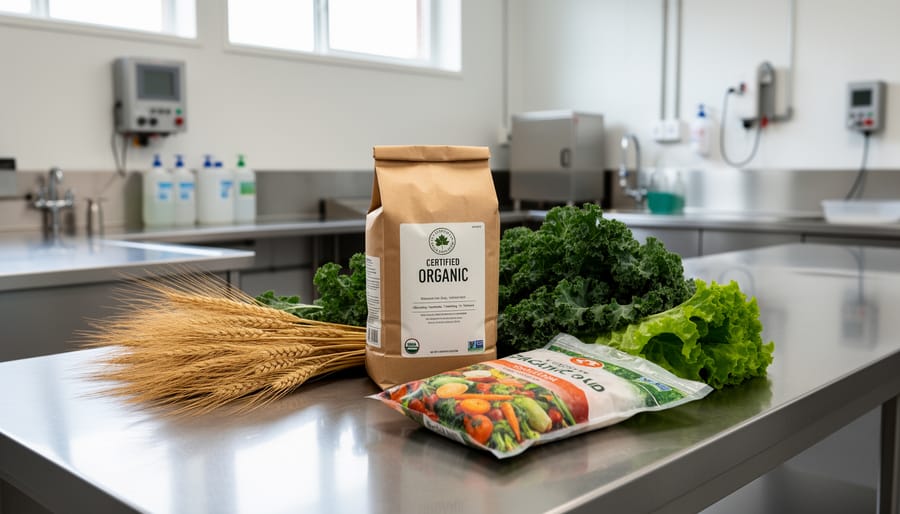
Organic processing in Canada means transforming certified organic ingredients into finished products while maintaining their organic integrity throughout every stage of handling, preparation, and packaging. Under the updated Canadian Organic Standards published March 26, 2026 (CAN/CGSB-32.310-2026 and CAN/CGSB-32.311-2026), processors must follow strict protocols governing everything from ingredient sourcing and facility sanitation to pest management and record-keeping. The standards require mandatory certification for any food, feed, or seed products represented as organic in import, export, and inter-provincial trade, or those bearing the federal organic logo.
For Alberta processors and agricultural professionals entering the organic market, understanding these requirements isn’t optional. The regulations define exactly how organic grains become certified flour, how vegetables transform into compliant frozen products, and how livestock becomes organic meat. Every processing step, from receiving raw materials to final packaging, must prevent contamination with non-organic substances and prohibited materials.
The 2026 standards update reflects Canada’s five-year revision cycle, managed by the Organic Federation of Canada to keep requirements both practical and scientifically current. These standards also maintain comparability with trading partners’ organic regulations, enabling equivalency agreements that open international markets for Canadian processors while protecting domestic consumers from non-compliant imports.
This matters particularly for processors in Alberta, where the organic sector continues expanding. Small-scale operations processing farm products for local markets face the same certification requirements as large facilities serving national distribution chains. The path to compliance starts with understanding what the standards require in your specific processing environment, whether that’s a grain mill, meat facility, dairy processor, or vegetable packing operation.
The financial and operational commitment is significant. But for processors ready to meet the standards, organic certification opens premium markets and connects your operation to growing consumer demand for verified organic products.
Understanding Organic Processing Under Canadian Law
Under Canadian law, organic processing includes any activity that alters the composition or characteristics of an organic agricultural product beyond basic handling, think milling grain into flour, pressing seeds into oil, fermenting vegetables, or formulating multi-ingredient products like granola bars or canned soups. The Canadian Organic Standards define processing broadly to cover mechanical, thermal, biological, and chemical methods that transform raw organic ingredients into finished products ready for retail or further manufacturing. If you’re changing what came off the farm into something different, you’re processing.
The standards apply to all processed organic food products, regardless of size or complexity. A small operation making organic salsa in batches of 50 jars faces the same regulatory framework as a large-scale processor producing thousands of cases daily. What matters is how you represent the final product: if it carries an organic claim, bears the federal organic logo, or moves across provincial or international borders, mandatory organic certification applies.
The distinction between on-farm handling and commercial processing matters for compliance. On-farm handling covers activities that prepare products for sale without fundamentally changing them: washing carrots, packaging lettuce, or freezing berries straight from the field. These activities fall under the production standards rather than processing requirements, though they still require proper documentation and often certification if the product leaves the province. Once you start combining ingredients, applying heat beyond blanching, or using permitted substances to create a different end product, you’ve crossed into processing territory. A farmer who cleans and bags their own wheat operates under handling rules; the moment they mill that wheat into flour or bake it into bread for sale, processing standards kick in. Understanding where your operation sits on this spectrum determines which sections of the Canadian Organic Standards govern your daily work and what your certification body will examine during audits.
The 2026 Canadian Organic Standards: What Processors Need to Know
The regulatory landscape for organic processing in Canada rests on three interconnected documents that together define what you can and cannot do in your operation. Published on March 26, 2026, the first two standards form the foundation: CAN/CGSB-32.310-2026 sets out the general principles and management standards for organic production systems, while CAN/CGSB-32.311-2026 provides the Permitted Substances Lists that detail exactly which inputs, additives, and processing aids you’re allowed to use. The third document, CAN/CGSB-32.312-2023, covers the management and general principles for organic aquaculture operations, relevant if your processing involves seafood products.
These Canadian standards aren’t static. They undergo a comprehensive review every five years, managed by the Organic Federation of Canada, to keep pace with evolving science, processing technologies, and market realities. The 2026 update reflects current research and industry feedback, meaning processors working under these standards are following requirements that align with contemporary best practices in organic integrity.
Why does staying current matter beyond avoiding compliance headaches? Market access hinges on it. The Canadian Organic Standards are designed to be comparable with the organic standards of major trading partners, which enables equivalency agreements that open doors for your products internationally. When the United States, European Union, or Japan recognizes Canadian organic certification as equivalent to their own, your processed goods can cross borders without additional certification costs or delays. This comparability also protects the Canadian market, ensuring imported organic products meet standards equivalent to what domestic processors must follow.
If you’re processing organic products for interprovincial or international trade, or if you want to use the federal organic logo on your labels, certification to these standards is mandatory. The framework applies to processed food broadly, covering everything from frozen vegetables to baked goods to fermented products, and understanding which document governs which aspect of your operation is the first step toward building a compliant processing system.
Core Requirements for Organic Processing Operations

Facility Standards and Contamination Prevention

Facility design and operational procedures form the backbone of organic processing compliance. The standards require that your processing space prevent contact between organic products and prohibited substances at every stage, from ingredient receiving through final packaging. This means establishing physical or temporal separation between organic and non-organic operations if you handle both.
Start with your facility layout. Designate specific areas for organic processing and mark them clearly. If complete physical separation isn’t feasible, process organic products in distinct batches with thorough cleaning between runs. Your certification body will want to see that cross-contamination risks are minimized through either dedicated equipment, dedicated production time, or documented cleaning protocols that remove all residues.
Cleaning procedures require particular attention. You can’t use conventional sanitizers or cleaning agents that contain prohibited substances on surfaces that contact organic products. Develop a written cleaning protocol that specifies which approved cleaners you’ll use, how you’ll verify complete removal of residues, and how often equipment gets cleaned. Keep dated records of every cleaning, these create your audit trail demonstrating organic integrity.
Pest management presents another critical area. The standards prohibit most synthetic pesticides in processing facilities. You’ll need to implement preventive measures: sealed entry points, proper waste management, and monitoring systems. If pest pressure requires intervention, only approved substances from the Permitted Substances Lists can be used, and application must prevent contact with organic ingredients or finished products.
Document everything. Your records should trace each batch from ingredient receipt through processing to final packaging, showing that organic integrity was maintained throughout. Include receiving logs, production batch sheets, cleaning records, and pest monitoring reports. This documentation proves compliance during annual inspections and supports your organic label claims.
Permitted and Prohibited Processing Methods
The Canadian Organic Standards take a precautionary approach to processing methods: if a technique isn’t explicitly allowed, you can’t use it and still call your product organic. The 2026 standards permit mechanical, physical, thermal, and biological processing methods that preserve the natural qualities of ingredients. Think cold pressing oils, pasteurization, fermentation, drying, freezing, and grinding. These traditional techniques maintain organic integrity without introducing synthetic chemistry into your production chain.
Chemical extraction methods using synthetic solvents are prohibited, as are most artificial additives and processing aids. You can’t use irradiation, genetic modification, or nanotechnology in organic processing. The standards also restrict methods that fundamentally alter the nutritional profile or introduce prohibited substances into the final product.
CAN/CGSB-32.311-2026, the Permitted Substances Lists, serves as your reference for what inputs you can use during processing. This document specifies allowed cleaning agents, processing aids, ingredients, and additives with conditions for each. Some substances are permitted only in specific applications or concentrations, so reading the annotations carefully matters. For example, certain enzymes may be allowed for cheese-making but not for baking, or specific acids permitted only when derived from natural sources.
When you’re uncertain whether a processing input or method complies, contact your certification body before using it. They can interpret the standards for your specific situation and help you avoid costly non-compliance. The Organic Federation of Canada also maintains technical guidance documents that clarify common processing questions, though these interpretations don’t replace the official standards themselves. Keeping current with the five-year revision cycle ensures you’re working from accurate requirements as processing technologies and market needs evolve.
Record-Keeping and Traceability

Comprehensive record-keeping separates compliant organic processors from those who struggle during certification inspections. The 2026 Canadian Organic Standards require processors to maintain detailed documentation proving organic integrity at every stage, from ingredient receipt through final product shipment.
Your records must establish a complete audit trail for each production batch. This means documenting ingredient sources with organic certificates, receiving dates, lot numbers, and quantities. Track every batch through processing with production logs that record dates, times, equipment used, and staff involved. Link finished products back to their ingredient sources so an inspector can trace any package on a retail shelf to the certified farms that grew its components.
Effective traceability systems answer three questions: What organic ingredients went into this batch? When and how was it processed? Where did the finished product go? Many processors use batch codes that encode this information, making it retrievable in minutes rather than hours when questions arise.
Your compliance plan should specify how long you retain records, most certification bodies require at least five years, and who maintains them. Digital systems work well if backed up regularly, but paper logs remain acceptable as long as they’re organized and accessible.
Small-scale processors often find simple spreadsheets sufficient for tracking a few product lines. Larger operations may need specialized software that integrates inventory, production, and sales data. The system matters less than consistency and completeness. Inspectors evaluate whether your records demonstrate continuous organic integrity and catch contamination risks before products reach consumers.
Missing or incomplete documentation is the most common compliance failure. Establish recording protocols before you begin processing, train all staff on their documentation responsibilities, and review records monthly to catch gaps early.
Labeling Your Organic Products Correctly
Getting your labels right isn’t just about compliance, it’s your gateway to premium markets and consumer trust. The Canadian Organic Standards set clear rules for how you can present processed organic products, and understanding these requirements protects both your certification and your reputation.
You can display the federal organic logo (the green and white Canada Organic symbol) on products that contain at least 95% certified organic ingredients by weight, excluding water and salt. Products with 70-95% organic content can list “contains X% organic ingredients” but cannot use the logo. Below 70%, you can only identify specific organic ingredients in the ingredient list itself, not on the principal display panel.
Your label must include the name and address of the certified operation or the party responsible for the product reaching the market, plus the certification body that verified your compliance. Many Alberta processors miss this detail during their first inspection, so double-check before your print run.
For export markets, labeling becomes strategic. The Canadian Organic Standards align closely with international frameworks precisely to enable organic equivalency agreements. These agreements, currently in place with the United States, European Union, Japan, and Switzerland, allow your products to enter those markets as certified organic without redundant certification. This trade alignment matters economically: processors who understand equivalency requirements can access premium export pricing without multiplying their certification costs.
The comparability of Canadian standards means your domestic compliance work translates directly into international market access. When you label correctly under CAN/CGSB-32.310-2026, you’re already meeting the threshold for major trading partners. Work with your certification body to confirm specific labeling requirements for your target markets, small variations in language or logo placement can affect border clearance, and getting it right the first time saves both money and market timing.
Getting Certified: The Process for Alberta Processors
The path to organic certification in Alberta doesn’t have to be complicated, but it does require planning and attention to detail. Most processors find the process manageable when they break it into clear steps and tap into local support networks.
Start by selecting an accredited certification body. The Canadian Food Inspection Agency maintains a list of organizations authorized to certify organic operations under the Canadian Organic Standards, and several serve Alberta processors well. Research each one’s fee structure, inspection approach, and processor experience before committing. Smaller regional certifiers often provide more hands-on guidance during your first year, which can make the transition smoother.
- Contact your chosen certification body and request an application package. Review their specific requirements and fee schedule before proceeding.
- Complete your organic system plan, documenting every aspect of your processing operation, ingredient sourcing, facility protocols, cleaning procedures, and contamination prevention measures.
- Submit your application along with the required documentation and initial fees. Most certifiers review applications within two weeks.
- Schedule your on-site inspection once your application is approved. The inspector will verify that your actual practices match your documented plan.
- Address any non-compliance issues identified during inspection. Your certifier will outline required corrections and set a timeline for resolution.
- Receive your organic certificate once all requirements are met. This typically takes four to eight weeks from inspection.
- Maintain your certification through annual updates, inspections, and ongoing compliance with record-keeping requirements.
Financial barriers shouldn’t stop you from pursuing certification. Alberta offers a cost-share program that reimburses a significant portion of certification costs for first-time applicants and annual renewals. Many processors recover their entire first-year investment through this program.
Connect with the Organic Alberta network early in your certification journey. Their members have navigated this exact process and offer practical insights you won’t find in the standards documents alone. They can recommend certifiers, share templates for organic system plans, and help you avoid common pitfalls that delay certification.
The preparation phase demands the most effort. Once your systems are in place and documented, annual renewal becomes routine, update your records, host the annual inspection, and adjust practices as needed. Most certified processors spend less than a week per year on compliance maintenance after their first year.
Common Questions About Organic Processing Compliance
Navigating organic processing compliance often raises practical questions for Canadian farmers and processors. These common concerns reflect real challenges in implementing the standards while running a viable operation.
Do I need certification if I only sell organic products at farmers’ markets?
If your sales remain within your province and you don’t use the federal organic logo, certification may not be mandatory. However, once you sell across provincial borders or want to use the Canada Organic logo for market credibility, you must become certified under CAN/CGSB-32.310-2026.
Can I process both organic and conventional products in the same facility?
Yes, but you need rigorous segregation protocols and thorough cleaning procedures between production runs. Your certification body will require detailed documentation showing how you prevent contamination and maintain organic integrity throughout shared processing equipment.
How long does transitioning an existing processing operation typically take?
Most processors need three to six months to prepare for initial certification inspection. This includes updating your organic system plan, establishing record-keeping systems, sourcing compliant ingredients, and implementing required cleaning protocols for equipment and facilities.
Where can I find approved ingredients and processing aids?
The Permitted Substances Lists in CAN/CGSB-32.311-2026 specify what you can use in organic processing. Your certification body can help interpret these lists for your specific products, and many suppliers now clearly label ingredients as compliant with Canadian organic standards.
Another frequent question involves inspection preparation. Walk through your entire process before the inspector arrives, checking that your documentation matches your actual practices. Keep ingredient purchase records, batch logs, and cleaning schedules organized and accessible. Most certification bodies appreciate processors who can quickly demonstrate traceability from raw material receipt through finished product.
Small-scale processors often wonder about cost-effective compliance strategies. Start by focusing on single-product processing before expanding your line. This simplifies record-keeping and reduces the complexity of demonstrating organic integrity. Many Alberta processors find that local organic farming networks offer mentorship from certified operators who’ve navigated similar challenges.
The standards update to CAN/CGSB-32.310-2026 and CAN/CGSB-32.311-2026 in March 2026 means staying current matters for long-term compliance. Subscribe to updates from your certification body and the Organic Federation of Canada, which manages the five-year standards revision cycle. Changes typically phase in gradually, giving established operations time to adjust practices.
If your operation involves unique processing methods, discuss them early with potential certification bodies. Some certifiers have more experience with specific product categories or processing techniques. Finding the right match saves confusion later and helps you build a working relationship that supports both compliance and business growth.
Meeting Canadian organic processing standards isn’t just about regulatory compliance, it’s an investment in your operation’s future. Certified organic processors in Alberta and across Canada consistently access premium markets, command higher prices, and build lasting relationships with consumers who value transparency and sustainability. The 2026 standards update reinforces Canada’s position as a global leader in organic integrity, opening doors to international markets through equivalency agreements while protecting the domestic organic marketplace.
The environmental benefits extend beyond individual farms. Every certified organic processor contributes to reduced chemical inputs, improved soil health, and biodiversity conservation across Canadian agricultural landscapes. Your commitment to organic processing ripples through supply chains, supporting organic farmers and demonstrating that sustainable food production can be both economically viable and environmentally responsible.
You’re not alone in this journey. Alberta’s organic community includes experienced farmers, processors, and certification bodies ready to share knowledge and support your success. Whether you’re transitioning your first product line or expanding an established organic operation, the infrastructure exists to help you navigate certification, troubleshoot challenges, and connect with markets.
The standards may seem detailed, but they exist to protect the organic label’s value, which ultimately protects your investment and market position. As consumer demand for organic products continues growing, certified processors who master these requirements position themselves at the forefront of Canadian agriculture’s most dynamic sector. Your commitment to organic processing today builds a more sustainable food system for tomorrow.