Hydrogen energy storage converts electricity into hydrogen gas through electrolysis, stores it, and then converts it back to electricity when needed, a process that typically achieves a round-trip efficiency of 35 to 45 percent. That means for every 100 kilowatt-hours of electricity you put in, you get back only 35 to 45 kilowatt-hours. For Canadian farmers weighing energy storage options for their operations, this efficiency number matters because it directly impacts your energy costs and the economic viability of going off-grid or reducing reliance on traditional power sources.
The conversation around hydrogen storage often focuses on that efficiency gap. Battery systems, by comparison, deliver round-trip efficiencies of 85 to 95 percent, making them the obvious choice for short-term storage needs. But hydrogen tells a different story when you need to store large amounts of energy for weeks or months, particularly during Alberta’s winter when solar production drops and heating demands spike. The lower efficiency becomes less of a penalty when the alternative is curtailing renewable energy production or maintaining expensive backup diesel generators.
This article breaks down what hydrogen energy storage efficiency actually means in practical terms, how the technology works on a farm scale, and whether the trade-offs make sense for your operation. We’ll look at real Canadian farm applications, compare hydrogen to Alberta solar microgrids and battery systems, and examine the total cost picture beyond the efficiency number alone. You’ll also hear from farmers and energy consultants who’ve worked with these systems, giving you the straight answers needed to decide if hydrogen fits into your energy strategy for 2026 and beyond.
What Hydrogen Energy Storage Means for Farms
Hydrogen energy storage is a way to bank surplus electricity from solar panels or wind turbines by converting it into hydrogen gas, holding onto that hydrogen until you need it, and then turning it back into electricity to run farm equipment, buildings, or irrigation systems. Think of it like putting up preserves or storing grain after harvest: you capture something abundant when you have it, set it aside safely, and draw on those reserves when conditions change and you need what you saved.
Here’s how the process works in practical terms. When your renewable energy system produces more electricity than you’re using in the moment, say, bright sun at midday or strong overnight winds, that excess power runs through a device called an electrolyzer. The electrolyzer splits ordinary water into hydrogen and oxygen gas. You store the hydrogen in pressurized tanks, much like propane storage familiar to most farms. Later, when the sun isn’t shining or the wind dies down and you need electricity, the hydrogen flows into a fuel cell (or in some cases, a modified generator) that combines it with oxygen from the air to produce electricity and water vapour. You’ve essentially turned water into a storable fuel using renewable power, then converted it back to electricity on demand.
To understand the key concepts, a few terms are worth knowing:
- Electrolysis
- The process of using electricity to split water molecules into hydrogen and oxygen gases, essentially running the chemistry of water formation in reverse.
- Fuel Cell
- A device that converts hydrogen and oxygen directly into electricity through an electrochemical reaction, producing only water and heat as byproducts, no combustion involved.
- Green Hydrogen
- Hydrogen produced using renewable electricity sources like solar or wind, making the entire cycle carbon-free, as opposed to hydrogen made from natural gas.
- Round-Trip Efficiency
- The percentage of original electricity you get back after the full cycle of converting power to hydrogen, storing it, and converting it back to electricity, typically 30 to 45 percent for hydrogen systems.
- Power-to-Gas
- The broader category of technologies that convert electricity into gaseous fuels for storage, with hydrogen being the most common example.
What sets hydrogen apart from battery storage is duration and form. Batteries excel at storing energy for hours or a day or two, cycling power in and out with minimal loss. Hydrogen can sit in a tank for weeks, months, or even seasons without degrading, making it suited for storing summer solar abundance to use during dark winter stretches. It’s also energy-dense by weight, stores at ambient temperature once compressed, and doesn’t wear out from repeated charge-discharge cycles the way batteries eventually do. The trade-off is that converting electricity to hydrogen and back again loses more energy than battery storage, but for certain farming situations where you need to hold large amounts of energy for extended periods, that efficiency penalty may be worth accepting.
How Hydrogen Storage Works: Farm-Scale Basics
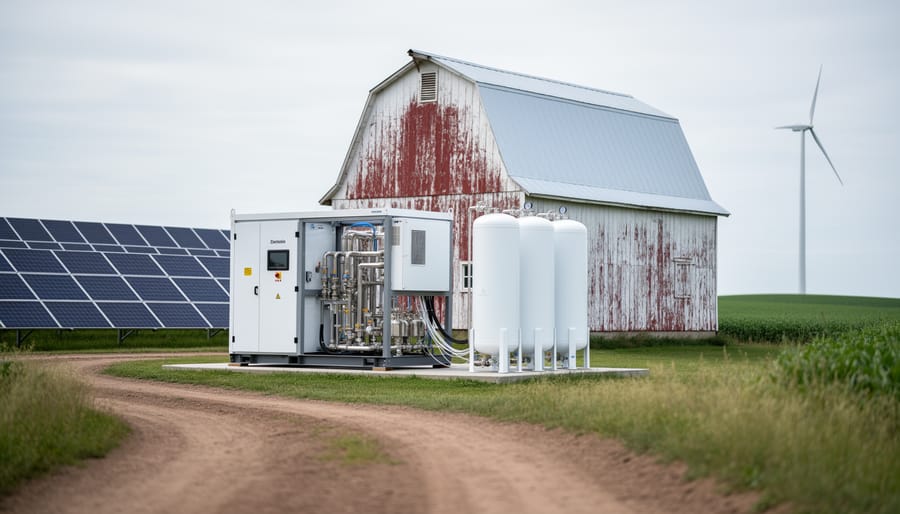
The Electrolysis Process
When you pass electricity through water, it breaks the H₂O molecules apart, a process called electrolysis. Think of it like using power to separate cream from milk, except here you’re splitting water into its two basic ingredients: hydrogen gas and oxygen gas. The hydrogen gets captured and stored; the oxygen is typically released into the air (it’s just regular oxygen, completely harmless).
The machine that does this work is called an electrolyzer. Inside, you’ve got two metal plates sitting in water with a tiny bit of salt or potassium solution added to help conduct electricity. When current flows between these plates, hydrogen bubbles form at one plate and oxygen at the other. The gases rise, get collected separately, and the hydrogen moves to your storage system.
For farm applications, you’ll encounter two main electrolyzer types. Alkaline electrolyzers are the older, proven technology. They’re reliable workhorses that use a liquid alkaline solution and can handle the stop-start nature of solar panels going in and out of clouds. They’re also cheaper upfront, which matters when you’re watching farm cash flow.
PEM electrolyzers, that’s proton exchange membrane, are newer and more compact. They respond faster to power fluctuations and produce slightly purer hydrogen, but they cost more and use specialized materials that need replacing over time. For most farm-scale systems starting out, alkaline units make more practical sense.
The electrolyzer is where your first efficiency hit happens: about 20 to 30 percent of your input electricity turns into heat rather than stored hydrogen.
Storage Methods and Requirements
Once hydrogen gas emerges from the electrolyzer, you face the challenge of keeping it contained until you need it. Unlike liquid fuels you’re accustomed to, hydrogen requires specialized storage because of its unique properties, it’s the lightest element and can leak through tiny gaps other gases can’t penetrate.
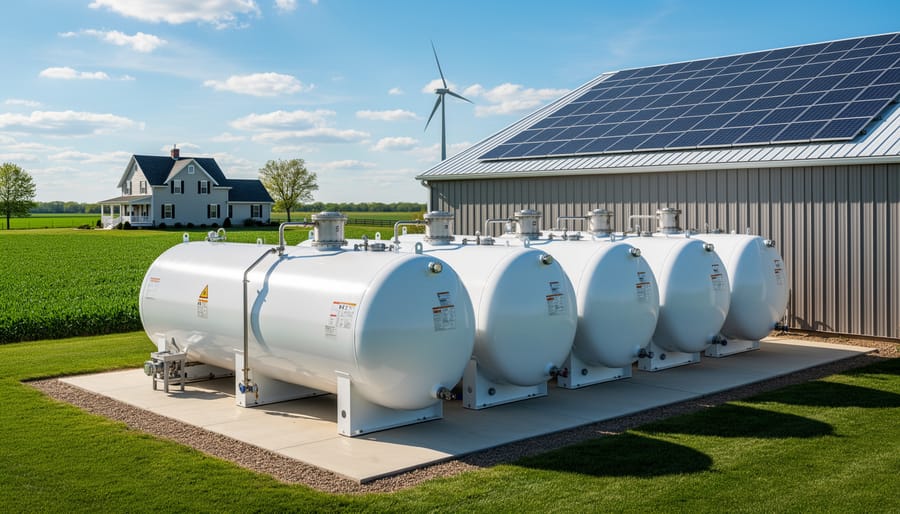
Most farm-scale systems use compressed gas storage in high-pressure steel or composite tanks. These cylinders typically hold hydrogen at 350 to 700 bar (5,000 to 10,000 psi), pressures far exceeding what you’d see in propane systems. A 700-bar tank storing 50 cubic metres of hydrogen might measure roughly 2 metres tall and 0.5 metres in diameter, similar in footprint to a large water heater but requiring secure anchoring and ventilation.
Space requirements extend beyond the tanks themselves. You’ll need clearance zones, typically 3 to 5 metres from buildings or ignition sources, plus adequate ventilation since hydrogen rises rapidly and can accumulate in enclosed spaces. Many Alberta farmers installing hydrogen systems dedicate a small outdoor pad or well-ventilated shed, similar to propane bulk storage setups but with stricter ventilation codes.
Safety considerations are paramount but manageable. Hydrogen itself isn’t toxic, and modern sensors detect leaks at concentrations well below flammability limits (4% in air). Proper grounding, explosion-proof electrical components in storage areas, and clear signage follow established industrial gas protocols. The Canadian Standards Association provides farm-appropriate guidelines (CSA B51) that your installer must follow, ensuring systems meet the same rigorous standards as commercial hydrogen facilities while remaining practical for agricultural settings.
Understanding Hydrogen Storage Efficiency
Where Energy Is Lost in the Cycle
Every step in the hydrogen storage cycle sheds energy, and understanding where helps you evaluate whether the trade-off makes sense for your operation.
Electrolysis: The First Loss (20-30%)
When your electrolyzer splits water into hydrogen and oxygen, it needs more electricity than the chemical bonds actually require. This overhead comes from resistance in the electrolyzer’s membranes and electrodes, plus heat that dissipates into the surroundings rather than doing useful work. Think of it like an inefficient pump that gets warm while running, that warmth represents wasted energy. Modern farm-scale electrolyzers typically convert 70-80% of input electricity into stored chemical energy in hydrogen.
Compression and Storage (10-15%)
Squeezing hydrogen into tanks at 350-700 bar pressure takes significant energy. Compressors consume electricity to achieve these pressures, and they also generate heat losses. Additionally, some hydrogen may escape through tank seals over extended storage periods, though modern systems minimize this leakage. The compression stage alone can consume 10-15% of the energy you originally put into electrolysis.
Fuel Cell Conversion: The Biggest Hit (40-50%)
Converting hydrogen back to electricity through fuel cells creates the largest efficiency drop. Fuel cells work through electrochemical reactions that inevitably produce heat alongside electricity. Current PEM fuel cells used in agricultural applications deliver 40-60% electrical efficiency, meaning nearly half the hydrogen’s energy becomes waste heat rather than usable power. Unlike batteries where heat loss is modest, this conversion penalty significantly impacts the overall round-trip efficiency of your hydrogen system.
Efficiency vs. Duration: The Storage Trade-Off
When you’re deciding whether hydrogen’s 30-45% round-trip efficiency is acceptable, the real question isn’t how much energy you lose, it’s how long you need to store it.
Batteries shine for daily cycling. If your solar panels generate excess power during the day and you want to use it that evening, a battery system’s 80-90% efficiency means you get back most of what you stored. But batteries become prohibitively expensive when you need to hold energy for weeks or months. The hardware cost per kilowatt-hour stored skyrockets because you’re paying for capacity that sits idle most of the time.
Hydrogen flips this calculation. Yes, you lose more energy in the conversion process, but hydrogen can sit in a tank for weeks, months, or across an entire season without degrading. For a farm that generates surplus wind energy storage in spring and fall but needs that power during summer irrigation or winter heating, hydrogen’s storage duration becomes the valuable trait.
Think of it this way: losing 60% of your April wind power sounds wasteful until you compare it to having zero stored power available in July because batteries would have cost five times more for seasonal capacity. The efficiency trade-off only makes sense when your storage timeline extends beyond a few days, which is exactly the situation many Alberta farms face with renewable energy and seasonal demand cycles.
Types of Hydrogen Storage Systems for Agricultural Use
Farm-scale hydrogen systems fall into three main categories, each designed for different operational needs and budget levels.
Compressed Gas Systems represent the most common approach for agricultural applications. These systems store hydrogen in high-pressure tanks, typically at 350 to 700 bar pressure, similar to how propane is stored on many farms today. A typical farm installation might include a small electrolyzer (5-50 kW), compression equipment, and storage cylinders sized to hold anywhere from 10 to 500 kilograms of hydrogen. The advantage here is proven technology and relatively straightforward installation, though compression does consume energy and adds to the overall efficiency loss we discussed earlier.
Backup Power Configurations integrate hydrogen storage specifically for emergency or peak power needs rather than daily cycling. Picture a farm that runs primarily on grid power but wants energy security during outages or harvest season when electricity demand spikes. These systems pair stored hydrogen with a fuel cell generator, often in the 10-50 kW range for small to mid-sized operations, that kicks in when needed. The hydrogen can sit for months without degrading, unlike diesel that requires fuel stabilizers and regular turnover.
Integrated Renewable Hybrids combine hydrogen storage with solar panels or wind turbines and often a battery bank. This is where hydrogen shines for Canadian farms: batteries handle day-to-day fluctuations efficiently, while hydrogen stores surplus summer solar production for winter use. A Prairie grain farm might install a 25 kW solar array, a 10 kWh battery for daily cycling, and hydrogen storage capable of providing 200-500 kWh of energy for the coldest months when solar production drops by 70 percent or more.
The key is matching system type to your storage duration needs, batteries for hours, hydrogen for weeks or seasons.
Where Hydrogen Storage Makes Sense on Farms
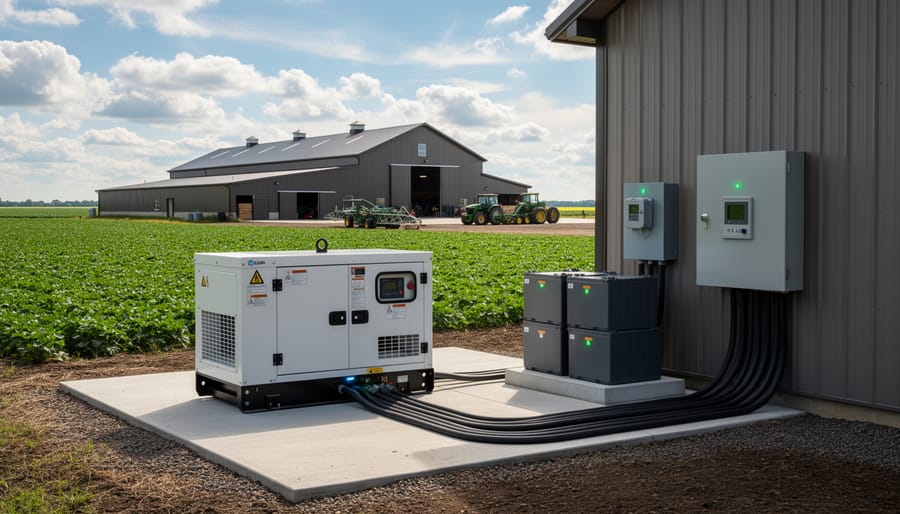
Despite hydrogen’s lower round-trip efficiency, certain farm scenarios create compelling use cases where its unique advantages outweigh the energy losses. The key is matching hydrogen’s strengths, long-duration storage, energy density, and versatility, to specific agricultural needs that other storage solutions struggle to address.
Seasonal energy balancing represents hydrogen’s most promising farm application. If you generate abundant solar power during Alberta’s long summer days but face heating demands through dark winter months, batteries become prohibitively expensive for storing energy across seasons. Hydrogen can capture June sunshine and release it as heat or electricity in January, something no battery system can do economically at scale. A 500-kilowatt solar array might produce triple your summer needs; that excess converts to hydrogen and sits in storage tanks until December without degradation.
Remote agricultural operations benefit significantly from hydrogen storage. Farms beyond grid reach currently rely on diesel generators for consistent power. Hydrogen systems paired with wind or solar eliminate fuel deliveries, price volatility, and emissions. The energy density of compressed hydrogen beats batteries for locations where transportation costs matter, you can truck in equipment once rather than continuously hauling diesel or replacing battery modules.
Critical farm systems demand reliable backup power that hydrogen delivers differently than batteries. While batteries excel at short outages, hydrogen provides extended emergency power for livestock ventilation, irrigation pumps, or cold storage. A properly sized hydrogen system can run essential equipment for days or weeks during grid failures, something especially valuable for intensive livestock operations where ventilation loss threatens animal welfare within hours.
Practical farm applications where hydrogen storage creates genuine value include:
- Seasonal energy balancing: storing summer solar generation for winter heating needs
- Remote operations without grid access: replacing diesel generators with renewable hydrogen systems
- Backup power for critical systems: multi-day emergency supply for livestock barns and processing facilities
- Fuel for farm equipment: powering hydrogen-compatible tractors and vehicles
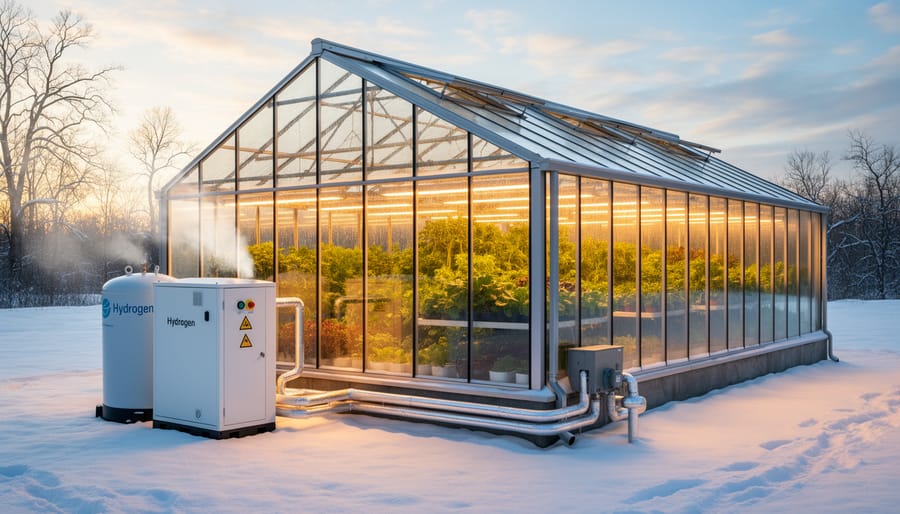
- Greenhouse heating and CO2 enrichment: fuel cells provide both heat and carbon dioxide for plant growth
The greenhouse application deserves special attention. Fuel cells converting hydrogen back to electricity produce heat and pure CO2 as byproducts, both valuable in controlled environment agriculture. You address three needs simultaneously: power, heating, and the CO2 enrichment that accelerates plant growth. This triple benefit improves the overall system economics despite the efficiency losses.
Hydrogen also makes sense when you’re already investing in major renewable infrastructure and want true energy independence. If you’re installing a megawatt of solar capacity, adding hydrogen storage positions your farm to operate completely off-grid during extended periods. The efficiency penalty matters less when the alternative is curtailing (wasting) renewable generation you’ve already paid to produce.
Hydrogen Storage in Action: Canadian Farm Case Study
Highwood Grain Farms in southern Alberta installed a pilot hydrogen storage system in 2024, offering concrete insights into how this technology performs on working farmland. The 2,800-acre mixed grain operation partnered with the University of Calgary’s Clean Energy Technologies Research Institute to test hydrogen storage as a solution for their growing renewable energy surplus.
The system uses a 50-kilowatt electrolyzer fed by excess solar power from their 200-kilowatt array. During peak summer production, solar panels generate far more electricity than the farm needs for daytime operations. Rather than selling this excess back to the grid at low rates, the electrolyzer converts it to hydrogen. The farm stores the compressed hydrogen at 350 bar in four commercial-grade cylinders with a combined capacity of 120 kilograms, enough to generate approximately 4,000 kilowatt-hours through their 30-kilowatt fuel cell during winter months when solar production drops by 70%.
“We knew the efficiency numbers going in, around 35% round-trip,” explains Derek Petersen, who manages Highwood’s renewable energy systems. “That seems terrible compared to batteries, but batteries couldn’t store our July surplus for use in January. The hydrogen sits there for months without degrading.”
The installation cost $285,000 including the electrolyzer, storage tanks, fuel cell, safety systems, and integration work. Federal and provincial grants covered $140,000. Petersen reports the system achieved 33% round-trip efficiency in its first full year, slightly below projections due to Alberta’s winter temperatures affecting fuel cell performance. They learned that heated enclosures are essential for reliable operation below -20°C.
Economically, the system doesn’t yet pay for itself on pure energy arbitrage. At current electricity rates, the stored hydrogen saves roughly $4,200 annually compared to grid power during winter peak demand periods. However, combined with smart energy management strategies and the farm’s participation in demand response programs, the broader energy independence delivers operational benefits beyond simple cost calculations.
“The real value is proving we can run critical systems through winter without grid dependence,” Petersen notes. “Feed mills, grain dryers, and heated workshops can’t wait for sunny days. That reliability has worth we’re still learning to quantify.”
Economic Reality: Costs and Payback Considerations
Let’s be blunt: hydrogen storage isn’t cheap upfront. A complete farm-scale system, electrolyzer, storage tanks, fuel cell, and installation, typically runs between $150,000 and $400,000 for a 50-100 kW setup in Canada. That’s roughly three to five times the cost of an equivalent battery system. The electrolyzer alone eats up 40-50% of that budget, while high-pressure storage tanks and safety systems add another substantial chunk.
Operating costs tell a different story. Hydrogen systems have minimal ongoing expenses beyond periodic maintenance, replacing filters, checking seals, and servicing the fuel cell stack every 10,000-15,000 hours. Annual maintenance typically runs $3,000-$6,000 for farm-scale installations. Compare that to diesel generators burning $50,000-$80,000 in fuel annually for similar backup capacity, and the equation starts shifting.
The cost per kilowatt-hour stored depends heavily on how you use the system. For daily cycling, batteries win decisively at $0.15-$0.25 per kWh stored. Hydrogen comes in higher at $0.35-$0.55 per kWh when cycling daily. But stretch that storage duration to weeks or months, storing summer solar for winter use, and hydrogen’s cost advantage emerges. Batteries lose capacity over time when sitting idle, while hydrogen waits indefinitely without degradation.
Payback periods for hydrogen systems currently range from 12-20 years without incentives, making them hard to justify on economics alone. However, Canadian programs change the math significantly. The federal Clean Technology Investment Tax Credit offers 30% back on eligible equipment. Alberta’s Emission Reduction Alberta sometimes funds pilot projects at 25-50% of costs. Farmers using hydrogen for both energy storage and green ammonia production can access multiple program streams.
The honest assessment? In 2026, hydrogen storage makes financial sense primarily when government support covers a substantial portion of capital costs, or when your farm genuinely needs seasonal storage that batteries can’t provide economically.
Expert Perspective: When to Consider Hydrogen
Dr. Sarah Thornton, a renewable energy systems consultant who has worked with over 40 Alberta farms on energy transitions, emphasizes that hydrogen storage isn’t a universal solution. “The question I ask every farmer is: what problem are you actually trying to solve?” she explains. “If you need backup power for a few hours during grid outages, batteries win every time. But if you’re looking to store September’s excess solar energy to power grain dryers in December, hydrogen starts making sense.”
The critical threshold, according to Thornton, is storage duration. “When you need to hold energy for more than three or four days, the cost curves shift dramatically. Battery banks sized for weeks of storage become prohibitively expensive, while hydrogen’s cost increases much more gradually with storage capacity.”
She cautions that in 2026, farm-scale hydrogen systems remain early-stage technology in Canada. “We’re past the experimental phase, but you’re still an early adopter. Expect a learning curve and higher upfront costs than promotional materials suggest.” Maintenance requirements are more complex than batteries, requiring familiarity with pressurized gas systems and periodic electrolyzer servicing.
Looking ahead, Thornton sees hydrogen finding its place alongside other storage methods rather than replacing them. “The farms I work with who are happiest with hydrogen typically have hybrid systems, batteries for daily cycling, hydrogen for seasonal storage. That combination addresses both efficiency and duration needs.”
Her advice for farmers considering hydrogen: start with a detailed energy audit showing your actual storage duration requirements. “Don’t buy hydrogen to solve a battery-scale problem. But if your analysis shows genuine multi-week or seasonal storage needs, it deserves serious consideration despite the efficiency trade-off.”
Common Questions About Hydrogen Storage Efficiency
Is hydrogen’s low efficiency worth it for my farm?
It depends on your storage timeline. If you need to store excess summer solar energy for winter heating or backup power lasting days or weeks, hydrogen’s 30-45% round-trip efficiency beats paying for grid power or building massive battery banks. For daily cycling, stick with batteries.
How does Alberta’s cold weather affect hydrogen storage performance?
Cold temperatures actually help compressed hydrogen storage by reducing pressure and improving tank safety margins. However, electrolyzers and fuel cells need proper insulation and may require small amounts of preheating below -20°C to maintain efficiency. Most commercial systems are designed for Canadian winters.
What maintenance does a farm hydrogen system need?
Expect quarterly inspections of compression equipment, annual electrolyzer membrane checks, and fuel cell stack servicing every 3,000-5,000 operating hours. Total maintenance time runs 10-15 hours annually for a typical farm installation, similar to maintaining a diesel generator.
Is hydrogen safe to store on farms?
Yes, when properly installed. Hydrogen tanks require ventilation, leak detection systems, and clearance from buildings, but farmers already manage propane and diesel safely using similar protocols. Hydrogen actually disperses faster than propane if leaked, reducing explosion risk.
The biggest concern farmers raise about efficiency isn’t the numbers themselves, it’s whether those losses translate to wasted money. Think of it this way: if you’re curtailing 1,000 kWh of solar production each month because your batteries are full, that energy has zero value. Converting it to hydrogen at 40% efficiency gives you 400 kWh of stored energy you can use later, which beats zero every time.
Regarding existing infrastructure, most farms can adapt buildings for hydrogen storage, though you’ll need electrical upgrades to support electrolyzer loads. Your renewable energy setup, solar arrays, wind turbines, inverters, integrates smoothly since electrolyzers accept the same DC or AC input batteries use. The real integration challenge is sizing components to match your farm’s energy production patterns, much like balancing energy storage for animals with feeding schedules.
Cold-weather operation deserves special attention in Alberta. While compression works better in winter, electrolyzers lose 5-10% efficiency below freezing if not insulated. Budget for heated enclosures or locate equipment in existing heated shops. One Peace River farmer reported his system maintained 38% round-trip efficiency year-round after adding a simple insulated housing with waste heat recovery from the compressor.
Hydrogen energy storage won’t replace batteries for most daily farm operations, and that’s perfectly fine. Its 30-45% round-trip efficiency looks poor next to lithium-ion’s 85-90%, but these technologies serve different purposes. Think of hydrogen as your long-term reserve, the system that holds summer’s surplus solar power through Alberta’s dark winter months when batteries would cost a fortune to scale up. It excels at seasonal storage and multi-day backup, where efficiency matters less than duration and energy density.
The real question isn’t whether hydrogen is efficient in absolute terms. It’s whether hydrogen fits your specific energy profile. If you need overnight storage for daily loads, batteries win. If you’re looking to store weeks of power, achieve genuine grid independence, or integrate with other renewable systems like biomass power hydrogen deserves serious consideration despite the conversion losses.
Map out your actual energy patterns. How long do you need to store power? What’s your seasonal variation? What does energy independence mean for your operation? These answers matter more than efficiency percentages alone. Climate-resilient farming means exploring every viable storage option and choosing the right tool for each job. Hydrogen isn’t perfect, but for certain applications, it’s becoming the practical choice Canadian farmers didn’t have five years ago.