Peat carbon sequestration projects in Canada typically cost between $500 and $3,000 per hectare for restoration work, with ongoing monitoring and verification adding $50 to $200 per hectare annually. The economics depend heavily on your project scale, baseline peatland condition, and whether you’re restoring degraded sites or protecting intact bogs. In 2026, nature-based carbon credits averaging $7 to $24 per tonne of CO₂ equivalent provide revenue potential, though high-quality verified removal credits with strong co-benefits can command $20 to $100+ per tonne.
Three factors drive these costs up or down most dramatically. Site accessibility matters enormously: a degraded peatland adjacent to existing farm infrastructure costs far less to restore than a remote bog requiring new access routes and equipment transport. The degree of degradation sets your baseline. Moderately drained sites might need simple rewetting through ditch blocking, while heavily disturbed peatlands demand comprehensive hydrological engineering, vegetation reestablishment, and years of adaptive management. Finally, your verification pathway shapes ongoing expenses. Self-monitoring with basic tools keeps costs minimal but limits your access to premium carbon markets, while third-party verification under rigorous protocols like Peatland Code or Verra unlocks higher credit prices but requires professional monitoring infrastructure.
For Alberta farmers exploring this opportunity, the financial picture has shifted considerably. Peatland carbon projects sequester 1 to 5 tonnes of CO₂ equivalent per hectare per year once established, creating a revenue stream that can offset restoration costs over 10 to 20 years. The decision between tackling restoration yourself or hiring specialists hinges on your equipment access, technical capacity, and risk tolerance, each carrying distinct implications for both upfront investment and long-term project performance.
Understanding Peat Carbon Sequestration Economics
How Peatland Restoration Creates Value
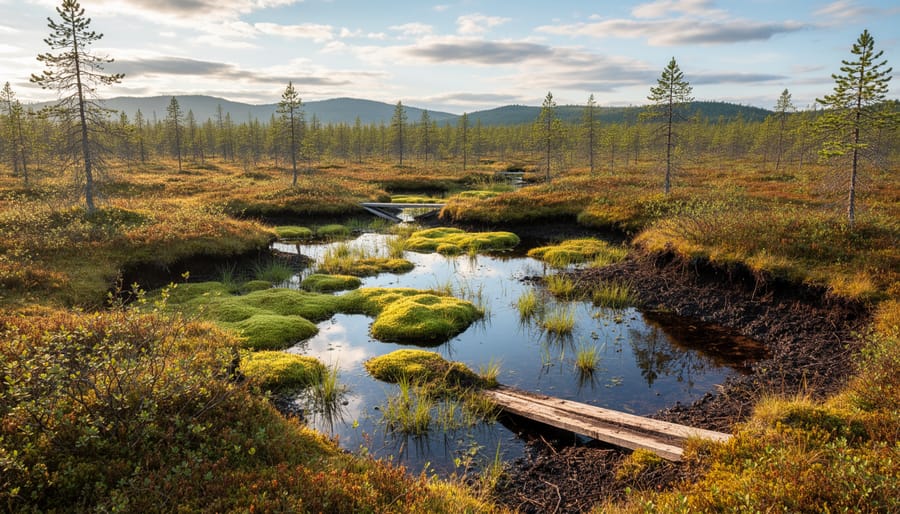
Healthy peatlands act as massive carbon vaults, holding twice as much carbon as the world’s forests despite covering only three percent of land surface. When we drain peatlands for agriculture or forestry, we expose ancient peat to oxygen. The result: decomposition converts stored carbon into CO₂, transforming these ecosystems from carbon sinks into emission sources releasing 5-10 tonnes of CO₂ equivalent per hectare annually.
Restoration reverses this damage. Rewetting degraded peat raises the water table, creating anaerobic conditions that halt oxidation and restart carbon accumulation. Within two to five years of proper rewetting, native peat-forming vegetation like sphagnum moss reestablishes and begins actively drawing CO₂ from the atmosphere through photosynthesis. Dead plant material accumulates underwater rather than decomposing, locking carbon away for centuries.
Canadian peatlands deliver measurable climate value through two pathways. First, rewetting immediately prevents ongoing emissions, those 5-10 tonnes per hectare that would otherwise escape. Second, restored peatlands actively sequester 0.5-2.0 tonnes CO₂e per hectare per year as new peat forms, with rates varying by site conditions and climate. A 40-hectare restored peatland can therefore prevent and capture 220-480 tonnes CO₂e annually.
The economics tie directly to credit markets. Unlike the soil sequestration costs farmers face with mineral soils, peatland projects combine avoided emissions with measurable removal, creating dual-value credits. These high-quality nature-based removal credits typically command premiums in the federal carbon price benchmark framework, often exceeding $26 per tonne for verified projects with co-benefits.
Carbon Credit Revenue Potential
Canadian peatland restoration projects generate carbon credits that tap into a dynamic and increasingly lucrative market. Understanding current pricing and how peat credits stack up against other soil carbon credits is essential for evaluating project economics in 2026.
Nature-based carbon credits averaged $7, $24 per tonne of CO₂ equivalent in 2026, but that broad range obscures significant variation in quality and buyer willingness to pay. Peatland credits, when properly verified and demonstrating genuine carbon removal rather than just avoided emissions, consistently command premiums at the upper end of this spectrum. High-quality nature-based credits with third-party verification, strong co-benefits like biodiversity enhancement, and robust permanence guarantees reach $20, $100+ per tonne, with verified removal credits exceeding $26 per tCO₂e.
| Credit Quality Tier | Price Range (2026) | Typical Project Type |
|---|---|---|
| Standard nature-based | $7, $24/tCO₂e | Basic forestry, some avoided conversion |
| High-quality verified | $20, $100+/tCO₂e | Peatland restoration, enhanced verification |
| Corporate portfolio average | €25, €80/tonne | Blended mix of nature and tech solutions |
Corporate buyers purchasing diversified carbon portfolios pay a blended average of €25 to €80 per tonne, reflecting their mix of project types and quality standards. Well-documented peatland projects with clear additionality proof and ongoing monitoring fit comfortably within this premium range, making them attractive to quality-conscious buyers seeking nature-based solutions with measurable impact.
Restoration Costs by Project Scale

Peatland restoration costs vary dramatically with project size, and understanding these scale-dependent economics helps Alberta farmers determine whether a pilot project or full commercial restoration makes sense for their operation. Like most agricultural infrastructure investments, per-hectare costs decrease as project scale increases, but the upfront capital commitment grows proportionally.
For small demonstration projects under 10 hectares, farmers typically face the highest per-hectare costs because fixed expenses like site assessment, engineering design, and initial permitting don’t scale down. These pilot-scale restorations serve as learning opportunities and proof-of-concept trials, allowing farmers to test restoration techniques on their specific peatland type before committing to larger areas. The investment here includes all the professional expertise needed to do the job right, compressed into a smaller footprint.
Mid-sized projects between 10 and 100 hectares represent the sweet spot for many Alberta agricultural operations. At this scale, fixed costs spread across enough area to improve per-hectare economics, yet the total capital requirement remains manageable for individual farm operations or small farm consortiums. These projects generate meaningful carbon credit volumes while maintaining practical oversight and management.
Large commercial restorations exceeding 100 hectares achieve the best per-hectare economics through economies of scale in equipment deployment, contractor mobilization, and monitoring infrastructure. However, they demand substantial upfront capital and typically require partnership structures, external financing, or aggregation of multiple landowners.
Typical investment ranges per hectare vary by scale:
- Small-scale projects (under 10 hectares): $15,000, $30,000 per hectare
- Medium-scale projects (10-100 hectares): $8,000, $18,000 per hectare
- Large-scale projects (100+ hectares): $5,000, $12,000 per hectare
These ranges reflect complete restoration packages including hydrological assessment, engineering and installation of water control structures, revegetation with native species, and initial monitoring setup. The wide spans account for site-specific factors: a degraded peatland adjacent to existing water sources with good equipment access sits at the lower end, while remote sites requiring extensive drainage modification and difficult terrain access push toward the upper bounds.
Small projects rarely pencil out on carbon credit economics alone, you’re paying premium per-hectare rates for minimal credit volumes. Their value lies in knowledge acquisition and testing compatibility with farm operations before scaling up. Medium projects start generating sufficient credit volumes to cover costs within realistic timeframes, especially if high-quality verification positions credits in the $20, $100+ per tonne range. Large projects can become genuinely profitable climate investments when restoration costs stay below $10,000 per hectare and annual sequestration rates hit 5-10 tonnes CO₂e per hectare.
Cost Breakdown: Where Your Investment Goes
Site Assessment and Planning
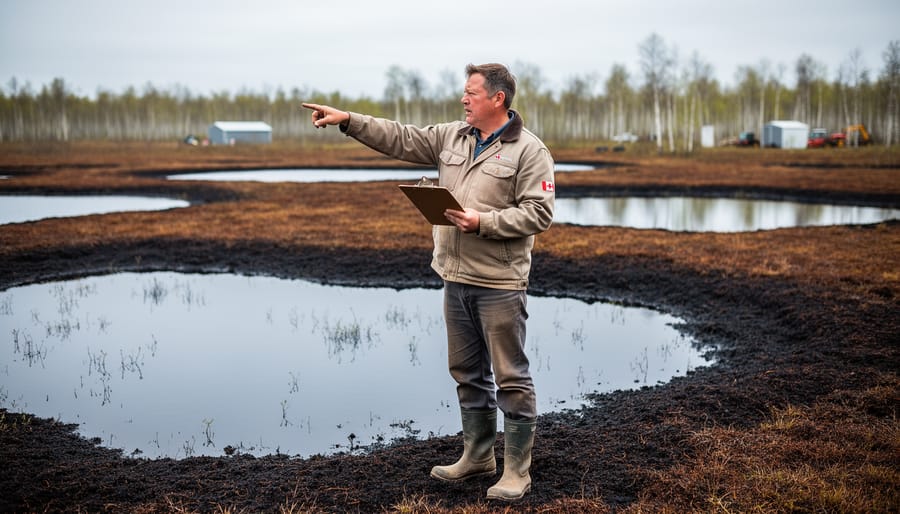
Before breaking ground on any peat restoration project, farmers must invest in thorough upfront assessment and planning, typically the smallest line item by proportion, but critical for success. A professional site evaluation in Alberta generally runs $3,000 to $8,000 for a small to mid-sized parcel, covering hydrological surveys to map water flow and drainage patterns, soil core sampling to determine peat depth and composition, and baseline carbon stock measurement that establishes your starting point for future credit claims. Restoration planning adds another $2,000 to $5,000, where qualified wetland engineers and carbon specialists design the rewetting strategy, specify infrastructure needs, and develop a monitoring protocol. While these costs feel abstract compared to physical work, they determine whether your project qualifies for high-quality carbon credits and avoid expensive mid-project corrections. Farmers attempting DIY assessment risk underestimating complexity or missing regulatory requirements, potentially disqualifying the entire investment from credit markets. Budget roughly 10 to 15 percent of total project costs for this phase, and view it as insurance: proper planning prevents the costly mistakes that turn promising peatland projects into stranded investments.
Physical Restoration Work
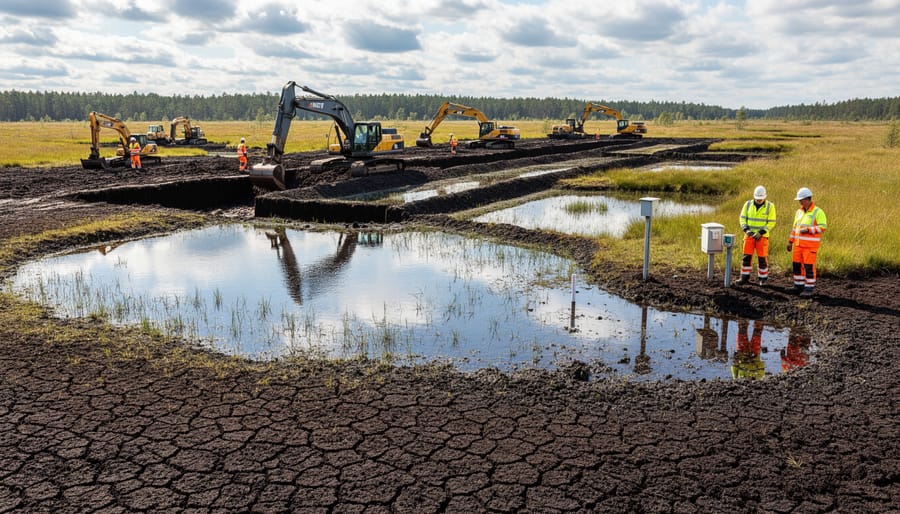
The physical work of restoring peatland hydrology typically consumes the largest share of your budget. Rewetting infrastructure, dams, weirs, and water control structures, costs $2,000 to $8,000 per hectare depending on site complexity and access. Simple plugs in existing ditches fall at the lower end, while engineered weirs with adjustable gates and monitoring systems push costs higher. Equipment rental adds another $1,500 to $4,000 per hectare: excavators for earthwork, tracked vehicles for soft ground access, and specialized materials like bentonite clay or peat packs for sealing leaks.
Labour represents 30 to 40 percent of physical restoration expenses. Small projects might rely on a farm crew and local contractors, but larger wetland rewetting often requires experienced hydrological technicians who understand peat dynamics and can prevent unintended downstream flooding. Expect $50 to $85 per hour for skilled operators in Alberta.
Revegetation with native peat-forming species, typically Sphagnum mosses, sedges, and other wetland plants, costs $500 to $2,500 per hectare. Seed or plug availability varies by season, and establishment success hinges on stable water tables, so this expense may recur if initial plantings fail. Budget for follow-up site visits and adaptive management rather than assuming one-time costs.
Monitoring and Verification
Ongoing monitoring represents a recurring expense that extends throughout your project’s crediting period, often 25 to 40 years for peatland restoration. Core activities include monthly water table measurements at established monitoring wells, annual vegetation surveys to track peat-forming species recovery, and periodic soil carbon stock assessments to quantify sequestration rates. For a typical 50-hectare restoration, expect to budget $3,000 to $8,000 annually for these activities if you hire consultants, though farmers can reduce costs by performing some monitoring tasks themselves after initial training.
Third-party verification adds another layer of expense. Independent auditors review your data and field conditions every three to five years to confirm carbon claims meet Alberta carbon regulations and marketplace standards. Verification fees vary significantly based on project complexity, auditor rates, and the specific protocol your project follows. Research the MRV requirements of your chosen carbon standard early, some registries demand satellite imagery analysis or specialized equipment that can push verification costs higher than basic field monitoring alone.
Administrative and Transaction Costs
Beyond the physical work of restoration, farmers face several administrative layers that add to the total project cost. Project management, whether handled by a consultant or internal staff, typically accounts for 5-10% of the overall budget, covering coordination, timeline tracking, and stakeholder communication throughout the multi-year restoration process.
Carbon credit registration involves upfront fees to enroll your project with a recognized standard or registry. These vary by program but commonly range from $2,000 to $10,000, depending on project scale and the rigor of the certification pathway you choose. Legal support for contracts, land use agreements, and credit ownership documentation can add another $1,500 to $5,000 for straightforward projects, more if complex tenure or partnership structures are involved.
Once credits are issued, marketplace transaction fees take a cut when you sell. Brokers and trading platforms typically charge 3-10% of the credit sale price, which means on a $50 per tonne credit, you might pay $1.50 to $5.00 per tonne in transaction costs. Some platforms also charge listing or subscription fees. These costs are modest compared to the revenue potential, high-quality nature-based credits with verified carbon removal can command over $26 per tCO₂e in 2026, but they’re worth budgeting for upfront to avoid surprises when you monetize your sequestration work.
What Determines Peat Restoration Costs
Site-Specific Physical Factors
The physical characteristics of your peatland site directly shape both the technical difficulty and the dollar cost of restoration. A flat, accessible site with intact peat layers and minimal artificial drainage requires far less intervention, and investment, than a deeply degraded, remote area with extensive ditch networks and eroded peat.
Terrain and accessibility set your baseline costs. If machinery can reach the site via existing farm roads, equipment rental and labour expenses stay manageable. Remote or uneven terrain, however, demands specialized equipment, longer mobilization times, and potentially helicopter-supported materials delivery, pushing costs up sharply. Steep slopes complicate water control structures and increase erosion risk during restoration work.
Current drainage patterns determine the scope of rewetting infrastructure. A site with a few shallow ditches may only need simple earthen dams and minor grading. By contrast, heavily drained peatlands, common in agricultural conversions, require multiple weirs, water level control structures, and sometimes pump systems to raise and stabilize the water table, multiplying both material and engineering costs.
Degree of degradation affects everything from baseline carbon stock assessment to revegetation needs. Moderately degraded peat with some native vegetation intact can recover with less intensive intervention. Severely degraded sites, where oxidation has consumed much of the upper peat layer, demand comprehensive soil analysis, thicker revegetation plantings, and longer monitoring periods to prove sequestration, all of which add to upfront and ongoing expenses.
Credit Quality and Market Premiums
Not all peat restoration credits trade at the same price. In 2026, the voluntary carbon market rewards quality with significant premiums. While generic nature-based credits average $7, $24 per tonne CO₂e, high-quality peatland restoration credits with robust verification and demonstrated co-benefits routinely command $20, $100+ per tonne. Understanding what drives these premiums helps you design a project that maximizes revenue.
Third-party verification stands as the single most important factor. Credits verified under established standards like Verra’s VCS or Gold Standard carry immediate credibility with corporate buyers, who pay substantially more for independently audited carbon accounting. Without this stamp of approval, even legitimate sequestration struggles to find buyers at competitive rates.
Permanence assurance addresses buyer concerns about long-term storage. Peatlands offer natural permanence advantages when properly restored, rewetted peat stops decomposing and begins rebuilding carbon stocks that can persist for centuries. Projects that include legal protections, conservation easements, or buffer pools against reversal risk fetch higher prices because they reduce the buyer’s exposure to future losses.
Additionality proof demonstrates that your restoration wouldn’t have happened without carbon finance. Strong additionality cases, documented degradation trends, financial barriers to restoration, or regulatory gaps, justify premium pricing because they show genuine climate impact rather than business-as-usual land management.
Co-benefits push top-tier credits into the premium range. Peatland restoration that restores habitat for species at risk, improves regional water quality, or engages Indigenous communities creates value beyond carbon. Corporate buyers increasingly seek these multi-benefit projects, with verified credits delivering measurable biodiversity gains exceeding $26 per tonne in current markets.
Regional and Regulatory Context
Alberta’s regulatory landscape and unique peatland characteristics create distinct economics for carbon sequestration projects. The province hosts approximately 60% of Canada’s peatlands, concentrated in the boreal and parkland transition zones, terrain that offers high sequestration potential but demands careful hydrological management. Alberta’s existing wetland policy framework requires provincial permits for most restoration activities affecting water flow, adding $2,000, $5,000 in regulatory compliance costs to initial project budgets, though these barriers are lower for rewetting previously drained agricultural land.
Federal carbon pricing updates announced in May 2026 are reshaping the economic calculus. While the headline trajectory changes don’t directly set credit prices, they signal stronger policy support for nature-based solutions, which has historically correlated with buyer demand and premium pricing in voluntary markets. Alberta farmers can leverage this momentum: high-quality peatland credits with third-party verification and proven permanence now command $20, $100+ per tonne in 2026 markets, well above the $7, $24 average for nature-based offsets. Projects demonstrating biodiversity co-benefits, common in Alberta’s diverse peatland ecosystems, can exceed $26 per tonne, making compliance costs a manageable fraction of long-term revenue for well-executed restoration.
DIY Restoration vs. Working with Professionals
What Farmers Can Do Themselves
While peat restoration demands specialized expertise for many tasks, motivated farmers can handle several meaningful activities that reduce overall costs and build hands-on knowledge. Start with basic water table monitoring, installing simple observation wells and recording depth measurements monthly provides critical data for tracking restoration progress. You’ll need a measuring tape, notebook, and consistent schedule, but the technique is straightforward once demonstrated by a professional.
Revegetation work offers another DIY opportunity, particularly planting native sphagnum moss fragments or sedge plugs in already-rewetted areas. This labour-intensive task suits farm crews during slower seasons, though you’ll want initial guidance on proper species selection and planting density for Alberta peatlands. Coordinating with neighbours, securing site access permissions, and managing stakeholder communication are natural extensions of existing farm management skills.
However, recognize the hard limits. Never attempt to design or build water control structures without engineering expertise, improper installation risks catastrophic drainage failures and liability. Carbon accounting calculations, baseline assessments, and third-party verification require certified professionals to ensure credit quality and market acceptance. Similarly, hydrological modeling and restoration planning demand technical training you can’t shortcut.
Approach DIY tasks as cost-saving contributions within a professionally-managed framework, not substitutes for expert oversight. The money saved on monitoring labour means little if structural errors or incomplete documentation disqualify your credits from premium markets.
When to Bring in Experts
Certain aspects of peat restoration demand professional expertise, not because they’re impossible to learn, but because mistakes carry serious financial and environmental consequences. Getting these elements wrong can invalidate your carbon credits entirely or create liabilities that far exceed the cost of hiring qualified help.
Hydrological engineering sits at the top of this list. Rewetting degraded peatlands requires precise water control structures, careful gradient calculations, and an understanding of regional hydrology that takes years to develop. A dam built in the wrong location or at the wrong height can flood productive farmland, damage neighbouring properties, or fail to raise water tables sufficiently for carbon sequestration. Professional hydrological engineers typically charge $5,000, $15,000 for assessment and design on small projects, but this investment prevents costly mistakes and ensures your infrastructure actually works.
Carbon accounting and third-party verification aren’t optional if you want marketable credits. Buyers in 2026 demand rigorous documentation of baseline conditions, additionality proof, and continuous monitoring data. Quality credits with verified carbon removal command $20, $100+ per tonne, while poorly documented projects struggle to find buyers even at the $7, $24 nature-based average. The verification process itself costs money, expect $10,000, $50,000 depending on project scale, but it’s the gateway to premium pricing.
Credit marketing represents another specialized domain. Navigating carbon registries, understanding buyer requirements, and negotiating contracts requires knowledge of a rapidly evolving market. Some farmers work with carbon aggregators who handle marketing for a percentage of revenue (typically 10-20%), while others hire consultants for one-time placement fees. Either approach costs less than underselling your credits or missing market opportunities altogether.
The trade-off calculation is straightforward: professionals cost money upfront but dramatically improve your chances of generating valuable, sellable credits that justify the restoration investment.
Revenue, Payback Periods, and Long-Term Returns
Peat restoration is a long-term investment that follows a different economic timeline than annual crop production. Understanding the real economics of payback periods helps Alberta farmers set realistic expectations and plan appropriately.
Upfront investment ranges from $2,000 to $8,000 per hectare, depending on site complexity and restoration approach. This capital goes out before any revenue comes in, making access to working capital or grant funding important for many operations.
Credit generation begins slowly. Rewetted peatlands need time to stabilize before they sequester significant carbon. Early years focus on stopping emissions from oxidation, which creates avoided-emission credits. Active carbon removal accelerates as vegetation establishes and peat-forming processes resume.
A typical Alberta peatland restoration project follows this economic timeline:
- Year 0: Planning, site assessment, and initial capital investment of $2,000, $8,000/ha
- Years 1-3: Physical restoration work, rewetting implementation, revegetation establishment, minimal credit generation
- Years 3-10: Accelerating credit generation as ecosystem stabilizes, first verification and market sales, revenue begins offsetting costs
- Years 10+: Steady credit generation of 2-8 tCO₂e per hectare annually, ongoing verification costs, consistent revenue stream
Break-even typically occurs between years 7 and 15, depending on credit quality and market prices. High-quality verified credits commanding $20, $100+ per tonne shorten payback periods substantially compared to lower-tier credits at $7, $24 per tonne.
Long-term returns become attractive once initial investment is recovered. A well-executed project generating 5 tCO₂e per hectare annually at $40 per credit produces $200 per hectare in annual revenue with relatively low maintenance costs. Over 30 years, that totals $6,000 per hectare, not accounting for potential price appreciation as carbon markets mature.
This patient capital approach aligns well with carbon investment models that treat ecosystem restoration as infrastructure rather than commodity production.
Practical Considerations Beyond the Numbers
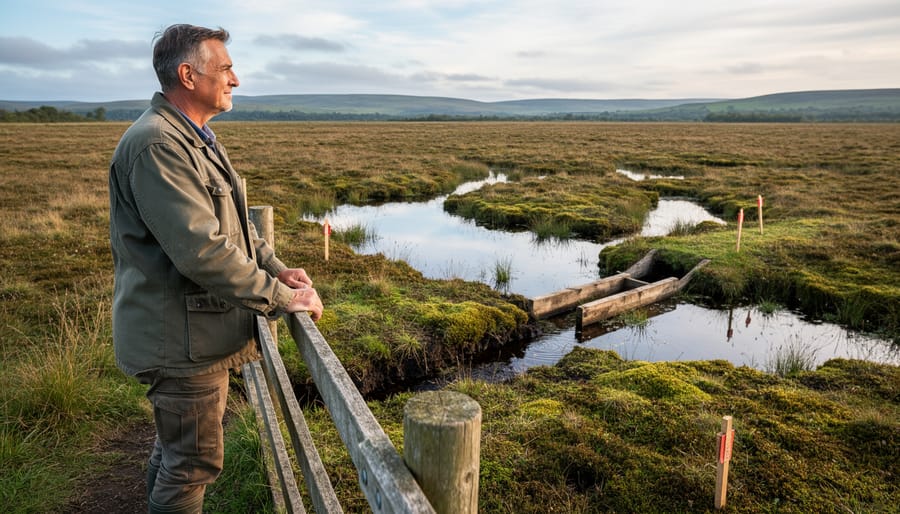
Peat restoration changes more than your bottom line, it reshapes how you use your land, manage water, and interact with your community. Before you commit capital, walk through these realities with your family and farm team.
Land Use and Operational Shifts
Rewetting degraded peat means accepting that parcel won’t produce crops or hay the way it once did. You’re trading annual revenue from that land for long-term carbon payments and ecosystem services. Some farmers find this difficult emotionally, especially if the land has been in production for generations. Plan now for how you’ll redirect machinery, adjust rotations, and explain the change to neighbours who might not understand why productive-looking ground is being “taken out.”
Water Management Ripple Effects
Raising the water table in one area affects adjacent fields. You might see improved moisture retention in nearby pastures, or unexpected wet spots in fields you still want to crop. Work with a hydrologist to model water flow before you start. Budget time for adjustments: installing tile drainage around the restoration zone, rerouting ditches, or coordinating with downstream neighbours who share your watershed.
Community and Legacy Value
Restored peatlands provide habitat for waterfowl, improve local water quality, and create wildlife corridors that benefit the entire region. Many Alberta farmers report that restoration projects become a source of pride, something tangible to show their kids and grandkids. You might host school field trips, attract birdwatchers, or collaborate with conservation groups. These intangibles don’t appear on a balance sheet, but they often matter as much as the credit revenue when you look back five years later.
Canadian Case Study: Alberta Peatland Restoration
The Beaverhill Lake region northeast of Edmonton offers a compelling example of peat restoration economics in practice. In 2023, a coalition of local landowners partnered with Ducks Unlimited Canada to restore 180 hectares of degraded agricultural peatland that had been drained decades earlier for hay production. The project provides concrete numbers that Alberta farmers can benchmark against their own situations.
Initial site assessment and hydrological surveys cost $42,000, while physical restoration work, installing water control structures, blocking drainage ditches, and establishing native sedge species, required $385,000 in capital investment. That translates to roughly $2,370 per hectare, falling within the mid-range for moderately degraded sites with reasonable access. The landowners secured partial funding through a provincial wetland restoration program, covering approximately 40% of infrastructure costs, though farmers considering similar projects should research current program availability rather than assume such support.
The restoration faced two significant challenges that shaped its timeline and budget. First, unexpected soil compaction from years of haying equipment required additional site preparation, adding $28,000 to costs. Second, securing third-party verification for carbon credit registration took nine months longer than projected, delaying revenue generation and testing the participants’ patience during the pre-revenue phase.
By late 2025, the site had sequestered an estimated 720 tonnes CO₂e, generating credits that sold for $31 per tonne, a premium price reflecting verified removal, strong additionality documentation, and measurable biodiversity co-benefits including restored waterfowl habitat. That first credit sale brought in $22,320, with projections suggesting the project will reach break-even by year seven and generate positive returns thereafter as annual sequestration continues.
The lead farmer emphasized that professional hydrological expertise proved essential and that realistic timeline expectations prevented frustration. His experience aligns with broader patterns of Alberta farmers successfully profiting from credits when they plan thoroughly, secure qualified partners, and commit to long-term land management changes rather than expecting quick payback.
What Changes the Price
Market dynamics shift the economics of peat carbon sequestration projects well beyond the physical restoration variables. Three interconnected forces matter most in 2026: credit quality differentiation, buyer demand patterns, and regulatory trajectory.
Market appetite for premium credits drives the widest price swings. While generic nature-based credits average $7, $24 per tCO₂e, verified peatland restoration credits with documented permanence, third-party validation, and biodiversity co-benefits routinely command $20, $100+ per tonne. Corporate buyers seeking high-integrity portfolios pay blended averages of €25, €80 per tonne (roughly CAD $38, $122), creating strong demand for projects that deliver measurable, additional carbon removal rather than just avoided emissions.
Federal carbon pricing signals influence project viability indirectly. The May 2026 updates to Canada’s industrial carbon pricing trajectory affect the broader carbon market, changing how companies value offsets against compliance obligations. When headline prices rise, offset demand typically strengthens.
Credit supply competition also matters. As more soil carbon, forestry, and peatland projects enter verification pipelines, market saturation in lower-quality segments can suppress prices, while differentiated projects with strong MRV protocols maintain premiums. Alberta farmers who invest in rigorous third-party verification and demonstrate genuine additionality position themselves in the premium tier where prices remain robust despite broader market fluctuations.
Common Questions About Peat Carbon Sequestration Costs
Common Questions About Peat Carbon Sequestration Costs
Many Alberta farmers considering peat restoration wonder about the practical realities before committing resources. Here are the questions we hear most often.
How do I know if my land is suitable for peat restoration?
The best indicator is historical wetland presence combined with current drainage patterns. Look for areas with organic-rich soils, existing water features, or historical records of wetland vegetation. A professional hydrological assessment will confirm whether your site has adequate water sources and soil conditions for successful rewetting.
What funding support is available for peat restoration projects?
Funding programs and eligibility criteria change regularly, so your first step should be contacting provincial agricultural departments and conservation organizations for current offerings. Research federal climate programs and provincial environmental stewardship grants directly, as specific 2026 program details and application requirements vary by jurisdiction and project type.
How long until I see revenue from carbon credits?
Most projects begin generating verified credits within two to three years after restoration work completes, though initial planning and baseline monitoring start earlier. Credit sales depend on verification schedules and market conditions, so expect your first revenue around year three or four of the total project timeline.
What if carbon prices drop after I invest in restoration?
Quality credits with verified removal and strong co-benefits have proven more resilient to market fluctuations, commanding $20 to $100+ per tonne in 2026 even while lower-quality offsets trade for $7 to $24. Diversify your revenue approach by banking credits during low-price periods and exploring premium buyers who value biodiversity and water quality benefits alongside carbon.
Can I still use restored peatland for other farm purposes?
Rewetted peatlands cannot support conventional cropping or most livestock grazing, but they can provide compatible uses like wild harvesting of native plants, limited eco-tourism, or water management benefits for adjacent fields. The land remains productive, just in a different ecological and economic model than row crops.
Risk management extends beyond price volatility. Consider starting with a pilot area rather than converting your entire peatland at once. This approach lets you test restoration techniques, understand the monitoring requirements, and build relationships with verification bodies before scaling up. You’ll also develop practical knowledge about water table management and vegetation response that reduces risk in subsequent phases.
Compatibility with existing operations matters more than many farmers initially realize. Restored peatlands require ongoing water management, which means maintaining infrastructure and monitoring water levels throughout the year. If your farm calendar is already packed during spring and fall, factor in the time commitment for dam maintenance and vegetation checks. Some farmers find that restoration work complements their existing conservation activities, while others discover it requires more attention than anticipated.
Peat carbon sequestration represents a substantial upfront investment, but the economics in 2026 reflect a maturing market that rewards quality and permanence. While initial restoration costs can reach thousands of dollars per hectare depending on site conditions and scale, verified nature-based removal credits from well-managed peatland projects command premiums of $20 to over $100 per tonne, far above generic offsets. This price differential reflects what buyers increasingly value: measurable carbon removal, third-party verification, and ecosystem co-benefits that generic credits can’t match.
For Alberta farmers evaluating this opportunity, the path forward starts with honest assessment. Does your land include degraded peatland? Can you commit to long-term water table management? Is your operation positioned to absorb slower revenue timelines compared to annual crops? These questions matter more than chasing perfect market timing.
Begin with a professional site evaluation. Hydrological conditions, baseline carbon stocks, and restoration feasibility determine whether a project pencils out, and qualified experts prevent costly missteps. View peat restoration not as a quick revenue stream but as a multi-decade climate investment that aligns land stewardship with economic opportunity.
The farmers and communities who act now, restoring these critical ecosystems while building expertise in carbon accounting and verification, will anchor Alberta’s role in nature-based climate solutions. Your land holds carbon storage potential that industrial technology can’t replicate. The market is recognizing that value. The question is whether you’re ready to unlock it.