Biodiversity is declining globally at rates not seen in 10 million years, with species disappearing 100 to 1,000 times faster than natural background extinction rates. That’s the sobering reality documented by the Intergovernmental Science-Policy Platform on Biodiversity and Ecosystem Services in their comprehensive 2019 assessment, a trend that has continued into 2026. Yet this global decline masks an important local truth: biodiversity can and does increase where land management changes, particularly on farms practicing regenerative agriculture.
For Canadian farmers, the question isn’t just academic. Biodiversity translates directly to pest control, pollination, soil health, and farm resilience. When Alberta producers observe more songbirds returning to their shelterbelts or notice ground beetles patrolling their no-till fields, they’re witnessing measurable biodiversity gains even as global trends move in the opposite direction.
The disconnect between global loss and local recovery matters because it shapes what farmers can actually control. You can’t reverse tropical deforestation from a grain operation in southern Alberta, but you can create habitat corridors, reduce tillage, diversify crop rotations, and manage grazing to support dozens more species on your own acres. Research from Agriculture and Agri-Food Canada has documented 30 to 60 percent increases in beneficial insect populations within three years of adopting specific regenerative practices.
This article breaks down what’s actually happening to biodiversity at global, national, and farm scales. You’ll learn how regenerative agriculture mechanistically rebuilds species diversity, see concrete examples from Canadian farms where biodiversity is measurably increasing, and gain practical tools to assess and enhance biodiversity on your own land. The global trajectory is concerning, but the capacity for local reversal through thoughtful farming is real and well-documented.
What Biodiversity Means in Agricultural Systems
Biodiversity describes the variety of life in a given place, the different species, the genetic variation within those species, and the distinct ecosystems they form together. On a farm, biodiversity isn’t an abstract environmental concept; it’s the living workforce that makes your land function. It’s the earthworms aerating soil, the native bees pollinating canola, the root fungi trading nutrients with crop plants, and the hawks controlling rodent populations without you lifting a finger.
Agricultural biodiversity operates at three interconnected levels. Species diversity refers to the range of different organisms present, from soil bacteria and insects to birds, mammals, and the crops themselves. Genetic diversity exists within species: the variation among individual wheat plants in a field, or among the microbial strains in your soil, which determines how well populations adapt to drought, disease, or changing conditions. Ecosystem diversity encompasses the variety of habitats and ecological communities across your land, native grassland remnants, wetland edges, shelterbelts, and the cultivated fields themselves, each supporting distinct assemblages of life.
Understanding a few key concepts helps clarify what biodiversity looks like in practice on Prairie farmland:
- Species Diversity
- The number and abundance of different organisms in an area. A diverse farm might host 15 bird species, hundreds of insect types, and thousands of soil organisms per square metre.
- Genetic Diversity
- The variation in genes within a species population. Greater genetic diversity in soil microbes or native plants increases resilience to environmental stress and disease.
- Ecosystem Diversity
- The variety of habitat types across a landscape. Farmland with cropland, native prairie patches, wetlands, and hedgerows supports more species than monoculture alone.
- Indicator Species
- Organisms whose presence or absence signals ecosystem health. Native grassland birds like meadowlarks indicate intact prairie habitat; certain ground beetles signal healthy soil food webs.
- Habitat Corridors
- Strips of natural vegetation connecting habitat patches. Shelterbelts and grassed waterways allow wildlife to move safely across agricultural landscapes, maintaining viable populations.
In the Canadian Prairies, high agricultural biodiversity might include native rough fescue and spear grass in pastures, Richardson’s ground squirrels and thirteen-lined ground squirrels coexisting in field margins, diverse pollinator communities visiting flowering cover crops, and mycorrhizal networks spanning your fields underground. Each element contributes to a functional, resilient farm ecosystem that works with you rather than requiring constant external inputs to remain productive.
The Current State: Is Biodiversity Increasing or Decreasing?
Global and National Biodiversity Trends
The evidence is stark: biodiversity is declining across agricultural landscapes worldwide, and Canada is no exception. Global assessments consistently document accelerating losses of farmland species, with the 2019 IPBES report identifying agriculture as a primary driver of ecosystem degradation. Insect populations have dropped by more than 70% in some monitored regions over the past fifty years, and vertebrate species associated with agricultural land have experienced steeper declines than those in other habitats.
In Canada, the data tells a similar story. Federal monitoring shows trends in bird populations that depend on farmland have declined 57% since 1970, with grassland birds experiencing even sharper drops. Native pollinators face mounting pressure, with pollinator population declines documented across multiple bee and butterfly species critical to crop pollination. Soil biodiversity remains harder to measure consistently, but studies comparing conventional and diversified systems reveal significant differences in microbial richness and earthworm abundance.
Yet these trends aren’t irreversible. Research on reduced tillage effects and diversified crop rotations demonstrates measurable biodiversity recovery within just a few growing seasons where farmers shift management practices. The decline is real and accelerating under conventional agriculture, but it responds quickly when we change course.
Regional Patterns in the Canadian Prairies
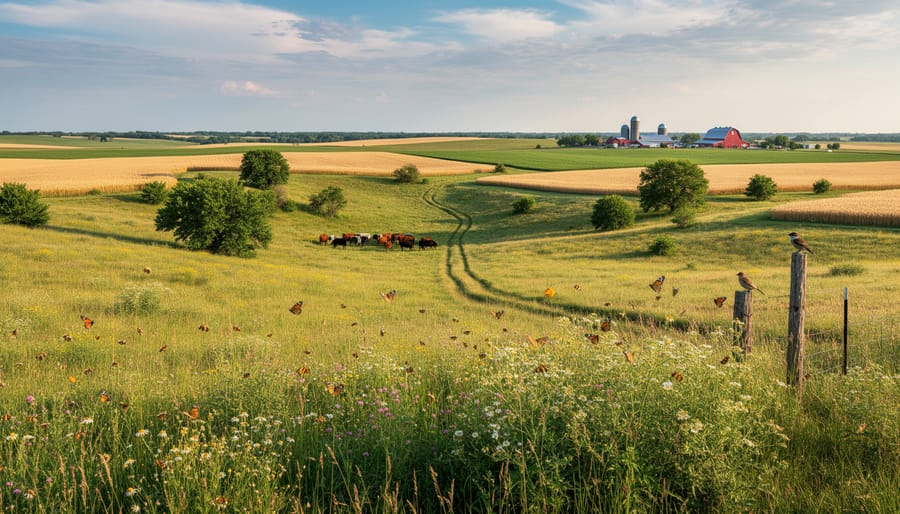
The Canadian Prairies face some of the most dramatic biodiversity declines in North America, with Alberta experiencing particularly sharp losses in native ecosystems converted to agricultural production. Since European settlement, approximately 70 percent of native grasslands across the Prairie provinces have been lost to cultivation, with Alberta retaining only about 25 percent of its original mixed-grass prairie. This conversion represents one of the most extensive ecosystem transformations globally and has fundamentally altered regional biodiversity patterns.
Grassland bird populations serve as a telling indicator of these changes. Species like the Sprague’s pipit, chestnut-collared longspur, and burrowing owl have declined by 60 to 87 percent since the 1970s across Prairie landscapes. These losses reflect not just habitat conversion but also intensification of remaining agricultural lands through practices that eliminate field margins, wetlands, and natural vegetation.
Wetland biodiversity has suffered parallel declines. The Prairie pothole region, which historically supported 50 to 80 percent of North American waterfowl production, has lost an estimated 40 to 70 percent of its wetlands in Alberta and Saskatchewan. Each drained slough eliminates habitat for amphibians, aquatic invertebrates, and water-dependent plant species, while reducing landscape connectivity that wildlife needs for seasonal movement.
Yet regional biodiversity isn’t uniformly declining. Specific areas where farmers have maintained native pastures, restored wetlands, or adopted diverse crop rotations show measurably higher species richness. In southern Alberta, properties with even 15 to 20 percent native grassland retained support three to five times more bird species than fully cultivated landscapes. These pockets of resistance demonstrate that regional patterns can shift with intentional land management decisions.
How Biodiversity Enhancement Works in Regenerative Agriculture
Soil Biodiversity as the Foundation
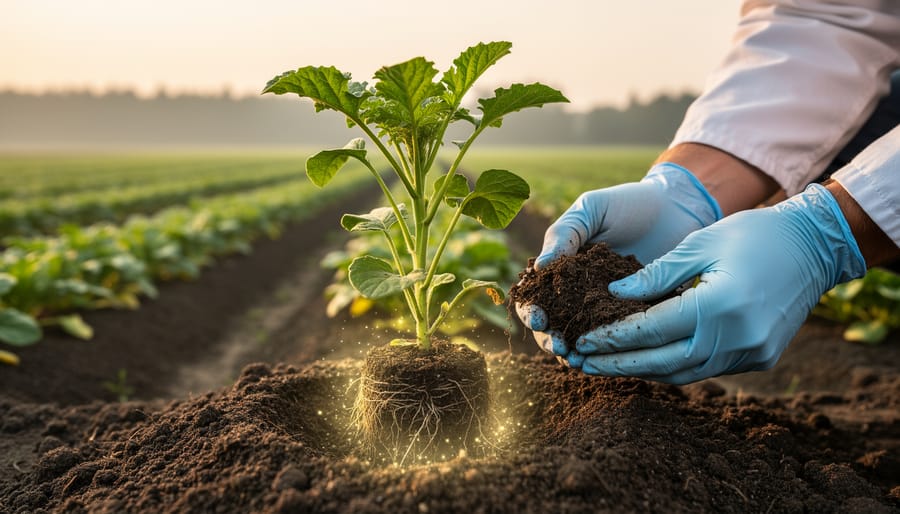
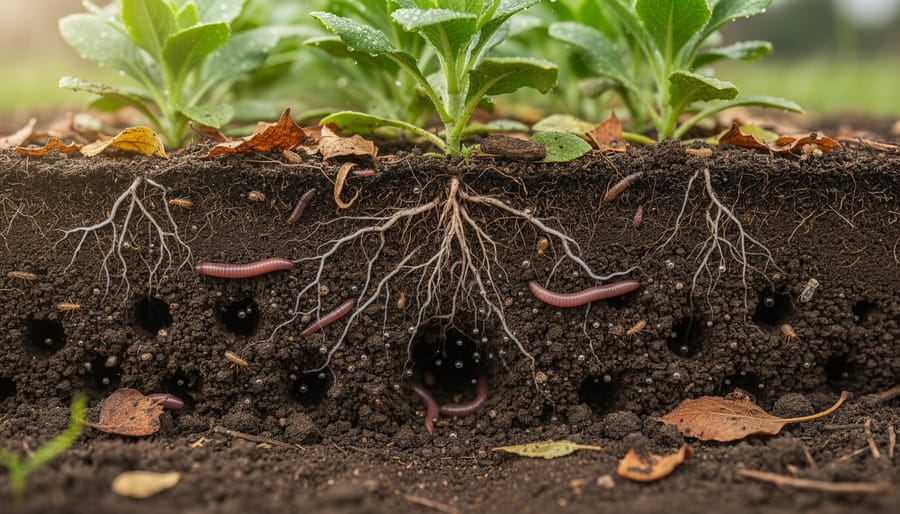
Underground life forms the engine of biodiversity recovery. When farmers reduce tillage, add diverse cover crops, and eliminate bare soil periods, microbial populations explode, bacteria and fungi that were dormant or absent colonize the rhizosphere and aggregate soil particles into stable structures. Research in Alberta shows soil microbial biomass can double within three to five years of transitioning to regenerative methods, with fungal networks extending metres through the profile rather than remaining confined to the surface centimetres.
These fungi form partnerships with plant roots, trading nutrients for carbon and creating highways that connect different plant species across a field. Earthworms return as soil structure improves and chemical inputs decrease, populations of 200 to 400 worms per square metre become common where previously only dozens existed. Each worm burrow channels water, aerates compacted layers, and deposits nutrient-rich castings. Nematodes, springtails, and predatory mites establish hunting grounds in the pore spaces, creating food webs that cycle nutrients and suppress disease organisms naturally.
Understanding how regenerative agriculture works starts here, in the soil matrix where organic matter boosts soil life and creates the resilience that carries through droughts, disease pressure, and market volatility. Farms with thriving soil communities need less synthetic nitrogen because bacteria fix it, require fewer fungicides because beneficial organisms outcompete pathogens, and withstand moisture stress because fungal networks extend root reach. This underground biodiversity directly translates to reduced input costs and stabilized yields.
Above-Ground Habitat and Species Recovery
When you shift from bare soil and monocultures to diverse cropping systems and permanent vegetation, you’re essentially rolling out the welcome mat for wildlife that’s been absent from conventional farmland for decades.
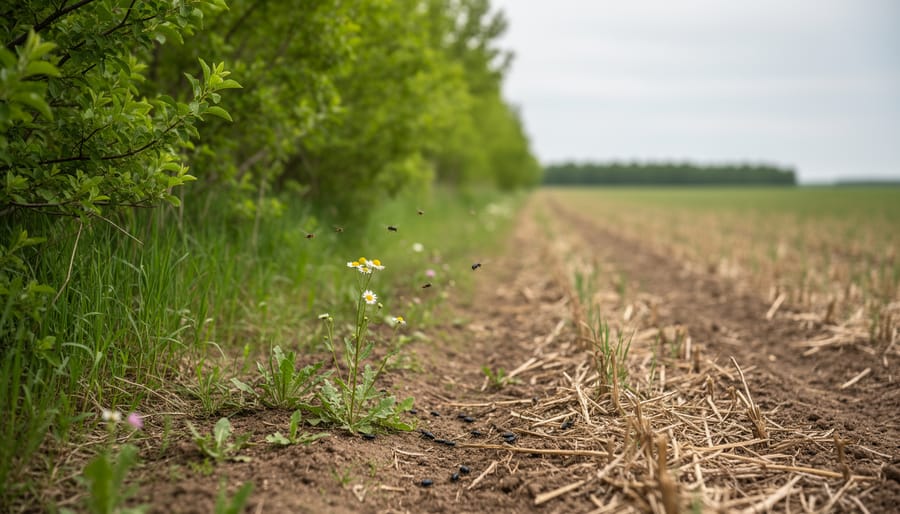
The recovery process starts with habitat structure. Hedgerows and field borders create nesting sites and corridors for movement. A single hedgerow can support over 600 species of plants, insects, and birds. On Alberta farms, native shrub hedgerows provide berries for migrant songbirds and shelter for ground-nesting species like meadowlarks, which have declined by 70 percent in Prairie regions since the 1970s.
Cover crops extend this benefit through the growing season and into winter. A diverse cover crop mix with flowering species like buckwheat or phacelia offers nectar and pollen when commercial crops aren’t blooming. This matters for pollinators facing the “hungry gap” between spring dandelions and summer canola. Leaving cover crop residue standing through winter creates overwintering habitat for beneficial insects like lady beetles and native bees, which emerge earlier the following spring to control aphids before they become problematic.
Reduced tillage accelerates recovery by leaving habitat intact. Ground-nesting bees need undisturbed soil to complete their life cycles. Many dig tunnels 15 to 30 centimetres deep where larvae develop over winter. A single tillage pass destroys these nests. Farms that’ve eliminated tillage for five years typically see native bee populations triple compared to tilled neighbours.
The timeline varies by species. Mobile pollinators like bumblebees colonize new habitat within a single season. Grassland birds take three to five years to establish territories in restored areas. Apex predators like hawks return last, usually after prey populations rebuild.
Alberta farmers report seeing species they hadn’t observed in 20 years within three growing seasons of adopting these practices. The recovery isn’t linear, but the direction is unmistakable when you provide the habitat structure these species need.
Components and Practices That Support Biodiversity
Diverse Crop Rotations and Polycultures
Rotating crops disrupts pest cycles and disease pressure, but the biodiversity payoff extends far beyond pest management. When you shift from continuous monoculture to four-, five-, or six-crop rotations, you create temporal and spatial diversity that multiplies habitat niches across your fields. Different crops flower at different times, offering staggered nectar sources for pollinators from early spring through fall. Deep-rooted crops like alfalfa create soil channels that shallow-rooted cereals can’t, supporting distinct communities of soil organisms at various depths.
Polycultures, growing two or more crop species simultaneously in the same field, take this further by providing structural complexity that mimics natural plant communities. Intercropping canola with a legume, for instance, creates a dual-layer canopy where beneficial insects find shelter and hunting grounds that wouldn’t exist in uniform stands. This diversity aligns with the five regenerative principles by keeping living roots in the soil and maximizing plant diversity.
Alberta farmers using diverse rotations consistently observe increased bird activity, particularly ground-nesting species like meadowlarks, and higher pollinator counts compared to conventional wheat-canola-fallow sequences.
Cover Cropping and Living Roots
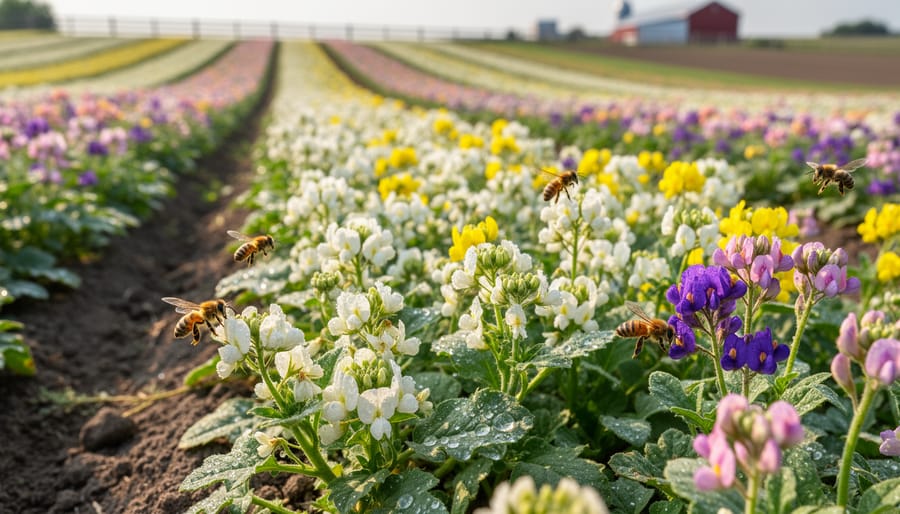
Cover crops transform bare soil into thriving habitat by maintaining living roots throughout the year, creating continuous food sources and shelter that conventional rotations eliminate. When you plant a diverse cover crop mix, say, clover, vetch, radish, and oats, after harvest, you’re establishing nectar sources for late-season pollinators, overwintering refuge for beneficial insects, and year-round feeding grounds for soil organisms that would otherwise go dormant or die off.
The presence of living roots matters more than most realize. Root exudates feed soil fungi and bacteria constantly, maintaining the underground food web that supports everything from earthworms to ground beetles. A single rye cover crop can add 3,000 kilograms per hectare of root biomass, creating channels and organic matter that house thousands of invertebrate species. Multi-species mixes amplify this effect: different root depths, structures, and exudate chemistries attract different organisms, multiplying habitat niches in a single field.
Above ground, flowering cover crops like phacelia or buckwheat provide critical pollen and nectar when main crops are dormant, bridging the gap that leaves pollinators starving in conventional systems. Alberta farmers using winter-hardy covers report seeing native bees and beneficial wasps well into October, species that vanish from bare-soil neighbours.
Integrated Livestock and Grazing Management
Moving livestock frequently across the landscape recreates the historical grazing patterns that shaped Prairie ecosystems. Bison once moved in dense herds, grazing intensely for short periods before moving on, leaving trampled plant material and nutrient-rich manure deposits that stimulated regrowth and diversity.
Adaptive multi-paddock grazing applies this principle. Cattle concentrate on small paddock areas for 12 to 48 hours, then move to fresh pasture. The brief, intense grazing pressure breaks up plant dominance by taller species, creating gaps where forbs and legumes establish. Hoof action presses seeds into soil contact and builds surface roughness that captures moisture and creates microhabitats for ground-nesting birds and insects.
The rest period following grazing, typically 30 to 90 days depending on season and growth rates, allows plants to recover fully and flower, providing sequential nectar sources throughout the growing season. This rotation prevents overgrazing of preferred species, maintaining plant diversity that supports varied insect, bird, and small mammal populations. Manure distribution across the landscape rather than concentrated in loafing areas feeds dung beetles and other decomposers, cycling nutrients while creating additional habitat complexity.
Real-World Applications: Biodiversity Gains on Canadian Farms
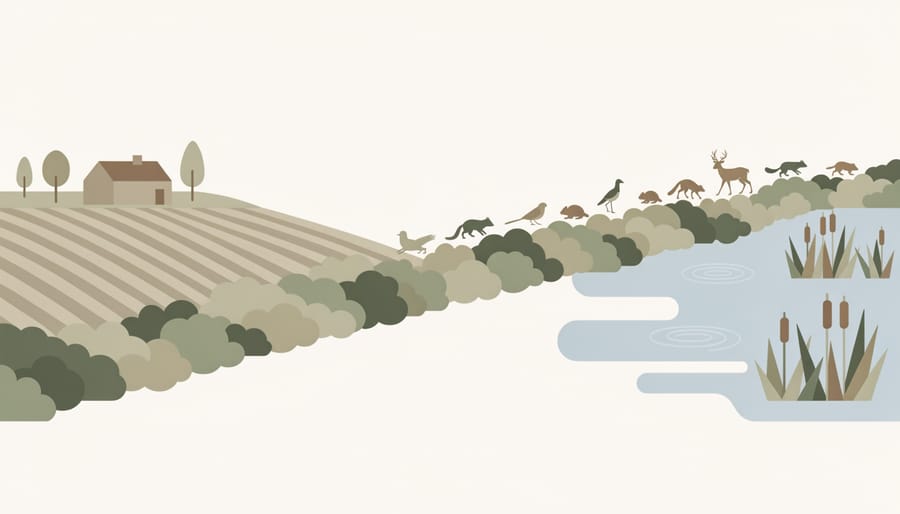
The transition from theory to practice reveals measurable biodiversity improvements across Canadian farms that have adopted regenerative methods. These real-world examples demonstrate not only that biodiversity can increase, but also the timelines and specific changes farmers observe when they implement regenerative practices.
At Spray Creek Ranch in southern Alberta, owner Luke Wintrup documented a 40% increase in bird species diversity within three years of transitioning to adaptive multi-paddock grazing. By 2024, his monitoring recorded 23 bird species compared to 14 species present under conventional continuous grazing. The shift included the return of grassland specialists like Sprague’s pipits and chestnut-collared longspurs, both species of conservation concern in the Prairies. Wintrup attributes this recovery to maintaining taller grass residues and creating varied habitat structures through planned livestock movement.
In Saskatchewan’s dark brown soil zone, the Zentner family farm near Swift Current measured earthworm populations before and after adopting no-till combined with diverse crop rotations. Their five-year monitoring showed earthworm counts increasing from 8 individuals per square metre to 47 individuals per square metre. Soil sampling also revealed a threefold increase in fungal biomass, indicating broader below-ground biodiversity recovery. These changes corresponded with improved water infiltration rates and reduced fertilizer requirements.
Quebec’s La Ferme des Quatre-Temps provides a striking example from a market garden context. After implementing permanent living pathways, diverse crop rotations spanning 80 vegetable varieties, and integrated flowering strips, the farm documented 63 beneficial insect species within two growing seasons. Owner Jean-Martin Fortier noted that pest pressure decreased substantially as predator populations established, reducing the need for even organic pest interventions.
Further west, Alberta’s Windy Acres Farm near Airdrie tracked pollinator activity before and after planting hedgerows and extending bloom periods through cover crop selection. Their transect counts showed native bee observations increasing from 12 per hour to 34 per hour over four years, with seven native bee species identified that weren’t present initially.
These farms share common implementation insights. Most saw initial biodiversity responses within one to two growing seasons, particularly for mobile species like pollinators and birds. Soil organism recovery typically required three to five years of consistent practice. Critically, these farmers emphasize that biodiversity gains didn’t compromise productivity. Several reported yield stability improvements and reduced input costs as ecological functions strengthened, demonstrating that biodiversity enhancement and commercial viability can advance together on working farms.
Measuring and Monitoring Biodiversity on Your Farm
You don’t need a PhD to track biodiversity changes on your land. Start with what’s already visible: walk your fields regularly and note which birds you see, how many pollinators visit your crops during bloom, and whether earthworms appear when you dig a shovel’s depth into the soil. Keep a simple log with dates and observations. Over months and seasons, patterns emerge that tell you whether your practices are working.
Soil biodiversity offers concrete metrics. Dig a 30 cm × 30 cm × 30 cm soil pit and count earthworms, healthy Prairie soils should contain at least 10 to 15 per cubic metre in spring and fall. Check for different earthworm species: deep-burrowing nightcrawlers indicate good soil structure, while surface-dwelling red wigglers show active organic matter decomposition. The slake test reveals soil aggregate stability influenced by fungal networks: drop a dry soil clod into water and watch whether it holds together (high biodiversity) or dissolves immediately (degraded).
For above-ground diversity, establish three or four permanent transects across different field zones. Walk each transect monthly during growing season and record plant species you encounter in a 1-metre-wide path. Count flowering plant types separately, they indicate pollinator support. Note bird species at dawn or dusk, when activity peaks. Even rough counts like “saw six different grassland birds today versus two last year” document meaningful trends.
Several Canadian programs provide structure without complexity. The Ontario Soil Health and Conservation Strategy offers biodiversity assessment protocols adaptable to Alberta conditions. Agriculture and Agri-Food Canada’s Living Lab initiatives in Alberta include farmer-led biodiversity monitoring with technical support. Local watershed groups often run citizen science programs tracking water quality and aquatic biodiversity, connecting farm practices to downstream ecosystem health.
Photo documentation works surprisingly well. Take pictures from the same spots each month, changing plant diversity, insect abundance on flowers, and even soil colour shifts become visible over two to three years. Compare images side-by-side and you’ll see biodiversity recovery your daily presence might overlook.
Common Questions About Biodiversity in Regenerative Agriculture
Farmers considering biodiversity enhancement often have practical questions about implementation, economics, and compatibility with commercial operations. These concerns are natural when evaluating any management shift, and the answers reveal that biodiversity gains align well with productive farming.
How long does it take to see biodiversity improvements?
Early changes appear within one growing season, pollinators respond quickly to flowering cover crops, while soil organism diversity typically shows measurable gains in two to three years. Bird and small mammal populations often increase noticeably within three to five years as habitat establishes.
Will increasing biodiversity reduce my yields?
Research across Canadian farms shows that biodiversity-focused regenerative systems maintain or improve yields over time, particularly during drought or variable conditions when diverse ecosystems prove more resilient. Short-term yield variability during transition is possible, but long-term production stability typically strengthens.
What about pest species, won’t more biodiversity mean more pests?
Higher biodiversity includes beneficial predators and parasitoids that naturally control pest populations, creating balanced ecosystems rather than pest explosions. Farms with greater insect diversity consistently report lower pest pressure than monocultures.
Can I measure biodiversity without expensive equipment or specialists?
Simple visual assessments work well: count pollinator species on flowering plants, note bird varieties, use basic soil tests for earthworm counts, and photograph plant diversity in field margins. Several Canadian programs provide free biodiversity assessment support to participating farmers.
The economic implications concern many producers, yet biodiversity enhancement rarely requires large capital investments. Most regenerative practices that build biodiversity, diverse rotations, cover crops, modified grazing, use existing equipment and infrastructure. Input costs often decrease as biological pest control and nutrient cycling replace some purchased inputs.
Government programs increasingly recognize biodiversity work. Several Alberta and federal initiatives now offer technical support and cost-share funding for practices like shelterbelts, wetland restoration, and pollinator habitat establishment. The Canadian Agricultural Partnership includes environmental stewardship streams that support biodiversity projects, and some certification programs pay premiums for verified biodiversity outcomes.
Timing your transition matters less than starting with manageable steps. Adding one cover crop species, establishing a small pollinator strip, or adjusting one grazing paddock begins the process without overwhelming your operation. Biodiversity responds to consistent practice more than perfect implementation, making incremental adoption both practical and effective for commercial farms.
The evidence is clear: biodiversity is declining in conventional agricultural systems, but it doesn’t have to stay that way. While global assessments show concerning losses in farmland species, pollinators, and soil life, the data also reveals something hopeful, farms that adopt regenerative practices consistently see biodiversity increase, often within just a few growing seasons.
For Alberta farmers, this isn’t abstract environmental theory. Biodiversity enhancement translates directly into more resilient operations. Healthier soil communities improve nutrient cycling and drought tolerance. Diverse pollinator populations boost crop yields. Beneficial insects reduce pest pressure without chemicals. Native plants along field edges protect against erosion and provide wildlife habitat that supports ecosystem balance.
The practices that drive these improvements, diverse rotations, cover cropping, adaptive grazing, reduced tillage, are accessible and scalable. You don’t need to transform your entire operation overnight. Start with one practice on a portion of your land, monitor the results, and expand what works.
Canadian farmers are already proving this approach succeeds in our climate and conditions. Their experiences show that biodiversity recovery supports both ecological health and economic viability. The farm becomes more productive, not less, when it works with natural systems rather than against them.
You’re not alone in this transition. Connect with other regenerative farmers in your region, access shared knowledge, and find support as you build biodiversity back into your land. The path forward exists, and it starts with the choices you make this season.