Salinity refers to the concentration of dissolved salts in soil or water, a metric measured in deciSiemens per metre (dS/m) or parts per million (ppm) that determines whether crops can access moisture and nutrients effectively. In Advanced Placement Environmental Science courses, salinity serves as a key indicator of soil health and ecosystem function, but for Canadian farmers, particularly across Alberta’s prairies, it represents a tangible challenge that directly affects yield, land value, and long-term farm viability.
Understanding salinity goes beyond memorizing a textbook definition. It requires grasping how salt accumulates in root zones, why certain soils become saline while others remain productive, and which management practices actually reverse damage versus those that simply mask symptoms. Prairie producers face an estimated 2 million hectares of salt-affected land in the Prairie provinces, with costs running into hundreds of millions of dollars annually in lost production.
This article bridges the academic framework taught in APES curricula with field-tested solutions from Alberta’s agricultural community. You’ll find the mechanistic processes that drive salt accumulation, the distinction between primary and secondary salinity, and the practical interventions that farmers across Western Canada have implemented to reclaim affected acres. Whether you’re a student preparing for an AP exam or a producer staring at white crusts forming on low-lying fields, the principles remain the same: salinity is manageable when you understand its behaviour and apply targeted strategies rooted in soil science and hydrology.
What Salinity Means in Environmental Science
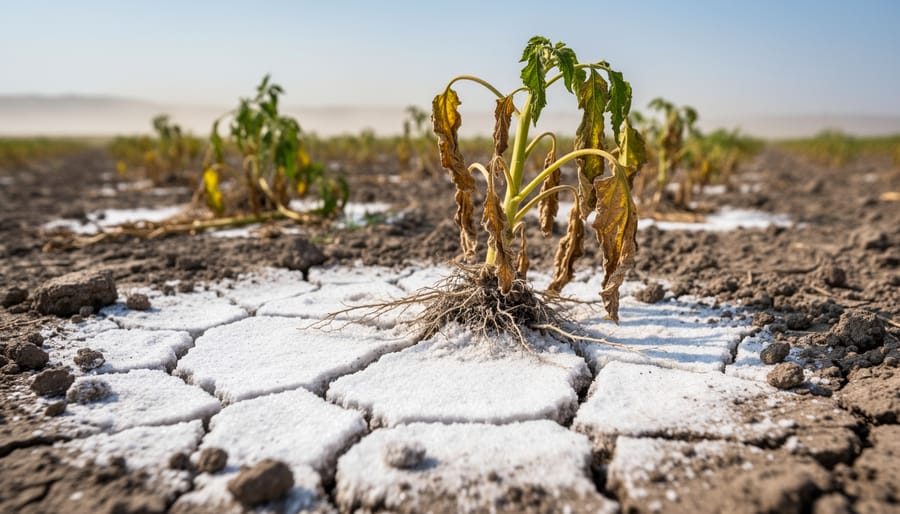
In Advanced Placement Environmental Science courses, salinity refers to the concentration of dissolved salts present in soil or water. These salts include calcium, magnesium, sodium, chloride, sulfate, and bicarbonate ions that accumulate naturally or through human activity. Unlike the simple taste of table salt, agricultural salinity involves a complex mixture of compounds that can fundamentally alter how soil and water function in farming systems.
Environmental scientists measure salinity in two primary ways. Parts per thousand (ppt) expresses the mass of salt per unit of water, while electrical conductivity (EC), measured in deciSiemens per metre (dS/m), indicates how well a soil or water sample conducts electricity. Higher salt content increases conductivity, making EC a practical field measurement. In Alberta, most soil testing labs report EC values because farmers can quickly compare readings against crop tolerance thresholds without converting units.
- Salinity
- The total concentration of soluble salts in soil or water, typically measured by electrical conductivity or total dissolved solids.
- Salinization
- The process by which salts accumulate in soil or water over time, either through natural geological processes or human activities like irrigation.
- Electrical Conductivity (EC)
- A measurement of how well a soil or water sample conducts electrical current, expressed in dS/m, used as a practical indicator of salt concentration in agricultural settings.
- Total Dissolved Solids (TDS)
- The combined mass of all inorganic and organic substances dissolved in water, measured in parts per thousand or milligrams per litre.
- Sodicity
- The proportion of sodium ions relative to calcium and magnesium on soil particles, which affects soil structure and water infiltration even when total salt levels are moderate.
This scientific framework matters because Alberta’s semi-arid climate creates ideal conditions for salt accumulation. When farmers understand that salinity is measurable and predictable rather than mysterious, they can monitor fields systematically, interpret soil test results accurately, and choose interventions based on actual salt concentrations rather than guesswork. A canola field showing patchy growth might have EC readings of 4 dS/m in bare spots versus 1.5 dS/m in healthy areas, giving the grower concrete data to guide remediation efforts. That precision separates successful salinity management from reactive crisis response.
How Salinity Develops and Spreads in Soil
Natural Salinization Processes
In Alberta’s semi-arid prairies, salt accumulation occurs naturally long before farmers ever break ground. Ancient marine sediments from prehistoric seas deposited layers of sodium chloride, magnesium sulfate, and calcium carbonate throughout the bedrock, creating a geological salt reservoir that continuously leaches into overlying soil.
The Alberta dry climate accelerates the concentration process through evapotranspiration, the combined loss of water from soil surface evaporation and plant transpiration. When evaporation rates exceed precipitation, which happens routinely across much of the province, water moves upward through soil profiles carrying dissolved minerals. As water evaporates at the surface, salts remain behind and accumulate in the root zone.
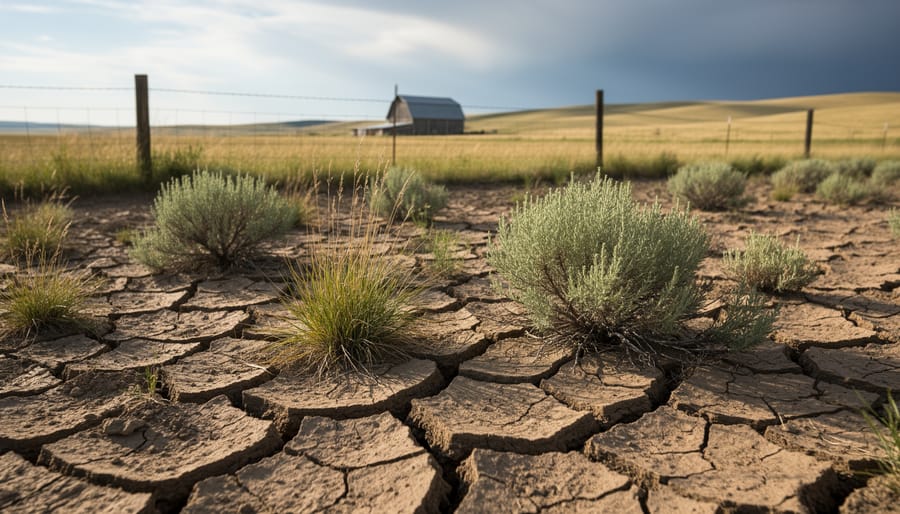
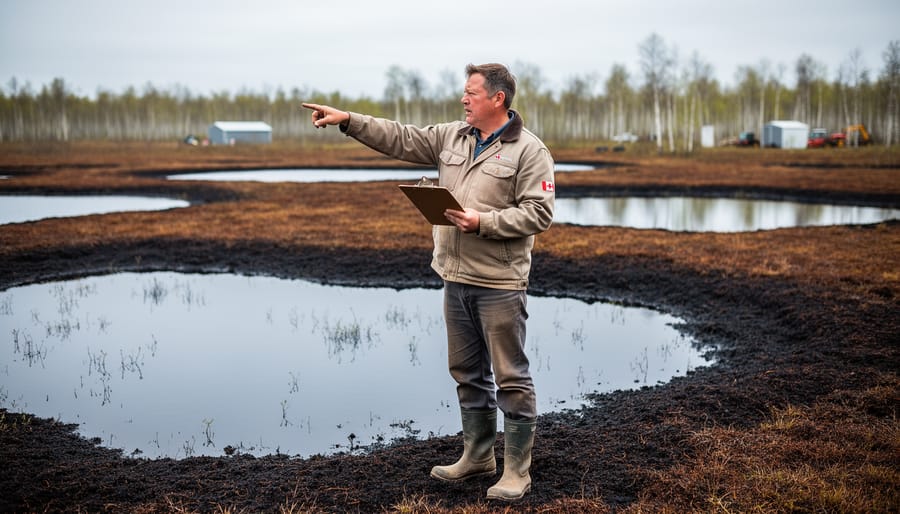
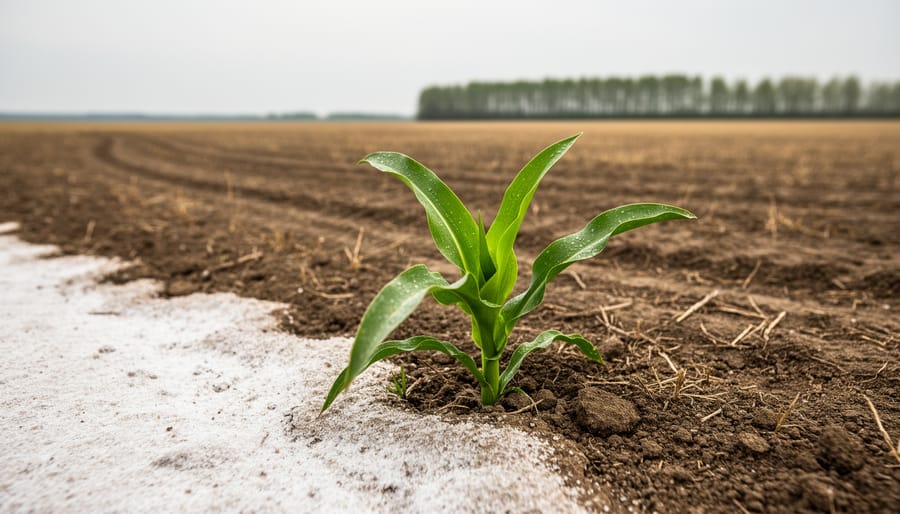
Shallow water tables make this worse. In low-lying areas or poorly drained depressions, groundwater sits just one to three meters below the surface, close enough for capillary rise drives salinization in fine-textured soils. The water wicks upward through tiny pore spaces, carrying dissolved salts that crystallize when the moisture evaporates. You’ll see this pattern on topographic low spots where white crusts form during dry spells.
Soil texture controls how fast this happens. Clay and silt particles create narrow pores that pull water higher through capillary action than coarser sandy soils, meaning clay-rich glacial till common across central Alberta faces greater natural salinity risk than sandier deposits found in the south.
Human-Influenced Salinity
Irrigation ranks as the most significant human driver of agricultural salinity in Alberta’s prairie landscape. When farmers apply water to crops, dissolved salts come along for the ride. As plants transpire and soil surfaces dry, water evaporates but the salts remain, gradually building up in the root zone. Over-irrigation compounds this problem, excess water can raise water tables, pulling saline groundwater upward through capillary action into the productive topsoil layers.
The choice of irrigation water matters enormously. River water in southern Alberta naturally carries dissolved minerals, and even moderate salt concentrations become problematic when applied repeatedly over years. Farmers using saline groundwater for irrigation face accelerated salt accumulation, sometimes rendering fields unproductive within a decade without careful leaching management.
Tillage practices alter how water and salts move through soil profiles. Conventional tillage disrupts soil structure, reducing infiltration rates and creating compacted layers that trap salts near the surface. When heavy equipment compresses subsoil, natural drainage pathways close off, preventing salts from leaching downward with precipitation.
Land clearing for agricultural expansion removes deep-rooted native vegetation that once drew water from lower soil horizons. Without this natural pump, water tables rise in cleared areas, bringing dissolved salts from geological deposits toward the surface. This process has created thousands of hectares of saline seeps across Alberta farmland where none existed before cultivation.
Drainage disruption, whether from road construction, field grading, or blocked natural watercourses, redirects water flow patterns and creates localized zones of salt concentration. Water pools in low spots, evaporates, and leaves behind white salt crusts that signal severe salinity problems requiring intervention.
Categories of Soil Salinity
Saline Soils
Saline soils contain elevated concentrations of soluble salts, primarily calcium, magnesium, and sulfate, but maintain relatively normal sodium levels. These soils register an electrical conductivity (EC) of 4 dS/m or higher in the saturated paste extract, the standard measurement protocol taught in APES courses and used across Alberta. Unlike sodic soils, saline soils typically preserve their structure and drainage capacity because calcium and magnesium don’t disperse clay particles the way excess sodium does.
The agricultural implications center on osmotic stress. High salt concentrations in soil water make it harder for plant roots to extract moisture, even when soil appears wet. Crops show stunted growth, leaf burn along margins, and reduced yields, symptoms that worsen as EC climbs above 8 dS/m. Salt-sensitive crops like canola and field peas suffer first, while barley and some forage grasses tolerate moderate levels. White salt crusts on soil surfaces after rain or irrigation signal severe salinization.
Alberta farmers managing agricultural salt problems monitor EC readings through soil testing at 15 cm and 60 cm depths, tracking whether salts concentrate near the surface or throughout the root zone. This data guides leaching decisions and crop rotation planning for affected fields.
Sodic and Saline-Sodic Soils
Sodic soils present a different challenge than purely saline conditions because excess sodium disrupts soil structure at the particle level. When sodium saturates more than 15 percent of the soil’s cation exchange sites (measured as Exchangeable Sodium Percentage or ESP), clay particles disperse rather than clump together. This dispersion creates a dense, almost impermeable layer that blocks water infiltration and air movement. Alberta farmers often describe sodic patches as slick when wet and rock-hard when dry, with surface crusting that prevents seedling emergence.
Saline-sodic soils contain both high total salts and elevated sodium levels. The salt content temporarily holds soil particles together, but as rain or irrigation leaches the salts, the sodium effect dominates and structure collapses. These soils shift behavior seasonally, draining adequately in dry periods but turning sticky and anaerobic after moisture events.
Managing sodic conditions requires different interventions than saline soils. Gypsum (calcium sulfate) displaces sodium from exchange sites and improves aggregation, while deep-rooted cover crops help break compacted layers. Drainage improvements alone won’t fix sodic soil the way they help saline conditions, you need to address the sodium chemistry first.
Measuring Salinity Levels
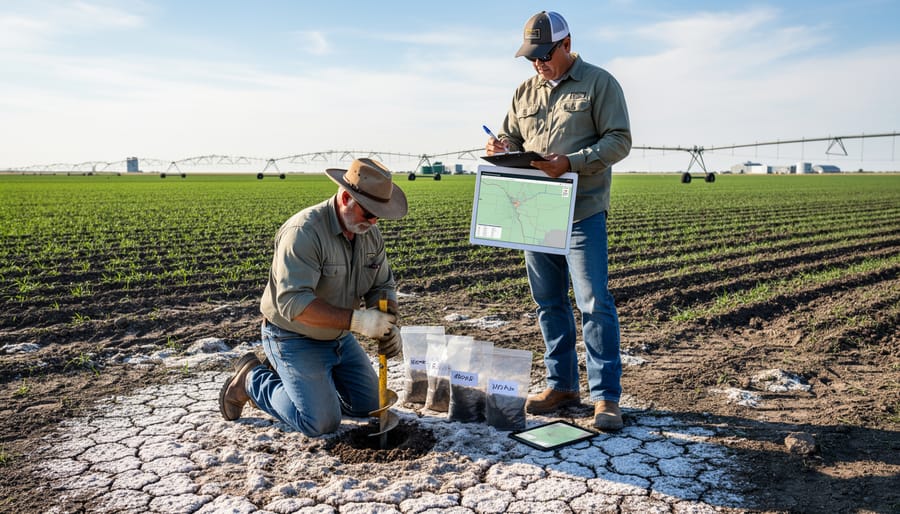
Alberta farmers rely on three primary methods to assess salinity levels in their fields. Electrical conductivity (EC) meters provide quick, on-site measurements of soil salinity, expressed in deciSiemens per metre (dS/m). Readings above 4 dS/m typically indicate moderate to severe salinity affecting most crops.
Visual crop stress patterns offer another diagnostic tool. Stunted growth, yellowing leaves, and irregular bare patches, especially in low-lying areas, signal potential salinity problems. These symptoms often appear first in salt-sensitive crops like canola and dry beans.
Laboratory soil testing delivers the most comprehensive assessment. Farmers submit samples to provincial labs for detailed analysis of EC, sodium adsorption ratio, and specific salt ions. Testing in fall or early spring, before salts leach deeper, produces the most accurate baseline data. Combining all three methods creates a complete picture of field salinity levels and helps target management zones effectively.
Where Salinity Knowledge Applies in Alberta Agriculture
Irrigation System Management
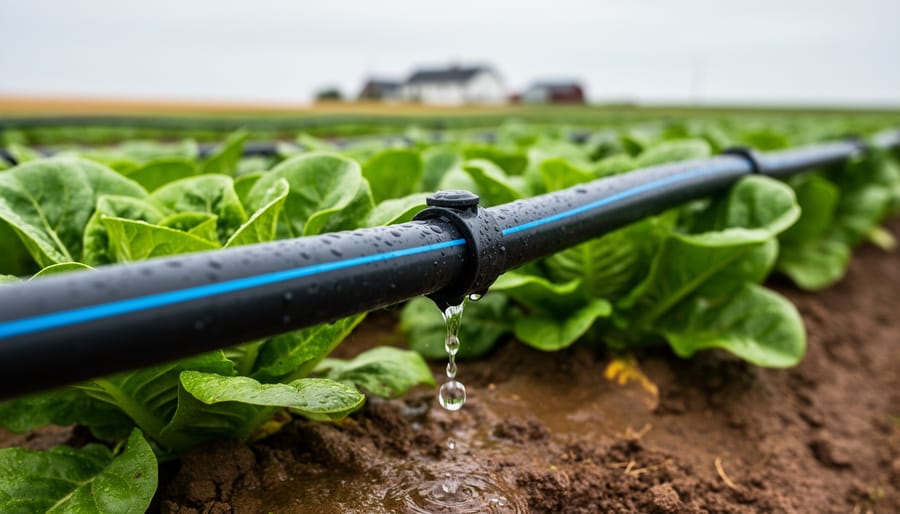
Understanding salinity helps Alberta farmers make smarter irrigation decisions that prevent salt from concentrating in the root zone. The key is managing how much water you apply and when, based on your soil’s electrical conductivity readings and your water source quality.
Irrigation scheduling becomes critical when salinity is present. Apply water frequently enough to keep salts moving downward past the root zone, but not so heavily that you raise the water table and trigger upward salt movement through capillary action. Many Alberta farmers find that lighter, more frequent irrigations work better than infrequent deep watering on saline soils, particularly during peak growing season when evapotranspiration rates climb.
Water source selection matters tremendously. Test your irrigation water’s salinity level before the season starts. Water with less than 0.7 dS/m generally poses minimal risk, while sources above 3.0 dS/m can worsen soil salinity with every application. If you’re pulling from saline groundwater or dugouts with concentrated salts, you may need to blend sources or switch to lower-salinity alternatives.
Calculate your leaching fraction, the extra water needed to flush accumulated salts below the root zone. A typical leaching fraction ranges from 10 to 20 percent of applied water, depending on crop tolerance and existing soil salinity. This isn’t wasted water; it’s essential maintenance that keeps your fields productive long-term.
Crop and Variety Selection
Choosing the right crops and varieties is one of the most cost-effective ways to maintain productivity on salt-affected land. Different plants tolerate salinity differently: barley typically withstands higher electrical conductivity (EC) levels than wheat, while canola shows moderate tolerance and dry beans struggle even at low salt concentrations. Matching crops to your field’s salinity zones protects yield and prevents expensive soil amendments from becoming your only option.
Many Alberta farmers now use EC mapping data to assign crops spatially across a single field. Salt-tolerant crops like kochia forage, tall wheatgrass, or specific barley cultivars go into the hottest saline zones, while sensitive crops occupy lower-EC areas. Organic operations in southern Alberta have successfully rotated salinity-tolerant alfalfa varieties with barley on moderately affected fields, using the deep-rooted legume to improve soil structure while harvesting a marketable crop.
Variety selection matters as much as species choice. Seed suppliers now publish salt tolerance ratings for individual cultivars; a salt-tolerant wheat variety can outperform a sensitive one by 30 percent in the same saline patch. Test multiple varieties on your own soil conditions before committing to large acreages.
Soil Reclamation Strategies
Rehabilitating salt-affected land requires a multi-pronged approach that addresses both the symptom (excess salts) and the underlying causes. The most common chemical amendment in Alberta is gypsum (calcium sulfate), which supplies calcium to displace sodium ions on soil particles, improving soil structure and drainage. Application rates typically range from 2 to 10 tonnes per hectare, depending on soil test results and the severity of sodium saturation.
Incorporating organic matter through compost, manure, or cover crop residues enhances soil structure and microbial activity, which gradually improves water infiltration and salt leaching efficiency. Many Alberta farmers report better results when combining gypsum with consistent organic amendments over several growing seasons rather than relying on a single treatment.
Drainage improvements prove essential where high water tables contribute to ongoing salt accumulation. Installing tile drains or constructing surface drainage channels allows excess water, and dissolved salts, to move away from crop root zones. Some producers use deep-rooted perennial forages like alfalfa as a biological drainage tool, drawing down water tables through transpiration while adding organic matter when the stand is eventually terminated.
Phytoremediation with salt-tolerant species such as tall wheatgrass or kochia can gradually extract salts from moderately affected areas, though this approach requires patience and works best as part of a longer-term rotation strategy.
Salinity Management Lessons from Alberta Farmers
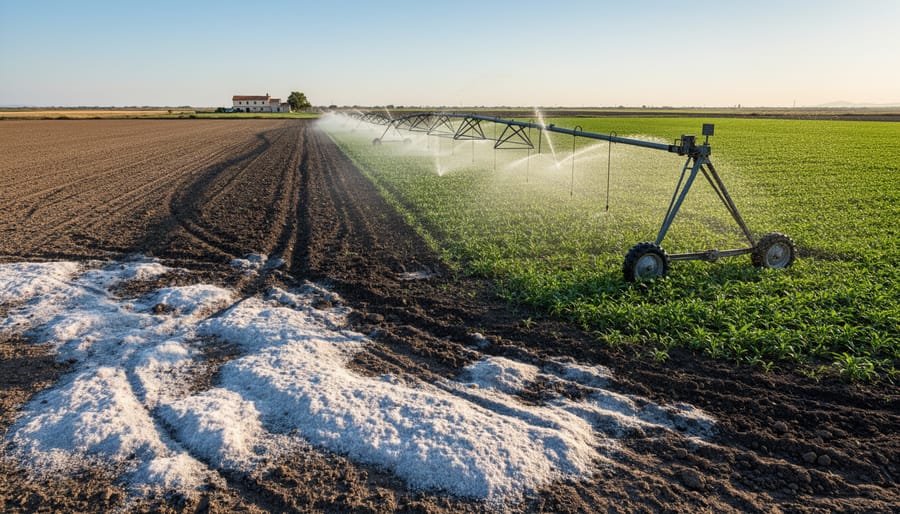
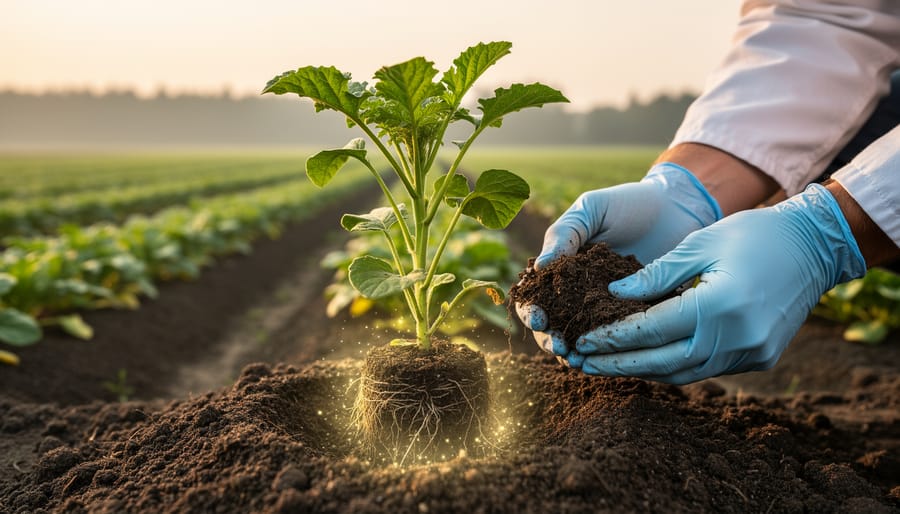
When Jordan Thiessen’s family farm near Brooks faced declining canola yields on their quarter-section of irrigated land, soil tests revealed electrical conductivity readings between 4 and 8 dS/m, well into the moderately saline range that APES students learn suppresses crop growth. Rather than abandoning the affected acres, Thiessen applied environmental science principles to methodical reclamation.
His first step was detailed mapping. Using a handheld EC meter, Thiessen walked transects across the field every 30 metres, recording readings at 15-centimetre depth. The data revealed salt accumulation concentrated in low-lying areas where irrigation water ponded and evaporated, exactly matching the capillary action and evapotranspiration mechanisms that drive natural salinization. “Once I saw the pattern, I understood we weren’t just fighting bad soil, we were fighting physics,” Thiessen explains.
He tackled the problem on three fronts. First, he installed subsurface drainage tile in the worst zones to lower the water table and interrupt upward salt movement. Second, he amended the soil with gypsum at two tonnes per acre, supplying calcium to displace sodium and improve structure, a direct application of understanding saline-sodic soil chemistry. Third, he switched from continuous canola to a rotation including barley and fall rye, both moderately salt-tolerant crops that maintained some economic return while the soil recovered.
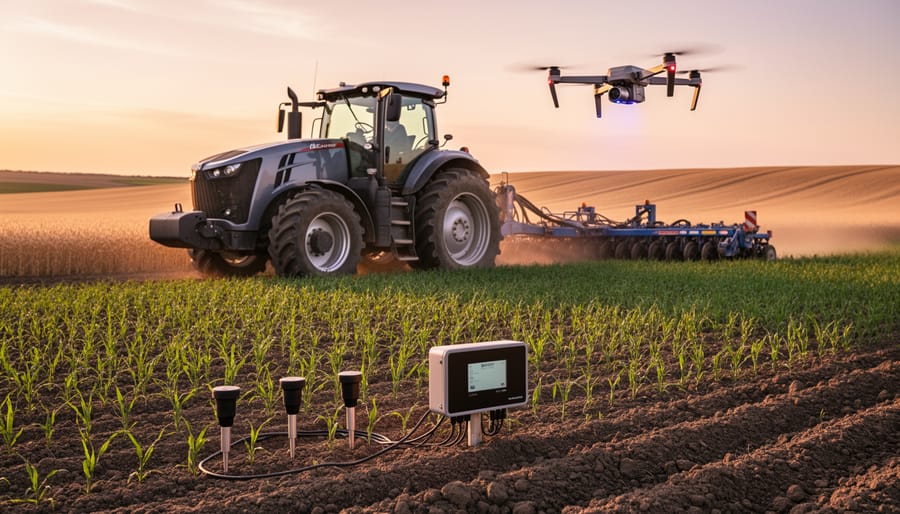
Thiessen also modified his irrigation schedule based on leaching fraction calculations. Instead of frequent light watering that concentrates salts near the surface, he adopted deeper, less frequent applications that push salts below the root zone. He monitors soil moisture with probes to avoid over-irrigation, recognizing that excess water drives the soil processes that mobilize and redistribute salts.
After three seasons, EC readings in the treated areas dropped to 2-3 dS/m, and canola yields rebounded to near-normal levels. Thiessen’s success demonstrates that the environmental science concepts taught in APES, understanding how salts move, accumulate, and interact with soil, translate directly into practical interventions that protect Alberta farmland productivity. His monitoring-first approach and willingness to adjust both crops and water management turned a salinity crisis into a manageable challenge.
Common Questions About Salinity in Farming
What EC reading indicates a salinity problem in my soil?
An electrical conductivity reading above 4 dS/m typically signals salinity levels that will affect most crop yields. Sensitive crops like canola and field peas show stress at 2-3 dS/m, while more tolerant species like barley can handle 6-8 dS/m before significant yield loss occurs.
Can organic farming practices actually reduce soil salinity?
Yes, but organic amendments work slowly and address symptoms rather than causes. Incorporating compost and manure improves soil structure and drainage, which helps leach salts below the root zone. However, you still need proper irrigation management and drainage to prevent continued salt accumulation regardless of your farming system.
How often should I test my soil for salinity in Alberta?
Test problem fields annually in early spring before seeding, and every three years for fields with no history of issues. If you’re actively managing a saline area with amendments or drainage improvements, test twice yearly to track progress and adjust your strategy.
Is saline land permanently damaged, or can it be reclaimed?
Saline land is not permanently ruined. With proper drainage to lower the water table, strategic leaching, and patience, most moderately saline fields can return to productive use within three to five years, though severely affected areas may take longer.
What’s the difference between salinity and alkalinity in soil?
Salinity refers to the total concentration of dissolved salts in soil, while alkalinity describes soil pH above 7.0. A soil can be saline without being alkaline, though sodic soils (high in sodium) are often both saline and alkaline, creating compounded management challenges.
Do gypsum applications work on all types of saline soil?
Gypsum helps reclaim sodic and saline-sodic soils by replacing sodium with calcium, but it won’t reduce salt levels in purely saline soils. You need soil test results showing high sodium levels before investing in gypsum treatments.
Should I avoid irrigating fields with salinity problems?
Not necessarily. Controlled irrigation with adequate leaching fraction can actually help flush salts below the root zone. The key is applying enough water to push salts down while maintaining drainage, which requires understanding your soil’s infiltration rate and working with local climate science data to time applications properly.
These questions reflect the real-world tension farmers face between the environmental science principles taught in APES courses and the practical decisions required on Alberta farms. Understanding measurement thresholds helps you know when to act, while recognizing the limitations of various treatments prevents wasted investment. Salinity management isn’t about quick fixes but rather informed, patient soil stewardship that balances water management, crop selection, and targeted amendments based on your specific soil chemistry and field conditions.
Understanding salinity through an environmental science lens gives Alberta farmers a powerful diagnostic framework. When you recognize salinity as the measurable concentration of dissolved salts in soil and water, you can move beyond guessing and start making informed management decisions based on actual data.
The concepts taught in APES courses translate directly to practical farming challenges across the province’s arid zones. Measuring electrical conductivity, distinguishing between saline and sodic conditions, and understanding how salts move through soil profiles aren’t just academic exercises. They’re the foundation for choosing the right crops, timing irrigation correctly, and investing in amendments that actually work for your specific conditions.
Early detection makes all the difference. Regular soil testing catches salinity problems before crop yields tank and soil structure deteriorates to the point where reclamation becomes costly and time-consuming. Most Alberta farmers who’ve successfully managed salt-affected land credit consistent monitoring as their most valuable tool.
You don’t have to navigate these challenges alone. Alberta Agriculture and Irrigation offers soil testing services and salinity management resources tailored to prairie conditions. Local agronomists understand the specific hydrology and geology of your region. Extension specialists can help interpret test results and recommend strategies that fit your operation’s scale and budget.
Protecting soil productivity in arid regions requires understanding the science behind the problem. With that knowledge, you’re equipped to make decisions that safeguard your land for decades to come.