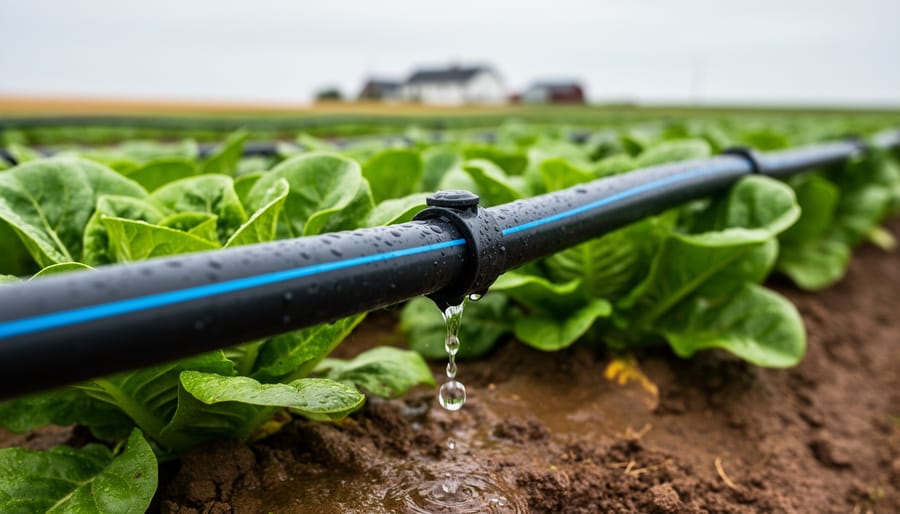
Blockchain is a shared digital record of transactions or data, secured through cryptography and stored across multiple computers, that creates a permanent, transparent trail anyone with permission can verify. For Canadian organic farmers managing water resources in 2026, this technology offers a practical solution to persistent challenges: proving irrigation efficiency to certifiers, documenting water usage during drought restrictions, and building consumer trust in sustainability claims.
Water stewardship has become non-negotiable in organic agriculture. Alberta producers know this reality well after experiencing consecutive years of variable precipitation and intensifying drought conditions across the prairies. When every litre counts and regulatory scrutiny increases, farmers need systems that track water use accurately, verify conservation practices credibly, and demonstrate compliance without mountains of paperwork.
That’s where blockchain enters the conversation. The technology creates tamper-proof records of irrigation events, soil moisture readings, and water source data that certifying bodies, retailers, and consumers can access and trust. Unlike spreadsheets or single-database systems that one party controls and can modify, blockchain distributes identical copies of the record across a network. Change one entry, and the mismatch becomes instantly visible.
This article explains how blockchain functions in agricultural terms, outlines the types of systems Canadian farmers might encounter, and details specific water management applications already operating on farms. You’ll see real implementation considerations for organic operations, from cost structures to integration with existing irrigation controls, backed by conversations with producers and technology providers working in this space today.
What Blockchain Means for Farmers
Think of blockchain as a farm record book that everyone can read but no one can erase or alter. Instead of keeping your water usage logs in a single notebook that could be lost or questioned, blockchain stores that same information across multiple computers in a network. Each entry gets locked in place permanently, creating a shared history that organic certifiers, buyers, and irrigation districts can all verify without taking your word for it.
For organic farmers in Alberta, this matters because your business depends on proving things. You need to show certification bodies that you’re following water restrictions during drought years. You need to demonstrate to premium buyers that your irrigation practices meet sustainability standards. You need records that survive equipment failures, office fires, and the inevitable “where did I put that form?” moments that happen on every farm.
Here’s how the essential blockchain concepts translate to farming operations:
- Ledger
- The complete record of transactions and data entries, similar to your farm’s paper logbook but digital and shared across the network. Every water measurement, irrigation event, and compliance check gets recorded in sequence.
- Node
- A computer or device that stores a copy of the ledger and helps verify new entries. Think of each node as a witness that keeps its own permanent copy of your farm’s records.
- Smart Contract
- Automated rules that execute when conditions are met, like automatically recording irrigation data when soil moisture drops below a threshold or flagging water use that exceeds your allocation.
- Immutability
- Once information enters the blockchain, it cannot be changed or deleted. Your water records from three years ago remain exactly as recorded, which matters when certifiers audit your historical practices.
- Transparency
- Authorized parties can view the recorded data without needing to contact you directly. Certification bodies see the same records you do, eliminating disputes about what actually happened.
The practical impact shows up in certification renewals. Instead of scrambling to compile irrigation logs and water meter readings each year, your blockchain system maintains that evidence continuously. When drought conditions trigger water restrictions, you can prove compliance immediately rather than waiting weeks to gather documentation. For Alberta farmers selling into premium organic markets, this transparent record becomes a competitive advantage that justifies higher prices.
How Blockchain Technology Works in Agricultural Settings
Data Collection and Input
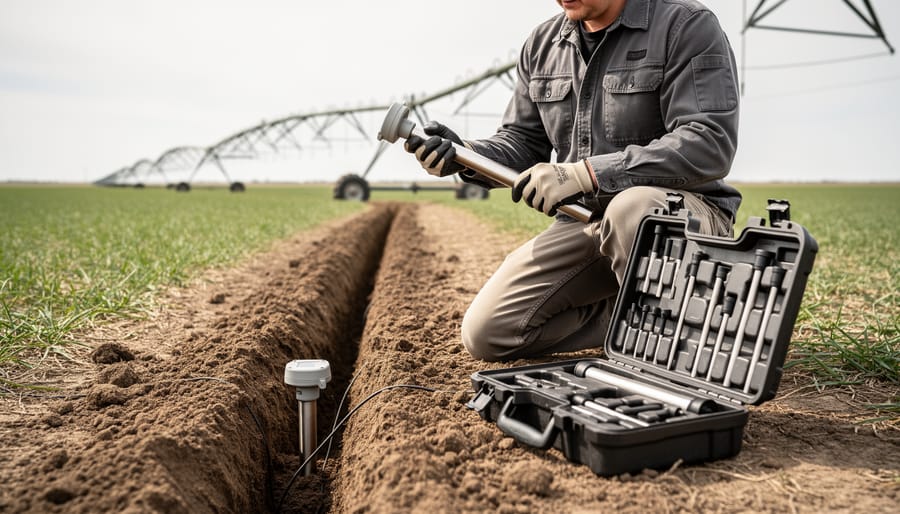
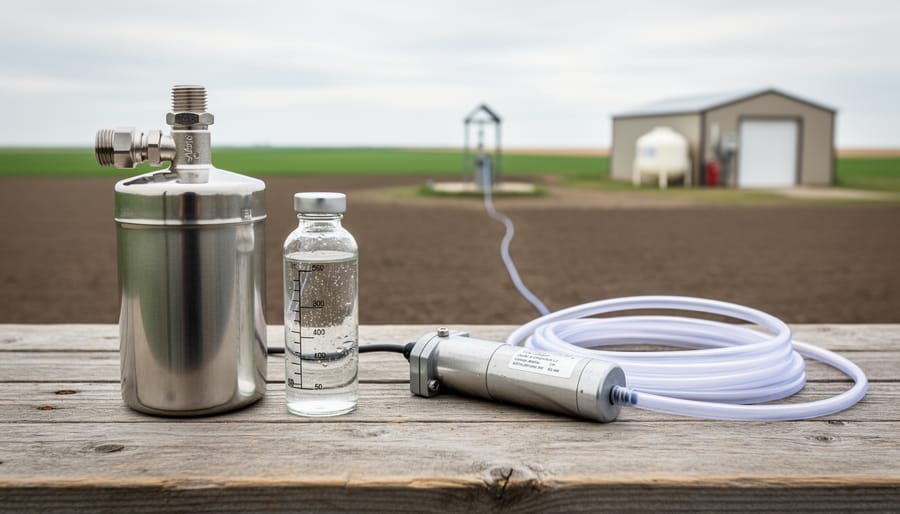
Getting accurate data into a blockchain system starts with measurement, and organic farmers in Alberta have multiple options, from high-tech sensors to simple manual logs. Modern smart irrigation solutions equipped with soil moisture probes, flow meters, and weather stations automatically capture real-time information about water usage, rainfall, and field conditions. These devices connect wirelessly to farm management platforms, feeding precise numbers directly into the blockchain without human intervention.
Not every input needs to be automated. Many organic operations successfully combine digital sensors with manual entries: a farmer might log irrigation events from a smartphone app, record well readings in a tablet-based system, or document hand-watering schedules through a simple web interface. The key is consistency and accuracy at the point of entry. Once recorded, this data becomes the raw material for blockchain’s verification process, creating a permanent trail that tracks every litre of water used on the farm. Even basic setups, pairing a digital water meter with weekly manual uploads, provide enough detail to build meaningful blockchain records for certification and sustainability reporting.
Verification and Recording
Once data from your farm reaches the blockchain network, it goes through a validation step before becoming permanent. In many agricultural blockchain systems designed for small to medium operations, a trusted group of participants, such as your organic certification body, irrigation district representatives, or fellow farmers in your cooperative, review and confirm the accuracy of new entries. This process, sometimes called consensus, ensures that the information matches real conditions. For instance, if your soil moisture sensor reports irrigation timing, validators check that the reading aligns with expected patterns and doesn’t conflict with previous records.
After validation, the data gets bundled into a “block” with a unique digital fingerprint that links it mathematically to all previous blocks. This chaining makes the record tamper-proof: changing one entry would break the entire sequence, immediately revealing the alteration. For your water management records, this means irrigation volumes, timing, and compliance documentation become permanent proof that can satisfy auditors years later. Unlike spreadsheets stored on a single computer, these records exist across multiple locations in the network, protecting them from loss or unauthorized changes. The result is a reliable audit trail that reduces paperwork during certification renewals and builds buyer confidence in your water stewardship claims.
Types of Blockchain Applications in Water Management
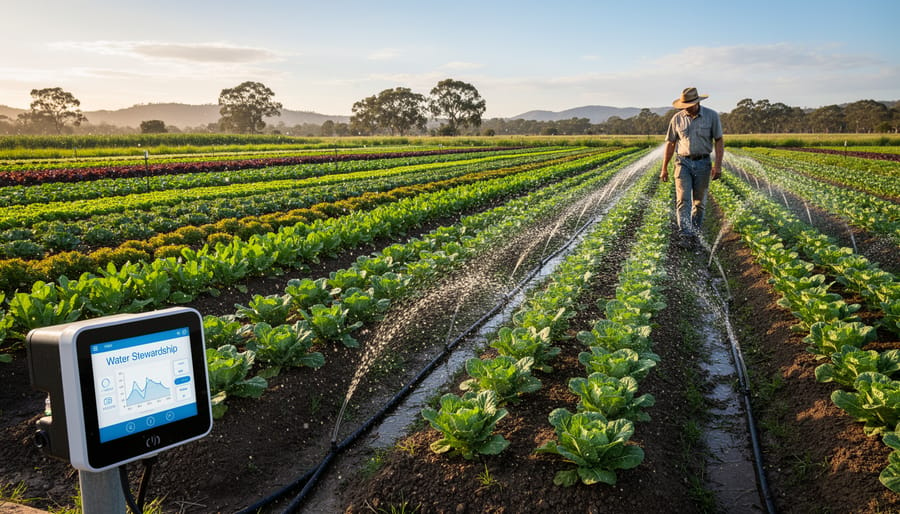
When choosing a blockchain system for water management, organic farmers encounter three main configurations, each with different strengths for agricultural operations.
Private Blockchains for Farm-Level Control
Private blockchains give individual farms or small cooperatives complete control over who accesses their water data. The farm operator determines which certifiers, buyers, or government agencies can view records. This setup works well for farmers tracking irrigation across their own fields, recording well water extraction, or documenting rainwater collection. The system remains secure and transparent for authorized users while keeping proprietary farming practices confidential. Implementation costs stay lower because fewer parties need access.
Permissioned Networks for Regional Cooperation
Permissioned blockchain networks suit irrigation districts and farm cooperatives managing shared water resources. Multiple farms join the network with verified identities, allowing them to record water draws from communal sources, share real-time availability data, and coordinate usage during drought periods. In Alberta’s semi-arid regions, this configuration helps farming communities distribute limited water fairly while maintaining auditable records for provincial authorities. Each participant sees relevant transactions without exposing unrelated farm operations.
IoT-Integrated Platforms Connecting Field Sensors
The most advanced systems link water precision tech directly to blockchain records. Soil moisture sensors, flow meters, and weather stations automatically feed data into the blockchain without manual entry. This real-time integration creates continuous records showing exactly when irrigation occurred, how much water specific crops received, and how soil conditions responded. The automated approach reduces administrative work while producing detailed evidence for organic certification audits. These platforms typically operate on private or permissioned blockchains, combining sensor accuracy with controlled data access.
The right configuration depends on whether a farmer needs individual record-keeping, cooperative resource management, or automated sensor integration.
How Blockchain Is Used for Water Resource Management in Organic Farming
Tracking and Verification for Organic Certification
Organic certification in Alberta requires detailed documentation of water management practices, from source tracking to irrigation timing. Traditional paper records can be lost, altered, or questioned during audits, creating stress and potential compliance gaps. Blockchain creates an immutable record of every water-related decision and action on your farm.
When you log irrigation events, water quality tests, or soil moisture readings into a blockchain system, that data becomes permanently verifiable. Certification bodies can access these records instantly during inspections, seeing exactly when and how much water you applied to each field. The technology timestamps every entry and links it to weather data, crop type, and growth stage, building a complete picture of your water stewardship.
For Alberta’s organic farmers facing increasingly rigorous certification standards, this transparency simplifies renewals. You’re not scrambling to reconstruct months of activity from memory or patchy notebooks. Instead, you present auditors with a comprehensive, tamper-proof record that demonstrates your commitment to responsible water use. Several Canadian certification bodies now accept blockchain records as primary documentation, recognizing their reliability and reducing the paperwork burden on farmers.
Managing Shared Water Resources
In Alberta’s semi-arid regions, where water rights and irrigation access affect multiple farms, blockchain creates a shared record that all parties can trust. When several organic operations draw from the same irrigation district or aquifer, blockchain systems track who uses what volume and when, eliminating disputes over allocation. Each farm inputs its water withdrawal data through meters connected to the blockchain, creating a transparent log that irrigation district managers, neighboring farmers, and regulatory bodies can all verify without needing a central authority to monitor every transaction.
This shared ledger proves especially valuable for coordinating groundwater irrigation among cooperatives, where multiple producers rely on the same wells or dugouts. The blockchain records automatically enforce agreed-upon limits, preventing overuse during drought periods and ensuring fair distribution during peak irrigation season. Alberta farmers using these systems report fewer conflicts over water access and clearer documentation for provincial water license renewals, since the blockchain provides an auditable trail that satisfies regulatory requirements while reducing the administrative burden of manual reporting.
Benefits for Canadian Organic Farmers
For organic producers managing tight margins and complex certification requirements, blockchain-based water management delivers measurable operational advantages. Canadian farmers adopting these systems report significant time savings during certification audits, permanent, tamper-proof records eliminate the need to reconstruct water usage logs from paper files or spreadsheets. Alberta organic grower Michael Chen cut his annual certification documentation time from three weeks to four days after implementing blockchain tracking across his 200-hectare mixed vegetable operation.
The verification advantage extends beyond the farm gate. Buyers increasingly demand proof of sustainable water practices, particularly for export markets and premium retail channels. Blockchain records provide instant, auditable verification that your organic carrots or lentils were grown using certified sustainable water management. Saskatchewan cooperative Organic Prairie Grains secured a 12% premium from European buyers by offering blockchain-verified water stewardship data alongside their organic certification.
Water efficiency improvements translate directly to cost savings and crop resilience. Real-time data flowing into blockchain systems helps farmers identify irrigation inefficiencies, detect leaks quickly, and optimize application timing based on actual soil moisture rather than guesswork. This matters enormously in Alberta’s semi-arid growing regions where every litre counts. Producers using blockchain-integrated soil sensors report 15-22% reductions in water use while maintaining or improving yields.
The administrative burden reduction proves especially valuable for smaller operations. Instead of manually logging meter readings and calculating usage reports for certification bodies, blockchain systems automate data collection and generate compliance reports on demand. This frees up time for actual farming rather than paperwork, while reducing the risk of documentation errors that can delay certification renewals or trigger additional inspections.
Getting Started: Implementation Considerations
Starting with blockchain water management doesn’t mean overhauling your entire operation overnight. Most Canadian organic farmers benefit from taking an incremental approach that matches their budget and technical comfort level.
Cost Structure and Investment
Initial setup costs typically range from $2,000 to $15,000 depending on system complexity and farm size. This includes basic IoT sensors for soil moisture and water flow monitoring, blockchain platform subscription fees, and initial training. Many Alberta farmers reduce upfront expenses by partnering with agricultural technology companies offering pilot programs or joining cooperative initiatives where multiple operations share infrastructure costs.
Technology Requirements
You’ll need reliable internet connectivity, which remains the biggest challenge in rural Alberta. Satellite internet services have improved substantially, though latency can affect real-time data uploads. Some blockchain systems work with intermittent connectivity, storing data locally and syncing when connection resumes. Basic hardware requirements include a tablet or computer for system access and sensors appropriate to your irrigation setup, often less complex than you’d expect.
Integration with Current Systems
Most modern blockchain platforms connect with existing farm management software through APIs. If you’re already using digital tools to track irrigation schedules or soil conditions, transitioning that data to blockchain verification is relatively straightforward. The challenge comes when operations rely heavily on paper records, requiring a transition period to digitize processes.
Collaborative Approaches
Regional farm cooperatives and agricultural extension programs offer the most practical entry point. Several Alberta irrigation districts are exploring shared blockchain systems where member farms collectively track water allocation and usage. This approach spreads costs, provides peer support during implementation, and creates the network effects that make blockchain truly valuable.
Start by identifying one specific water management challenge, perhaps certification documentation or irrigation scheduling, and pilot a blockchain solution for that single aspect. Expand gradually as you build confidence and see tangible benefits in your operation’s efficiency and record accuracy.
Common Questions About Blockchain and Water Management
Organic farmers across Canada frequently have practical questions about implementing blockchain technology for water management. These concerns range from upfront costs to day-to-day usability on working farms.
Is blockchain affordable for small organic farms?
Initial costs vary significantly depending on whether you join a cooperative system or build custom infrastructure, but shared platforms through regional farm associations can reduce individual investment to a few hundred dollars annually. Many pilot programs in Alberta offer subsidized entry points for early adopters.
Does blockchain require constant internet connectivity?
Most agricultural blockchain systems can store data locally and sync when connectivity is available, recognizing that rural internet can be unreliable. Offline data collection through sensors and manual entries gets uploaded during your next connection.
Who owns and controls the water usage data?
In properly designed systems, farmers retain ownership of their operational data and control who can access it. You decide whether to share records with certifiers, buyers, or irrigation districts while keeping sensitive business information private.
Can blockchain integrate with equipment I already use?
Many modern irrigation controllers and soil moisture sensors can connect to blockchain platforms through standard data protocols. Older equipment may require adapter devices, but basic integration is often simpler than farmers expect.
Technical complexity is another common concern. While blockchain sounds intimidating, most agricultural platforms are designed with farmer-friendly interfaces that require minimal training. If you can use farm management software or a smartphone app, you can likely navigate blockchain water tracking systems. The learning curve resembles adopting any new digital tool rather than requiring specialized technical knowledge.
Realistic timelines matter too. Don’t expect immediate transformation. Most farms see measurable benefits in record-keeping efficiency within the first growing season, while financial returns through premium pricing or reduced certification costs typically emerge over two to three years as the technology proves its value to buyers and regulators.
Blockchain technology represents more than just a digital record-keeping upgrade for Canadian organic farmers. It offers a practical pathway toward the transparency, efficiency, and accountability that water stewardship demands in an era of increasing resource pressure. For farmers already committed to sustainable practices, blockchain aligns naturally with organic principles by creating verifiable proof of responsible water use without adding layers of bureaucracy.
The technology’s ability to document every irrigation decision, track moisture levels, and validate conservation efforts creates competitive advantages that extend beyond the farm gate. Buyers increasingly reward verified sustainability, and blockchain provides the evidence they’re seeking. At the same time, these systems help farmers make smarter water management decisions based on reliable data rather than guesswork.
Starting doesn’t require transforming your entire operation overnight. Many Alberta farmers are finding success through cooperative pilots and regional programs that spread costs while building collective expertise. These collaborative approaches mirror the community-focused values that have always strengthened Canadian agriculture.
Water management challenges won’t disappear, but the tools available to address them continue improving. Blockchain gives organic farmers a way to document their stewardship, optimize their resources, and strengthen their market position simultaneously. For operations balancing environmental responsibility with economic viability, that combination makes exploration worthwhile.
The question isn’t whether blockchain will play a role in agriculture’s future, but rather how quickly farmers can adapt it to serve their specific needs. Canadian organic producers who investigate these emerging opportunities position themselves to lead rather than follow.