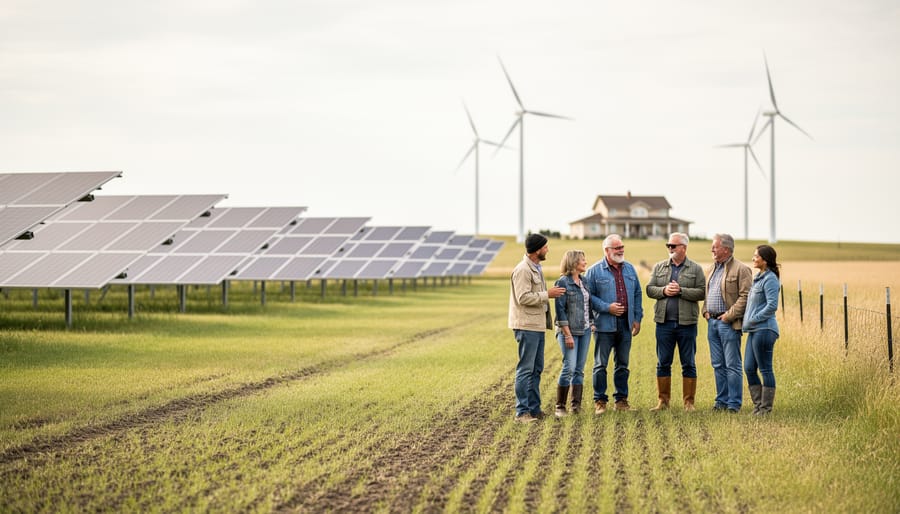
Community renewable energy associations connect farmers and rural landowners with the expertise, financing tools, and peer networks needed to develop solar, wind, or biomass projects on agricultural land. These organizations function as both advocacy bodies and practical service hubs, offering feasibility assessments, grant application support, and shared-ownership models that spread risk across multiple participants. For Alberta farmers evaluating renewable energy in 2026, they provide a direct path from curiosity to operational systems, with member-driven governance that keeps decision-making rooted in local agricultural realities.
The rise of these associations across Canada reflects a shift in farm energy economics. While individual producers once faced steep upfront costs and complex regulatory pathways alone, community models pool capital and technical knowledge. Members gain access to power purchase agreements negotiated at scale, streamlined interconnection processes, and case studies from neighbours who’ve already navigated provincial permitting. One association member in southern Alberta, a fourth-generation grain farmer, reduced his operation’s electricity costs by 60 percent through a shared solar array developed with five adjacent properties, a project structured entirely through member workshops and co-investment.
Beyond cost savings, these groups address the isolation many producers feel when exploring unfamiliar technology. Regular field days, webinars with energy engineers, and direct consultation hours turn abstract concepts into concrete next steps. Whether you’re managing 200 hectares or 2,000, the association model offers a tested framework for integrating renewable energy without sacrificing operational focus.
What Community Renewable Energy Associations Are
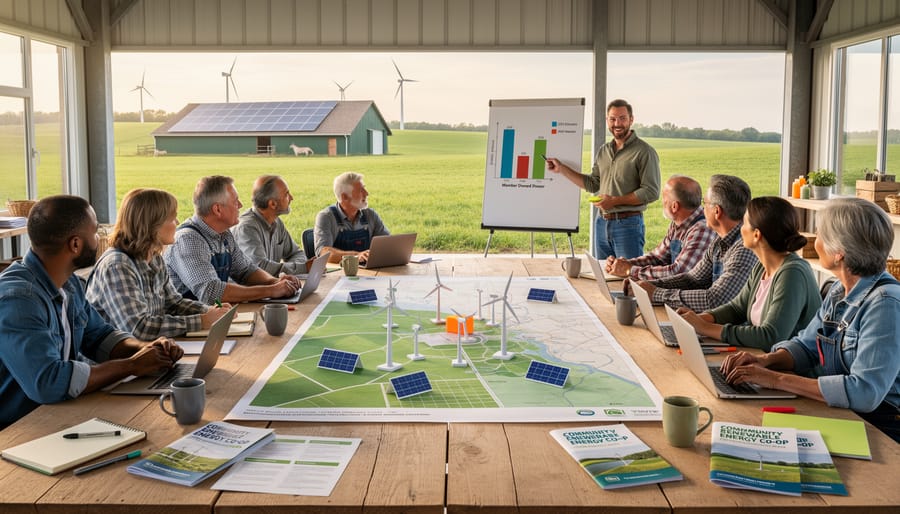
A community renewable energy association is a member-driven organization where local residents, farmers, and businesses collectively develop and own renewable energy projects. Unlike traditional utility companies or private developers who extract profits from communities, these associations operate on a cooperative model where citizens jointly own projects and share both the governance decisions and financial benefits. Members purchase shares in solar arrays, wind turbines, or biomass facilities, then receive returns through dividend payments, reduced energy costs, or credits on their electricity bills.
The shared ownership structure fundamentally changes who controls and benefits from renewable energy development. In a typical private project, an outside company installs equipment on leased land, pays minimal rent to the landowner, and exports all profits. With a community association, members decide together which projects to pursue, where to locate them, and how to distribute returns. For Alberta farmers, this means voting rights on project decisions, transparent financial reporting, and the ability to pool resources with neighbours to afford larger installations that individual operations couldn’t finance alone.
This cooperative approach builds local capacity and keeps energy dollars circulating within rural economies. Members gain technical knowledge through participation, communities develop expertise in renewable energy development, and the association itself becomes a permanent local institution that can launch multiple projects over time. The model works particularly well in agricultural regions where landowners have suitable sites, understand long-term investments, and value collaboration with trusted neighbours over dealing with unfamiliar corporations.
What Community Renewable Energy Associations Do
Collective Energy Projects
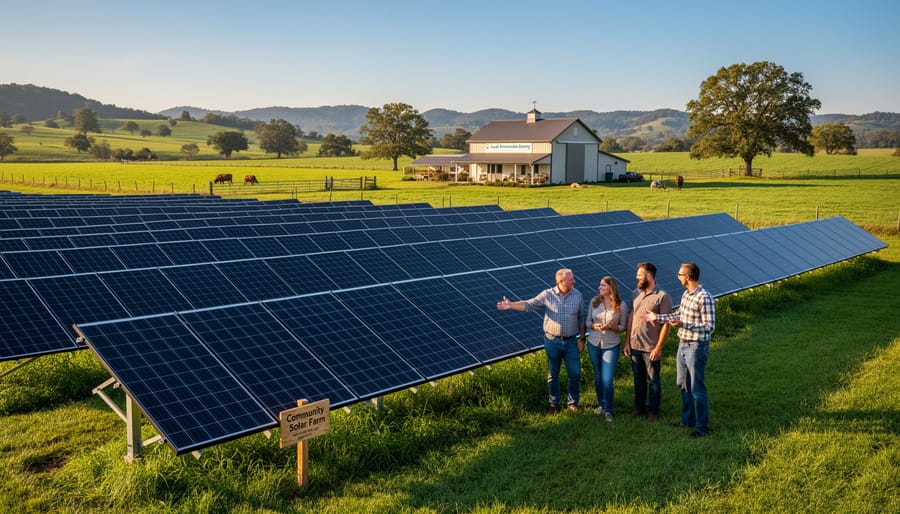
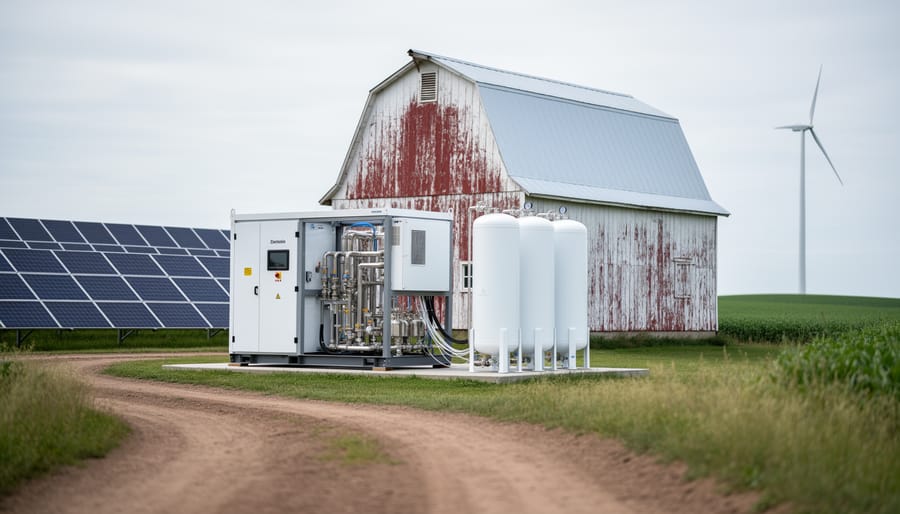
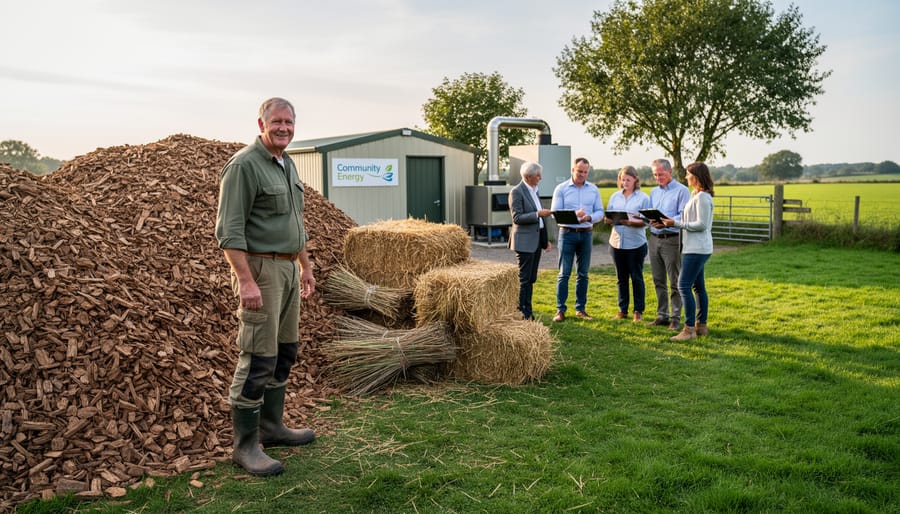
Community renewable energy associations develop three main types of local energy projects that Alberta farmers can invest in or directly benefit from. Solar installations range from ground-mounted arrays on marginal farmland to rooftop systems on barns and equipment sheds, with members purchasing shares that generate returns through electricity credits or revenue-sharing agreements. Wind projects typically involve medium-scale turbines positioned on agricultural land where farmers receive lease payments while continuing to crop around turbine bases. Biomass systems convert agricultural waste like straw, manure, and food processing residues into heat or electricity, creating a dual benefit by solving waste management challenges while producing energy.
These community solar and other renewable projects differ from individual farm installations because the association handles development, permitting, and ongoing maintenance. Members contribute capital proportional to their desired share, reducing individual financial risk. A grain operation might invest in 20 percent of a solar array, receiving energy credits that offset electricity bills for grain dryers and irrigation pumps, while a neighbouring livestock producer invests in the biomass portion that converts bedding waste into heat for barn heating. This shared-ownership model makes larger, more efficient projects financially viable for farmers who couldn’t justify the upfront cost alone.
Education and Technical Support
Community renewable energy associations function as knowledge hubs, demystifying renewable technologies for farmers who may lack expertise in solar arrays, wind turbines, or anaerobic digesters. They organize hands-on workshops where producers learn system sizing, grid connection requirements, and maintenance protocols specific to agricultural operations. Technical staff conduct site assessments and feasibility studies, analyzing your farm’s energy consumption patterns, available renewable resources, and return-on-investment timelines before you commit capital.
Many associations partner with rural electric co-ops and university extension programs to deliver region-specific training on Alberta’s regulatory environment, net metering policies, and agricultural energy incentives. Rather than hiring expensive consultants independently, members access shared expertise at subsidized rates. This collaborative approach means a grain producer in Lethbridge evaluating solar can learn from a dairy operation in Red Deer that’s already generating surplus power, shortening your learning curve and reducing costly missteps during project planning.
Financing and Grant Access
Community renewable energy associations unlock funding opportunities that remain out of reach for individual farmers. They aggregate member applications to strengthen proposals for provincial and federal programs, increasing approval rates while reducing administrative burden. Associations track evolving incentives like the Green Community Program handle complex paperwork, and negotiate bulk equipment pricing that cuts project costs by 15-30%. By pooling member capital, they finance projects too large for single operations, a 2 MW solar array serving twelve farms costs $200,000 per participant instead of $2.4 million individually. Associations also connect members with community bonds, credit unions offering preferential rates for renewable projects, and revolving loan funds that recycle repayments into new installations. This collective approach transforms renewable energy from an expensive aspiration into an achievable investment for Alberta’s agricultural community.
Who Community Renewable Energy Associations Serve
Farmers and Rural Landowners
For crop and livestock producers, community renewable energy associations deliver three core advantages that directly strengthen farm economics. Energy expenses, already a significant line item for grain drying, irrigation pumps, livestock ventilation, and cold storage, drop when farms source power from cooperative solar or wind projects at predictable, below-retail rates locked in over multi-year contracts.
Beyond lower utility bills, many Alberta farmers generate new income streams by leasing marginal land or rooftops to association-backed installations; solar lease payments range from $600 to $1,500 per acre annually in Western Canada, offering steady cash flow from land unsuitable for cropping. Finally, remote operations miles from reliable grid connections gain energy security through microgrid setups or standalone systems developed collectively, reducing downtime during outages and eliminating the need for costly diesel generators.
Rural Communities and Municipalities
Small towns and rural municipalities face unique energy challenges, aging infrastructure, distance from major grids, and limited budgets for upgrades. Community renewable energy associations offer these communities a path toward energy independence while keeping dollars circulating locally. When a municipality invests in a solar array or wind project through an association, energy revenue stays in the region rather than flowing to distant utilities.
For co-operatives and Indigenous communities, these associations align with existing governance models and values of collective ownership. A rural hamlet that partners with a community energy association can stabilize electricity costs, create local jobs during construction and maintenance, and generate revenue that funds other municipal services. Indigenous communities particularly benefit from associations that respect traditional land stewardship while building economic capacity through renewable projects on reserve lands. Several Alberta towns have reduced municipal energy expenses by 30-40% through association-backed solar installations, freeing budget for infrastructure improvements that benefit all residents.
How Alberta Farmers Can Engage with Community Renewable Energy Associations
Finding Associations in Your Region
Locating an active community renewable energy association in your area starts with provincial networks. The Alberta Community and Co-operative Association (ACCA) maintains a directory of co-operatives, including energy-focused groups. Check their online listings or call directly to ask about renewable energy co-ops near your region.
At the national level, Co-operatives and Mutuals Canada offers searchable resources for finding member organizations across the country. Their website includes filters for energy and utility co-ops.
Local Rural Municipalities often know which associations operate in their jurisdictions. Contact your county office or agricultural fieldman, they can point you toward community energy initiatives and may already partner with these groups on rural development projects.
Attend regional farm conferences and sustainability expos where associations typically recruit members and showcase projects. These events provide face-to-face introductions and let you ask detailed questions about participation requirements and current opportunities in your specific farming context.
Membership Options and Investment Levels
Most community renewable energy associations offer tiered membership structures that accommodate different budgets and involvement levels. Understanding these options helps you choose the participation level that fits your farm’s financial situation and time availability.
Share Purchase Models
The most common approach involves purchasing shares or units in a renewable energy project. Entry-level investments typically start between $500 and $2,500, making participation accessible for smaller operations. Larger shares ranging from $5,000 to $50,000 suit farms with more capital to invest. Returns come through energy credits, dividend payments, or reduced electricity rates depending on the project structure.
Some associations offer payment plans spread over two to five years, reducing the upfront barrier. Your investment remains tied to the specific project’s lifespan, usually 20 to 25 years for solar and wind installations.
Participation Levels
Passive members invest capital and receive returns without operational responsibilities. Active members attend annual meetings, vote on project decisions, and help shape association priorities. Board members commit 5 to 15 hours monthly guiding strategy, approving projects, and ensuring financial health.
Choose your level based on available time, expertise, and desired influence over community energy direction.
Starting a New Association
If no suitable association exists in your area, forming one may be the path forward. Start by gathering a core group of interested farmers or community members, typically five to ten committed individuals, who share the vision of community-owned renewable energy.
Your first steps involve defining clear goals (energy self-sufficiency, cost reduction, carbon targets), researching successful models elsewhere, and consulting a lawyer familiar with cooperative or non-profit structures. Most community energy associations incorporate as cooperatives under provincial legislation, which allows member ownership and democratic governance. Alberta’s Cooperatives Act provides the framework.
You’ll need founding documents (articles of incorporation, bylaws), an initial business plan outlining feasibility and financing, and early conversations with energy regulators, utilities, and potential funders. Organizations like the Alberta Community and Co-operative Association offer guidance on cooperative formation. While starting from scratch demands significant time and coordination, it ensures the association addresses your community’s specific energy needs from day one.
Expert Perspective: Community Energy in Practice
When Sarah Chen joined the Battle River Solar Co-op in 2021, her 600-acre grain operation near Camrose was spending $18,000 annually on electricity. Three years later, her farm’s energy costs have dropped by 62%.
“I was skeptical at first,” Chen admits. “Installing solar independently would’ve cost me $85,000 upfront. Through the co-op’s shared purchasing model, we negotiated bulk equipment rates and spread installation costs across twelve member farms. My portion was $28,000, and I qualified for federal grants I didn’t even know existed.”
The co-op provided more than financial leverage. “Their technical advisor walked me through system sizing for my grain dryers and irrigation pumps. He calculated payback periods using my actual hydro bills, not generic estimates. That specificity made the decision straightforward.”
Chen encountered resistance from her accountant, who questioned the cooperative ownership structure. “The co-op’s lawyer explained everything in plain language at no extra charge, that’s a service I couldn’t have afforded hiring independently.”
Her operation now generates 45 kilowatts during peak growing season, enough to run her entire facility with surplus fed back to the grid. “Last month I received a $340 credit on my power bill. My grain dryer runs on sunshine now.”
Beyond economics, Chen values the knowledge network. “When my inverter threw an error code, I texted the group chat. Two farmers responded within an hour with troubleshooting steps. That’s worth more than the energy savings.”
Frequently Asked Questions
What does membership in a community renewable energy association typically cost?
Initial membership fees range from $25 to $500 depending on the association, with share purchases for project investment starting around $1,000. Many associations offer payment plans and tiered membership levels to accommodate different budgets and participation goals.
How much time do farmers need to commit as members?
Passive members can participate with minimal time investment, typically attending an annual general meeting and reviewing quarterly updates. Active involvement on committees or the board requires 5-10 hours monthly, though this varies by association size and project phase.
How long before a renewable energy project starts generating returns?
Most community projects begin producing energy and revenue within 18-36 months of initial planning, though payback periods for member investments typically run 7-12 years. Early participants often see electricity cost savings immediately once the project connects to the grid.
Can I participate if I already have renewable energy on my farm?
Absolutely. Farmers with existing solar arrays or wind turbines often become valuable members, sharing practical experience while benefiting from collective purchasing power for expansions and association-negotiated maintenance contracts.
Beyond these basics, farmers frequently ask whether participation affects existing utility arrangements. Your farm continues receiving power through standard connections; community projects typically feed into the grid with members receiving credits or dividends rather than direct electricity delivery. This structure works alongside your current setup without requiring infrastructure changes at your operation.
Another common concern involves project scale and land requirements. While large solar or wind installations need significant acreage, many associations develop distributed projects across multiple member properties or focus on smaller community-scale systems. You can participate financially without hosting equipment, or you might lease a portion of your land to the association for installation, creating an additional revenue stream.
Compatibility with farm operations rarely poses issues. Associations schedule meetings and site visits around agricultural calendars, understanding that seeding and harvest take priority. The cooperative structure means you control your involvement level, scaling participation up during quieter seasons and stepping back when farm demands peak.
Community renewable energy associations offer Alberta farmers a practical path to lower energy costs, strengthen energy security, and contribute to climate solutions without shouldering the burden alone. By pooling resources, sharing expertise, and developing projects collectively, these member-driven organizations make renewable energy accessible and economically viable for operations of all sizes.
Whether you’re curious about reducing your farm’s energy expenses, exploring hosting opportunities for solar or wind installations, or looking to invest in local renewable projects, connecting with a community energy association is a tangible first step. The cooperative model has proven itself across rural Alberta, turning what seems complex into achievable action through shared knowledge and collective strength.
Reach out to associations in your region, attend an information session, or talk with neighbouring farmers already involved. Your participation helps build resilient rural communities while positioning your operation for long-term sustainability and economic stability in a changing energy landscape.