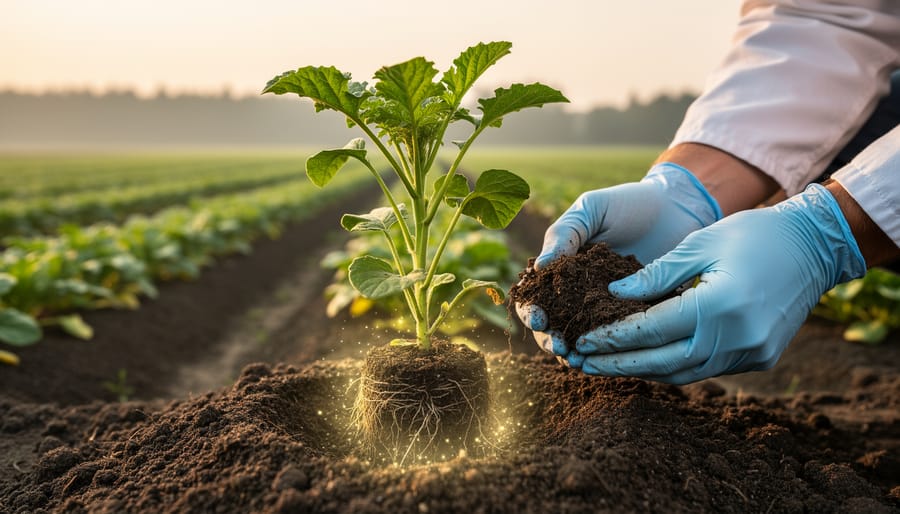
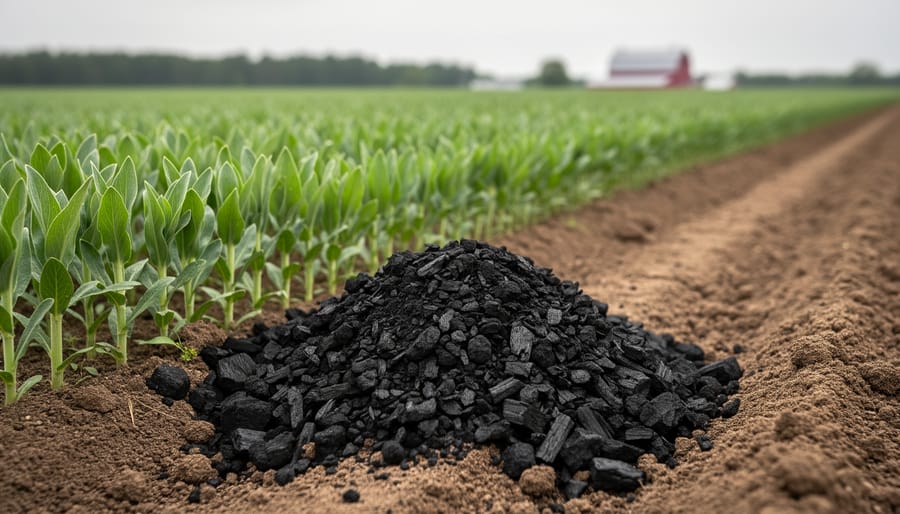
No, biochar is not a fertilizer. It’s a soil amendment that works alongside fertilizers, improving how your soil holds and delivers nutrients to crops rather than providing those nutrients directly.
This distinction matters because understanding what biochar actually does changes how you use it on your farm. While fertilizers supply nitrogen, phosphorus, and potassium that plants consume, biochar creates a stable carbon structure in your soil that acts like a sponge, catching and storing nutrients that would otherwise leach away. The result? Your existing fertilizer programs work more efficiently, and your soil builds long-term fertility instead of requiring constant inputs to maintain productivity.
For Canadian farmers facing rising fertilizer costs and tighter environmental regulations, biochar offers a practical way to improve nutrient use efficiency while building carbon-negative soil. Alberta producers working with everything from clay loams to sandy soils have found biochar particularly valuable for reducing nitrogen losses, increasing water retention during dry stretches, and supporting microbial activity that unlocks nutrients already present in the soil.
This article clarifies exactly how biochar differs from fertilizers, explains the science behind how it improves soil fertility, and provides practical guidance on integrating biochar into your existing nutrient management program. You’ll learn what biochar can and cannot do, how to calculate application rates for different soil types, and what results to expect in your first growing season versus the long-term benefits that develop over time.
What Biochar Actually Is
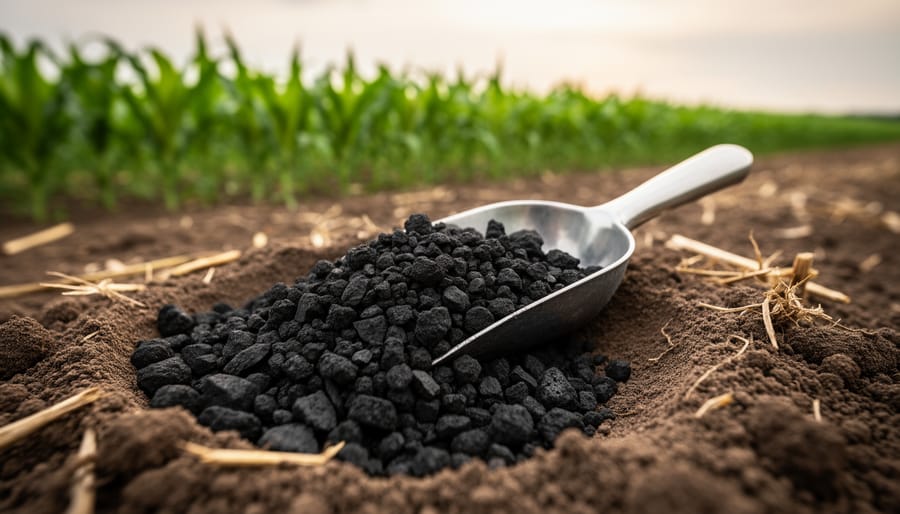
Biochar is a carbon-rich material created by heating organic matter in an oxygen-limited environment. The process, called pyrolysis, transforms agricultural residues, wood waste, or manure into a porous, charcoal-like substance that remains stable in soil for hundreds to thousands of years.
Understanding what biochar actually is requires distinguishing it from materials it resembles but fundamentally differs from:
- Biochar
- A stable carbon biochar material produced through pyrolysis, specifically intended for soil application to improve soil function rather than for fuel or filtration.
- Pyrolysis
- The thermal decomposition of organic material at temperatures between 300°C and 700°C in the absence or near-absence of oxygen, which preserves carbon in a stable form rather than releasing it as CO2.
- Soil Amendment
- A material added to soil to improve its physical properties, structure, or capacity to support plant growth, distinct from fertilizers which provide direct plant nutrition.
- Fertilizer
- A substance that supplies essential nutrients directly to plants, typically nitrogen, phosphorus, and potassium in forms plants can immediately absorb and use.
The key difference between biochar and regular charcoal lies in production intent and structure. While both result from heating organic matter, biochar is produced specifically for agricultural use and optimized for soil benefits. Its porous structure resembles a sponge at the microscopic level, with countless tiny chambers that provide habitat for soil microbes and storage space for water and nutrients.
Biochar also differs sharply from ash, which results from complete combustion. Ash consists mainly of minerals left after organic matter burns away, while biochar retains a carbon structure that gives it stability and function in soil.
This distinction matters for Canadian farmers: biochar is a soil amendment that improves how your soil functions, not a fertilizer that feeds your crops directly. It won’t replace your nitrogen applications or phosphorus programs, but it changes the environment where those nutrients work.
How Biochar Works in Soil
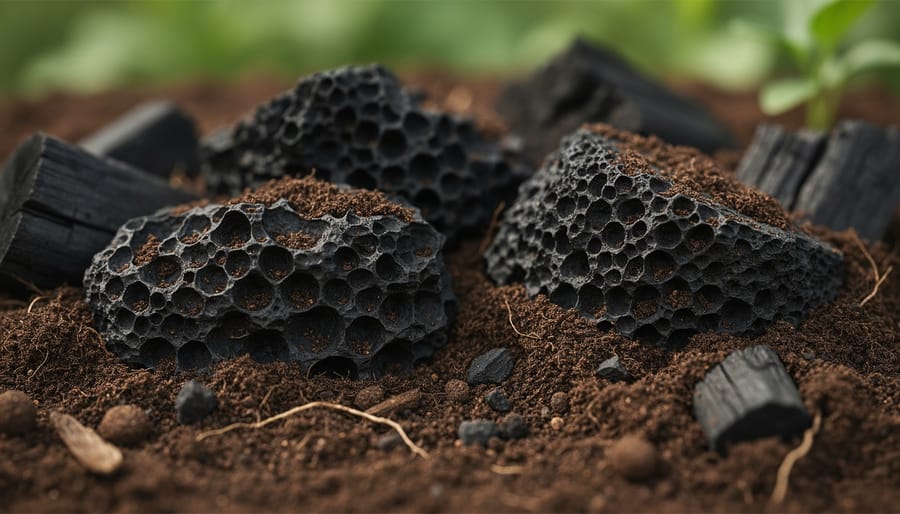
Biochar’s effectiveness in soil comes from its physical structure and chemical properties rather than direct nutrient delivery. When incorporated into your fields, biochar functions as infrastructure that enhances how soil systems operate, creating conditions where plants can access nutrients more efficiently.
The porous nature of biochar is central to its soil benefits. Under magnification, biochar reveals a honeycomb-like structure with countless tiny chambers and channels. These pores, formed during the high-temperature pyrolysis process, create massive surface area, a single gram of biochar can have a surface area exceeding 300 square metres. This vast internal landscape becomes prime real estate for beneficial microbes. Bacteria, fungi, and other microorganisms colonize these protected spaces, establishing thriving communities that drive nutrient cycling and soil biodiversity. The sheltered pores protect microbes from predation and environmental stress, allowing populations to grow and function more effectively than in unmodified soil.
Biochar also increases cation exchange capacity, which determines how well soil holds onto positively-charged nutrients like calcium, magnesium, and potassium. Alberta soils vary widely in natural CEC, but biochar’s negatively-charged surfaces add exchange sites that prevent nutrient leaching, particularly important during spring snowmelt or heavy rainfall events. This means fertilizers you’ve already applied stay in the root zone longer, available when crops need them rather than washing away.
Water retention improves similarly. Those same pores that house microbes also act as tiny reservoirs, absorbing and holding moisture during wet periods and releasing it gradually as soil dries. For farmers dealing with drought stress or managing irrigation, biochar can buffer against moisture fluctuations and extend the time between waterings.
Perhaps most importantly, biochar creates a stable platform for nutrient cycling. Unlike organic matter that decomposes within months or years, biochar persists for decades or centuries. Nutrients absorbed onto biochar surfaces or held within its pores remain accessible to plant roots and microbes, cycling through the soil system rather than disappearing through decomposition or leaching. This stability means biochar’s benefits compound over time, improving soil function season after season without the need for reapplication.
Different Forms and Production Methods
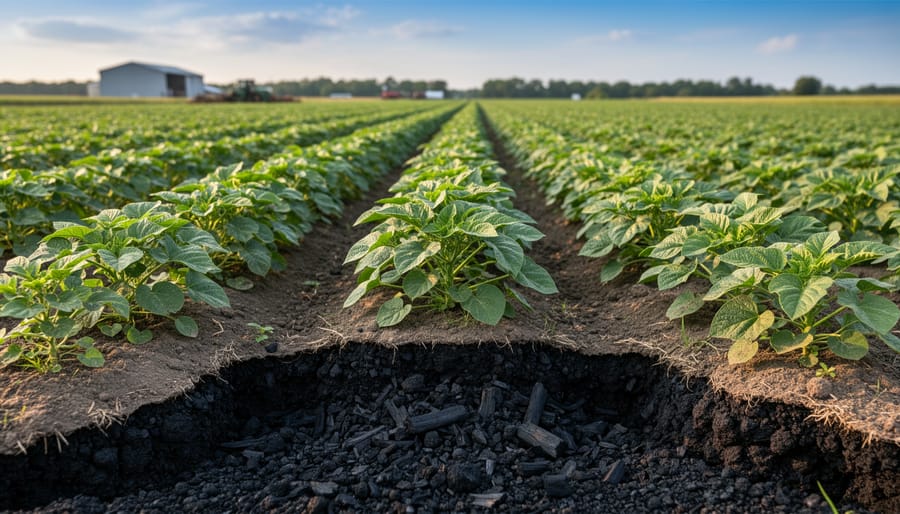
Not all biochar delivers the same results in your fields. The feedstock you start with and how you process it determine whether the finished product suits your soil needs and farming goals.
Feedstock choice matters because different organic materials carry different nutrient profiles and structural properties. Wood-based biochar from forestry waste tends to be high in carbon but low in nitrogen and other nutrients, making it excellent for long-term soil structure improvement but requiring pairing with nitrogen sources. Crop residues like wheat straw or canola stubble, common across Alberta farms, produce biochar with moderate nutrient content and faster decomposition rates. Manure-based biochar captures more phosphorus and potassium while helping stabilize nitrogen that would otherwise volatilize, though it requires careful processing to eliminate pathogens.
Common feedstock sources available to Canadian farmers include:
- Softwood chips and sawdust from lumber operations, producing high-porosity biochar ideal for water retention
- Hardwood residues, creating denser biochar with stronger nutrient-holding capacity
- Cereal crop residues like wheat and barley straw, yielding biochar with moderate ash content and nutrient value
- Oilseed residues such as canola stalks, offering biochar with slightly higher nitrogen retention
- Dairy or beef cattle manure, producing nutrient-rich biochar that benefits from pre-composting before pyrolysis
- Municipal green waste and yard trimmings, providing mixed-composition biochar suitable for general soil improvement
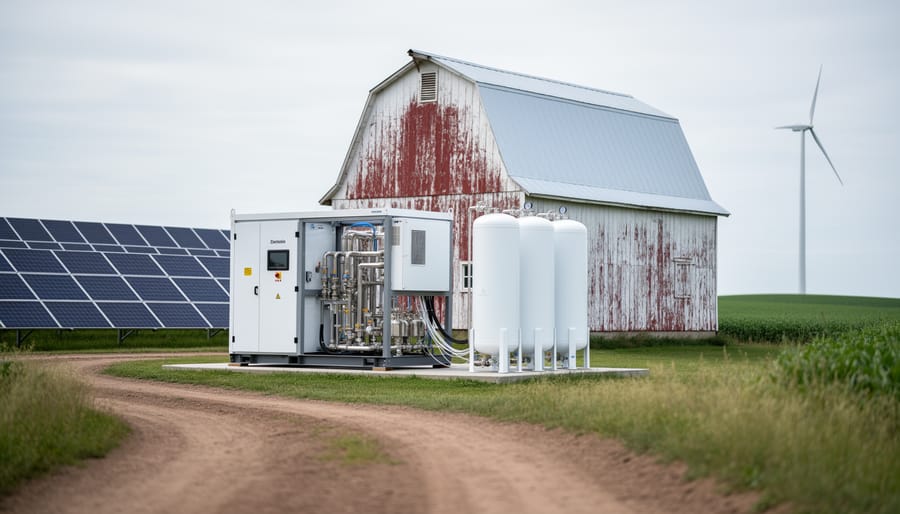
Production temperature during pyrolysis shapes the biochar’s final characteristics. Lower temperatures between 300 and 500 degrees Celsius preserve more volatile compounds and nutrients, creating biochar that interacts more actively with soil microbes but breaks down faster. Higher temperatures above 500 degrees produce more stable, carbon-dense biochar with greater surface area for nutrient adsorption but lower immediate nutrient content. Many Alberta farmers who turn waste into biochar using on-farm systems typically achieve mid-range temperatures that balance stability with practical production constraints.
The right biochar for your operation depends on your soil type, primary crops, and fertility strategy. Sandy soils benefit from any biochar that improves water retention, while heavy clay soils respond better to wood-based biochar that enhances drainage and aeration.
Biochar vs. Fertilizer: Understanding the Difference
Fertilizers and biochar serve fundamentally different purposes on your farm, though they often work best together. Understanding this distinction helps you make informed decisions about soil management and input costs.
Commercial fertilizers deliver nutrients directly to plants in forms they can immediately absorb. When you apply nitrogen, phosphorus, or potassium fertilizers, you’re feeding the crop now. The nutrient content is high and quantifiable, a bag of 46-0-0 urea contains 46% nitrogen that plants can access within days or weeks of application.
Biochar contains minimal plant-available nutrients. While the feedstock source matters, most biochar products deliver less than 2% nitrogen and modest amounts of other nutrients, far below what any commercial fertilizer provides. You can’t replace 100 kilograms of actual nitrogen per hectare with biochar and expect the same crop response.
What biochar does is change how your soil handles nutrients over time. Its porous structure acts like a sponge, capturing nutrients that might otherwise leach away during heavy rains or irrigation. This increased cation exchange capacity means the fertilizer you do apply stays in the root zone longer, giving crops more opportunity to use it. Biochar also creates habitat for beneficial microbes that cycle nutrients from organic matter, gradually improving your soil’s natural fertility.
Think of fertilizer as depositing money in your account and biochar as upgrading your account to reduce transaction fees and earn better interest. One provides the resource; the other improves efficiency.
This is why combining them makes sense. Many Canadian farmers pre-charge biochar by mixing it with compost or using it as a manure amendment before field application. This loads nutrients into biochar’s pore spaces while creating better conditions for long-term nutrient cycling. You still need to provide adequate fertility through fertilizers or organic sources, but biochar helps you get more value from those inputs season after season.
Practical Applications on Canadian Farms
Combining Biochar with Fertilizers and Compost
Biochar performs best when paired with nutrient sources rather than applied alone. Its porous structure acts like a sponge for fertilizers and compost, holding nutrients where plant roots can access them and reducing leaching losses that often occur in sandy soils or during heavy rainfall.
Pre-charging biochar before field application significantly improves its effectiveness. Mix dry biochar with liquid fertilizer, compost tea, or manure slurry and let it sit for 24 to 48 hours. The biochar absorbs nutrients during this time, creating a loaded amendment ready to feed plants gradually. Alberta farmers working with liquid hog manure have found this method particularly effective, reducing the sharp ammonia smell while capturing nitrogen that would otherwise volatilize.
For dry applications, layer biochar into compost piles during construction. The carbon-rich material balances nitrogen-heavy materials like fresh manure, reduces odor, and accelerates decomposition. Once the compost matures, the biochar remains embedded with a full spectrum of nutrients and beneficial microbes.
You can also broadcast biochar and granular fertilizer together during spring fieldwork, incorporating both in a single pass. This approach saves time while ensuring the biochar is positioned to capture mobile nutrients like nitrogen immediately after application.
Application Rates and Methods
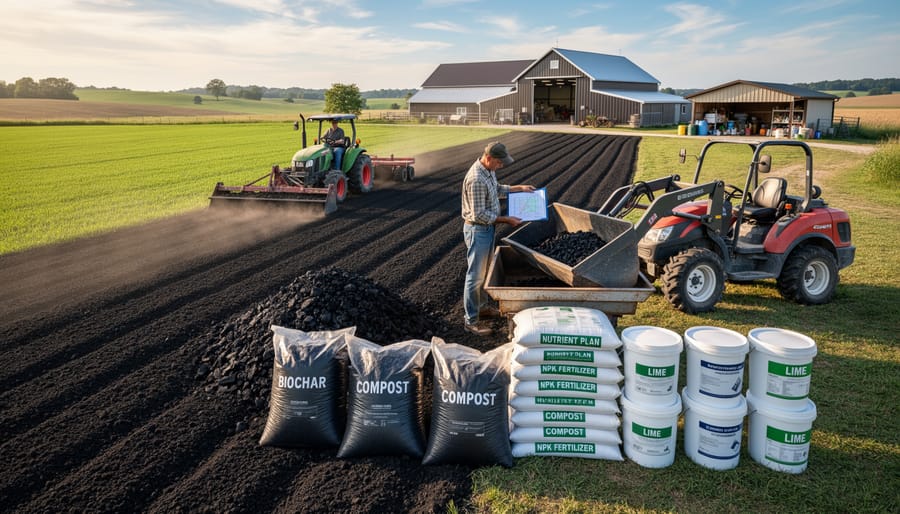
Starting application rates of 2.5 to 5 tonnes per hectare work well for most Alberta field crops, with higher rates of 10 to 20 tonnes per hectare reserved for intensive vegetable production or pasture renovation where long-term benefits justify the investment. Research from Canadian prairie soils shows measurable improvements at even the lower end of this range.
Incorporation depth matters. Work biochar into the top 10 to 15 centimetres of soil where most root activity and microbial life concentrate. Shallow broadcasting without incorporation leaves biochar vulnerable to wind erosion on Alberta’s open fields and limits its contact with soil microbes.
Standard farm equipment handles biochar application effectively. Manure spreaders work for larger particles, while lime spreaders suit finer grades. Many farmers mix biochar with compost or manure before spreading, which improves distribution and reduces dust. A disc harrow or cultivator incorporates biochar adequately during normal tillage operations.
Apply biochar in calm conditions, prairie winds scatter fine particles easily. Spring application before seeding allows time for initial microbial colonization. Split applications across multiple years spread costs while building soil carbon gradually, a practical approach for operations testing biochar’s fit within existing fertility programs.
Benefits Beyond Nutrition
While biochar’s impact on nutrient management gets most of the attention, its environmental benefits make it a powerful tool for climate-resilient farming systems. As Canadian agriculture faces increasing pressure from drought, extreme weather, and carbon reduction goals, biochar delivers multiple advantages that extend well beyond soil fertility.
Carbon Sequestration and Climate Action
Biochar locks carbon into soil for centuries, effectively removing it from the atmospheric carbon cycle. Every tonne of biochar applied stores approximately 3.6 tonnes of CO2-equivalent carbon, creating a measurable climate benefit that farmers can quantify. For Alberta producers working toward sustainability targets, this represents one of the few agricultural practices that actively removes carbon rather than simply reducing emissions. When integrated with other approaches, biochar functions as one of several natural climate solutions transforming how farms address environmental challenges.
Water Management in Drought-Prone Regions
Biochar’s porous structure significantly improves soil water dynamics, particularly valuable during Alberta’s periodic drought cycles. The material can hold up to six times its weight in water, reducing irrigation needs and helping crops withstand dry periods. This water-holding capacity also moderates nutrient leaching during heavy rainfall events, keeping nutrients available in the root zone rather than draining into groundwater.
Additional Environmental Co-Benefits
- Increases water retention capacity by 15-20% in sandy or degraded soils
- Sequesters 2.5-3.5 tonnes of carbon per tonne of biochar applied
- Reduces nitrous oxide emissions from soil by 25-50%
- Decreases methane production in waterlogged or poorly-drained fields
Beyond these measurable benefits, biochar creates lasting improvements to soil structure. Its stable carbon matrix supports aggregation, increasing pore space and root penetration while reducing compaction over time, creating soil conditions that support both productivity and resilience for decades after application.
Common Questions About Biochar and Fertilization
Farmers exploring biochar for the first time often have similar practical concerns. The questions below address the most common uncertainties about integrating biochar into existing fertility programs and what to realistically expect on Canadian farms.
Can biochar replace fertilizer entirely?
No. Biochar contains minimal plant-available nutrients and works by improving how your soil holds and cycles the nutrients you already apply. It enhances fertilizer efficiency rather than substituting for it.
How long does biochar last in soil?
Biochar’s stable carbon structure means it persists for decades to centuries in most agricultural soils. Unlike compost that breaks down within a few years, biochar provides long-term benefits from a single application.
Does biochar work in all soil types?
Biochar typically shows the most dramatic improvements in sandy or degraded soils with low organic matter. Heavy clay soils may see smaller benefits, though drainage and aeration often improve regardless of soil texture.
Will biochar affect my soil pH?
Most biochar has a neutral to alkaline pH, so it can slightly raise pH in acidic soils over time. This effect is generally modest and beneficial for many Alberta soils, but test your specific biochar and monitor soil pH if working with already alkaline conditions.
Regarding yield expectations, approach biochar as a gradual soil builder rather than a quick production boost. Research from Canadian trials shows yield increases often emerge in the second or third year after application as soil biology establishes and nutrient cycling improves. First-year results vary widely depending on your starting soil health, the biochar quality, and how you integrate it with your existing fertility program.
Cost remains a practical consideration. While biochar is a one-time investment with decades-long benefits, upfront expense can be significant. Start with test plots to evaluate performance in your specific conditions before committing to field-scale application. Some Alberta producers reduce costs by co-composting biochar with manure or by sourcing locally-produced material from agricultural waste streams. The economic return depends heavily on your soil’s starting condition and the specific challenges you’re addressing, whether that’s nutrient leaching, water retention, or building carbon stocks for long-term resilience.
Making Biochar Work for Your Operation
For Alberta farmers considering biochar, the first decision is whether to produce it on-farm or purchase from suppliers. Small-scale pyrolysis units are available but require upfront investment in equipment and time to learn safe operation. Many farms start by purchasing biochar from regional producers who process forestry waste or agricultural residues, with costs typically ranging from $400 to $1,200 per tonne depending on quality and transportation distance.
The most practical entry point is a small-scale trial on five to ten hectares rather than committing your entire operation immediately. Choose a field where you can monitor changes against a control area using the same fertility program. This approach lets you evaluate biochar’s performance in your specific soil type and climate conditions without significant financial risk.
Cost-benefit analysis needs a long-term perspective. While initial application costs may exceed $500 per hectare at recommended rates, biochar remains active in soil for decades. The economic return comes gradually through improved water retention during dry periods, reduced fertilizer losses, and enhanced soil structure. Some Alberta farmers report measurable improvements in water-holding capacity within the first growing season, particularly valuable given increasingly variable precipitation patterns.
Integration works best when you blend biochar with compost or manure before field application, allowing nutrients to pre-charge the porous structure. Apply during fall incorporation or spring tillage when you’re already working the soil. Track changes using regular soil tests, focusing on organic matter levels, cation exchange capacity, and baseline nutrient availability.
The University of Alberta and Olds College have conducted biochar research trials you can reference, and regional agronomists familiar with sustainable soil amendments can provide guidance specific to your operation’s needs and goals.
Biochar isn’t a fertilizer, it’s a soil amendment that makes your fertility program work better. While it carries minimal nutrients on its own, its real value lies in improving how your soil holds, cycles, and delivers the nutrients you’re already applying. Think of it as upgrading your soil’s capacity to support plant growth over the long term rather than feeding crops directly.
For Canadian farmers exploring sustainable farming practices, biochar represents a strategic investment in soil resilience. It won’t replace your nitrogen applications or eliminate the need for phosphorus, but it can reduce nutrient losses, improve drought tolerance, and sequester carbon while you grow crops. The benefits compound over years, not weeks.
The best approach? Start small. Test biochar on a field section, monitor how it interacts with your current fertility practices, and track changes in soil structure and water retention. Connect with other farmers who’ve tried it and consult agronomists familiar with Alberta’s soils. Biochar works best when it’s part of a complete soil health strategy, not a standalone solution. Your local agricultural extension services can help you determine if biochar fits your operation’s goals and how to integrate it effectively with your existing practices.