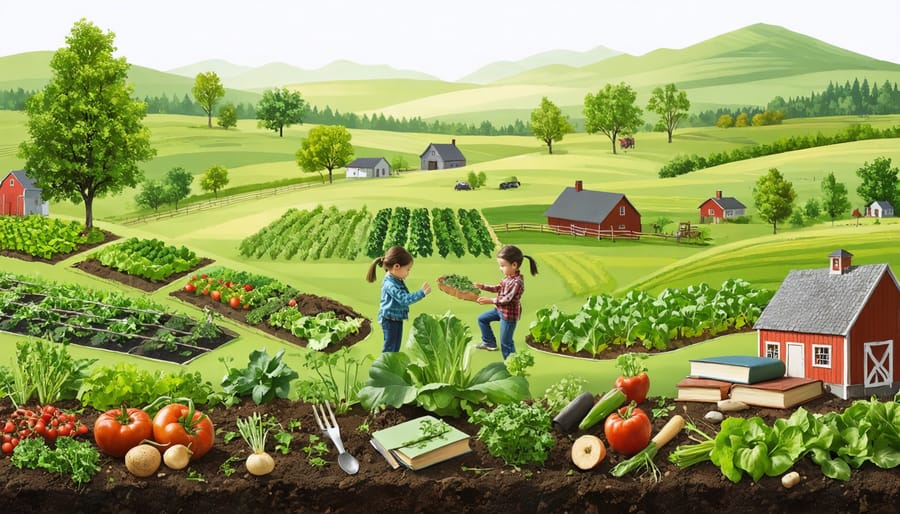
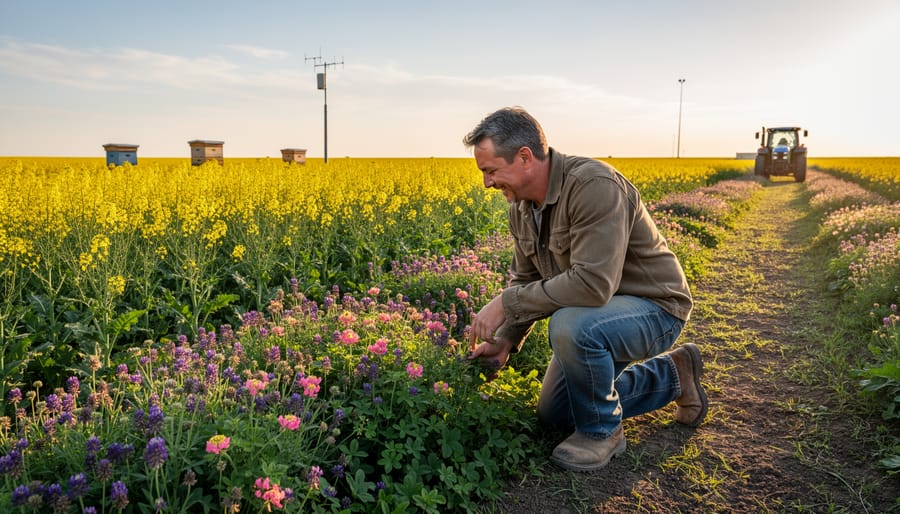
Innovation farms function as living laboratories where Alberta producers can witness biodiversity practices in action before committing resources to implementation on their own land. These specialized operations test regenerative techniques like pollinator strips, multi-species cover crops, and integrated pest management systems under real commercial conditions, measuring impacts on yield, soil health, and farm profitability over multiple growing seasons.
The concept addresses a critical gap in agricultural research: the space between university trials and full-scale farm adoption. While controlled studies provide valuable data, innovation farms demonstrate how biodiversity-enhancing practices perform within actual operational constraints—dealing with variable weather, existing equipment, labour availability, and market pressures that Canadian farmers face daily. This practical testing ground reduces risk for producers considering transitions toward more ecologically resilient systems.
Across Canada, innovation farms are proving that biodiversity enhancement and economic viability can work together. A Saskatchewan operation increased native bee populations by 340% while maintaining canola yields through strategic wildflower plantings. An Ontario vegetable farm reduced chemical inputs by 60% using beneficial insect habitats and companion planting. These documented results matter because they come from working farms, not research plots, making the data directly relevant to commercial agriculture.
For Alberta farmers connected to local food networks, innovation farms offer particular value. They demonstrate how biodiversity practices can differentiate products in direct-marketing channels while building soil resilience against increasing climate variability. The farms provide mentorship opportunities, host field days, and share detailed economic analyses that help neighbouring producers make informed decisions about adopting tested innovations on their own operations.
What Makes an Innovation Farm Different from Traditional Operations
The Living Laboratory Approach
Innovation farms break away from traditional research models by bringing science directly to the field. Instead of conducting experiments in controlled laboratory settings, these farms test new agricultural techniques under real-world conditions, where weather variability, soil diversity, and economic pressures mirror what Canadian producers face daily.
The living laboratory approach thrives on collaboration. Farmers work alongside researchers, agronomists, and extension specialists to design trials that address practical challenges. This partnership ensures that innovations aren’t just scientifically sound but also economically viable and easy to implement. A grain producer in central Alberta, for instance, might partner with university researchers to test companion cropping systems over several growing seasons, monitoring both biodiversity outcomes and yield impacts on their actual production acres.
What makes this approach particularly valuable is the two-way knowledge exchange. Farmers contribute generations of land-specific expertise, while scientists bring technical knowledge and measurement protocols. Together, they evaluate everything from pollinator strip placement to cover crop timing, collecting data that benefits the broader agricultural community.
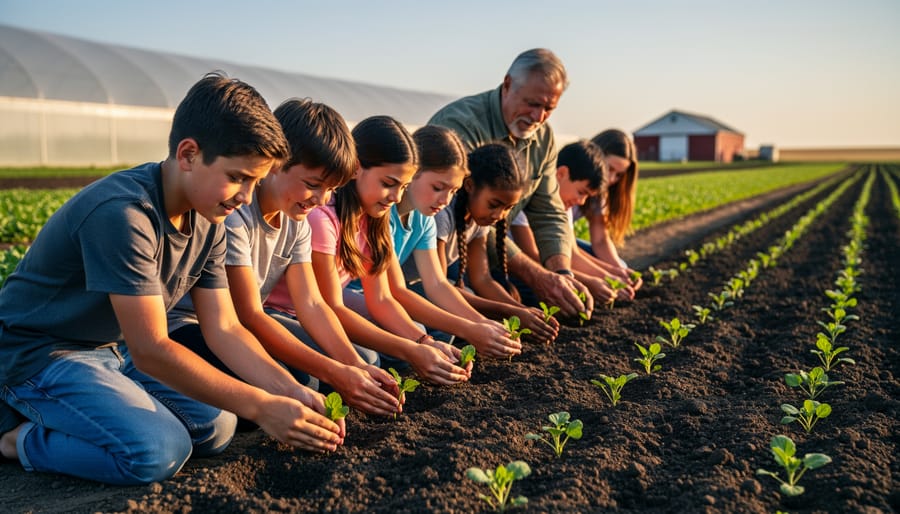
These partnerships also create demonstration opportunities. When neighboring farmers see biodiversity practices succeeding on familiar landscapes rather than distant research stations, adoption becomes more realistic. Field days and farm tours transform abstract concepts into tangible results, showing exactly how increased biodiversity translates to healthier soils, improved pest management, and stronger crop resilience across diverse Alberta growing conditions.
Bridging Research and Practice
Innovation farms serve as essential testing grounds where university research meets real-world farming conditions. These facilities take promising scientific discoveries and evaluate them under practical circumstances, ensuring that new techniques actually work before recommending them to producers. Rather than expecting farmers to experiment with unproven methods on their own operations, innovation farms absorb the risk and refine the approaches until they’re ready for broader adoption.
The translation process involves careful monitoring and adaptation. Researchers work alongside experienced farm managers to identify potential challenges that might not surface in controlled laboratory settings. For example, a biodiversity practice that shows promise in small research plots gets scaled up and tested across different soil types, weather patterns, and management systems typical of commercial operations. This collaborative approach ensures that recommendations consider labour requirements, equipment compatibility, and economic viability.
Alberta’s innovation farms regularly share their findings through field days, online resources, and direct consultation. Farmers can see techniques in action, ask questions specific to their own situations, and access detailed data about inputs, costs, and outcomes. This knowledge transfer extends beyond individual practices to include integrated systems, similar to how CSA farming models demonstrate complete farm-to-consumer approaches. The result is a steady flow of validated, practical innovations that farmers can confidently implement, knowing these methods have been thoroughly tested under conditions matching their own operations.
Farm-to-Table Innovations Being Tested on Canadian Innovation Farms
Polyculture and Companion Planting Systems
Innovation farms across Canada are discovering that growing multiple crops together—rather than in isolation—creates healthier, more resilient growing systems. These polyculture and companion planting trials move away from monoculture approaches by testing crop combinations that work together much like plants do in natural ecosystems.
At Alberta’s research farms, innovative growers are experimenting with strategic plant pairings that provide mutual benefits. For example, planting nitrogen-fixing legumes alongside grain crops reduces fertilizer needs while improving soil structure. Tall sunflowers or corn can provide natural trellising for climbing beans, maximizing vertical growing space on limited acreage.
These diverse plantings also support beneficial insect populations that help control pests naturally. Flowering companion plants like sweet alyssum or yarrow attract predatory insects and pollinators, reducing reliance on chemical interventions. One southern Alberta producer testing intercropping reported a 30 percent reduction in aphid damage after incorporating flowering borders throughout vegetable beds.
Innovation farms document which combinations thrive in Canadian prairie conditions, tracking metrics like yield per hectare, soil organic matter changes, and pest pressure over multiple growing seasons. They’re finding that polyculture systems often show improved drought resilience—critical for Alberta’s variable climate patterns.
The data collected helps farmers understand implementation timing, optimal plant spacing (typically 30-45 centimetres depending on species), and which varieties perform best together. This practical research transforms companion planting from traditional gardening wisdom into evidence-based farming strategy suitable for commercial operations.
Habitat Corridors and On-Farm Wildlife Zones
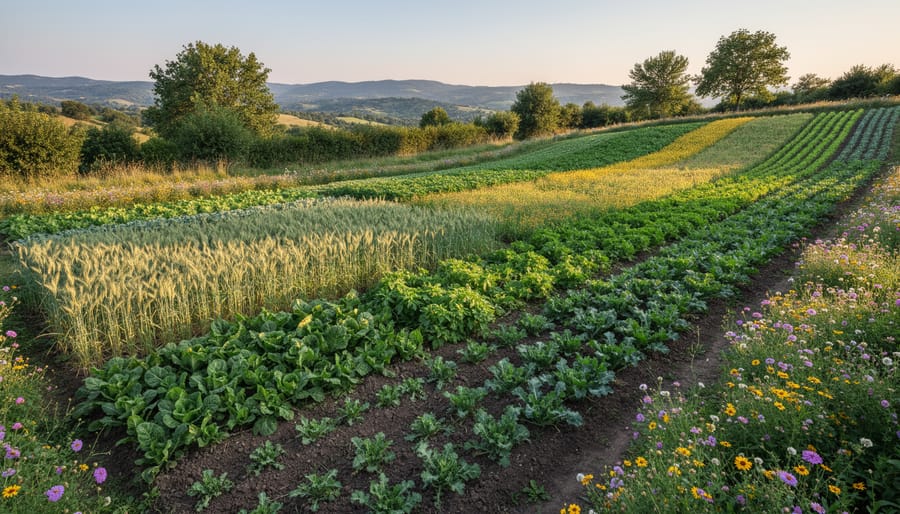
Innovation farms across Canada are testing strategic wildlife habitat integration that works alongside—not against—crop production. These experimental zones demonstrate how farmers can support biodiversity while maintaining or even improving their bottom line.
Hedgerows planted along field edges serve multiple purposes on these testing grounds. They provide shelter for beneficial insects and birds that naturally control pest populations, reducing the need for chemical interventions. At the Olds College Smart Farm in Alberta, mixed native shrub hedgerows have shown a 30% increase in natural predator insects within adjacent crop fields, translating to measurable pest reduction.
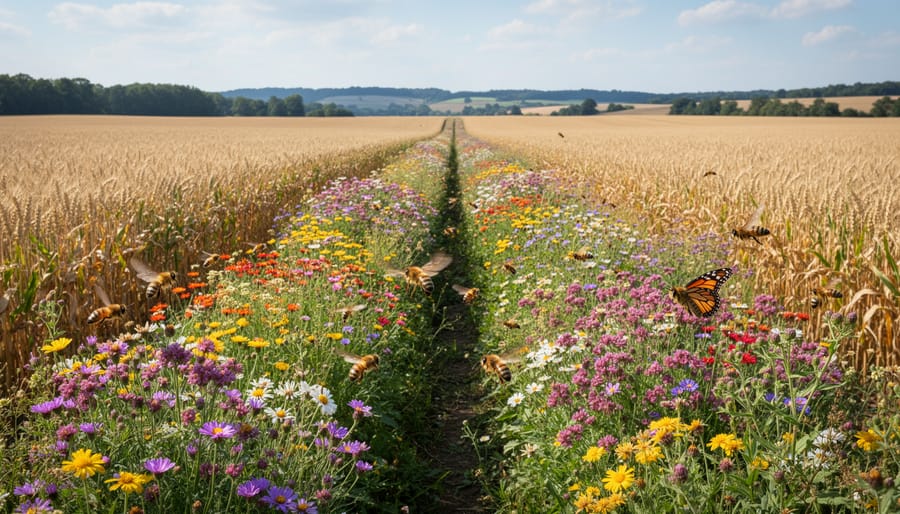
Pollinator strips are proving particularly valuable in canola and pulse crop operations. These deliberate bands of wildflowers and native plants, typically 3 to 5 metres wide, run through or alongside productive fields. Research from innovation farms indicates these strips boost pollinator activity, which can increase canola yields by up to 20% in some conditions. The key is selecting plant species that bloom throughout the growing season, ensuring consistent pollinator support.
Wetland buffers represent another practical innovation being refined. By maintaining 10 to 15 metre vegetated zones around existing wetlands and drainage areas, farms create natural filtration systems that improve water quality while providing critical habitat for waterfowl and amphibians. These buffers also reduce soil erosion and nutrient runoff.
The data emerging from these experimental zones suggests that dedicating 5-10% of farmland to wildlife habitat can enhance overall farm resilience without compromising profitability, offering Alberta farmers a proven pathway toward sustainable intensification.
Livestock Integration for Ecosystem Services
Innovation farms across Alberta are testing livestock integration models that transform animals from simple production units into ecosystem managers. Through rotational grazing trials, cattle and sheep move systematically across paddocks, allowing pastures 30-60 days of recovery between grazing events. This approach builds soil organic matter by 0.5-2% annually while stimulating root growth and carbon sequestration.
At Clearwater Farm near Red Deer, producers are experimenting with mob grazing techniques where high-density herds spend just 12-24 hours on a paddock before moving on. “We’re seeing earthworm populations triple and perennial diversity increase by 40%,” explains farm manager Sarah Chen. The intensive but brief grazing mimics natural bison movement patterns that historically maintained prairie ecosystems.
Animal-crop integration models are proving equally valuable for pest management and nutrient cycling. Chicken tractors following cattle rotations reduce fly populations by up to 70% while distributing manure and controlling parasites. Sheep integrated into orchard systems manage undergrowth and contribute nitrogen without chemical inputs.
These integrated systems create financial resilience through diversified income streams. Farms combining livestock with crop production can market premium grass-fed products alongside regeneratively grown grains. The approach complements other sustainability innovations like sustainable packaging solutions that add value throughout the supply chain.
Starting small with 2-5 hectares allows farmers to refine grazing timing and stocking density before scaling up, reducing risk while building practical knowledge.
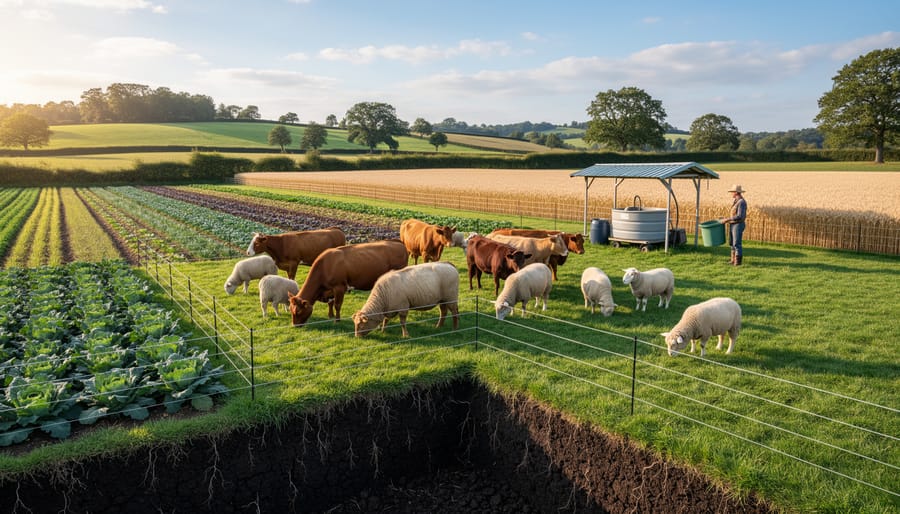
Alberta Innovation Farm Case Study: Real Results from the Field
When Mike and Sarah Thompson took over their 400-hectare mixed grain and cattle operation near Lacombe in 2018, they faced a decision that many Alberta farmers know well: stick with conventional practices or try something different. They chose innovation, and the results have been transformative.
The Thompsons partnered with the University of Alberta’s Agricultural Research Station to establish what they call their “learning lab” approach. They dedicated 80 hectares to testing biodiversity-friendly practices while maintaining their conventional operations on the remaining land. This side-by-side comparison gave them real data they could trust.
Their first major change involved establishing pollinator corridors along field edges and between crop sections. They planted native wildflower strips featuring purple prairie clover, gaillardia, and wild bergamot. Within two growing seasons, they documented a 340 percent increase in native bee populations and a 280 percent increase in beneficial predatory insects. Sarah notes that these numbers came from monthly monitoring sessions with local entomologists, making the data reliable and scientifically sound.
The economic impacts surprised them most. Their canola yields in fields adjacent to pollinator strips increased by 18 percent compared to conventional fields, translating to approximately $14,000 additional revenue per year. The strips themselves cost roughly $3,200 to establish and require minimal maintenance. Mike explains that the math simply works: “We’re seeing better pollination, fewer pest problems, and the strips act as natural windbreaks reducing soil erosion.”
They also integrated rotational grazing with extended rest periods, allowing native plant species to recover between cattle movements. This practice increased plant diversity in their pastures from 12 species to 37 species within three years. Soil organic matter improved by 1.2 percent, and water infiltration rates doubled, helping during Alberta’s unpredictable rainfall patterns.
The learning curve had challenges. Their first pollinator strip planting failed due to timing issues, teaching them that fall seeding worked better for their location than spring planting. They also learned that patience matters; meaningful biodiversity changes took 18 to 24 months to become evident.
For farmers considering similar changes, the Thompsons emphasize starting small. They recommend dedicating just 5 to 10 percent of land initially to test practices. They also stress the importance of connecting with research institutions and extension services. The support they received from agronomists and ecologists made troubleshooting easier and kept them motivated during the transition period.
Their success has inspired four neighbouring operations to start their own innovation projects, creating an informal network of farmers sharing observations and solutions. This community approach, Mike says, makes the journey less isolating and more rewarding for everyone involved.
How Innovation Farms Measure Biodiversity Enhancement
Soil Health Indicators
Innovation farms across Alberta are taking soil health monitoring to new levels by tracking key biodiversity indicators that reveal what’s happening beneath the surface. These measurements go beyond basic soil tests to paint a complete picture of soil vitality.
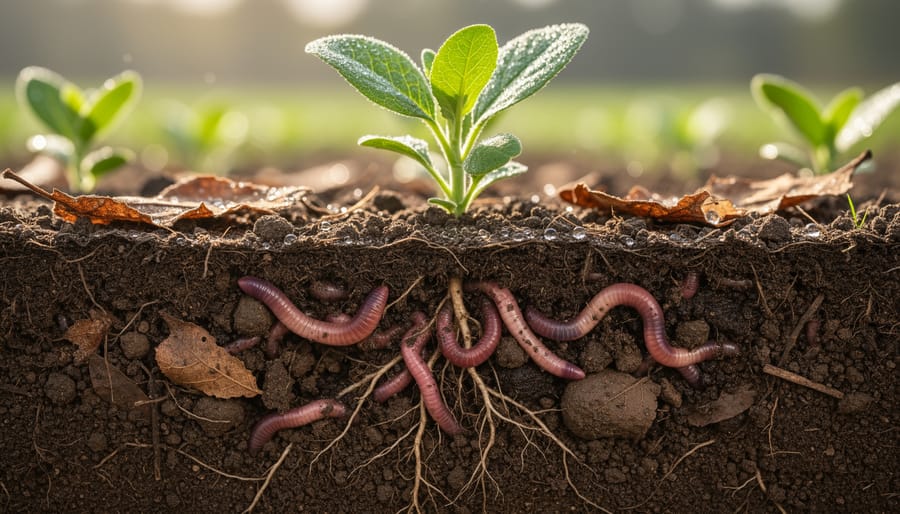
Microbial activity serves as a primary indicator, measured through respiration tests that track carbon dioxide production. Healthy soils typically show 400-800 milligrams of CO2 per kilogram of soil per day, indicating active decomposition and nutrient cycling. Some Alberta innovation farms use commercial test kits that provide results within 24 hours, making this metric accessible for regular monitoring.
Earthworm populations offer another reliable gauge. Farmers count earthworms in designated soil samples, with healthy agricultural soils supporting 5-10 earthworms per shovel of soil (roughly 2 litres). These counts are typically conducted in spring and fall when conditions are moist.
Organic matter content remains fundamental, with innovation farms targeting 4-6% in prairie soils. Regular testing through accredited labs helps track improvements over time, with many farms seeing increases of 0.5-1% over five-year periods through cover cropping and reduced tillage.
Saskatchewan farmer Dale Leftwich reports his innovation farm monitors all three indicators quarterly, noting that earthworm counts doubled within three years of implementing diverse crop rotations. These metrics provide concrete evidence that sustainable practices are working.
Above-Ground Biodiversity Tracking
Innovation farms across Alberta are pioneering practical methods to track wildlife that farmers can adapt to their own operations. These monitoring techniques help assess whether biodiversity initiatives are truly working.
Pollinator counts offer one of the most accessible starting points. Simple timed observations during peak flowering periods—counting bees, butterflies, and other pollinators visiting crops over 15-minute intervals—provide baseline data that improves year over year. Some farms establish designated monitoring transects, walking the same 100-meter route weekly to record pollinator activity.
For beneficial insects, sticky traps and visual surveys identify predator populations like ladybugs and ground beetles that control pests naturally. Alberta farmers participating in innovation trials are testing smartphone apps that use image recognition to identify beneficial species, making documentation easier than ever.
Bird monitoring proves equally valuable. Installing nesting boxes with counters tracks cavity-nesting species, while seasonal point counts—recording all birds seen or heard from fixed locations—reveal population trends. Dr. Sarah Mitchell from the University of Alberta notes that farms integrating diverse habitat features typically see 40-60% higher bird diversity within three growing seasons.
These straightforward tracking methods don’t require specialized expertise, just consistency. The data gathered demonstrates ecosystem health improvements to inform adaptive management decisions moving forward.
Expert Insights: What Researchers Are Learning
Dr. Sarah Chen, an agronomist with the University of Alberta’s Applied Research Division, has spent the past three years studying innovation farms across the province. “What we’re discovering is that biodiversity enhancement doesn’t have to be an all-or-nothing approach,” she explains. “Farmers who integrate even small pollinator strips—just 3 to 5 metres wide—along field edges are seeing measurable improvements in crop pollination rates, sometimes up to 25% in canola yields.”
Her observations align with findings from Tom Schneider, a fourth-generation farmer near Red Deer who transformed 40 hectares of his operation into a biodiversity innovation site. “We started with companion planting trials, mixing flowering species like phacelia and buckwheat between crop rows,” Tom shares. “Not only did we see increased beneficial insect populations, but soil health indicators improved within two growing seasons. Our organic matter increased by 1.2%, which directly impacts water retention.”
Dr. Michael Okonkwo, an ecologist working with several Alberta innovation farms, emphasizes the importance of region-specific approaches. “What works in southern Alberta won’t necessarily translate to northern conditions. We’re learning that biodiversity strategies need to match your local ecosystem,” he notes. His research team has documented over 150 native plant species that can be integrated into farming operations without compromising productivity.
The practical recommendations emerging from these projects are surprisingly accessible. Jennifer Morrison, an agricultural extension specialist, suggests starting small. “Begin with one field corner or a single hedgerow. Monitor what thrives naturally, then expand gradually. Most farmers we work with see positive results within 18 months.”
These experts also highlight the value of knowledge sharing through farm education programs, which connect experienced innovation farm operators with those just beginning their biodiversity journey.
The consensus among researchers is clear: innovation farms provide real-world laboratories where scientific theory meets practical application. As Dr. Chen concludes, “These aren’t experimental fantasies. They’re working farms proving that biodiversity and profitability can coexist when approached thoughtfully and systematically.”
Adapting Innovation Farm Practices to Your Operation
Starting with Low-Risk Experiments
Starting small is the key to successful biodiversity integration. Rather than overhauling your entire operation, consider dedicating 2-5% of your land as a testing ground for new practices. This approach minimizes financial risk while providing valuable real-world data specific to your farm’s conditions.
One accessible entry point is establishing pollinator strips along field margins. These 3-5 metre wide strips of native wildflowers require minimal investment and can be planted in areas that are challenging to cultivate anyway. Alberta farmers have reported noticeable improvements in canola and pulse crop yields within the first growing season after introducing these habitat corridors.
Another low-risk experiment involves adjusting mowing schedules in non-productive areas. By delaying cutting until late summer, you allow native plants to complete their lifecycle, supporting ground-nesting birds and beneficial insects. This practice costs nothing to implement and provides immediate biodiversity benefits.
Cover cropping on a single field section offers another practical starting point. Choose hardy species like winter rye or hairy vetch that build soil health while attracting beneficial organisms. Monitor soil organic matter, earthworm populations, and crop performance in subsequent seasons compared to conventionally managed fields.
The beauty of these experiments is their flexibility. If results don’t meet expectations, you can adjust without significant consequences. However, most farmers discover that even modest biodiversity enhancements deliver measurable benefits, building confidence to expand these practices across larger acreages over time.
Accessing Support and Funding
Canadian farmers exploring biodiversity-focused innovations have access to several funding opportunities and support programs. The Canadian Agricultural Partnership (CAP) offers cost-share funding through provincial programs like Alberta’s Results Driven Agriculture Research (RDAR), which supports on-farm research and innovation projects focused on environmental sustainability.
The federal Agricultural Climate Solutions initiative provides grants specifically for practices that enhance carbon sequestration and biodiversity, including cover cropping, hedgerow establishment, and wetland restoration. Projects can receive up to 70% cost-sharing for eligible activities, making significant habitat improvements financially accessible.
For farmers interested in connecting biodiversity initiatives with market opportunities, exploring direct sales strategies can help monetize conservation efforts through premium products that appeal to environmentally conscious consumers.
Technical assistance is available through organizations like the Organic Agriculture Centre of Canada and regional agrologists who provide free or low-cost consultations on implementing biodiversity practices. Many provincial agriculture departments also offer Environmental Farm Plans, which include cost-share funding for beneficial management practices.
The Growing Forward programs support knowledge transfer through demonstration farms and peer learning networks, allowing farmers to visit innovation farms and participate in field days showcasing practical applications. Additionally, conservation organizations sometimes partner with farmers through stewardship programs that provide financial incentives for protecting wildlife habitat while maintaining productive agricultural land.
Farmers should contact their regional agricultural fieldperson to identify programs specific to their operation’s needs and location.
Innovation farms represent more than just test plots or research stations. They’re living laboratories where Canadian farmers can witness firsthand how biodiversity-friendly practices translate into real-world economic benefits. The innovations being developed and tested at these facilities aren’t theoretical concepts confined to academic papers—they’re practical solutions designed to work within the realities of Canadian agriculture, from our short growing seasons to our diverse regional conditions.
For Alberta farmers looking to enhance both productivity and environmental stewardship, innovation farms offer a clear pathway forward. The practices being refined at these sites—whether integrating native pollinators into crop rotations, establishing wildlife corridors that double as windbreaks, or implementing precision biodiversity monitoring—have been tested under conditions similar to what you face on your own operation. This means less guesswork and more confidence when adopting new approaches.
The journey toward economically viable, biodiversity-friendly farming isn’t one you need to take alone. Innovation farms thrive on community participation and knowledge sharing. By visiting demonstration sites, attending field days, or even collaborating on research trials, you become part of a network committed to building agricultural resilience for the long term. Your experience and insights matter—they help researchers understand what works in real farm settings and what needs refinement.
As stewards of the land, Canadian farmers are uniquely positioned to shape the future of sustainable agriculture. The innovations being tested today will define how we farm tomorrow. By engaging with innovation farms and bringing tested practices back to your operation, you’re not just improving your own farm’s sustainability—you’re contributing to a collective effort that benefits our entire agricultural community and the ecosystems that support it.