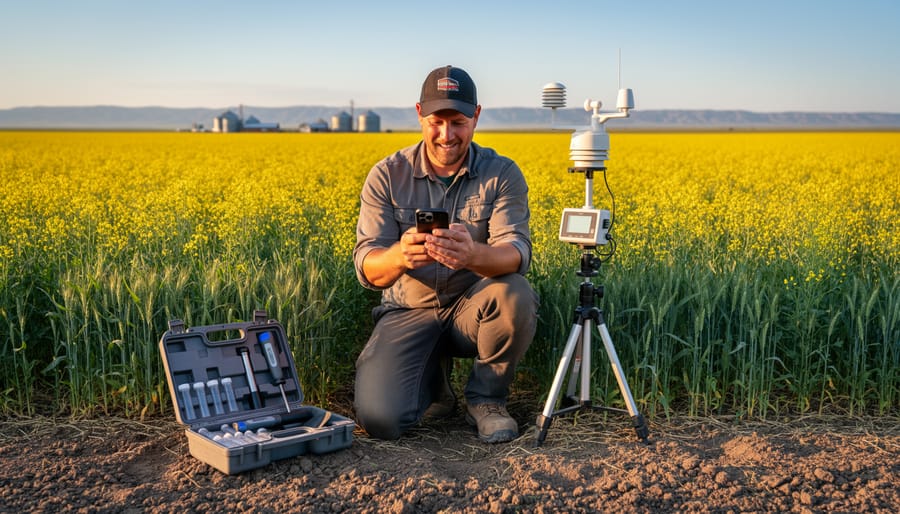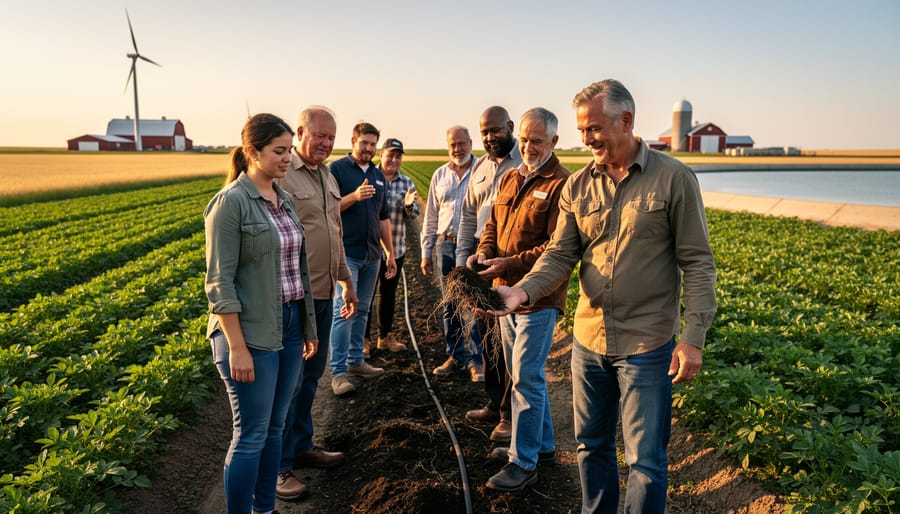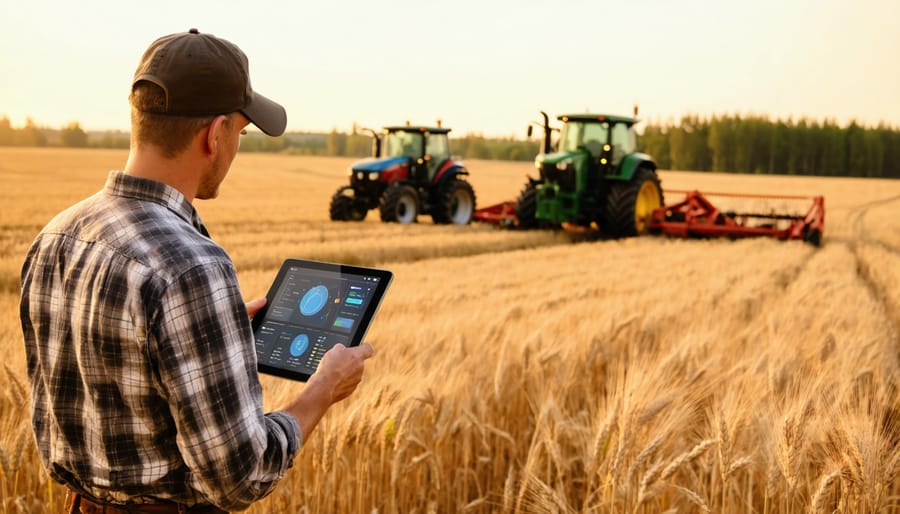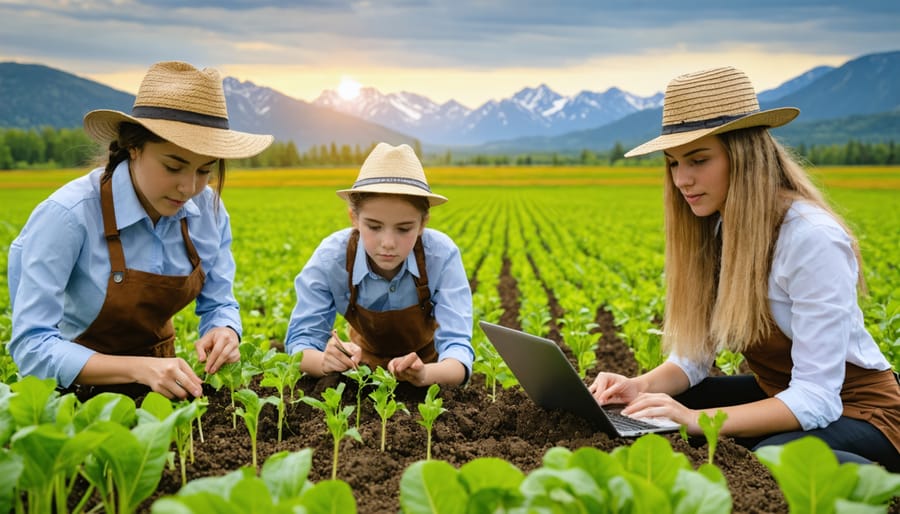
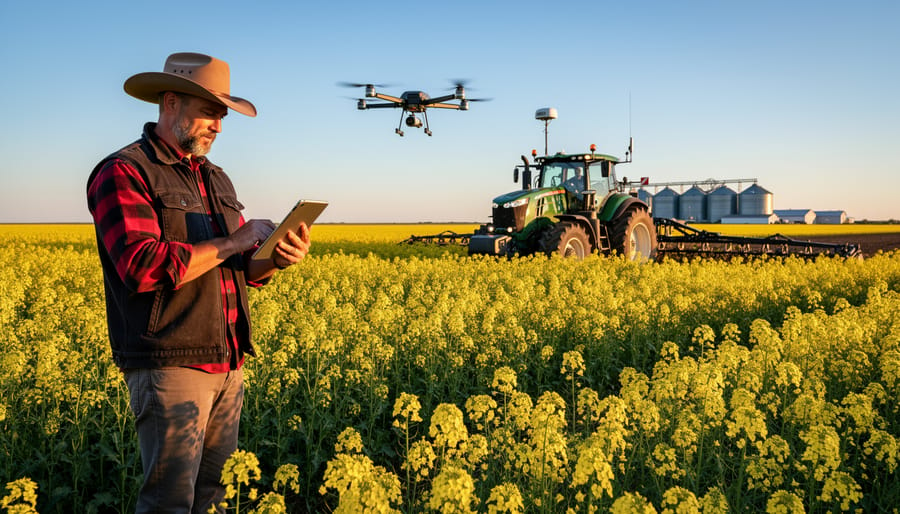
Artificial intelligence is reshaping how Canadian farmers plant, monitor, and harvest their crops. From automated weed detection systems that reduce herbicide use by up to 90% to predictive models that forecast disease outbreaks weeks in advance, AI tools are moving beyond experimental phases into everyday farm operations across Alberta and beyond.
The technology isn’t just for large commercial operations anymore. Mid-sized family farms are now accessing affordable AI-powered solutions through smartphone apps and cloud-based platforms. A canola producer near Red Deer recently cut input costs by 23% using satellite imagery combined with machine learning algorithms that identify exactly which field sections need fertilizer. Another cattle rancher in southern Alberta uses AI-driven cameras to monitor herd health, catching respiratory issues days earlier than traditional visual inspections allowed.
The Canadian agriculture sector faces unique challenges that make AI particularly valuable. Our short growing seasons demand precision timing. Variable weather patterns require quick adaptation. Labour shortages continue to strain operations during critical periods. AI addresses these pain points by processing massive amounts of data faster than any human could, then translating that information into clear recommendations.
But this isn’t about replacing farmers with robots. The most successful implementations treat AI as a decision-support tool, not a replacement for experience and judgment. A grain farmer in Saskatchewan described it perfectly: “The AI system tells me what’s happening in my fields right now. I decide what to do about it based on 30 years of farming this land.”
This article explores practical AI applications already working on Canadian farms, real cost-benefit analyses from producers who’ve made the investment, and straightforward steps for evaluating whether these tools fit your operation.
What AI-Powered Personalized Learning Means for Canadian Farmers
AI-powered personalized learning in agriculture represents a fundamental shift from one-size-fits-all training methods to systems that adapt specifically to your farm’s unique conditions, challenges, and goals. Unlike traditional agricultural education that typically delivers the same information to everyone, these intelligent systems analyze data from your operation and suggest learning content tailored to your soil types, crops, climate zone, and experience level.
Think of it this way: two wheat farmers in central Alberta might face completely different challenges. One farms sandy loam soils near Lacombe, while another manages heavy clay 100 kilometres north. An AI-powered learning platform recognizes these differences and automatically adjusts recommended courses, tutorials, and resources to match each operation’s specific needs.
Traditional agricultural education has long relied on winter workshops, extension bulletins, and seasonal field days. While valuable, these approaches deliver generalized information that farmers must then filter for relevance. AI agriculture systems flip this model. They learn from the questions you ask, the topics you explore, and the digital agronomy tools you’re already using to create a customized learning journey.
- Machine Learning
- The process by which AI systems improve their recommendations over time by analyzing patterns in farm data and user interactions. The more you use these systems, the better they understand your operation.
- Personalized Learning Paths
- Customized sequences of educational content that match your current knowledge level, learning preferences, and specific farming challenges rather than following a predetermined curriculum.
- Adaptive Content
- Educational materials that automatically adjust in complexity, format, and focus based on how quickly you’re grasping concepts and which topics require more attention.
- Data-Driven Recommendations
- Learning suggestions generated by analyzing information from your farm sensors, yield records, weather patterns, and regional agricultural data to identify knowledge gaps and opportunities.
According to Dr. Sarah Pethybridge, a precision agriculture specialist at the University of Alberta, “These platforms don’t just teach farming practices. They become familiar with your operation and suggest learning opportunities at exactly the right time, like recommending pest management training when disease pressure typically increases in your area.”
The system might notice you’re searching for information about variable rate seeding in spring, then proactively suggest advanced tutorials on interpreting soil conductivity maps or managing fertilizer applications across zones. It connects the dots between what you need to know and what you’re trying to accomplish on your land.
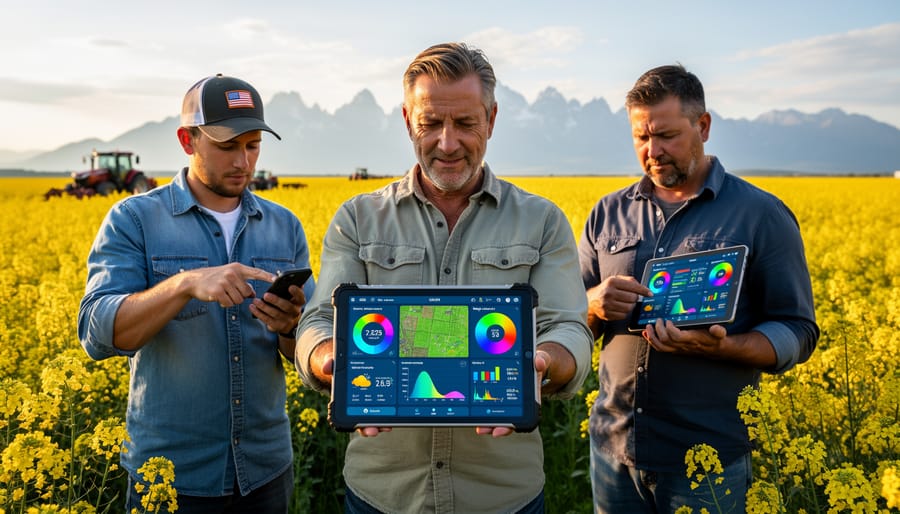
Why Alberta Farmers Are Turning to AI for Agricultural Knowledge
Alberta’s agricultural landscape presents unique challenges that make AI-powered learning tools particularly valuable for farmers across the province. With over 40,000 farms spanning 21 million hectares, producers face obstacles that traditional extension services and learning methods struggle to address efficiently.
Distance remains one of the most significant barriers to agricultural education in Alberta. Many farmers operate hours away from the nearest agricultural college or research station. Traveling to workshops or training sessions can mean a full day away from the farm during critical seasons. AI-powered learning platforms allow producers to access expert knowledge from their kitchen table at 10 p.m. after finishing evening chores, or from their combine cab during breaks.
The province’s remarkable soil diversity adds another layer of complexity. From the dark, rich soils of the Peace Country to the lighter brown soils of the southeastern prairies, what works on one farm may not translate 200 kilometers away. AI systems can analyze local soil data, weather patterns, and crop performance to deliver personalized recommendations that account for these specific conditions, rather than offering one-size-fits-all advice.
Climate variability has intensified in recent years, pushing farmers to adapt faster than ever before. The 2021 drought followed by excessive moisture in 2022 demonstrated how quickly conditions can shift. As part of the broader digital agriculture revolution AI learning platforms can update recommendations in real-time based on current conditions, helping farmers make informed decisions when timing matters most.
The push toward sustainable practices creates additional learning demands. Producers are exploring cover cropping, reduced tillage, and integrated pest management while maintaining profitability. These practices require new knowledge and skills that AI systems can deliver through interactive modules, video demonstrations, and virtual mentorship programs.
“We needed something that could scale beyond our traditional extension model,” explains Dr. Sarah Chen, an agronomist working with Alberta farmers. “AI tools help us reach more producers with timely, relevant information tailored to their specific operations.”
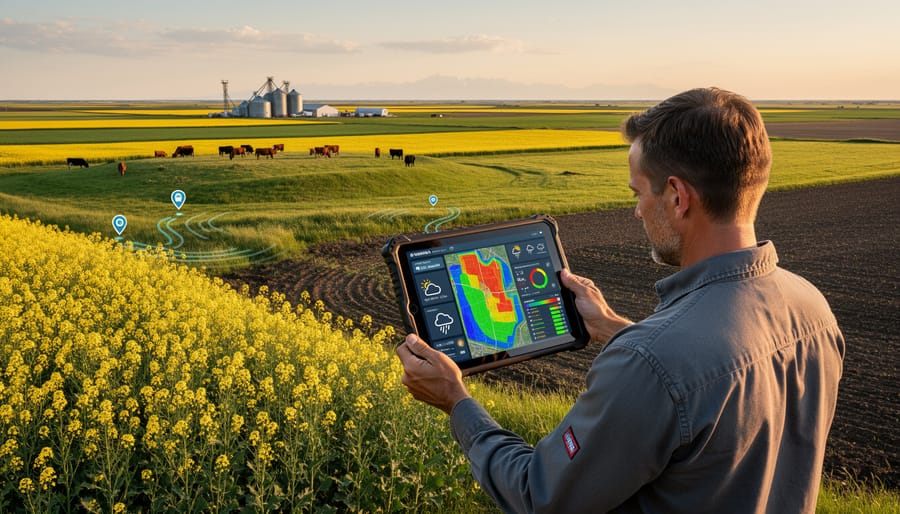
Real Applications: AI Learning Tools Already Working on Canadian Farms
Personalized Soil Health Education
AI platforms are transforming how Canadian farmers understand and improve their soil health by analyzing site-specific data and delivering tailored education. These systems process information from soil tests, including pH levels, nutrient concentrations, and organic matter content measured in parts per million, then generate customized learning modules addressing each farm’s unique challenges.
Instead of generic advice, AI-driven soil analysis systems identify patterns in your fields and recommend targeted practices. If your soil test reveals low nitrogen levels at 15 kg/ha when optimal ranges sit at 40-60 kg/ha, the platform explains why this matters for your specific crops and suggests corrective measures suited to Alberta’s growing conditions.
Greg Thompson, a soil health specialist working with farms near Lethbridge, explains: “The AI doesn’t just tell you what’s wrong. It teaches you the science behind the problem and walks you through solutions that fit your operation’s budget and timeline.”
These platforms track your progress over seasons, adjusting recommendations as your soil conditions improve. You’ll receive alerts about upcoming application windows, videos demonstrating proper techniques, and connections to other farmers who’ve tackled similar issues. The result is education that evolves with your land.
Adaptive Crop Management Training
AI-powered training platforms are transforming how Canadian farmers build expertise in crop management by delivering personalized learning that adapts to individual experience levels and regional conditions. These systems analyze your farm’s specific climate data, soil composition, and historical yields to create customized training modules on critical topics like crop rotation strategies, integrated pest management, and optimal harvest timing.
Take the example of a fourth-generation Alberta wheat producer who recently expanded into pulse crops. An AI training platform assessed his 20 years of cereal experience and created a targeted learning path focusing specifically on lentil and chickpea rotation patterns suited to his soil zone. The system incorporated local weather data from the past decade and recommended pest management approaches proven effective within 50 kilometres of his operation.
Dr. Sarah Mitchell, an agricultural extension specialist at the University of Alberta, has observed these platforms in action across the province. “What makes AI training valuable is its ability to recognize knowledge gaps without making farmers feel inadequate,” she explains. “The software identifies what you already know well and focuses your time on areas where personalized guidance will make the biggest difference.”
These systems also track learning progress and suggest when to revisit certain topics based on seasonal timing, ensuring you refresh your knowledge on harvest optimization right when you need it most.
Climate-Smart Practice Recommendations
AI in agriculture now extends beyond field monitoring to personalized carbon management coaching. Modern learning platforms analyze your specific operation and provide customized recommendations for reducing emissions while maintaining productivity. These systems consider your acreage, crop rotation, soil type, and equipment to suggest practical changes you can implement immediately.
For grain farmers in Alberta, AI platforms might recommend variable-rate nitrogen applications based on soil carbon levels, reducing fertilizer use by 15-20% in specific zones. A 400-hectare operation near Lethbridge recently cut fuel consumption by 12% after an AI system recommended optimized tillage patterns based on soil moisture data and field topology.
The technology adapts as you progress. Start with one practice, like cover cropping on a trial section, and the platform tracks your carbon sequestration results. It then suggests the next step, whether that’s adjusting seeding rates or modifying harvest timing. You’re not getting generic advice from a manual. The system learns from your results and compares them against regional data to refine future recommendations.
Some platforms connect you with agronomists who review the AI suggestions before implementation, combining machine learning with human expertise. This hybrid approach helps you make confident decisions about changes that affect both your environmental footprint and your bottom line.
How AI Personalizes Learning for Different Farm Operations
AI-powered farm learning systems in agriculture start by gathering essential information about each producer. The technology assesses three key areas: your existing knowledge and experience level, the specific characteristics of your operation, and how you prefer to absorb new information. This isn’t a simple quiz. Modern agricultural AI platforms analyze patterns from your interactions, track which resources you engage with most, and note where you spend time asking questions or seeking clarification.
The assessment happens continuously. As you work with the system, it learns whether you’re comfortable with technical terminology or prefer visual demonstrations. It notes if you’re managing 400 hectares of canola near Red Deer or running a 150-head cattle operation in southern Alberta. The AI considers your crop rotation patterns, equipment inventory, soil types, and even regional weather challenges specific to your area.
Here’s how this personalization translates across different farm types:
| Farm Type | Knowledge Focus | Learning Priority |
|---|---|---|
| Grain Operations | Soil health, precision seeding, harvest optimization | Crop rotation planning, pest management timing |
| Livestock | Animal welfare, feed efficiency, reproduction cycles | Health monitoring, pasture management |
| Mixed Operations | Integration strategies, labour allocation | Balancing crop and animal production cycles |
| Organic Farms | Certification requirements, natural pest control | Soil fertility without synthetics |
Take two Alberta producers as examples. A grain farmer near Lethbridge receives guided tutorials on optimizing seeding rates based on soil moisture data and long-range forecasts. The system might recommend modules about precision agriculture tools or frost risk management for their specific crops. It prioritizes content about combine settings, grain storage, and market timing.
Meanwhile, a livestock producer in the Peace Country sees completely different content. Their AI learning path focuses on pasture rotation strategies, winter feeding protocols, and animal health indicators. The system might flag educational resources about cold stress management or suggest connections with veterinary expertise networks.
Sarah Chen, an agricultural education specialist with Alberta Agriculture and Forestry, explains the practical benefits: “Farmers don’t have time to sift through generic information. When AI identifies that a producer is dealing with club root in canola, it immediately surfaces research, treatment options, and connects them with others who’ve managed the same issue successfully.”
The personalization extends to delivery format too. Some producers prefer short video clips they can watch during morning coffee. Others want detailed written guides they can reference in the field. The AI adapts, serving content in the format you actually use rather than what you ignore.
Canadian Case Study: AI Learning in Action
When Three Hills Farms, a 2,000-hectare grain operation northeast of Calgary, faced declining canola yields and rising fertilizer costs in 2021, owner Michael Chen knew something had to change. He turned to an AI-powered soil analytics platform called AgriIntel, which combines machine learning with real-time field data to create customized management recommendations.
“We’d been farming the same way for 20 years,” Chen explains. “But the AI showed us patterns we couldn’t see ourselves.”
AgriIntel analyzed five years of yield maps, soil tests, weather data, and satellite imagery from Chen’s fields. The system identified 47 distinct management zones across his canola acreage, each requiring different fertilizer applications. Previous practice had treated entire quarter-sections uniformly.
The results were measurable and immediate. In the first growing season, Three Hills Farms reduced nitrogen fertilizer use by 18% while increasing average canola yields by 220 kilograms per hectare. The cost savings totaled $32,400 in fertilizer alone, while the improved yields added another $64,000 in revenue.
The AI learning component proved particularly valuable for soil health improvements. The platform tracked organic matter changes across management zones and recommended specific crop rotations for areas showing degradation. After two seasons, soil organic matter increased by 0.4% in previously struggling zones, a significant jump that typically takes years to achieve.
Chen’s experience caught the attention of the Kneehill Agricultural Cooperative, which represents 83 farm operations in central Alberta. The co-op partnered with AgriIntel in 2023 to roll out the platform across member farms. Results have been consistent: members report an average 15% reduction in input costs and a 12% improvement in overall crop yields.
“The AI learns from every field in our network,” says Sarah Kowalski, agronomist for the cooperative. “A fungicide timing strategy that works in one member’s wheat field can inform recommendations for similar conditions on another farm 50 kilometres away.”
The cooperative now uses the shared data to identify emerging pest pressures and optimize fungicide applications region-wide. This coordinated approach reduced fungicide use by 22% across member farms in 2024 while maintaining disease control, demonstrating how AI in agriculture extends beyond individual operations to benefit entire farming communities.
Getting Started: Practical Steps for Alberta Farmers
Getting started with AI in agriculture doesn’t require a complete overhaul of how you operate. Many Alberta farmers are discovering that these tools integrate into existing routines more easily than expected.
The first step is determining whether AI-powered learning fits your current priorities. Are you looking to improve soil health? Optimize irrigation? Better manage crop rotation? Most platforms work best when you start with a specific challenge rather than trying to learn everything at once.
Bruce McKinnon, who runs a mixed grain operation near Lacombe, spent about 30 minutes daily for his first month using an AI-powered soil management platform. “I was skeptical about the time commitment,” he admits. “But the system learned my schedule and started sending recommendations when I actually had time to review them, usually during morning coffee.”
Here’s a practical approach to exploring these tools:
- Identify one specific area where you want to improve your knowledge or practice. Keep it focused.
- Research platforms designed for Canadian growing conditions. Many offer free trials or basic versions.
- Commit to 15-30 minutes daily for the first two weeks. Consistency matters more than duration.
- Document what you’re learning and any changes you implement. Simple notes work fine.
- After 30 days, evaluate results. Are you making better decisions? Saving time? Then consider expanding.
Most platforms require basic internet access and a smartphone or tablet. If connectivity is limited in your fields, look for systems that sync when you’re back at the house.
Cost varies widely. Some agricultural education resources offer AI components at no charge, while specialized platforms range from $50 to $500 monthly depending on farm size and features.
Don’t expect instant expertise. These systems improve as they learn your operation, typically becoming noticeably more useful after 60-90 days of regular interaction. The learning curve exists, but it’s gentler than mastering most new equipment.
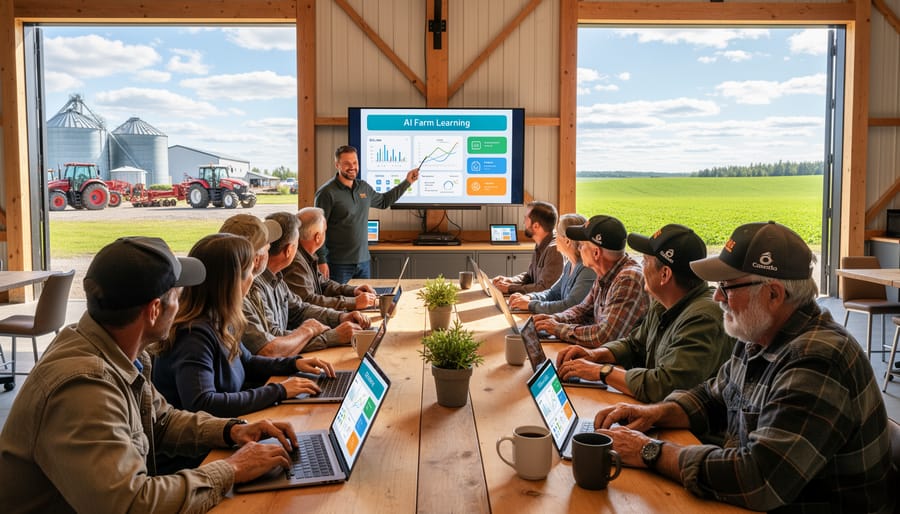
The intersection of AI and agriculture is opening doors that seemed closed just a few years ago. For Canadian farmers juggling long days and tight margins, personalized learning powered by artificial intelligence isn’t about replacing experience or tradition. It’s about getting the right information at the right time, tailored to your operation’s unique conditions.
You’re not alone in this transition. Farmers across Alberta and beyond are already testing these tools, sharing what works, and building a support network that values both innovation and practical results. The technology adapts to your schedule, not the other way around. Whether you check in during morning coffee or late evening after chores, AI-powered platforms wait for you, ready to address questions about soil health, crop management, or sustainable practices specific to your region.
The beauty of these systems lies in their accessibility. You don’t need a computer science degree or hours of training. Start small. Maybe it’s a soil analysis app or a weather forecasting tool enhanced by machine learning. Test one application, see how it fits your workflow, then build from there.
More sustainable farming practices become achievable when you have guidance that accounts for your actual constraints: your land, your budget, your climate. This technology respects the knowledge you’ve already earned while helping you refine and expand it. The community growing around AI in agriculture understands that rural innovation happens through collaboration, not competition. Your questions matter, your challenges are valid, and solutions exist that work within real farm economics.