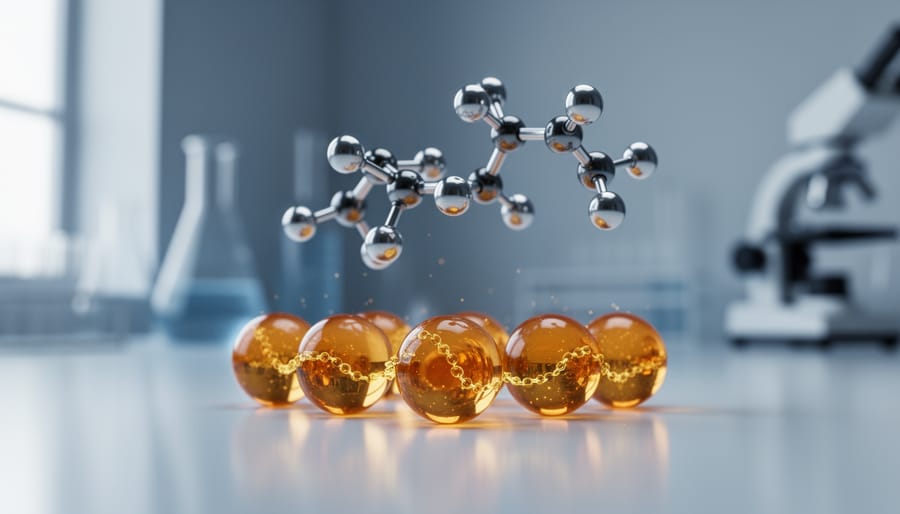
Solid-phase peptides Canada researchers use is built one amino acid at a time on a tiny resin bead, using a repeating cycle of three moves: unlock the end of the chain, add the next building block, and wash away the leftovers. Once the last piece is attached, the finished peptide is cut free and cleaned up. It’s a bench-top process that takes a day or two for a short peptide, and it’s best learned with basic lab habits and a clear head for order of operations.
The beads are what make it work. Because the growing chain stays anchored to a solid support, you can flush out excess chemicals with a simple rinse instead of separating a messy mixture after every step. That trick is why this method took over from older approaches and why it’s behind many of the peptides Canada researchers and suppliers talk about today.
Why should a farmer or ag professional care? Peptides show up in plant-health research, animal nutrition, and soil and water monitoring, and a few Canadian prairie projects are already exploring them. Understanding the basics helps you ask sharper questions about what’s in a product and how it was made.
This guide walks through the tools and materials, safety and stop conditions, the step-by-step cycle in plain language, and how to verify what you’ve made. Responsible handling of chemical waste comes along for the ride, because good science and good stewardship go together.
Why Peptide Synthesis Shows Up in Farming and Environmental Work
A peptide is a short chain of amino acids, the same building blocks that make up proteins. Think of it as a small piece of a protein: a few to a few dozen links in a chain, rather than the hundreds or thousands you find in a full protein. Their size and specific order are what give each peptide its particular behaviour.
You may not run into peptides by name on the farm, but they turn up in more places than you might expect. Here are the main ones.
– Plant biostimulants. Some products on the market contain peptides or amino acid mixtures, and researchers are studying how certain peptides influence plant growth signals and stress response.
– Antimicrobial peptides. Scientists are investigating these as possible alternatives or complements to conventional crop and livestock inputs. This work is still developing, so treat it as research, not a ready-made replacement.
– Animal health research. Peptides are used as tools to study immune responses and to develop new diagnostics and treatments.
– Testing labs. Water and soil laboratories can rely on synthetic peptides as reference standards, which help instruments give consistent, trustworthy readings.
What ties these together is that a researcher or manufacturer needs a specific peptide, made to a specific sequence, and made cleanly. Nature produces peptides in plants and animals, but for research and product work it is usually more practical to build them in the lab. That is where solid-phase synthesis comes in, and understanding the basics helps you ask sharper questions about the products and research you encounter.
The Big Idea: Building a Peptide on a Bead, Like a Row Crop One Pass at a Time
Picture seeding a field in passes. You finish one pass, clear the debris, then set up the next. Solid-phase peptide synthesis works on a similar rhythm, just at a microscopic scale.
The key move is anchoring. The first amino acid gets attached to a tiny solid support, usually a resin bead you could barely see on its own. From there, the chain grows one amino acid at a time while staying fixed to that bead. Because the growing peptide is stuck in place, the lab can flush the bead with solvent after every step. Extra reagents and leftover amino acids simply wash away, and the chain stays put.
That’s the real advantage. Older solution-phase methods built peptides while everything floated freely in liquid. After each addition, chemists had to separate the new, longer chain from all the leftovers, a slow and often wasteful job that got harder as the chain grew. With the bead holding the chain, a quick wash replaces a full purification at every step.
The technique was introduced by American chemist Bruce Merrifield in the early 1960s, and it earned him the Nobel Prize in Chemistry in 1984. Its basic logic is still the foundation of how most peptides are made today.
Think of the bead as a fixed row marker. Everything else can be rinsed past it, and the work stays right where you left it.
Tools and Materials Used in Solid-Phase Peptide Synthesis
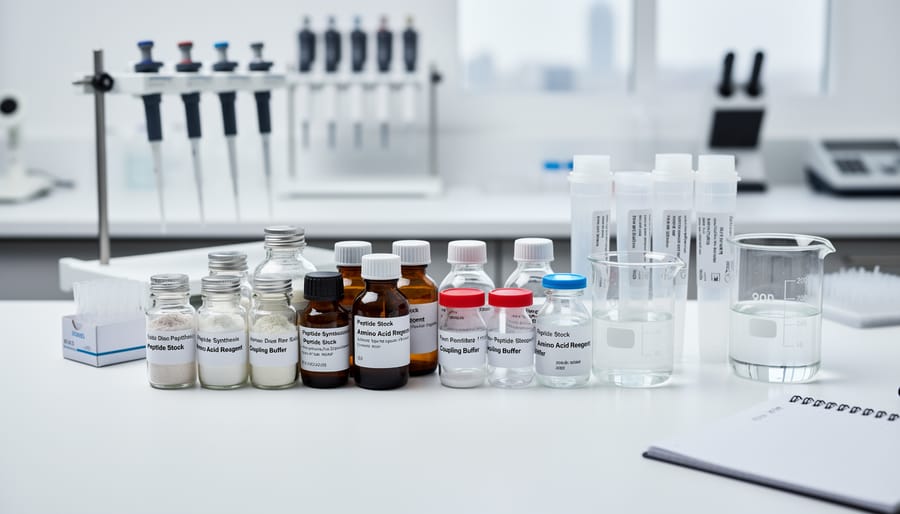
A solid-phase lab setup is simpler than it sounds. Think of it as a short list of ingredients plus a vessel to mix them in. Here are the core materials, defined as they come up:
- Resin: tiny polymer beads, usually 100 to 200 micrometres wide, that act as the solid support the peptide grows from.
- Protected amino acids: the building blocks, each wearing a removable cap so it only joins the chain where intended.
- Coupling reagents: chemicals that activate an incoming amino acid so it bonds firmly to the chain.
- Deprotection solution: a mild chemical bath that removes the cap and readies the chain for the next addition.
- Wash solvents: liquids, often measured in tens of millilitres per rinse, that flush away leftovers without disturbing the beads.
- Reaction vessel or automated synthesizer: a filtered container, or a machine that handles the liquids for you.
- Cleavage chemicals: a strong acid mixture that releases the finished peptide from the bead.
Protecting groups deserve a closer look because they make the whole method work. Picture a cap on the end of a hose. Without it, the chain could grow in the wrong direction or link up with the wrong partner. The cap stays on until the lab deliberately removes it, so each amino acid is added one at a time and in the right order.
Two capping strategies dominate. Fmoc chemistry uses a cap that comes off with a mild base, which makes it gentler on the equipment and on delicate sequences. Boc chemistry uses a cap removed with acid, a harsher approach that still suits certain difficult peptides. Most labs today lean toward Fmoc for everyday work, though both are well established.
Scale matters too. A small research batch might use around 0.1 millimoles of resin, which is only a fraction of a gram of beads. Amino acids are typically added in excess, often three to five times the amount of available attachment sites, to push each step to completion. That excess gets washed away after every cycle, which is exactly why the solid support is so handy.
Safety Warnings and When to Stop: Handling Lab Chemicals Responsibly
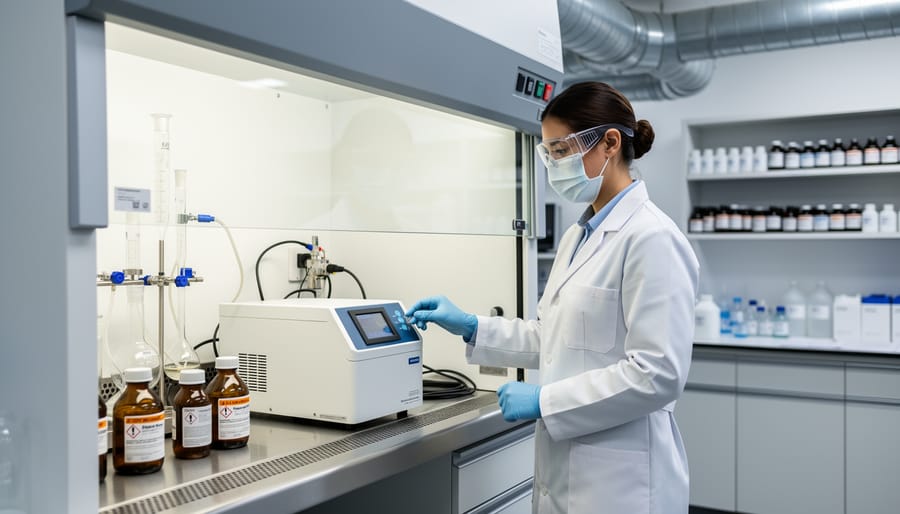
Solid-phase peptide synthesis is a safe, routine process in the right setting, and that setting is a trained, properly equipped laboratory. The work relies on solvents and strong acids that need real engineering controls, which is why it belongs in a lab rather than on a farm or in a shop.
Here is what a responsible lab has in place. Reactions run inside a fume hood so vapours are drawn away from people. Staff wear gloves, safety glasses, and lab coats, with extra protection when handling cleavage acids. Every bottle is labelled, and every waste stream is collected in its own marked container.
Knowing when to stop matters just as much. Pause the work if any of these show up:
– Reagents or containers have no labels
– There is no ventilation or the fume hood isn’t working
– No trained supervisor is on site
– Waste containers are full, mixed, or unmarked
If you’re a producer curious about peptide-based products, you don’t need to make anything yourself. Work with accredited labs and reputable suppliers who already have the equipment, training, and documentation. They can show you what a product contains and how it was made.
Disposal ties directly into the environmental side of farming. Spent solvents and acids must go to licensed hazardous-waste handlers, never down a drain or onto the ground, and good habits like this help you prevent water pollution that could reach wells, creeks, and wastewater systems.
Step-by-Step: How a Peptide Is Built, Cycle by Cycle
Think of one cycle of peptide building the way you’d think of a seeding pass followed by a clean-up pass: do one job, tidy up, then do the next. The chemistry repeats, and the same short loop is run again for every amino acid in the sequence. Here is how it unfolds, in order.
- Load the first amino acid. The first protected amino acid is chemically anchored to the resin beads. This is the foundation, and the chain will grow outward from it.
- Remove the protecting cap (deprotection). A mild chemical solution takes the “cap” off the end of the growing chain. That frees up the one spot where the next amino acid is allowed to attach.
- Wash. Solvent is flushed through to rinse away the deprotection chemicals and the removed caps. Because the chain is anchored to the beads, nothing valuable goes down the drain.
- Add the next protected amino acid (coupling). The next amino acid, with its own cap in place, is added along with a coupling reagent that helps it bond to the open end of the chain. Using a surplus of the incoming amino acid helps the reaction go to completion.
- Wash again. Leftover reagents and unreacted amino acids are rinsed off, leaving a clean, slightly longer chain.
- Repeat the cycle. Steps two through five are run again for each remaining amino acid until the full sequence is assembled.
- Cleave and finish. A strong acid mixture releases the finished peptide from the resin and strips off the remaining protecting groups on the side chains. What comes out is a crude peptide, ready for purification.
Notice how the washing steps do the heavy lifting. Each pass leaves the chain clean before the next one starts, much like clearing a field before the next operation so small errors don’t pile up. That is the real advantage of working on a solid support: you rinse instead of re-purifying at every stage.
Doing this by hand for a long sequence would be slow and repetitive. That’s where automated synthesizers come in. These instruments pump the reagents and solvents in and out of the reaction vessel on a programmed schedule, running the deprotect, wash, couple, wash loop without someone standing over it. A single cycle can take from a few minutes to under an hour depending on the instrument and method, and automation also improves consistency from one batch to the next.
The final cleavage step is the only one that is truly different from the rest. Everything before it is the same loop run over and over, which is why the process scales so well from short research peptides to longer, more complex sequences.
Verifying the Result: Purification, Testing, and Next Steps
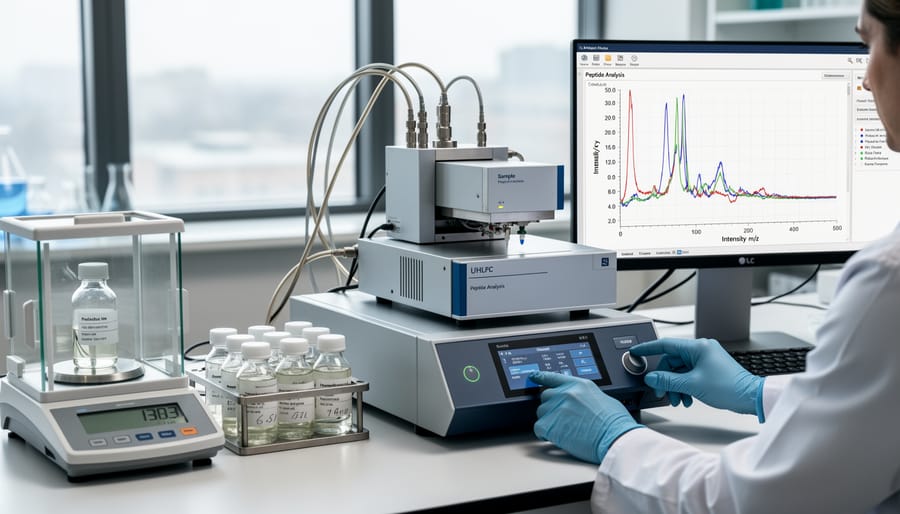
Once the peptide is cleaved from the resin, the job isn’t finished. The crude mixture contains the target plus near-misses: chains that are one amino acid short, or that picked up a leftover cap. Labs sort this out in two stages.
First comes purification, usually with HPLC (high-performance liquid chromatography). The mixture is pushed through a packed column, and each molecule travels at a slightly different speed. The target peptide comes off at a predictable time and is collected, while the near-misses are set aside.
Next is identity confirmation by mass spectrometry. Think of it as weighing the molecule very precisely. Every amino acid sequence has a known mass, so if the measured value matches the expected one, the chain is almost certainly the right length and composition.
Purity matters because contaminants can skew research results or weaken a product’s performance. A 95% pure peptide is a different input than a 70% one, and you can’t see the difference by eye.
When you evaluate a supplier or lab, ask for:
– A certificate of analysis for the specific batch
– The purity percentage and the method used to measure it
– Mass spectrometry data confirming the expected molecular weight
– Sequence confirmation, where it’s relevant to your use
For next steps, compare these documents across suppliers and keep them on file, much as you would for residue monitoring records. If a result looks unclear, an accredited lab can help interpret it. The same habit of asking for data underpins soil testing basics and it serves you just as well here.
A Canadian Perspective: Research Labs, Expert Voices, and Real-World Use
Canada has a strong track record of turning lab chemistry into tools for farms and ecosystems. Agriculture and Agri-Food Canada runs research programs across the Prairies, and universities such as the University of Alberta and the University of Guelph study how short protein fragments can support plant health and animal health. Natural Resources Canada and provincial research bodies contribute their own work on environmental monitoring. If you want to see what is active near you, public research summaries and program pages from these institutions are the best place to start, since they describe current projects in the researchers’ own words.
Solid-phase synthesis is part of that picture because researchers need small, pure batches of specific peptides to test. Building them on a bead lets a lab make a sequence, check it, and try a slightly different version without starting from scratch each time. That speed is what makes early-stage screening practical.
Here is a spot we’d suggest reserving for a voice from the field:
> Interview prompt for a Canadian biochemist or ag-research scientist: “Why does solid-phase synthesis matter for the research your team does, and what should producers know when they hear about peptide-based products?”
Pairing a short pull-quote like this with a named researcher, confirmed with them directly, keeps the story grounded and honest.
You don’t have to do this learning alone. Plenty of Alberta producers are swapping ideas and asking good questions of scientists, and many of them tune into farm science podcasts to hear researchers explain their work in everyday language. Curiosity, shared across the community, is how new tools find their way from the lab bench to the field.
Common Questions About Solid-Phase Peptide Synthesis
Why is the chain built on a solid bead?
Anchoring the growing peptide to a bead lets the lab wash away leftover chemicals after every step with a simple rinse. That saves the slow clean-up of purifying a dissolved mixture each time an amino acid is added.
How long does it take?
Each add-one-amino-acid cycle usually takes anywhere from a few minutes to a couple of hours, depending on the method and equipment. A short peptide might be built in a day, while longer ones take more time, plus extra days for purification and testing.
How long can a peptide be?
Most labs comfortably make chains of roughly 10 to 50 amino acids. Beyond that, small errors pile up and yields drop, so very long chains get tricky.
Is it the same as making a protein?
Not quite. Proteins are much longer chains that living cells build and fold into specific shapes, while synthesis in a lab produces shorter peptides one step at a time.
Can it be done on a farm or in a shop? Realistically, no. The solvents and acids involved call for fume hoods, protective gear, and trained staff, so producers are better off working with accredited labs and suppliers.
As for the environment, the chemicals are a real consideration, which is why responsible labs collect, label, and send solvent waste to licensed disposal facilities rather than down the drain. Asking a supplier how they manage waste is a fair question, and a good one.
Solid-phase peptide synthesis comes down to a simple rhythm: anchor the first amino acid to a resin bead, cap, uncap, couple, wash, and repeat until the chain is complete. Then the finished peptide is released from the bead and checked to make sure it’s what was ordered. That’s the whole story, and none of it requires a chemistry degree to follow.
For producers, that understanding is practical. When you know what a certificate of analysis should show, such as purity percentage and sequence confirmation, you can ask suppliers sharper questions and read their answers with confidence. The same goes for conversations with researchers working on plant or animal health tools.
You don’t need to master the lab work to benefit from it. Keep asking questions, and lean on your community. Local workshops, peer groups, and agriculture podcasts are great places to hear from the scientists and growers putting this work to use. Curiosity is a strong foundation, and every question you ask helps the whole farming community make better-informed choices.