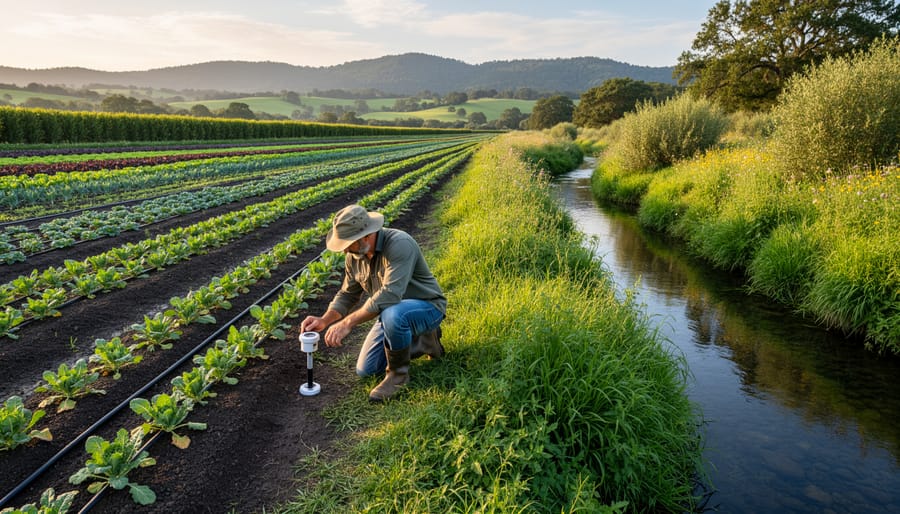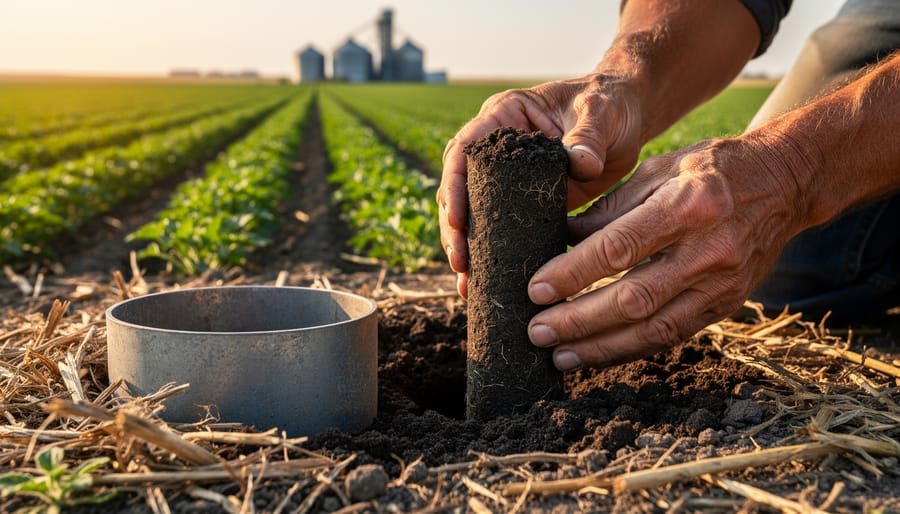
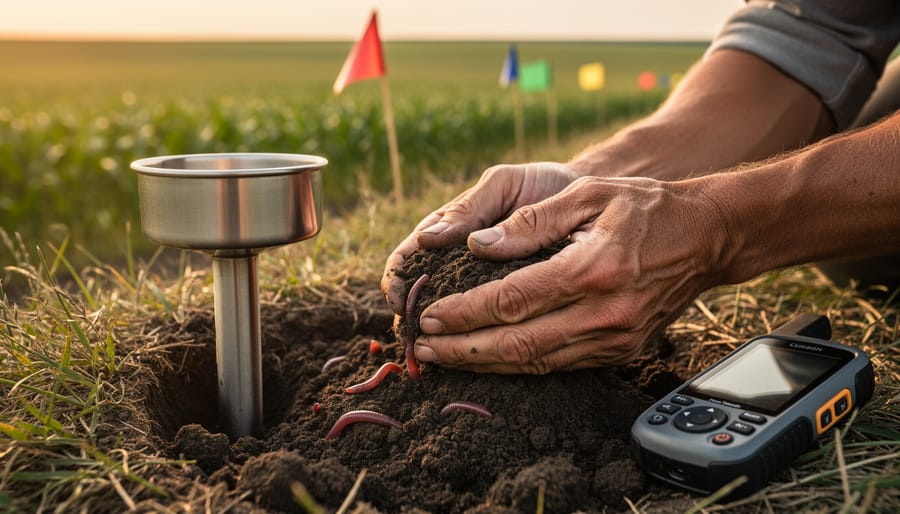
Measure soil organic matter annually using the loss-on-ignition method or Walkley-Black test, targeting a minimum of 3-5% for prairie soils to establish your baseline before organic certification bodies implement mandatory outcome standards. Track your results in a simple spreadsheet with GPS coordinates for each sampling location, creating the documentation trail that emerging Canadian organic regulations will require.
Test biological activity through permanganate oxidizable carbon (POXC) or soil respiration tests every growing season, particularly in spring before seeding and fall after harvest. These indicators respond quickly to management changes and provide the measurable proof that your practices are building soil health, not just maintaining it. Alberta farmers working with certification bodies are already seeing these metrics included in verification protocols.
Assess aggregate stability using the slake test or wet sieving method to quantify your soil’s resilience to erosion and compaction. Aim for at least 50% water-stable aggregates in the top 15 centimeters, a threshold that researchers at Canadian universities identify as critical for healthy soil structure. This simple field test costs nothing and delivers immediate visual feedback on whether your organic practices are strengthening soil architecture.
Monitor infiltration rates with a single-ring infiltrometer at multiple field locations, establishing benchmarks before policy shifts make these measurements mandatory. Healthy agricultural soils should absorb at least 25 millimeters per hour. Understanding where you stand today positions you ahead of regulatory changes while identifying areas needing immediate management attention to meet future outcome-based organic standards.
The Gap Between Measuring and Meaning
What Organic Certification Currently Requires
Canada’s current organic certification requirements take a process-based approach to soil management rather than measuring specific outcomes. Under the Canadian Organic Standards (COS), administered by the Canadian Food Inspection Agency, organic operations must follow prescribed practices but aren’t required to demonstrate soil health improvements through quantifiable metrics.
The standards mandate several soil management practices. Operators must maintain or improve soil organic matter through composting, cover cropping, crop rotations, and minimal tillage where practical. They’re required to implement erosion prevention measures and document their soil-building strategies in their Organic System Plan. Prohibited practices include synthetic fertilizers, sewage sludge, and most conventional pesticides.
However, the standards don’t specify target levels for indicators like soil organic carbon, aggregate stability, or biological activity. There’s no requirement to test soil health annually or prove that your practices are actually improving outcomes. This means two certified organic farms could have vastly different soil quality while both meeting certification standards.
Recommended practices go beyond the mandates. Many certification bodies encourage regular soil testing, diverse crop rotations extending beyond three years, and integrating livestock where feasible. Some suggest monitoring earthworm populations or conducting infiltration tests, but these remain voluntary.
This gap between required practices and measurable outcomes has sparked discussions about incorporating soil health indicators into future certification standards, particularly as research from Canadian institutions demonstrates the value of outcome-based assessment in organic systems.
Where the Standards Fall Short
Current organic certification standards in Canada focus primarily on input-based requirements—what you can and cannot apply to your land. While these practices aim to protect soil health, they don’t directly measure whether your soil is actually improving. This creates a significant gap between following the rules and achieving tangible soil health outcomes.
“We’ve been certified organic for twelve years, but the standards never asked us to test our soil biology or track our organic matter gains,” explains Sarah Chen, who farms 240 hectares near Lacombe, Alberta. “We assumed that by following the approved practices, our soil was getting healthier, but we had no real data to prove it.”
This absence of outcome-based metrics means two certified organic farms can have vastly different soil health levels despite following identical protocols. One farm might be building organic matter at 0.5 percent annually, while another’s levels stagnate. Under current standards, both receive the same certification.
The gap becomes particularly problematic when addressing region-specific challenges. Alberta’s diverse climate zones—from semi-arid regions in the south to parkland in the north—require different soil management approaches. Generic practice-based standards can’t account for these variations or verify whether adopted practices actually work in your specific conditions.
Without mandatory soil testing or biological assessments, farmers lack baseline data to demonstrate improvement over time. This shortcoming leaves organic certification unable to truly verify its core promise: building healthy, living soils that sustain long-term agricultural productivity.
Soil Health Indicators That Actually Matter for Organic Standards
Biological Indicators: Living Soil Metrics
Living soil metrics give us tangible ways to measure the underground ecosystem that drives agricultural productivity. These biological indicators respond quickly to management changes, making them valuable tools for organic farmers tracking their soil health journey.
Microbial biomass measures the total mass of living microorganisms in your soil. Think of it as the engine powering nutrient cycling and disease suppression. Healthy Alberta soils typically contain 300-600 micrograms of microbial carbon per gram of soil, though organically managed fields often exceed these ranges. “We’ve seen microbial biomass increase by 40% within three years of transitioning to organic practices,” shares Dr. Amanda Green, a soil ecologist working with Alberta producers. Simple on-farm tests now make this metric accessible without laboratory equipment.
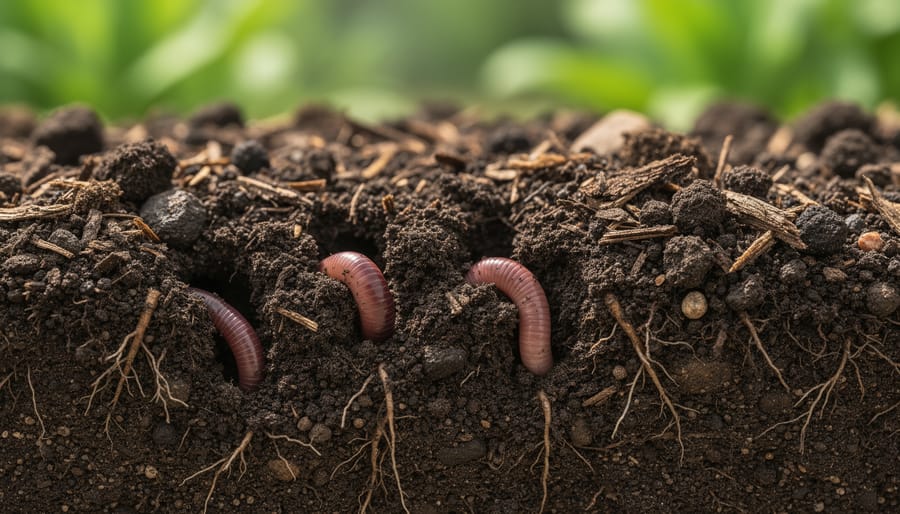
Earthworm populations serve as excellent bio-indicators because they’re sensitive to management practices. Count earthworms in a 30 cm × 30 cm × 15 cm deep soil sample. Healthy Alberta agricultural soils should host at least 10-15 earthworms per sample, with organic fields often supporting 20 or more. These soil engineers improve water infiltration and nutrient availability while their presence indicates low chemical residues.
Soil respiration measures carbon dioxide release from microbial activity and root respiration. Higher rates generally indicate more active biological communities. Alberta’s temperate soils typically show respiration rates of 50-150 mg CO2 per square metre per hour during growing season, with organically managed soils trending toward the upper range. This metric directly connects to organic matter decomposition and nutrient release timing, making it particularly relevant for certification standards emphasizing biological function.
Physical Indicators: Structure and Function
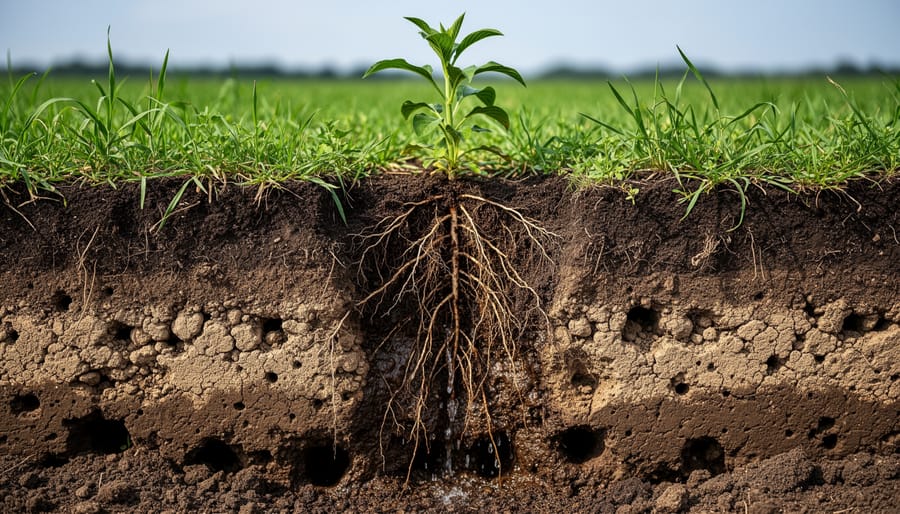
Physical soil properties reveal fundamental information about how your soil functions and supports crop production. Understanding these indicators helps you track improvements and meet emerging organic certification standards that focus on measurable outcomes.
Aggregate stability measures how well soil particles stick together when wet, directly affecting erosion resistance and root penetration. Prairie soils typically show stability ratings of 40-60% for conventional fields, while healthy organic soils often exceed 70%. Test this by placing dried soil clumps in water and observing how long they hold together. Strong aggregates indicate active microbial life and adequate organic matter binding soil particles.
Bulk density reflects soil compaction, measured in grams per cubic centimeter. Alberta’s clay loam soils function best below 1.3 g/cm³, while sandy loam soils should stay under 1.5 g/cm³. Higher values restrict root growth and reduce water movement. Regular monitoring helps you catch compaction problems before they significantly impact yields.
Infiltration rates show how quickly water enters your soil. Healthy prairie soils should absorb at least 25-50 millimeters per hour. Lower rates signal compaction or poor structure, leading to runoff and nutrient loss. Simple field tests using metal rings pressed into soil provide baseline measurements for tracking progress over time.
Water-holding capacity determines drought resilience. Each 1% increase in organic matter allows soil to hold an additional 15-20 millimeters of plant-available water per 30 centimeters of depth. For certification purposes, document these metrics annually to demonstrate continuous improvement in soil function.
Chemical Indicators: Nutrient Cycling and pH
Chemical indicators provide measurable data about your soil’s nutrient availability and cycling capacity—essential information for meeting organic certification requirements and building long-term fertility.
Soil organic matter (SOM) serves as the foundation of healthy soils, typically ranging from 2-6% in Canadian prairie soils, though levels above 4% are ideal for optimal productivity. Organic matter acts as a nutrient reservoir, releasing nitrogen, phosphorus, and other elements through microbial decomposition. For organic farmers in Alberta, maintaining or increasing SOM is often a primary goal, as synthetic fertilizers aren’t an option for quick nutrient fixes.
The carbon-to-nitrogen (C:N) ratio tells you how quickly organic materials will decompose and release nutrients. Fresh crop residues with high C:N ratios (above 30:1) temporarily tie up nitrogen as microbes break them down, while materials closer to 20:1 release nutrients more readily. Understanding these ratios helps you plan cover crop termination timing and compost applications effectively.
Soil pH dramatically influences nutrient availability. Most crops thrive between 6.0-7.5, where essential nutrients remain accessible to plant roots. Alberta soils tend toward neutral to slightly alkaline conditions, but localized acidity can develop. Regular pH testing—ideally annually—allows you to address imbalances through amendments like lime or elemental sulfur before deficiencies appear.
Available nutrient testing measures what’s immediately accessible to plants, not just total reserves. For organic operations, this data guides decisions about compost application rates, green manure selection, and rotation planning. Many certification bodies now recognize these chemical indicators as outcome measures, rewarding farmers who demonstrate improving soil fertility through natural management practices rather than simply prohibiting synthetic inputs.
Why Context Matters More Than Numbers
A soil organic matter reading of 4% might indicate excellent health in Alberta’s Black soil zone but could signal deficiency in the Peace River region, where values typically range higher. That’s why establishing your own baseline measurements proves more valuable than chasing arbitrary numbers. Your farm’s starting point, combined with knowledge of your specific soil type and regional conditions, creates the meaningful context for measuring progress.
Before implementing regenerative organic agriculture practices, document your current conditions across multiple growing seasons. This approach accounts for natural variation and weather impacts. A Grey Luvisol in central Alberta will respond differently to management changes than a Dark Brown Chernozem in the south, even when both farms follow identical practices. Understanding these regional and soil-specific characteristics helps you set realistic improvement targets and interpret your results accurately.
How Outcome Standards Change the Game
Practice-Based vs. Outcome-Based: Understanding the Shift
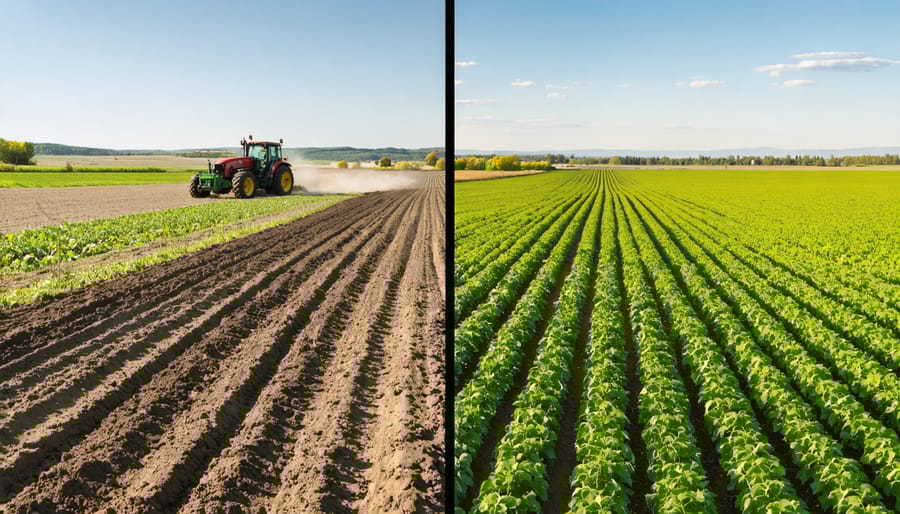
Traditionally, organic certification has focused on practice-based standards. Farmers demonstrate compliance by implementing specific techniques like applying compost, planting cover crops, or following crop rotation schedules. If you follow the approved methods, you meet the requirements. This approach provides clear guidelines and relatively straightforward verification processes.
However, practice-based standards don’t always tell the complete story. Two farmers might both use cover crops, yet achieve vastly different results depending on their soil type, climate conditions, and management decisions. A farmer in southern Alberta applying the same practices as someone in the Peace Region will see different outcomes due to variations in precipitation, temperature, and growing season length.
Outcome-based standards represent a significant shift in thinking. Rather than dictating how you farm, these standards measure what you achieve. They focus on tangible results: increased soil organic matter, improved water infiltration rates, or enhanced biological activity. You demonstrate success through measurable improvements in soil health indicators, regardless of which specific sustainable practices you employ to get there.
This flexibility can be empowering. You choose the methods that work best for your unique operation while remaining accountable for results. However, it also requires more sophisticated monitoring and data collection. Many Canadian farmers are already tracking these metrics voluntarily, recognizing that healthy soil drives long-term productivity and profitability. As organic policy evolves, understanding both approaches helps you prepare for future certification requirements while building resilience in your farming system.
What Progressive Organic Programs Are Already Doing
Several organic certification programs are beginning to integrate outcome-based soil health measures alongside traditional practice-based standards. The European Union’s organic regulation updates, implemented in 2022, now encourage member states to incorporate soil quality indicators into their certification frameworks, offering a model that Canadian programs are watching closely.
In Canada, the Organic Federation of Canada has initiated pilot projects exploring how to measure and reward soil health improvements within certification standards. Some provincial organic associations are partnering with farmers to test practical monitoring systems that track metrics like soil organic matter, aggregate stability, and biological activity over time.
The Regenerative Organic Certification program, while not yet widely adopted in Canada, provides an international example of tiered standards where farms earn recognition for measurable soil health improvements beyond baseline organic requirements. This approach allows farmers to demonstrate continuous improvement rather than simply meeting minimum compliance thresholds.
In Alberta specifically, several organic growers are voluntarily participating in research partnerships with universities to establish regional baseline data for soil health indicators. These early adopters are helping shape what realistic, climate-appropriate standards might look like for Prairie conditions. Their experiences suggest that flexible, region-specific thresholds will be essential as certification bodies develop outcome-based frameworks that work across Canada’s diverse agricultural zones.
Making Standards Work on Your Farm
Building Your Baseline: Where to Start
Establishing your baseline starts with thoughtful timing and consistent methodology. For organic operations in Alberta, the ideal sampling window falls in early spring before seeding or in late fall after harvest, when soil conditions are relatively stable and comparable year-over-year.
Begin with a simple three-test approach: soil organic matter, aggregate stability, and biological activity through either respiration tests or active carbon measurements. This provides a snapshot of physical, chemical, and biological health without overwhelming your budget or testing capacity. Alberta farmer James Korneychuk from Lethbridge County recommends starting small: “We tested just two fields our first year, which gave us confidence before expanding to the whole operation.”
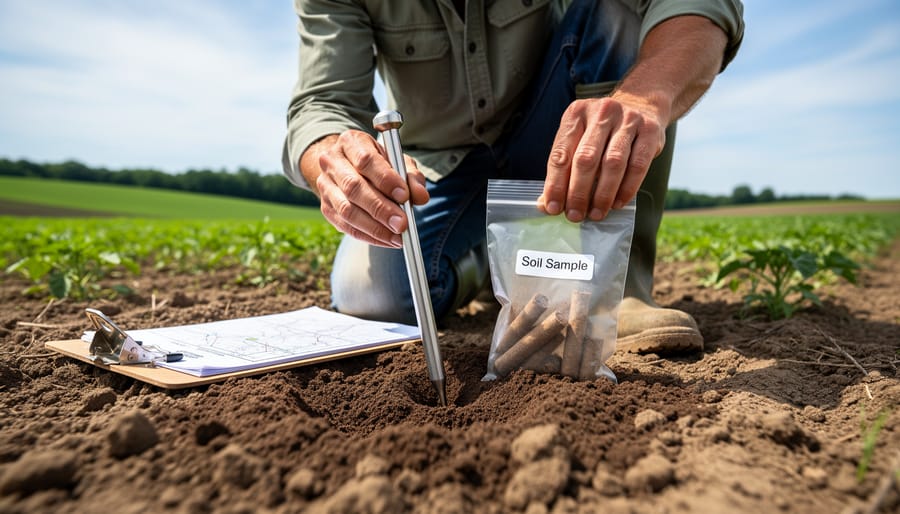
Follow proper sampling protocols by collecting 15-20 soil cores per management zone to a depth of 15 centimetres, mixing thoroughly, and submitting samples within 24 hours. Consistency matters more than perfection – use the same sampling locations, depth, and timing each year to track meaningful trends.
Choose laboratories familiar with organic systems and Canadian soil types. Provincial soil testing labs often provide baseline packages specifically designed for organic certification compliance, with pricing typically ranging from 75 to 150 dollars per complete analysis.
Document everything: create simple maps showing sampling locations, record weather conditions during collection, and note recent management practices. This context becomes invaluable when interpreting results and demonstrating progress toward outcome-based standards. Most certification bodies now accept digital records, making documentation easier than ever for busy farm operations.
Tracking Progress Without Overwhelming Yourself
You don’t need expensive lab tests every month to track meaningful changes in your soil. Start with baseline testing in spring or fall, then retest annually or every two years depending on your management changes. This frequency captures real trends without draining your budget or time.
Create a simple record-keeping system that works for your operation. A basic spreadsheet tracking test dates, results for key indicators like organic matter percentage, aggregate stability, and biological activity gives you enough data to spot improvements. Many Alberta farmers photograph their soil samples alongside test results, creating a visual timeline that’s easy to reference during decision-making.
The good news? Much of this monitoring integrates seamlessly with your organic compliance documentation. Your existing records of amendments, crop rotations, and management practices already tell part of the soil health story. Add test results to these files, and you’ve built a comprehensive picture without duplicating efforts.
Consider partnering with neighboring farms to share testing costs or compare regional trends. Alberta’s Growing Forward programs occasionally offer cost-share opportunities for soil testing, making professional analysis more accessible. Focus on consistency over perfection—regular monitoring with a few key indicators beats sporadic comprehensive testing every time.
When the Numbers Don’t Improve: Troubleshooting
Sometimes soil health indicators don’t respond as quickly as we’d hope, and that’s perfectly normal. Alberta farmer Sarah Chen experienced this when her organic matter readings plateaued after three years of cover cropping. If you’re facing similar challenges, first remember that soil improvement takes time—typically five to seven years before significant changes appear in some indicators.
Start by reviewing your baseline measurements. Were they taken during the same season? Soil moisture and temperature affect readings considerably. Consider testing multiple areas of your field, as variability is common. Some indicators, like aggregate stability, respond faster than others like organic matter percentage.
If numbers decline, examine recent weather patterns. Drought years or excessive rainfall can temporarily impact biological activity. Check your nutrient balance—excessive tillage, even unintentional compaction from equipment, can reverse progress.
Reach out to your regional agronomist or organic certification body for perspective. Many Alberta producers have found success by adjusting their cover crop species mix or rotation timing. Sometimes the solution is simply patience and consistency. Your soil is listening; it just operates on its own timeline. Keep detailed records, adjust one practice at a time, and celebrate small victories along the way.
What’s Coming for Canadian Organic Standards
Expert Insight: Building Standards That Support Farmers
We spoke with Dr. Marie Leblanc, a soil health researcher at the University of Alberta, about integrating outcome standards into Canadian organic policy. “The key is making standards flexible enough to reflect regional differences,” she explains. “A producer in southern Alberta dealing with clay soils shouldn’t be measured by the same exact benchmarks as someone farming sandy loam in Ontario.”
Dr. Leblanc suggests a tiered approach where farmers establish baseline measurements at certification, then demonstrate improvement over time rather than meeting absolute thresholds immediately. “This rewards farmers who are genuinely building soil health, even if they’re starting from degraded land,” she notes.
She recommends that certification bodies provide testing support and consider aggregated metrics rather than single indicators. “Measuring three to five complementary indicators, such as organic matter percentage, aggregate stability, and biological activity, gives a more complete picture without overwhelming producers.”
The goal should be creating standards that recognize the work farmers are already doing. “Most organic producers are natural soil stewards,” Dr. Leblanc adds. “Good policy should validate their practices and provide pathways for continuous improvement, not create barriers to certification.”
How Farmers Can Shape the Conversation
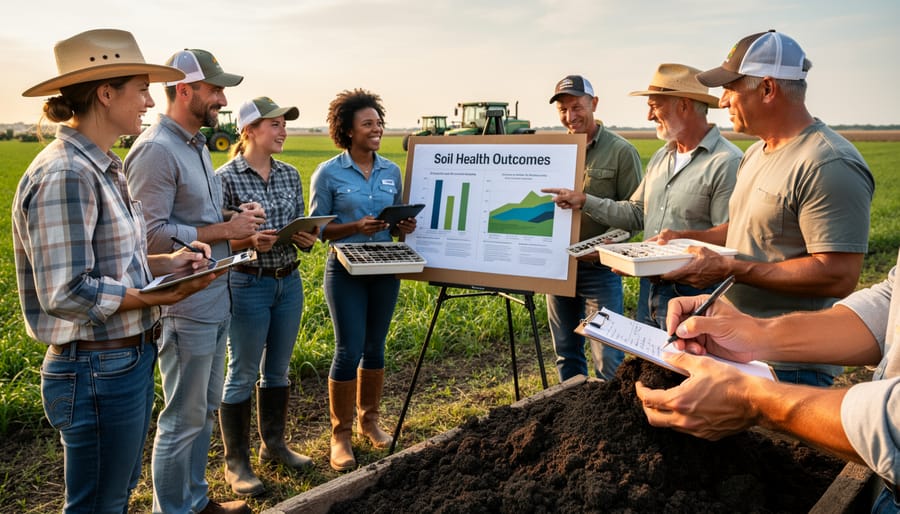
Canadian farmers have a unique opportunity to influence how soil health indicators are integrated into organic standards. The Canadian Organic Standards are reviewed every five years through a collaborative process that welcomes farmer input. You can participate by joining technical committees, attending public consultation sessions, or submitting written feedback to the Canadian General Standards Board when updates are proposed.
Prairie provinces, including Alberta, have active organic farming associations that aggregate farmer perspectives and present them to policy makers. Joining these groups amplifies your voice and connects you with others sharing similar soil health experiences. Many farmers have successfully advocated for regionally appropriate standards by documenting their on-farm results and sharing data with certification bodies.
Consider participating in farmer-led research projects that measure soil health outcomes under Canadian growing conditions. Your real-world data helps shape practical, achievable standards. Organizations offering assistance to organic farmers can guide you through formal feedback processes and connect you with advocacy networks.
Start by documenting your current soil health practices and results. This information becomes powerful evidence when standards bodies seek input on outcome-based requirements. Your experience matters in creating policies that reflect the realities of Canadian organic farming.
Soil health indicators transform from abstract measurements into powerful management tools when paired with clear outcome standards. As organic policy evolves toward outcome-based requirements, Canadian farmers who begin measuring now will be positioned ahead of the curve—both for certification purposes and for their own operational success.
The message from agricultural professionals across Alberta is consistent: start establishing your baseline today. Even simple, affordable tests for organic matter, aggregate stability, and active carbon provide valuable insights that compound over time. Dr. Michelle Hubbard from the University of Alberta emphasizes that “five years of consistent data tells a story that a single snapshot never can.”
Engaging with standards development is equally important. Provincial organic associations and certification bodies are actively seeking farmer input to shape practical, regionally-appropriate benchmarks. Your experience with what works in Alberta’s diverse growing conditions—from the Peace Country to the irrigation districts of southern Alberta—is essential knowledge that should inform policy. Community participation ensures standards reflect real-world farming challenges rather than theoretical ideals.
The economic case for investing in soil health monitoring continues to strengthen. Farmers documenting measurable improvements in water infiltration rates, nutrient cycling, and biological activity report reduced input costs alongside yield stability. These improvements create resilience against drought and excess moisture—critical advantages in our increasingly variable climate.
Beginning this journey doesn’t require perfection. Start with one or two indicators, track them consistently, and build from there. The combination of your monitoring efforts and evolving outcome standards creates pathways toward both environmental stewardship and economic viability for the next generation of Canadian agriculture.