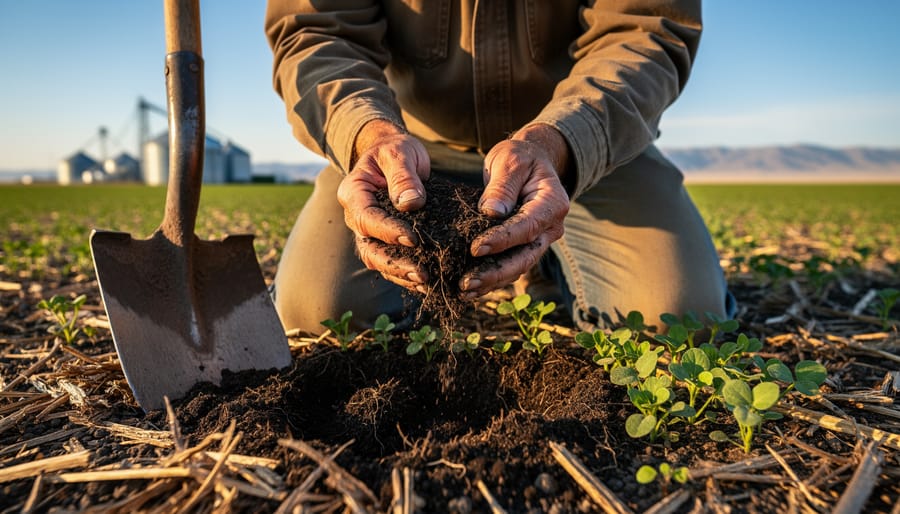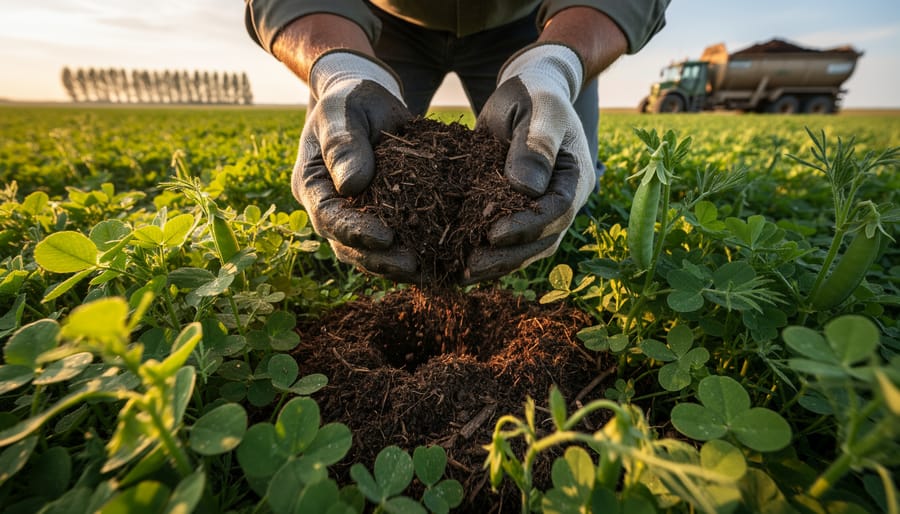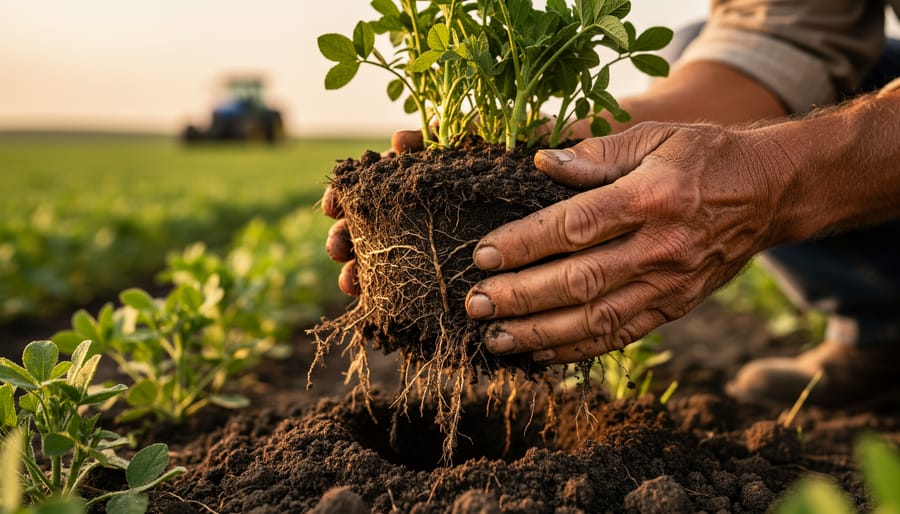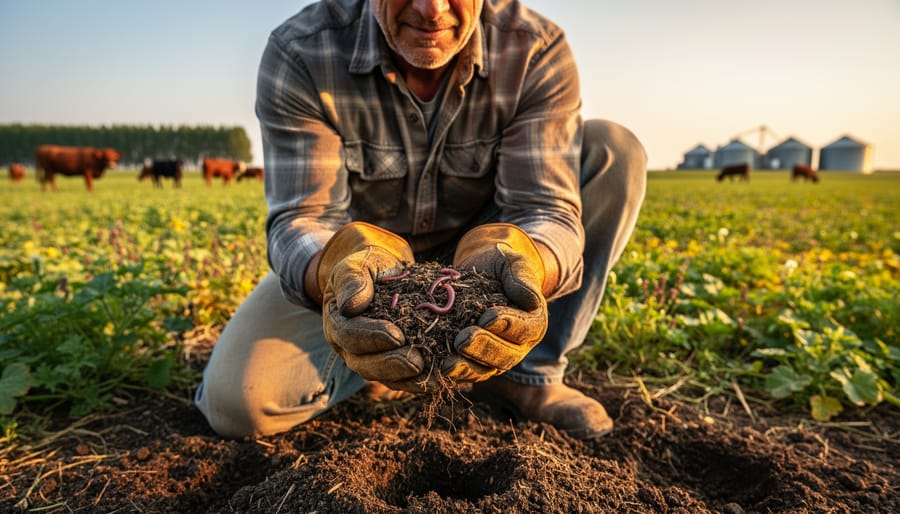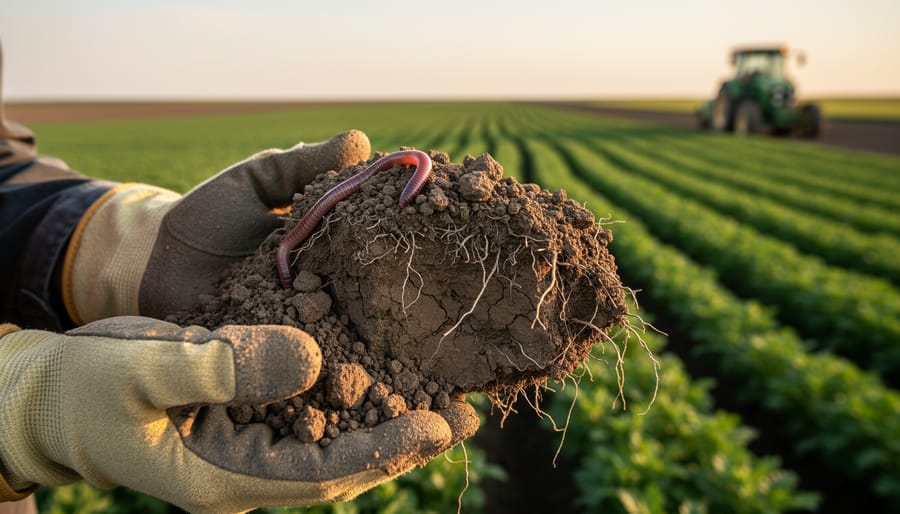
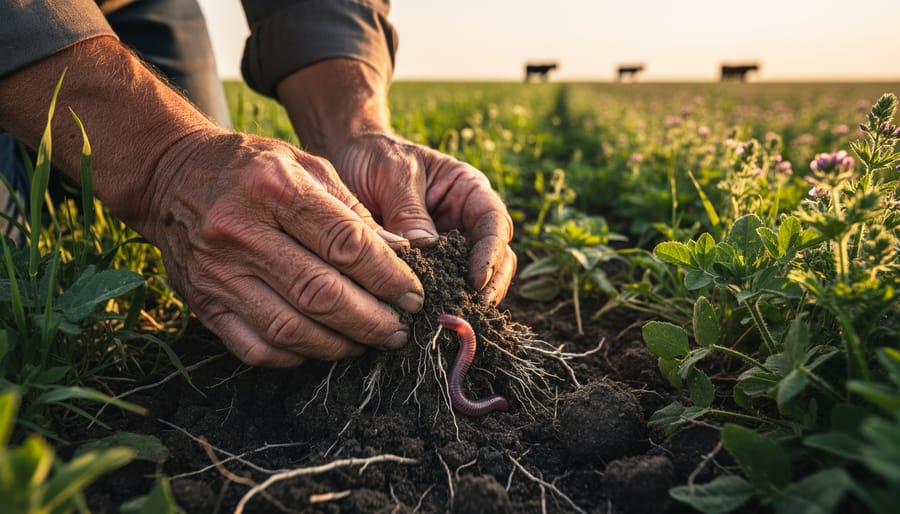
Your soil is telling a story—and understanding the five soil health principles can help you read it better and respond with practices that build lasting fertility, resilience, and profitability.
These principles aren’t complicated theories dreamed up in a laboratory. They’re observations drawn from nature itself, refined by decades of farmer experience and scientific validation. Across Alberta and throughout Canada, producers are discovering that when they align their management decisions with these foundational principles, their soil responds with improved structure, increased water-holding capacity, stronger nutrient cycling, and better crop performance year after year.
The beauty of the soil health framework is its flexibility. Whether you’re managing 160 acres of diverse vegetables near Edmonton or 5,000 acres of grain in the Peace Country, these principles adapt to your operation’s unique circumstances. They work together, each one reinforcing the others, creating a management approach that’s greater than the sum of its parts.
Think of soil as a living system rather than an inert growing medium. Every management decision you make either feeds that living system or depletes it. The five principles—minimizing soil disturbance, keeping soil covered, maintaining living roots, diversifying plant species, and integrating livestock where possible—provide a roadmap for feeding and strengthening the biological community beneath your feet.
This isn’t about abandoning everything you know or making radical overnight changes. It’s about understanding how natural systems function and finding practical ways to incorporate that knowledge into your current operation. The farmers who’ve embraced these principles report not just healthier soil, but often reduced input costs, improved drought resilience, and stronger bottom lines.
Let’s explore each principle and discover how you can put them to work on your land.
Why Soil Health Principles Matter for Canadian Farmers
Understanding why soil health principles matter starts with recognizing the unique conditions Canadian farmers face. Alberta’s prairie climate presents distinct challenges, from cold winters that freeze soil microbial activity to short growing seasons and variable precipitation patterns. These conditions make building resilient, healthy soil not just beneficial, but essential for long-term farm success.
The economic case for healthy soil is compelling. Canadian farmers who implement soil health practices typically see input cost reductions of 15-30% within three to five years. Improved soil structure means better water infiltration, reducing irrigation needs by up to 40% in some operations. Healthier soil also supports more efficient nutrient cycling, decreasing fertilizer requirements while maintaining or even increasing yields. Many Alberta producers report yield improvements of 10-20% after consistently applying soil health principles, directly impacting their bottom line.
From an environmental perspective, the stakes are significant. Agriculture and Agri-Food Canada reports that approximately 36% of Canadian agricultural land shows signs of degradation, with erosion affecting millions of hectares annually. In Alberta alone, wind and water erosion remove valuable topsoil that took centuries to develop. However, the opportunity for positive impact is equally substantial. Canadian agricultural soils have the potential to sequester 2-5 million tonnes of carbon dioxide equivalent annually when managed according to soil health principles, contributing meaningfully to national climate goals while improving farm productivity.
Beyond carbon, healthy soils provide critical ecosystem services including water filtration, biodiversity support, and enhanced drought resilience. During Alberta’s increasingly variable weather patterns, farms with improved soil health have demonstrated better recovery from both drought and excess moisture events. This resilience translates to more stable production and reduced risk, factors that matter tremendously when margins are tight.
The path forward isn’t about working harder but working smarter with nature’s systems. By understanding and implementing soil health principles, Canadian farmers position themselves for economic sustainability while stewarding the land for future generations.
Principle 1: Minimize Soil Disturbance
What This Means in Practice
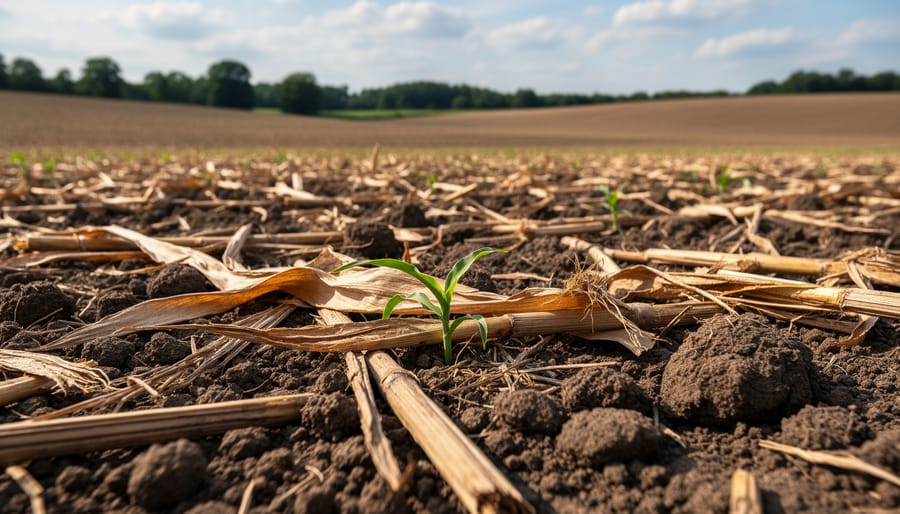
In Alberta’s diverse growing conditions, minimizing soil disturbance looks different from farm to farm, but the core benefits remain consistent. No-till farming means planting directly into crop residue without turning the soil, while reduced-till involves minimal disturbance just at the seed row. Both approaches protect soil structure, reduce erosion from prairie winds, and help retain precious moisture during dry periods.
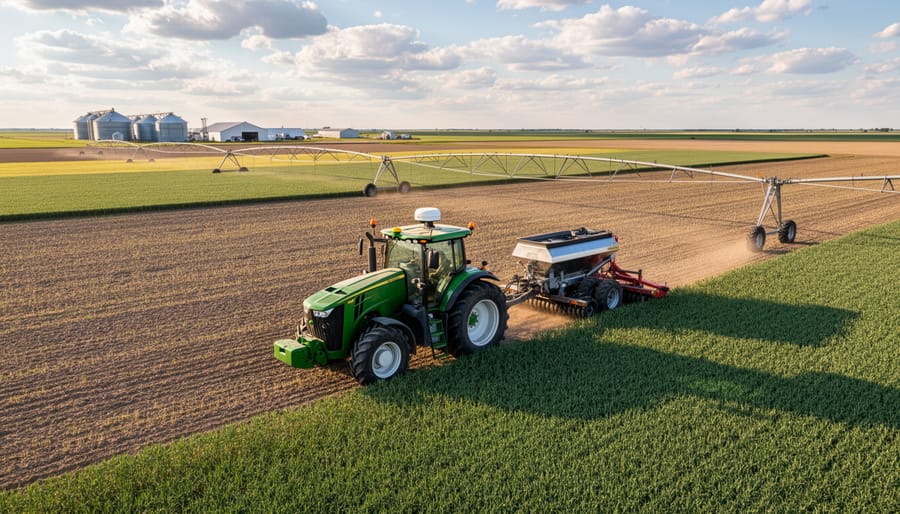
For farmers transitioning from conventional tillage, starting with reduced-till on a portion of your land allows you to test equipment and observe results without committing your entire operation. Many Alberta producers have found success using modern air seeders that cut through residue while placing seed and fertilizer in one pass. This approach functions as both an efficient planting method and no-till as climate solution, reducing fuel costs and carbon emissions significantly.
The key challenge in Alberta is managing heavy residue in shorter growing seasons. Consider using residue management attachments on your combine and varying row spacing to prevent buildup. Spring soil temperatures may be cooler initially under no-till, so adjusting seeding dates by 3-5 days can optimize emergence. With patience and proper equipment adjustments, most Alberta farmers see improved water infiltration and reduced wind erosion within the first growing season.
Alberta Case Study: Transitioning from Conventional to No-Till
When Jim Morrison from Lethbridge County began his transition from conventional tillage to no-till in 2018, he faced immediate challenges that tested his commitment. “The first year was rough,” Jim admits. “My yields dropped about 15%, and I second-guessed everything.” Working with his local agronomist, Jim learned that soil disturbance from decades of tillage had depleted organic matter to just 2.1%, and his soil needed time to rebuild its structure.
By year three, Jim’s patience paid off. Soil organic matter increased to 3.4%, and earthworm populations tripled. His canola yields not only recovered but exceeded his conventional averages by 8%. Water infiltration improved dramatically—previously, heavy rains would pool on his fields for hours; now water soaks in within minutes. Jim’s experience mirrors findings from other Prairie farmers focused on doubling soil health through reduced disturbance.
“The key was staying the course and keeping my soil covered with residue,” Jim explains. He now saves approximately $35 per acre annually on fuel and equipment costs while building healthier, more resilient soil for future generations.
Expert Insight
Dr. Sarah Mitchell, a soil scientist with Agriculture and Agri-Food Canada, emphasizes that minimizing disturbance doesn’t mean abandoning all tillage overnight. “For organic producers in Alberta, the transition can be gradual,” she explains. “Start by reducing tillage depth and frequency in selected fields. Many producers find success with zone tillage or strip tillage, which maintains some soil structure while managing weeds effectively.” She adds that combining reduced disturbance with diverse crop rotations creates resilience in organic systems. “The key is working with your soil’s natural processes rather than fighting against them. Even small reductions in tillage intensity can yield measurable improvements in soil aggregation and water infiltration within two to three growing seasons.”
Principle 2: Keep the Soil Covered
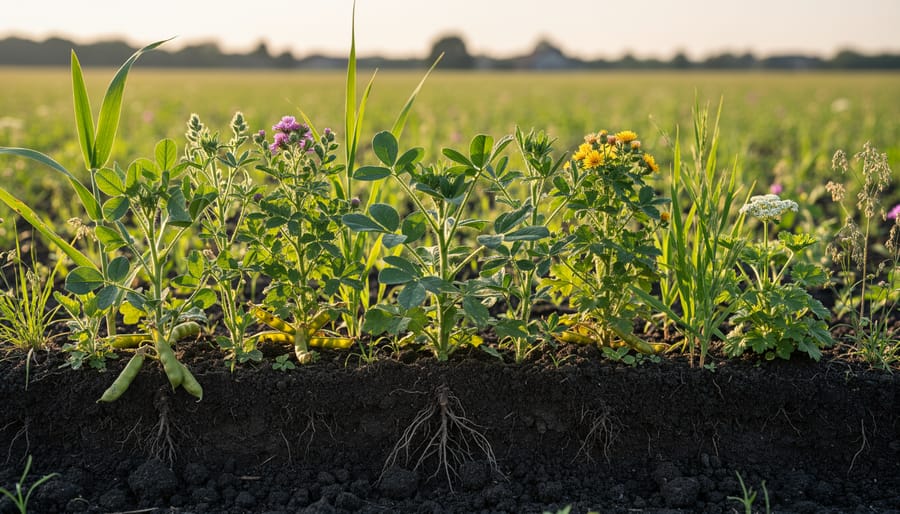
Cover Crop Options for Alberta’s Growing Season
Alberta’s shorter growing season demands strategic cover crop selection, but several species thrive under these conditions. For early spring seeding (late April to May), consider winter-hardy cereals like fall rye or winter wheat, which establish quickly and provide excellent soil coverage. Summer annual options work well when seeded after spring crops, typically from June through early August.
Fast-growing choices include oats, which mature in 60-70 days and offer excellent weed suppression, and radish varieties like tillage radish that break up compacted soil layers while scavenging nutrients. Peas and field beans add nitrogen while improving soil structure, making them valuable rotation partners. For late-season plantings (mid-August), focus on cold-tolerant species like winter rye or hairy vetch.
Mix multiple species to maximize benefits—combining grasses with legumes creates diverse root systems and balanced nutrient cycling. A popular Alberta blend includes oats, peas, and radish, providing quick establishment and multiple soil health advantages. Time your planting to ensure at least 60 frost-free days for adequate biomass production.
Local cover crop success stories demonstrate how producers adapt these species to their specific regions, proving that even shorter seasons can support robust cover cropping programs.
Managing Crop Residue Throughout the Year
Keeping your soil covered year-round doesn’t end when you harvest your cash crop. The residue left behind serves as your first line of defense against erosion and provides ongoing benefits to soil biology. In Alberta’s climate, managing crop residue strategically makes the difference between building or losing soil health over winter.
Consider leaving taller stubble during harvest, ideally 30-40 cm, to trap snow and reduce wind erosion across Prairie fields. This practice also creates beneficial microclimates for soil organisms. When direct seeding into residue the following spring, you’re maintaining that protective layer while minimizing soil disturbance.
For fields where residue alone isn’t sufficient, winter cover crops like fall rye or winter wheat can bridge the gap between harvest and spring seeding. Alberta farmer James Chen from Lacombe found that seeding fall rye immediately after barley harvest gave him excellent ground cover through winter. “The rye protects the soil and adds organic matter when I terminate it in spring,” he explains.
The key is planning your residue management as part of your overall rotation strategy, ensuring every field has adequate cover during vulnerable periods when bare soil faces Alberta’s harsh winter winds and spring snowmelt.
Expert Insight
“When selecting cover crops for organic systems in Alberta, focus on diversity and timing,” advises Dr. Maria Chen, agronomist specializing in soil health at Olds College. “I recommend blending at least three species—typically a grass, a legume, and a brassica—to maximize soil benefits. For example, oats provide quick biomass, field peas fix nitrogen, and radishes break up compaction.” Dr. Chen emphasizes termination timing as critical: “In organic systems without herbicides, winter-kill species like oats work beautifully for our climate. They naturally terminate, leaving residue that protects soil through spring.” She notes that many Alberta farmers succeed by seeding cover crops immediately after harvest in late August, capturing remaining moisture and growing season. “Don’t overthink it—start simple with proven mixes and adjust based on your observations each season.”
Principle 3: Maximize Living Roots
Extending the Growing Season Underground
Alberta’s short growing season presents unique challenges for maintaining living roots year-round, but strategic planning can significantly extend your underground growing period. The key is combining succession planting with strategic perennial integration.
Start by establishing perennial forages like alfalfa or meadow bromegrass in rotation areas. These deep-rooted plants maintain active root systems from early spring thaw through late fall, often adding 60-90 additional days of living root activity compared to annual crops alone. Peace Country producer James Henderson integrated 20% perennial strips into his annual cropping system and measured improved water infiltration rates within two seasons.
For annual crops, plan succession plantings that maximize soil coverage. After harvesting winter wheat in late July, immediately seed a cover crop mix of oats and field peas. This approach keeps roots feeding soil biology through September or early October, depending on your region’s first frost date.
Consider frost-tolerant species like winter rye, which can be seeded in late August and maintains root growth until freeze-up, then resumes activity during spring thaw before your cash crop planting. Edmonton-area agronomist Dr. Sarah Chen notes that “even dormant periods with established root structures provide habitat and food sources for soil organisms, maintaining ecosystem function through winter months.”
The Connection Between Roots and Soil Carbon
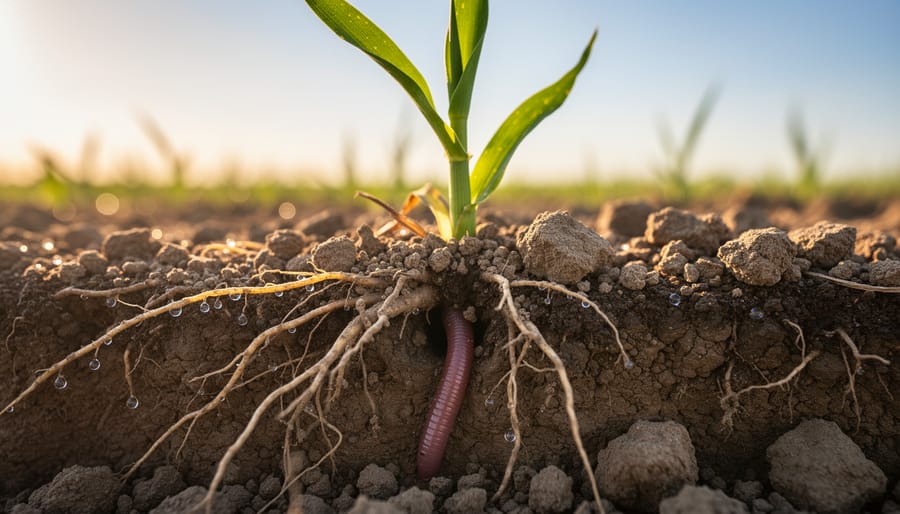
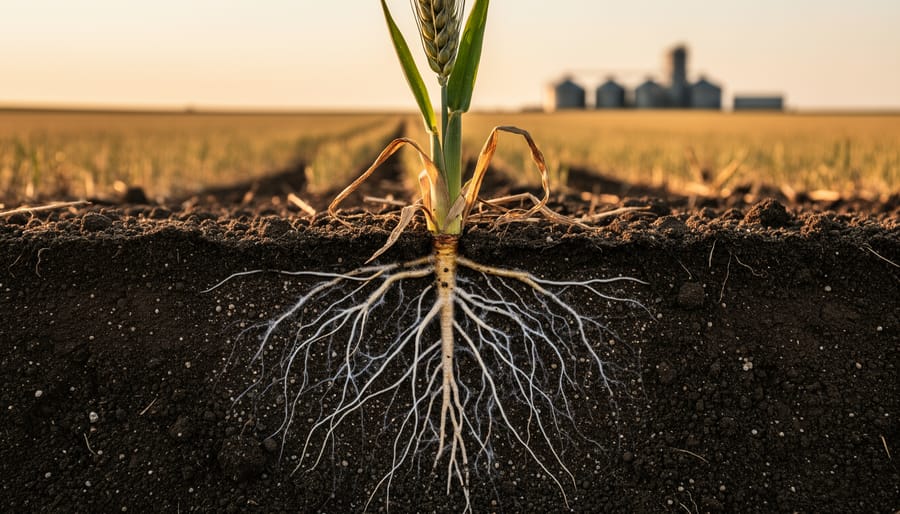
Living roots are essentially carbon-pumping powerhouses working beneath your fields. Through photosynthesis, plants capture carbon dioxide from the atmosphere and convert it into sugars. A significant portion of these sugars—up to 40 percent—travels down through the plant and is released through the roots as exudates. These carbon-rich compounds feed the billions of microorganisms living in your soil, creating a thriving underground ecosystem.
This relationship drives carbon sequestration in a remarkably efficient way. As soil microbes consume root exudates, they multiply and eventually die, contributing their carbon-based bodies to soil organic matter. The roots themselves also add carbon directly through sloughed-off cells and fine root turnover. In Alberta conditions, maintaining living roots year-round through cover cropping or extended growing seasons can sequester an additional 0.5 to 1.0 tonnes of carbon per hectare annually.
The practical benefit for your operation goes beyond environmental impact. This continuous carbon addition improves soil structure, increases water-holding capacity by up to 20 percent, and builds the nutrient-rich organic matter that supports higher yields. The longer you keep living roots in the ground throughout the year, the more carbon you’re banking in your soil—literally growing your farm’s most valuable asset from the ground up.
Expert Insight
Dr. Maya Chen, a soil microbiologist with Agriculture and Agri-Food Canada in Lethbridge, has spent over 15 years studying root systems in prairie soils. “What surprised me most in our research is how quickly soil biology responds when farmers adopt even two or three of these principles together,” she explains. “We’ve documented measurable improvements in root penetration and water infiltration within just one growing season on Alberta farms.” Dr. Chen emphasizes that keeping living roots in the soil year-round makes the biggest difference. “In our cold climate, winter-hardy cover crops create underground highways for water and nutrients. The soil doesn’t shut down – it’s working for you even under snow.” Her team’s field trials show that combining minimal disturbance with diverse crop rotations can double beneficial fungal networks within three years, directly improving drought resilience across the prairies.
Principle 4: Increase Biodiversity
Crop Rotation Strategies for Organic Systems
Designing an effective crop rotation starts with planning three to four years ahead, incorporating crops from different plant families to disrupt pest and disease cycles naturally. Alberta organic farmers are finding success with rotations that alternate deep-rooted crops like alfalfa with shallow-rooted cereals, preventing nutrient depletion at any single soil depth.
Consider a proven sequence: begin with a nitrogen-fixing legume like field peas or lentils, follow with a heavy feeder such as wheat or canola, then plant a cover crop or green manure, and finish with a lighter-feeding cereal like oats. This pattern builds soil organic matter while managing nutrient demands strategically.
Jim Peterson, an organic grain farmer near Leduc, shares his experience: “Rotating between pulses, cereals, and a rest year with cover crops cut my disease pressure by half within three seasons. The soil just comes alive when you give it variety.”
Include at least one nitrogen-fixing legume every three years to reduce synthetic fertilizer dependence. Incorporate crops with diverse root structures—taproots, fibrous roots, and rhizomes—to improve soil structure at multiple depths. Time your rotations to leave fields with residue cover heading into winter, protecting against erosion and feeding soil biology year-round. Track your results annually, adjusting sequences based on what your specific soil conditions reveal.
Integrating Livestock and Beneficial Insects
Incorporating livestock and beneficial organisms creates a living, dynamic soil ecosystem that naturally builds fertility and resilience. Managed grazing using techniques like rotational or adaptive multi-paddock grazing mimics how wild herds historically moved across the prairies, preventing overgrazing while stimulating root growth and organic matter cycling. When cattle graze an area briefly then move on, their hoofprints create soil pockets for seed germination, and their manure feeds soil microbes.
Alberta rancher Tom Kasprick has seen remarkable results integrating sheep into his crop rotation, reducing pest pressure while adding nitrogen naturally. “The sheep handle our weed control and fertilization in one pass,” he explains, noting significant input cost savings.
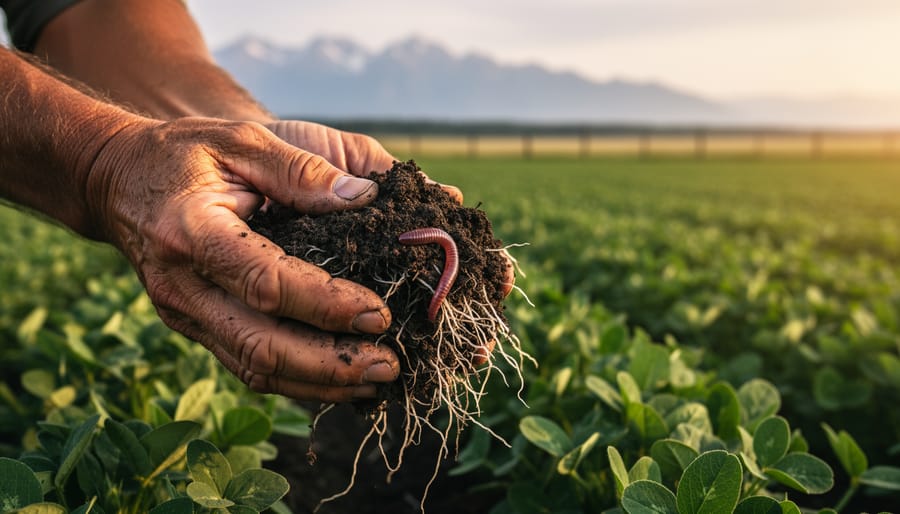
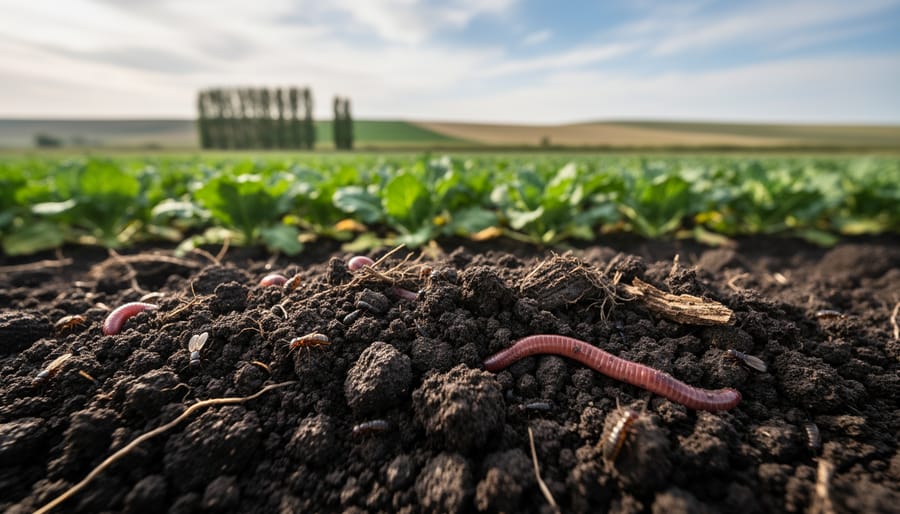
Beyond livestock, encouraging beneficial insects and organisms strengthens your soil’s natural defense systems. Maintain field margins with native flowering plants to attract pollinators and predatory insects that control pests. Ground beetles, earthworms, and predatory mites all contribute to healthier soil structure and nutrient cycling. Reducing tillage and maintaining year-round living roots provides habitat for these allies. Consider installing beetle banks or insectary strips along field edges, creating corridors that support biodiversity while improving your bottom line through reduced chemical inputs and enhanced pollination services.
Expert Insight
“Building biodiversity starts with understanding that your soil is an ecosystem, not just a growing medium,” explains Sarah Chen, organic farming specialist with 15 years of experience across central Alberta. “I’ve watched producers transform their operations by focusing on year-round living roots and diverse crop rotations. One Mixed Farm near Red Deer added flowering cover crop species between their main rotations and saw beneficial insect populations triple within two seasons. The key is patience and consistency. Start small—maybe add one companion crop this year or leave crop residue on just one field. Monitor what happens with your soil structure and earthworm counts. These principles work together, so each improvement you make supports the others. The biodiversity you’re building above ground directly feeds the soil life below, creating resilience that protects your operation through Alberta’s variable weather patterns.”
Principle 5: Integrate Livestock Thoughtfully
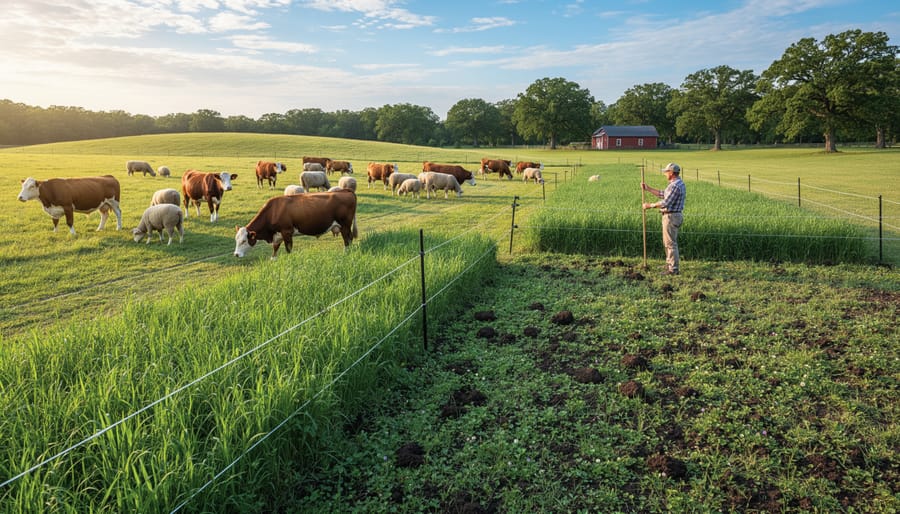
Rotational Grazing Basics for Soil Health
Rotational grazing, particularly adaptive multi-paddock systems, offers Alberta farmers a powerful approach to rebuilding soil through grazing while maintaining productive livestock operations. This method involves moving animals through smaller paddocks more frequently, allowing adequate rest periods for plant recovery between grazing events.
The key is timing. When cattle graze a paddock for 1-3 days then move on, plants maintain healthy root systems that feed soil biology and build organic matter. Rest periods typically range from 30-90 days depending on season and forage growth rates. This mimics how bison historically moved across the prairies, creating the rich soils our region is known for.
Many Alberta ranchers report improved forage production, better water retention, and reduced feed costs within just a few years of implementation. The system works by stimulating plant growth through controlled grazing pressure, increasing root mass, and encouraging diverse plant communities. Animal impact from hoof action also helps incorporate organic matter and create soil surface roughness that captures moisture. Starting small with existing infrastructure and gradually adding paddocks makes this practice accessible for operations of any size.
Using Manure Strategically in Organic Systems
Manure represents one of the most valuable resources in organic farming systems when managed properly. The key to success lies in composting before application – a process that stabilizes nutrients, eliminates pathogens, and creates a soil amendment that feeds beneficial microorganisms rather than just crops.
For Alberta producers, proper composting typically requires maintaining temperatures between 55-65°C for at least three days, with regular turning every 7-10 days. This thermal process ensures you meet organic certification standards while creating a product that won’t burn plants or introduce weed seeds into your fields.
When applying composted manure, timing matters significantly. Fall applications allow nutrients to integrate into the soil biology over winter, while spring applications should occur at least 120 days before harvesting crops for human consumption under organic standards. Aim for application rates of 10-20 tonnes per hectare, adjusted based on soil tests and crop requirements.
Jason Mueller, an organic grain farmer near Lacombe, shares his approach: “We test our compost annually and apply based on what our soil actually needs, not just what we have available. This targeted strategy has reduced our input costs while improving our soil structure.”
Consider establishing designated composting areas with proper drainage and accessibility for equipment. Monitor moisture levels – your compost pile should feel like a wrung-out sponge – and maintain a carbon-to-nitrogen ratio around 30:1 for optimal decomposition.
Expert Insight
“The beauty of these five principles is they work together on the land,” shares Tom Hendricks, a third-generation rancher from Olds, Alberta. “We started with simple changes—keeping living roots year-round through cover crops and reducing tillage on 40 hectares. Within two seasons, we noticed improved water infiltration and healthier livestock grazing. The key is starting small and building confidence. Don’t try to implement everything at once—pick one principle that fits your operation and expand from there.”
Implementing All Five Principles Together
The five soil health principles—minimizing soil disturbance, maximizing soil cover, increasing plant diversity, maintaining living roots year-round, and integrating livestock—don’t work independently. They function as interconnected components of a healthy soil ecosystem, each amplifying the benefits of the others. When you combine diverse cover crops with reduced tillage, for example, you’re simultaneously feeding soil biology, protecting against erosion, and building organic matter more effectively than either practice alone. This synergy is what makes regenerative farming principles so powerful for long-term sustainability.
Starting your journey doesn’t require implementing all five principles immediately. For Alberta grain producers with existing no-till equipment, beginning with soil cover through diverse cover crop mixes is often the most practical entry point. Livestock operations might prioritize adaptive grazing management first, then gradually introduce diverse forage species. Mixed farms have a unique advantage—you can integrate livestock into crop rotations more easily, accelerating soil improvement.
Focus on what aligns with your current equipment, knowledge, and financial resources. Many successful farmers start with one or two principles, master them over two to three growing seasons, then layer in additional practices as they gain confidence and see results.
Monitoring progress keeps you motivated and guides decision-making. Simple on-farm tests like the slake test (observing how soil aggregates hold together in water) or counting earthworms per cubic metre of soil provide immediate feedback. More comprehensive soil testing every two to three years tracks organic matter percentage, aggregate stability, and biological activity. Many Alberta producers also track operational indicators: reduced fuel costs from less tillage, decreased fertilizer requirements, or improved water infiltration rates during heavy rainfall events.
Remember, soil health improvement is measured in years, not months. Celebrate small wins along the way, connect with other farmers implementing these practices, and adjust your approach based on what you observe in your fields.
Transforming your farm’s soil health doesn’t require an overnight revolution. The beauty of these five principles lies in their flexibility and proven track record across Alberta’s diverse agricultural landscape. Whether you manage 40 hectares near Lethbridge or 400 hectares in the Peace Region, you can start small and build momentum.
Consider beginning with just one or two principles that align with your current operation. Many Alberta farmers have found success by first reducing tillage while introducing a simple cover crop mix. Others start by diversifying their rotation before tackling livestock integration. There’s no single right path, only the path that works for your land, your goals, and your resources.
The results speak for themselves. Farmers implementing these principles report improved water infiltration, reduced input costs, stronger drought resilience, and healthier crops. Beyond your farm gate, you’re contributing to climate solutions and building soil carbon that will benefit future generations.
You’re not alone on this journey. Alberta’s agricultural community offers tremendous support through local workshops, on-farm demonstrations, and peer networks where experienced farmers share real-world insights. Regional agrologists and soil health specialists stand ready to help you design strategies tailored to your operation.
Connect with your local agricultural fieldmen, attend soil health workshops, or join a farmer-led research group in your area. The knowledge and support systems exist; now it’s about taking that first step.
As stewards of the land, Alberta farmers hold incredible power to regenerate soil, strengthen rural communities, and demonstrate climate leadership. Your commitment to soil health principles today creates lasting benefits for generations to come.