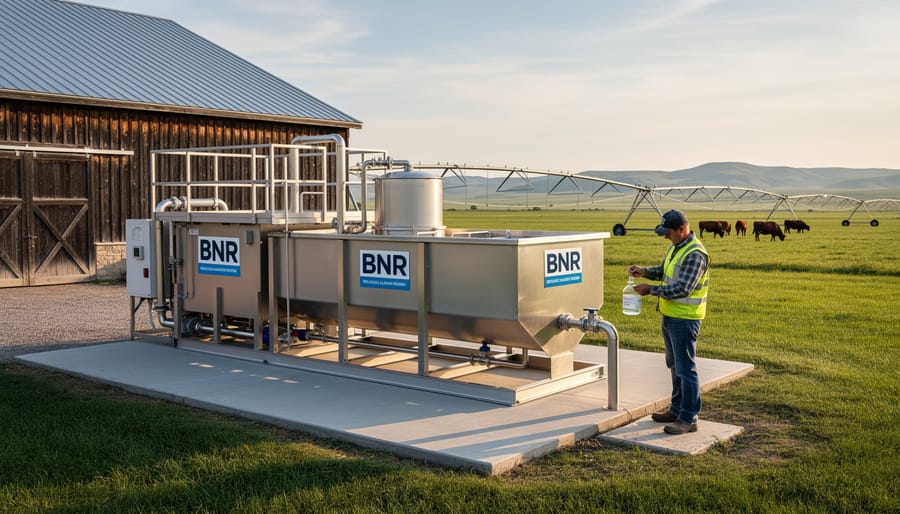
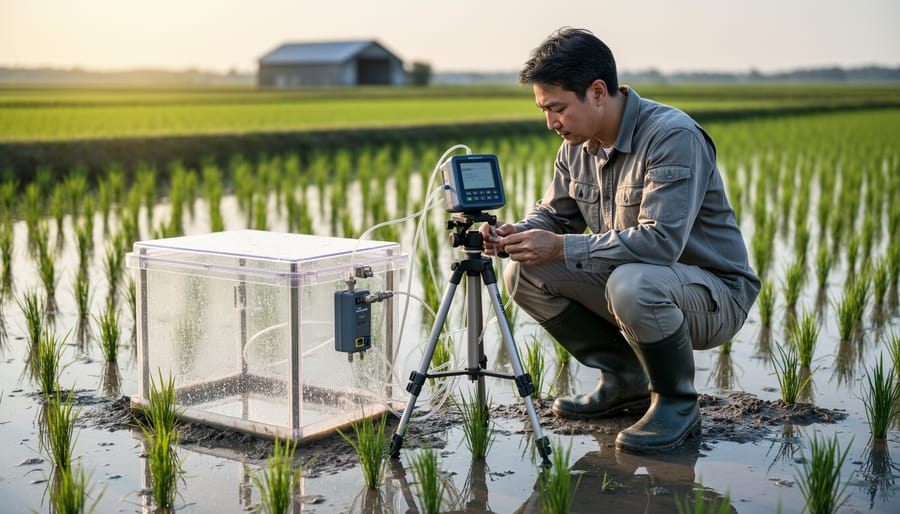
Rice paddies account for approximately 8% of global methane emissions, making them a significant contributor to climate change that Canadian farmers can now transform into a revenue opportunity through Measurement, Reporting, and Verification certification programs.
Measure your baseline emissions using portable methane analyzers or install automated chamber systems in representative field sections to establish accurate starting data. Document water management practices throughout the growing season, including flooding duration, drainage timing, and irrigation schedules, as these directly influence methane production rates. Calculate your field’s methane output using IPCC Tier 2 or Tier 3 methodologies, which provide the precision required for carbon credit markets.
Implement alternate wetting and drying cycles by draining fields for 3-7 days when water levels drop 15 centimeters below the soil surface, reducing methane emissions by 30-70% while maintaining yields. Apply composted rather than fresh organic amendments, as decomposed materials release significantly less methane during anaerobic breakdown. Time fertilizer applications to match crop uptake periods, preventing excess nutrients from fueling methane-producing bacteria in waterlogged soils.
The opportunity extends beyond environmental stewardship. MRV certification transforms verified emission reductions into tradeable carbon credits, with rice methane projects currently earning between $15-40 per tonne of CO2 equivalent. Alberta farmers piloting these systems report documentation takes 2-4 hours monthly once protocols are established, with third-party verification occurring annually. The certification process requires continuous monitoring equipment, detailed record-keeping of management practices, and independent audits, but participating producers emphasize that carbon revenue often exceeds implementation costs within two growing seasons.
Understanding methane dynamics in flooded rice systems positions you to capture both agronomic improvements and emerging carbon market opportunities.
Why Rice Paddies Produce So Much Methane
The Flooded Field Effect
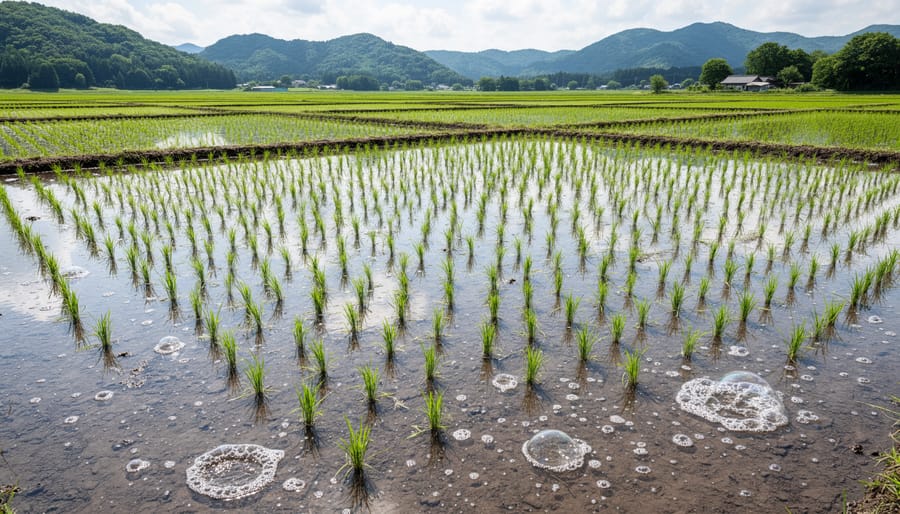
When rice paddies are flooded, something remarkable happens beneath the water’s surface. The standing water creates anaerobic conditions, meaning oxygen can’t penetrate the soil. This oxygen-free environment becomes an ideal habitat for methanogens, specialized bacteria that produce methane as a byproduct of breaking down organic matter.
Think of it like composting in reverse. While your compost pile needs oxygen to break down materials efficiently, flooded rice fields work differently. The waterlogged soil forces microbes to find alternative ways to process plant residues and soil organic matter. Without oxygen available, these methanogens step in and produce methane gas, which bubbles up through the water and into the atmosphere.
Dr. Sarah Chen, a soil microbiologist at the University of Alberta, explains it simply: “The longer fields stay flooded and the warmer the water temperature, the more active these bacteria become. It’s a natural process, but one we can manage better with the right practices.”
The depth and duration of flooding directly influence how much methane gets produced. Continuously flooded fields can emit between 20 to 100 kilograms of methane per hectare during a growing season, making water management a key factor in reducing emissions.
Peak Emission Periods in the Growing Season
Methane emissions from rice paddies follow a distinct pattern throughout the growing season, with the highest release occurring during specific growth stages. Peak emissions typically happen during the mid-season flooding period, roughly 30 to 60 days after transplanting, when plants are actively growing and soil organic matter decomposition is most intense. During this phase, warm soil temperatures combined with standing water create ideal conditions for methane-producing bacteria.
Understanding these emission peaks is essential for accurate measurement and effective mitigation. The reproductive stage of rice growth often sees a secondary emission spike, as root systems expand and create more pathways for methane to escape into the atmosphere. For farmers pursuing carbon credits through MRV certification, timing your measurements during these critical windows ensures you capture the most significant emissions data.
While rice cultivation isn’t common in Alberta’s agricultural landscape, Canadian farmers exploring diversified cropping systems or working with international carbon offset programs benefit from this knowledge. Dr. Sarah Chen, an agricultural emissions specialist at the University of Saskatchewan, notes that “capturing data during peak periods gives us 70 to 80 percent of the total seasonal emissions picture, making monitoring more efficient and cost-effective for certification purposes.”
Understanding MRV: Measurement, Reporting, and Verification
The Three Pillars of MRV
Understanding how MRV works doesn’t have to be complicated. Think of it as three straightforward steps that build credibility for your emission reduction efforts.
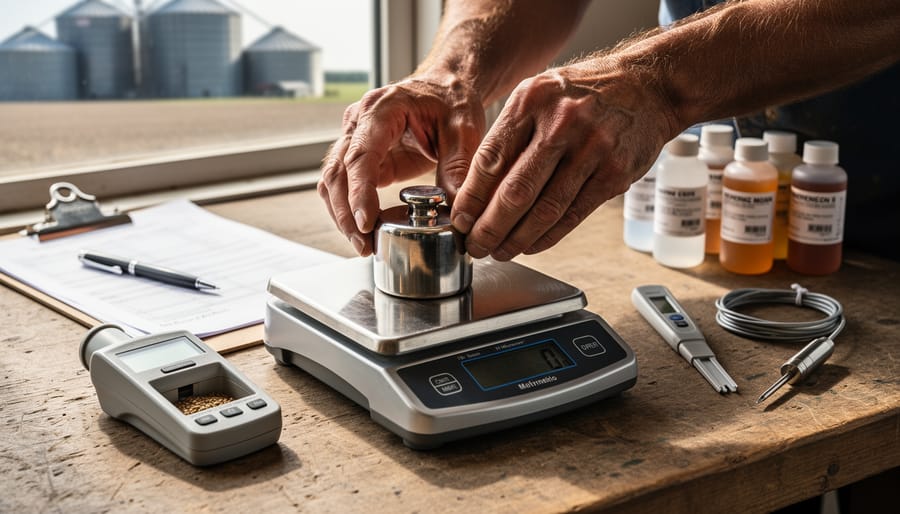
Measurement is the foundation—it’s about collecting accurate data on methane emissions from your rice fields. This might involve periodic water sampling, monitoring flooding schedules, or using specialized equipment to capture emission readings. For Canadian farmers new to rice production or those managing small trial plots, measurement can be as simple as keeping detailed records of water management practices, organic matter inputs, and field conditions. More established operations might partner with agricultural consultants who use portable gas analyzers or chamber-based systems to directly measure methane release during the growing season.
Reporting takes your measurement data and documents it in a standardized format. You’ll record your farming practices—when you drained fields, what amendments you applied, and any mid-season drainage events. This creates a transparent record that shows how your management choices impact emissions. Many MRV plan templates include user-friendly digital platforms where you can log this information throughout the season.
Verification is where independent third-party experts review your measurements and reports to confirm accuracy. They ensure your data collection methods meet established standards and that your reported reductions are genuine. This outside validation gives buyers of carbon credits confidence in your environmental claims. While it adds a step to the process, verification protects both you and the integrity of emission reduction programs, ensuring fair compensation for your sustainable practices.
Why Certification Matters for Your Operation
Methane reduction certification isn’t just about environmental responsibility—it represents a genuine economic opportunity for your farming operation. By documenting and verifying your methane reduction efforts, you gain access to carbon credit programs that can generate additional revenue streams alongside your traditional crop sales.
Certified operations are increasingly attracting attention from buyers seeking sustainably-produced rice. Premium markets, particularly in urban centers across Canada and internationally, are willing to pay more for products with verified environmental credentials. This certification acts as your proof of commitment to sustainable practices.
Beyond direct financial benefits, certification can strengthen your position when applying for agricultural grants and sustainability-focused funding programs. Many government and private initiatives now prioritize operations with documented environmental performance. The certification process itself often reveals operational efficiencies you might have overlooked, potentially reducing input costs while improving your environmental footprint.
For Canadian farmers exploring diversification, certified methane reduction provides a competitive advantage in an evolving agricultural marketplace where sustainability credentials matter more each season.
Practical Methods to Measure Methane from Your Rice Fields
Chamber-Based Measurement Techniques
Chamber-based measurement is the most practical method for quantifying methane emissions from rice paddies. These systems work by placing enclosed chambers over water and soil surfaces to capture gas samples for analysis.
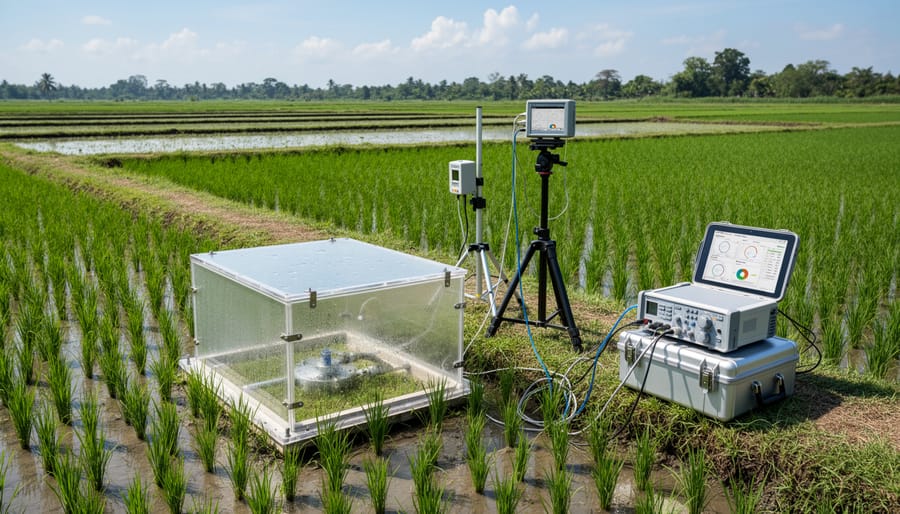
Static chambers are the most cost-effective option, typically ranging from $200 to $800 per unit. You’ll place these chambers on the paddy surface for 30-60 minutes, then collect gas samples manually using syringes. These samples are analyzed with portable gas analyzers ($3,000-$8,000) or sent to laboratories. While budget-friendly, static chambers require significant labour and provide only snapshots of emissions throughout the growing season.
Automated chambers offer continuous monitoring with less hands-on time. These systems ($15,000-$40,000 per unit) automatically close at programmed intervals, collect samples, and relay data to your computer or smartphone. Dr. Sarah Chen from the University of Alberta notes that “automated systems capture the daily fluctuation patterns that manual sampling often misses, giving farmers more accurate emission profiles for MRV reporting.”
For practical implementation, plan to install 3-5 chambers per hectare to account for field variability. Position them in representative areas, avoiding field edges or unusual spots. You’ll need reliable power sources for automated systems and regular calibration for all equipment. Many Canadian agricultural consultants now offer chamber rental programs, allowing you to test methods before committing to purchase. Consider partnering with neighbouring farms to share equipment costs and technical expertise.
Remote Sensing and Modeling Approaches
Technology is transforming how we measure methane emissions from rice fields, making monitoring more accessible and cost-effective for farmers. Satellite imagery and drone technology now allow agricultural professionals to estimate emissions across large areas without constant field visits. These remote sensing tools detect methane concentrations and monitor factors like water management and plant health that influence emissions.
Computer models combine this satellite data with local weather patterns, soil conditions, and farming practices to predict methane output with impressive accuracy. For Canadian farmers exploring rice cultivation or working with international partners, these technologies simplify the MRV certification process significantly. Dr. Sarah Chen, an agricultural technology specialist based in Calgary, explains: “Remote sensing reduces the need for expensive on-site equipment while still providing reliable data for carbon credit programs.”
Several Canadian agricultural organizations are already piloting these approaches for other crops, demonstrating their practical application. The technology continues improving, with newer systems offering real-time monitoring capabilities. While initial setup requires some investment, many certification programs now accept remote sensing data, making sustainable rice farming more economically viable. This approach lets you focus on implementing reduction strategies while technology handles the detailed measurements needed for verification.
Choosing the Right Method for Your Farm Size
Selecting the right measurement method depends on three key factors: your farm’s size, available budget, and certification goals. For small operations under 20 hectares, manual chamber sampling offers an affordable entry point, typically costing $2,000-5,000 annually. Mid-sized farms (20-100 hectares) often benefit from combining chambers with periodic professional assessments, balancing accuracy with cost-effectiveness at $8,000-15,000 per year.
Large-scale operations exceeding 100 hectares should consider automated monitoring systems or micrometeorological towers, which provide continuous data despite higher upfront investments of $25,000-50,000. Dr. Jennifer Walsh from Agriculture and Agri-Food Canada notes that “farms pursuing carbon credits need verifiable, consistent data—automated systems typically satisfy auditors more readily.”
Before committing, consult with certification bodies about their specific requirements. Some programs accept modeled estimates for smaller farms, while others mandate direct measurements. Start with your certification end-goal and work backwards to determine which method delivers the necessary data quality within your budget constraints.
Proven Strategies to Reduce Methane Emissions
Water Management: Alternate Wetting and Drying
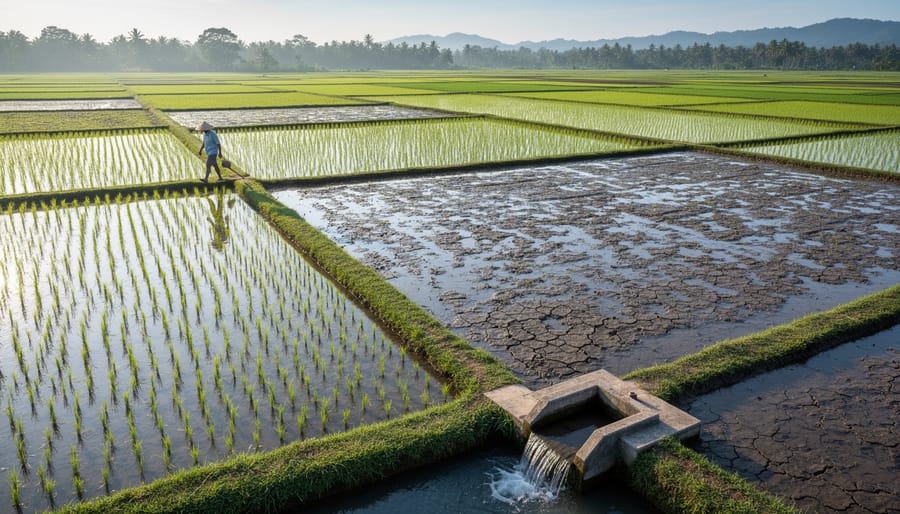
Alternate Wetting and Drying, commonly called AWD, offers rice farmers a practical way to cut methane emissions by up to 48% while using 25% less water. This technique breaks the cycle of continuous flooding that creates the oxygen-free conditions methane-producing bacteria thrive in.
Here’s how to implement AWD on your operation. First, install perforated PVC pipes or field water tubes at several locations across your paddy to monitor water levels below the soil surface. During the growing season, allow the water level to drop 15 centimetres below the soil surface before re-flooding to 5 centimetres above ground. The soil stays moist but not waterlogged, letting oxygen penetrate and disrupting methane production.
Timing matters. Start AWD about two weeks after transplanting, once plants are established. Maintain continuous flooding only during flowering, when rice is most sensitive to water stress. Most varieties handle this schedule well, though you’ll want to monitor plant health during your first season.
Dr. Sarah Chen, a soil scientist working with Alberta growers exploring rice production, notes that “farmers adapting AWD typically see no yield loss while documenting significant emission reductions for MRV certification.” Track your water levels daily and maintain detailed records showing drainage cycles, field conditions, and any observations. This documentation becomes essential evidence when pursuing carbon credits through verification programs.
Organic Amendment Management
How you manage organic materials in your rice paddies directly impacts methane production. When organic matter like crop residues, manure, or compost decomposes underwater in flooded conditions, it creates the perfect environment for methane-producing microbes. The key is timing and application method.
Consider incorporating organic amendments during the dry season or well before flooding. This allows materials to decompose aerobically, significantly reducing methane emissions once water is added. Alberta farmer research collaborations have shown that composted materials, which have already undergone substantial decomposition, produce 30-40% less methane compared to fresh manure or green crop residues applied directly to flooded fields.
When you must add organic matter, aim for smaller, more frequent applications rather than large single doses. This prevents the buildup of readily decomposable material that fuels methane production. Some Canadian growers are finding success with surface application rather than incorporation, as this limits contact with anaerobic zones in the soil.
Working with your agronomist to match organic amendment rates with actual crop needs prevents excess material from becoming methane fuel. This approach not only reduces emissions but also improves nutrient efficiency, giving you environmental and economic benefits that strengthen your position for MRV certification and potential carbon credit opportunities.
Rice Variety Selection and Timing
Selecting the right rice variety can significantly influence methane emissions from your paddies. Certain cultivars naturally produce less methane due to characteristics like shorter growing seasons, lower biomass production, and root structures that release less organic matter into the soil. Research shows that choosing fast-maturing varieties can reduce your growing season by up to 20 days, which directly translates to fewer days of methane production.
When planning your planting schedule, timing matters for emissions reduction. Early-season planting in warmer soil conditions can accelerate plant growth and shorten the flooded period. Dr. Sarah Chen, an agronomist with Agriculture and Agri-Food Canada, notes that “farmers who strategically time their planting based on soil temperature data often see a 15-20% reduction in seasonal methane emissions without sacrificing yield.”
Consider varieties bred specifically for lower greenhouse gas emissions. While Alberta’s rice cultivation is limited compared to traditional growing regions, farmers exploring rice production can learn from successful case studies in California and Asia where emission-conscious variety selection has become standard practice. Working with your local agricultural extension office can help identify cultivars suitable for your specific conditions while meeting MRV certification requirements. This dual approach of variety selection and timing optimization creates measurable emission reductions that strengthen your carbon credit potential.
The Certification Process: Step-by-Step
Establishing Your Baseline Emissions
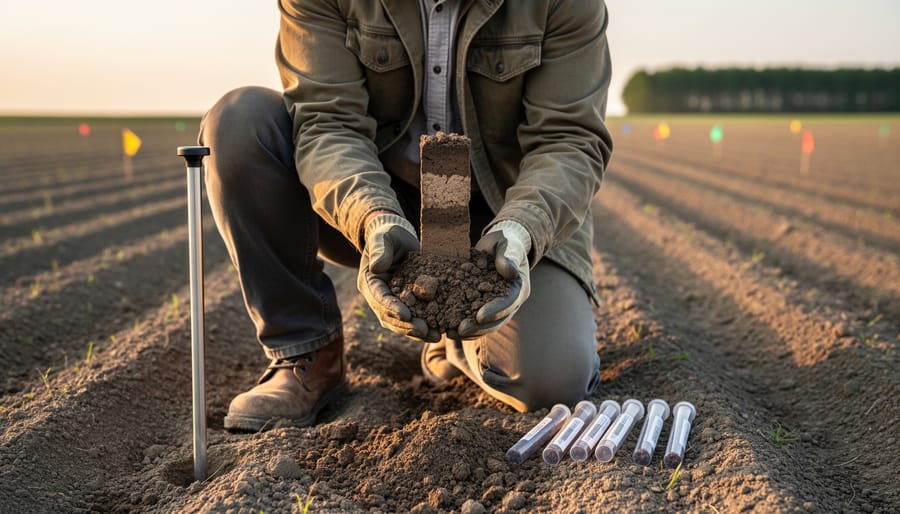
Before you can reduce methane emissions, you need to know where you’re starting from. Think of this as taking a snapshot of your current operation. Begin by documenting your existing farming practices in detail: water management schedules, fertilizer application rates and timing, rice variety selection, and field drainage patterns. Keep records of when fields are flooded, how long water remains standing, and drainage frequency throughout the growing season.
Next, measure your baseline emissions. While specialized equipment exists for precise measurements, Canadian farmers can start with estimation tools and calculators provided through agricultural extension services. Track factors that influence methane production, including organic matter incorporation, soil temperature patterns, and local climate data. Alberta farmers should note regional temperature variations that affect emission levels.
Consider partnering with local agricultural researchers or sustainability consultants who can help establish accurate baseline measurements. This initial documentation becomes your reference point for demonstrating emission reductions later in the MRV certification process, proving the environmental and economic value of your mitigation efforts.
Implementing and Documenting Changes
Proper record-keeping forms the backbone of successful MRV certification for methane reduction in rice production. Start by establishing a baseline documentation system that tracks water management schedules, including dates and duration of field drainage periods. Digital tools and farm management software can simplify this process, but traditional logbooks work equally well if consistently maintained.
Monitor and record water depth measurements at least twice weekly during the growing season, noting any deviations from your planned alternate wetting and drying schedule. Document fertilizer applications, including type, amount in kilograms per hectare, and application dates. Temperature readings and weather conditions should also be logged, as these factors influence methane emissions.
Your documentation for verifiers must include photographic evidence of water management practices, ideally timestamped images showing field conditions at various growth stages. Saskatchewan farmer Tom Chen recommends using smartphone apps that automatically geotag and date photos, creating an easily accessible visual timeline.
Maintain clear records of any challenges encountered and how you addressed them. Third-party verifiers appreciate transparency and thorough documentation that demonstrates your commitment to protocol adherence. Keep all records for at least seven years, as certification bodies may request historical data during audits or renewal processes.
Working with Third-Party Verifiers
Third-party verification brings credibility to your carbon credit certification claims. These independent auditors will review your measurement protocols, data collection methods, and emissions calculations to ensure accuracy and compliance with program standards.
During an audit, expect verifiers to examine your field records, sampling procedures, and any technology used for monitoring. They’ll want to see documented baseline measurements and evidence of implemented reduction practices. Plan for site visits where auditors may take their own measurements or observe your methods firsthand.
Verification costs typically range from $2,000 to $8,000 annually, depending on your operation’s size and complexity. While this represents an investment, verified credits command higher market prices, often offsetting these expenses.
To prepare effectively, maintain detailed records throughout the growing season. Document everything from water management schedules to fertilizer applications. Consider connecting with other Canadian producers who’ve completed verification to learn from their experiences. Many agricultural associations now offer workshops specifically focused on preparing for verification audits, helping you streamline the process and avoid common pitfalls.
Canadian Context: Opportunities and Challenges
Rice Production Potential in Western Canada
Climate change is opening unexpected doors for Western Canadian agriculture. While rice cultivation traditionally thrives in warmer regions, shifting climate zones are creating emerging opportunities in Alberta and Saskatchewan that deserve serious attention from forward-thinking farmers.
Dr. Maria Chen, an agronomist at the University of Alberta, has been monitoring these developments closely. “We’re seeing extended growing seasons and warmer temperatures that could support specialty rice varieties in select microclimates across the prairies,” she explains. Her research team has identified several areas where experimental plots might succeed, particularly in southern Alberta’s irrigated zones.
The implications for methane emissions and carbon credit opportunities are significant. Saskatchewan farmer Tom Bergstrom participated in a pilot project testing cold-hardy rice varieties. “It’s still early days, but understanding methane management from the start gives us an advantage,” he notes. “We can implement water management practices right from establishment rather than retrofitting later.”
However, experts caution that commercial viability remains years away. Infrastructure development, variety selection, and market access all need careful consideration. Still, the potential for certified low-emission rice production positions early adopters to tap into both domestic markets and emerging carbon credit programs as this frontier develops.
Carbon Credit Markets and Canadian Programs
While rice cultivation isn’t widespread in Canada, farmers exploring methane reduction strategies in wetland agriculture can benefit from understanding how these efforts connect to carbon markets. Methane reduction from agricultural sources, including rice paddies, can generate carbon credits through verified emission reductions.
Canadian carbon offset protocols emphasize rigorous monitoring, reporting, and verification to ensure legitimate emission reductions. For Alberta farmers interested in diversifying into alternative crops or managing wetland areas, certified methane reduction activities may qualify for carbon credit generation under provincial and federal programs.
The process requires establishing baseline emissions, implementing verified reduction practices like alternate wetting and drying or amended fertilizer management, and documenting changes through approved MRV systems. Each tonne of methane reduced equals approximately 28 tonnes of CO2 equivalent over a 100-year period, creating substantial credit value.
Market opportunities continue expanding as Canadian industries seek agricultural offsets to meet net-zero commitments. Working with certified aggregators and understanding protocol requirements positions farmers to capture both environmental and economic benefits from methane reduction efforts.
Real-World Success: Farmers Making It Work
While rice isn’t a major crop in Alberta, farmers worldwide are proving that methane reduction in paddies can deliver real returns. California rice growers provide particularly relevant lessons for Canadian producers considering similar ventures or diversification.
The Koda Farms success story demonstrates what’s possible. This family operation in California’s Central Valley implemented alternate wetting and drying techniques in 2019, cutting methane emissions by 48 percent while reducing water use by 25 percent. Their MRV certification opened doors to premium markets in Japan and South Korea, where consumers pay extra for verified low-emission rice. Within two years, the farm generated $32,000 annually in carbon credits while improving their bottom line through reduced water pumping costs.
Another inspiring example comes from the Sacramento Valley Rice Producers cooperative. Twenty-three farms pooled resources to implement shared MRV monitoring equipment, splitting certification costs and technical expertise. This collaborative approach reduced individual farmer investment from $8,500 to just $1,200 per operation. The group now markets their rice collectively under a sustainability label, commanding a 15 percent price premium.
Dr. Sarah Chen, an agronomist who worked with both operations, shared key insights: “Start small with one field to understand the management changes before scaling up. The learning curve isn’t steep, but it requires attention to detail during those first growing seasons.”
Common lessons learned include the importance of accurate baseline measurements, maintaining detailed records from day one, and connecting with certification bodies early in the process. Most successful farmers report break-even on their MRV investment within three to four years, with ongoing profit increases through combined carbon credit revenue and operational efficiencies. The message is clear: with proper planning and support, methane reduction creates genuine economic opportunities alongside environmental benefits.
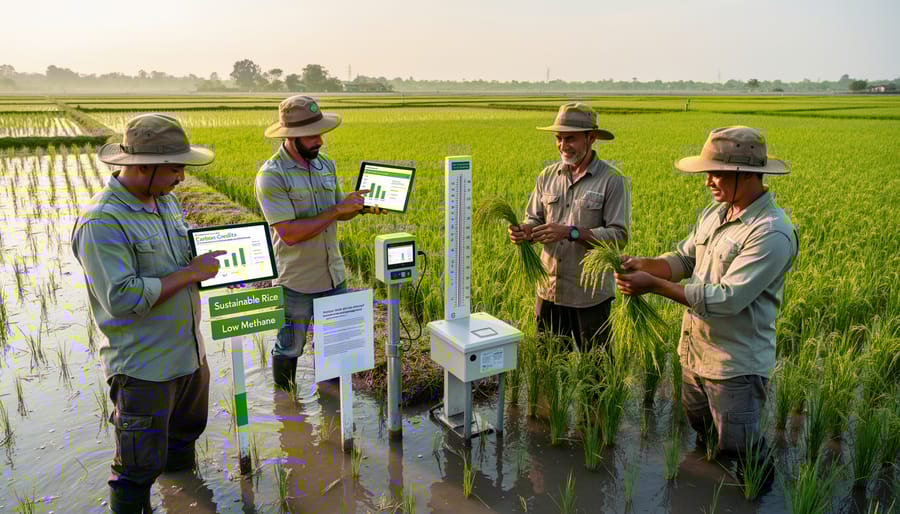
For Canadian rice farmers and those in the broader agricultural community exploring new sustainability pathways, methane MRV certification represents a genuine dual opportunity. By implementing measurement, reporting, and verification systems in your rice operations, you’re not only contributing to meaningful climate action but also positioning your farm to benefit from the growing carbon credit market. The environmental impact is significant—reducing methane emissions from rice paddies directly addresses one of agriculture’s most potent greenhouse gas challenges while maintaining productive yields.
The good news is that getting started doesn’t require overwhelming changes to your existing operations. Begin by connecting with provincial agricultural extension services and sustainability networks in your region. Many Canadian farmers have found success by starting small—measuring emissions on a portion of their fields, testing alternate wetting and drying techniques during a single growing season, or joining cooperative groups to share equipment and expertise. Resources like Agriculture and Agri-Food Canada’s Environmental Farm Plans provide structured support, while emerging certification programs are becoming increasingly farmer-friendly with streamlined processes.
The community aspect matters here. You’re not alone in this journey. Agricultural professionals across Canada are collaborating, sharing data, and building collective knowledge about what works in our unique climate conditions. Whether you farm rice commercially or are considering it as part of crop diversification, exploring methane MRV certification positions you at the forefront of sustainable agriculture.
Take that first step today. Reach out to your local agricultural association, attend an information session, or connect with farmers already navigating this process. The opportunity is real, and your farm could be part of the solution.