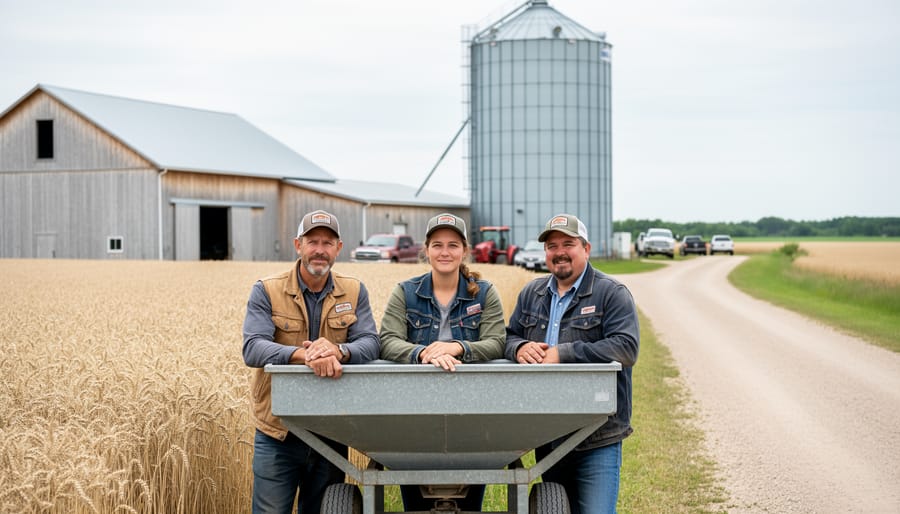
Producer cooperatives give farmers shared ownership of processing, marketing, or supply infrastructure, allowing members to capture a larger share of the value chain while reducing individual risk and costs. Across Canada, these collaborations range from beef and grain marketing co-ops to organic certification groups and community-supported agriculture networks, each demonstrating how pooled resources and collective decision-making strengthen farm resilience.
For farmers exploring cooperative membership or considering forming one, real-world examples offer clarity on structure, governance, and member benefits. The models below span livestock, grains, specialty crops, and value-added enterprises, chosen for their relevance to Canadian agricultural conditions and their focus on sustainable, community-rooted practices. Rather than presenting fabricated metrics, each example highlights the cooperative’s core function, governance approach, and the practical advantages members report, such as improved market access, shared equipment costs, or enhanced bargaining power with buyers.
The cooperative model suits operations of all sizes. Smaller farms gain economies of scale they couldn’t achieve alone, mid-sized operations reduce certification and marketing burdens, and larger producers benefit from diversified risk and stronger regional food networks. Whether you’re seeking better prices for your grain, shared access to processing facilities, or collaborative approaches to soil health, the examples that follow illustrate how Canadian farmers are using cooperatives to build profitable, sustainable livelihoods together.
Each cooperative profiled here operates transparently, prioritizes member input, and aligns financial returns with environmental stewardship. These aren’t theoretical constructs but working farms and businesses where decisions are made collectively and profits return to the people doing the work.
How We Selected These Cooperative Examples
We chose these seven cooperatives using clear, verifiable criteria to ensure the examples offer meaningful insight for Canadian farmers exploring cooperative membership.
First, we prioritized Canadian operations, with particular attention to Alberta-based models where available. This geographic focus ensures the legal structures, market conditions, and environmental contexts align with what readers face in their own regions.
Second, we looked for cooperatives with demonstrated sustainability outcomes. Rather than relying on marketing claims, we selected organizations with transparent practices in soil health, renewable energy adoption, organic certification support, or resource efficiency improvements that members can observe and verify.
Third, we sought diversity across agricultural sectors. The examples span grain production, livestock operations, equipment sharing, processing, energy generation, input supply, and knowledge exchange. This range shows how cooperative principles adapt to different farm types and scale operations.
Fourth, we focused on accessibility for small-to-medium scale producers. Each example represents a model where membership requirements, capital contributions, and operational commitments remain realistic for farms without extensive existing infrastructure or large financial reserves.
These criteria matter because cooperative success depends on practical fit with your farm’s resources, goals, and regional context. The examples ahead offer tested frameworks you can adapt rather than theoretical ideals.
1. Organic Grain Marketing Cooperatives: Sharing Access to Premium Markets
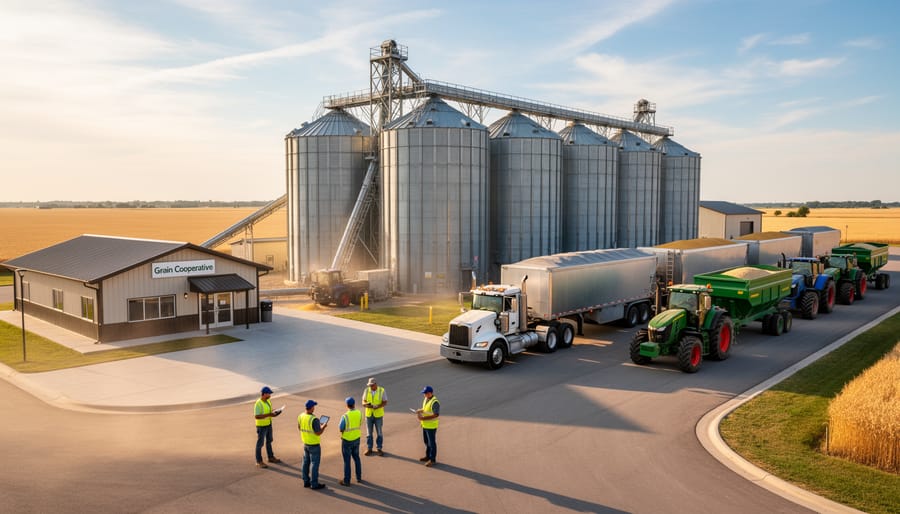
Organic grain marketing cooperatives give small and mid-sized producers collective bargaining power they couldn’t achieve alone. Instead of selling directly to commodity buyers at conventional prices, members pool their certified organic wheat, barley, oats, pulses, or specialty grains, allowing the cooperative to negotiate with premium buyers who value organic certification and consistent supply. One farmer with a few hundred acres of organic wheat has limited leverage; dozens of farmers together can fill container loads, meet buyer volume requirements, and command prices that reflect the organic premium.
The cooperative often handles certification coordination, reducing the administrative burden on individual members. Rather than each farm navigating organic standards documentation independently, the co-op provides shared guidance on record-keeping, inspection scheduling, and compliance updates. Some cooperatives maintain relationships with certification bodies and arrange group audits, streamlining the process for everyone involved. This collective approach makes organic certification more accessible, particularly for producers new to organic markets or those transitioning from conventional systems.
Shared storage infrastructure is another practical advantage. Cooperatives may operate dedicated organic grain bins or warehouse space that meets organic handling standards, preventing contamination and ensuring product integrity from harvest through sale. Members benefit from professional grain handling, moisture management, and quality testing without each farm needing to invest in specialized storage. The cooperative sets quality standards, protein content, moisture levels, cleanliness, that protect the collective’s reputation and ensure consistent access to premium markets.
Members typically gain several tangible benefits from participation:
- Access to buyers who pay premiums for certified organic grains
- Reduced certification and administrative overhead through shared processes
- Professional storage that maintains organic integrity and grain quality
- Market intelligence and price transparency across organic channels
- Collective negotiating strength with processors and export buyers
The cooperative model aligns well with organic principles: shared knowledge, environmental stewardship, and equitable distribution of economic value. For Alberta grain producers exploring organic transitions, joining an established marketing cooperative can lower risk and accelerate the learning curve. The collective absorbs market variability better than individual farms, and members gain peer support as they refine organic growing practices. By pooling harvests and sharing infrastructure, organic grain cooperatives make premium markets accessible to farms that would otherwise sell into conventional channels at lower returns.
2. Livestock Producer Cooperatives: Collective Purchasing and Feedlot Management
Livestock producer cooperatives address two of the largest cost pressures in cattle and hog operations: input expenses and market access. When ranchers join forces, they pool their purchasing power to negotiate volume discounts on feed, veterinary supplies, breeding stock, and animal health products. Instead of each farm placing small orders at retail prices, the cooperative places bulk orders that suppliers are willing to discount. The same principle applies to genetics, whether sourcing semen from high-quality bulls or purchasing replacement heifers, where collective buying reduces per-unit costs and gives members access to superior bloodlines they might not afford individually.
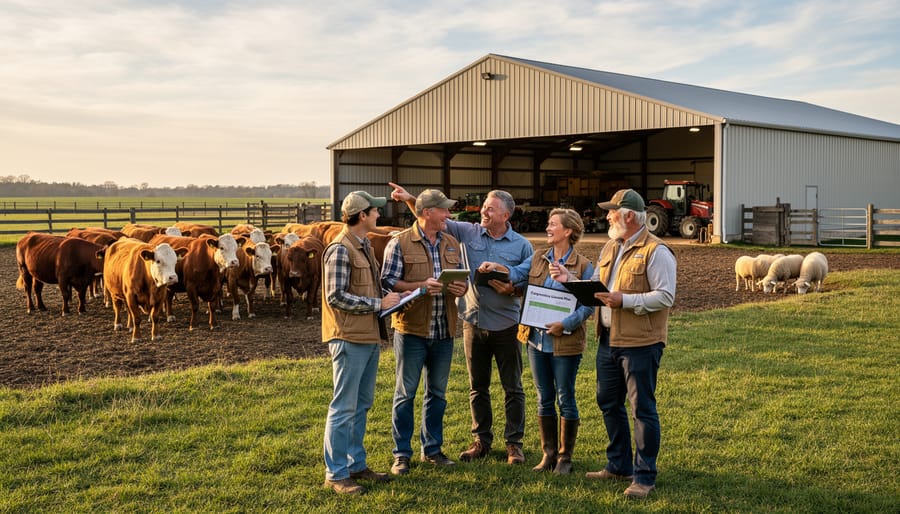
Shared feedlot facilities take cooperation further by distributing the capital burden of infrastructure. A group of ranchers might jointly own and operate a finishing facility, splitting the costs of pens, feed handling equipment, water systems, and labor. Each member sends cattle to the shared lot according to an agreed schedule, and the cooperative manages feeding protocols, health monitoring, and record-keeping. This arrangement lets smaller producers finish animals to market weight without building their own feedlot or relying entirely on custom feeding operations where they have less control over management practices.
Marketing coordination is another key function. When the cooperative aggregates finished cattle from multiple members, it can negotiate more favorable contracts with packers or sell directly to processors who require consistent, larger volumes. Coordinated marketing also gives members leverage to time sales strategically rather than being forced to sell at unfavorable moments due to cash flow or capacity constraints.
The cumulative effect is lower individual risk and improved economic resilience. Capital requirements drop, operating costs decline, and revenue stability increases, all critical for sustaining livestock operations in volatile commodity markets.
3. Equipment Sharing Cooperatives: Reducing Capital Barriers for Sustainable Practices
Equipment cooperatives remove one of the biggest obstacles to adopting sustainable practices: the upfront cost of specialized machinery. Many regenerative agriculture techniques, no-till seeding, precision fertilizer application, cover crop interseeding, or soil health monitoring, require equipment that can cost tens of thousands of dollars to purchase outright. For small and mid-size farms, that capital barrier often means sticking with conventional methods even when producers recognize the long-term benefits of transitioning.
Machinery cooperatives change that equation by pooling ownership among members. A cooperative might collectively purchase a no-till drill, GPS-guided row planter, compost spreader, or portable on-farm processing unit. Members schedule use, share maintenance responsibilities, and split the capital cost proportionally based on their expected usage. This model allows individual farmers to access the same technology that large operations deploy, without carrying the full financial burden alone.
Beyond machinery, some cooperatives pool renewable energy installations such as solar arrays or mobile biogas digesters that can rotate among farms. Others focus on soil health implements: roller-crimpers for terminating cover crops, subsoilers for breaking compaction layers, or precision soil sampling rigs. The cooperative structure makes these tools financially accessible while encouraging members to experiment with practices that improve soil organic matter, reduce erosion, and lower input dependency.
Equipment sharing also builds technical knowledge within the membership. As farmers use shared tools, they exchange tips on settings, timing, and troubleshooting, informal peer learning that strengthens everyone’s capacity. This collective skill development complements value-added income strategies by enabling producers to adopt the infrastructure needed for diversified, sustainable production models. When the financial and technical barriers drop, more farms can transition toward practices that sustain both land and livelihood.
4. Value-Added Processing Cooperatives: Keeping Profits in Rural Communities
Value-added processing cooperatives transform raw farm products into finished goods that command higher prices and keep economic benefits in rural communities. When farmers mill their own wheat into organic flour, turn milk into artisan cheese, or press oilseeds into culinary oils, they capture the margin that would otherwise go to outside processors and distributors.
These cooperatives typically pool member production to achieve the volume needed for efficient processing, then share the infrastructure costs of commercial facilities, equipment maintenance, and regulatory compliance. A grain cooperative might install stone mills to produce heritage flour blends, while a dairy cooperative invests in aging rooms and packaging equipment for specialty cheeses. Members supply raw materials, participate in governance decisions about product lines and quality standards, and share in the profits proportional to their contribution.
Processing co-ops also create local employment beyond the farm gate. Skilled positions in milling, cheesemaking, bottling, quality control, and distribution provide year-round work in rural areas where seasonal agricultural jobs dominate. This employment stability strengthens community resilience and reduces the need for residents to seek work in urban centres.
The cooperative structure supports experimentation with niche products that larger commercial processors might ignore. Members can trial small batches of specialty items, respond quickly to market feedback, and build direct relationships with buyers who value traceability and local sourcing. Much like rural electric co-opscommunity solar initiatives, and other local energy projects that distribute infrastructure costs across multiple participants, processing cooperatives make capital-intensive ventures accessible to producers who could not afford them individually.
5. Renewable Energy Cooperatives: Shared Solar and Biogas Projects
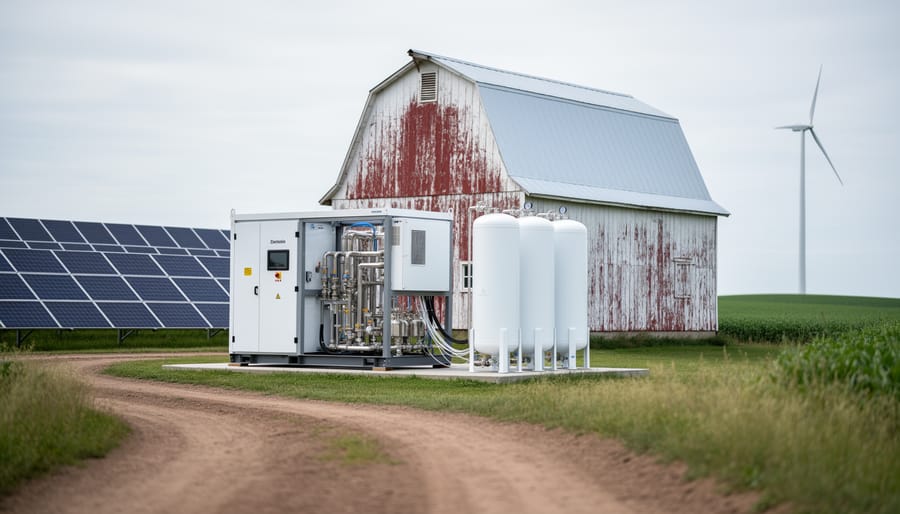
Renewable energy cooperatives allow groups of farmers to pool capital for solar installations, wind turbines, or biogas digesters that would be prohibitively expensive individually. Members share both the upfront investment and the long-term benefits: reduced electricity bills, potential income from selling power back to the grid, and a smaller carbon footprint. In regions with favourable net metering policies, solar cooperatives can offset a meaningful portion of farm energy costs, while biogas digesters turn livestock manure into both renewable natural gas and nutrient-rich fertilizer.
Solar arrays are often the most accessible entry point. A cooperative might install a ground-mounted or barn-roof system sized to serve multiple member farms, dividing output according to each member’s investment stake. Wind turbines require specific site conditions, consistent wind speeds, setback distances, and grid interconnection agreements, but can generate substantial power where conditions align. Biogas digesters suit livestock operations with sufficient manure volume and offer the dual advantage of methane capture and improved nutrient cycling.
Feasibility depends on several factors: site suitability (solar irradiance, wind patterns, proximity to electrical infrastructure), regulatory environment (provincial renewable energy programs, connection agreements with utilities), and capital availability. Many cooperatives secure financing through a mix of member equity, government grants targeted at agricultural sustainability, and low-interest loans for renewable energy projects. Planning typically involves a technical assessment, an economic model projecting payback periods under different scenarios, and clear governance agreements on how generated energy or revenue will be allocated.
The environmental benefits extend beyond emissions reduction. Energy independence reduces exposure to volatile fuel prices, and digesters eliminate methane release from manure storage, a significant greenhouse gas source on livestock farms.
6. Input Supply Cooperatives: Bulk Purchasing for Organic and Regenerative Inputs
Input supply cooperatives tackle one of the biggest barriers to adopting organic and regenerative practices: the high cost of sustainable inputs. By pooling their purchasing power, farmer members negotiate volume discounts on items like certified organic seed, cover crop blends, biological amendments, natural pest controls, and soil health products that would otherwise strain individual farm budgets.
These cooperatives typically operate through annual or seasonal order consolidation. Members submit their input needs, say, crimson clover seed for cover cropping or mycorrhizal inoculants for transplants, and the cooperative aggregates orders to qualify for wholesale pricing. The savings get passed directly to members, often making the difference between experimenting with a regenerative practice and sticking with conventional methods because the upfront investment feels too steep.
Beyond price breaks, input co-ops provide access to specialized products that local retailers don’t stock. A farmer transitioning to organic production might need specific varieties of nitrogen-fixing legumes or biological fungicides approved for certification. The cooperative’s collective buying power convinces suppliers to carry these niche items and deliver them to rural areas where individual orders wouldn’t justify the logistics.
Many input cooperatives also coordinate with seed cleaning facilities, allowing members to clean and bag their own saved seed at shared equipment rather than purchasing new stock every season. This arrangement cuts costs while preserving regional seed genetics adapted to local growing conditions. Some cooperatives maintain seed libraries where members contribute and borrow heritage or trial varieties, spreading both genetic diversity and financial risk across the membership.
The operational model keeps overhead low, many run with minimal staff or on volunteer coordination, so nearly all the purchasing advantage flows to farmers rather than administrative costs.
7. Knowledge-Sharing and Research Cooperatives: Farmer-Led Innovation Networks
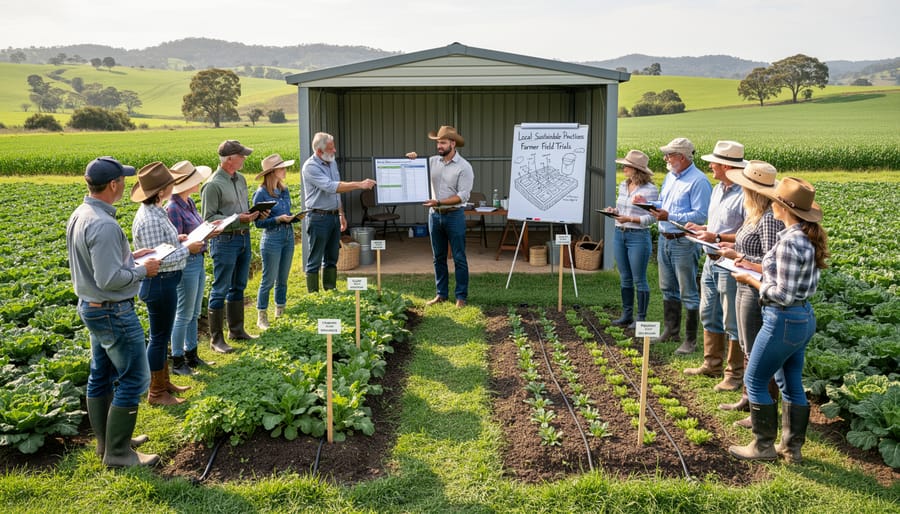
Knowledge-sharing cooperatives flip the traditional research model on its head. Instead of waiting for university extension services or corporate agronomists to dictate best practices, member farmers become co-researchers who design experiments, gather data, and interpret results together. These networks focus on testing sustainable practices under real farm conditions, then pooling observations so every member learns faster than they could working alone.
A typical research cooperative organizes trials across multiple member farms simultaneously. One farmer might test strip tillage on half a field while neighbours trial different cover crop mixes or variable-rate fertility protocols. Members meet regularly to compare notes, troubleshoot challenges, and refine techniques before wider adoption. This peer-to-peer structure builds confidence in new methods because farmers see results from operations similar to their own rather than controlled research plots that may not reflect local soil types, weather patterns, or equipment constraints.
The knowledge exchange goes beyond formal trials. Members share practical insights about timing decisions, equipment modifications, marketing strategies, and navigating certification processes. Experienced farmers mentor newcomers through transitions to organic or regenerative systems. Some cooperatives maintain shared databases tracking crop performance, input costs, and environmental indicators so members can benchmark their operations and identify improvement opportunities.
These cooperatives often partner with agricultural researchers who value farmer expertise and want to study practices under working farm conditions. The collaboration produces findings more directly applicable to commercial agriculture while giving farmers agency in shaping research priorities. For producers committed to sustainability, these networks accelerate the learning curve and reduce the isolation that often accompanies adopting practices outside the conventional mainstream.
What These Cooperatives Have in Common
Across these seven cooperative models, several unifying principles emerge. Each operates on democratic governance, one member, one vote, ensuring no individual producer dominates decision-making regardless of farm size. They distribute benefits equitably, whether through patronage refunds, shared cost savings, or collective access to infrastructure and markets that individual operations couldn’t afford alone.
Member education stands out as a consistent priority. These cooperatives invest in training, peer learning networks, and knowledge exchange because informed members make better collective decisions and adopt practices that strengthen the entire group. Their focus extends beyond immediate profit, they’re built for long-term sustainability, balancing economic viability with environmental stewardship and social well-being.
Perhaps most importantly, they build community resilience. By pooling resources, sharing risk, and retaining value locally, cooperatives anchor rural economies and create networks that withstand market volatility better than isolated operations. If you’re considering cooperative membership or formation, start by identifying the specific challenges your farm faces and look for models that address those needs while aligning with your region’s agricultural context and regulatory environment.
Common Questions About Producer Cooperatives
How do I find and join an existing cooperative in my region?
Contact your provincial agriculture department or the Canadian Co-operative Association for directories of active cooperatives. Most cooperatives have membership application processes that involve attending informational meetings, reviewing bylaws, and meeting eligibility requirements specific to the sector and region served.
What are typical membership costs and ongoing obligations?
Membership structures vary widely by cooperative type and scale. Some require initial share purchases or capital contributions, while others operate on annual fees. Obligations typically include participating in governance (attending meetings, voting on key decisions), meeting quality or production standards, and committing to use cooperative services for an agreed portion of your operation.
How are decisions made within producer cooperatives?
Canadian cooperatives follow democratic governance principles, usually operating on a one-member-one-vote basis regardless of farm size or investment level. Major decisions require member votes at annual general meetings, while elected boards of directors handle day-to-day management and policy implementation between meetings.
What legal structures apply to cooperatives in Canada?
Cooperatives can incorporate federally under the Canada Cooperatives Act or provincially under respective cooperative legislation. Each structure has specific requirements for governance, capitalization, and member rights. Consulting with a lawyer experienced in cooperative law helps determine which incorporation path suits your group’s needs and provincial context.
Risk management in cooperatives differs from conventional business structures because members share both benefits and challenges collectively. Most cooperatives build financial reserves from a portion of annual surpluses to buffer against market downturns or operational setbacks. Members typically bear limited liability up to their share investment, protecting personal assets while still participating in the cooperative’s financial health. Strong cooperatives also invest in member education programs to build shared understanding of market conditions, sustainable practices, and cooperative principles, which strengthens decision-making during difficult periods.
Starting a new cooperative requires committed founding members, legal incorporation, capital planning, and governance structure development. Provincial cooperative development organizations and agricultural extension services often provide formation support, model bylaws, and feasibility planning assistance at low or no cost.