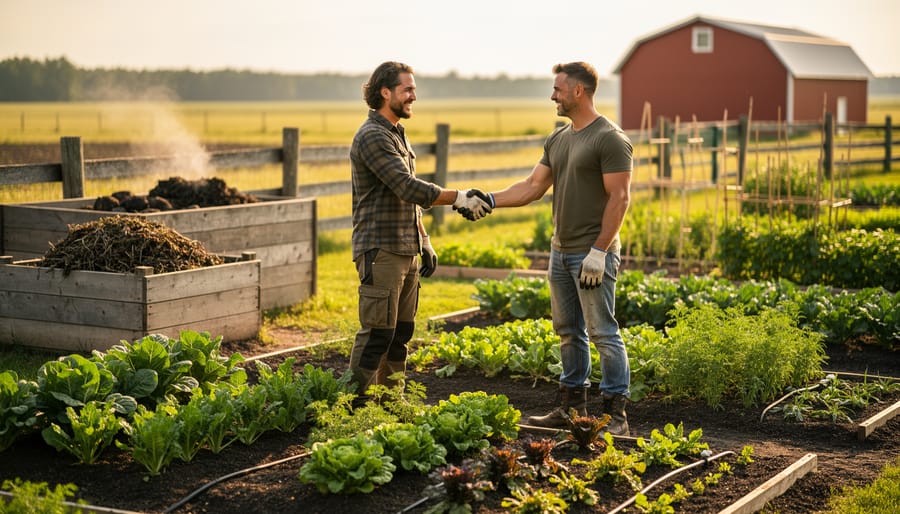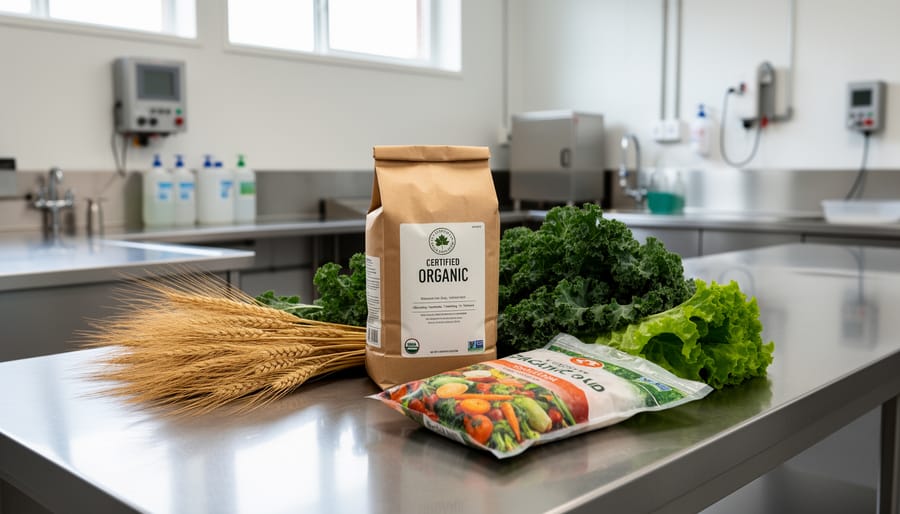
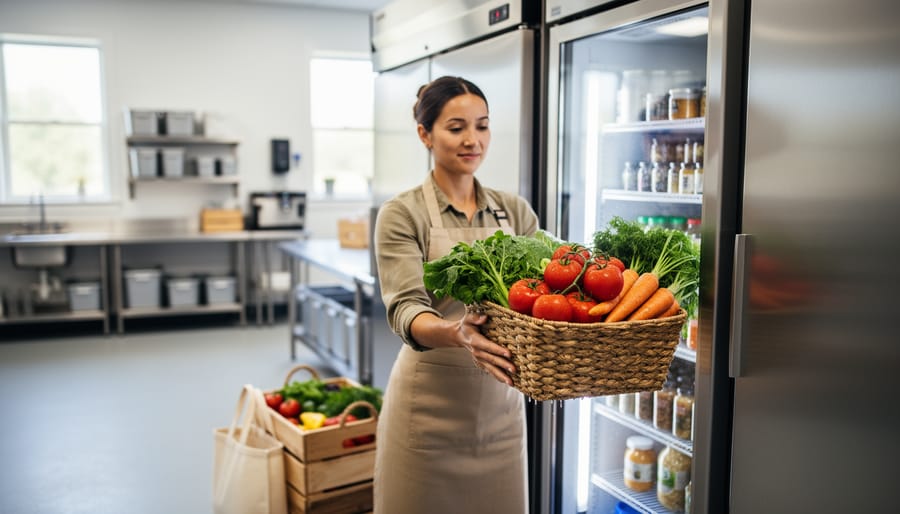
The Union County Food Hub operates as a dual-purpose community system that addresses food insecurity while creating new market channels for local producers. Run through the Union-Snyder Community Action Agency and housed at the Miller Center for Recreation & Wellness’ Cornerstone Kitchen in Lewisburg, Pennsylvania, this hub model combines emergency food distribution with an online marketplace connecting growers directly to institutional and retail buyers throughout the region.
For Canadian farmers exploring food hub development, Union County offers a proven template worth examining. The hub tackles two persistent challenges in regional food systems: getting fresh, local product to customers who want it, and ensuring vulnerable community members have reliable access to nutritious food. Rather than choosing between social mission and market viability, this model integrates both.
The emergency food program provides shelf-stable items, fresh foods, and prepared meals to agency clients and walk-ins, while redistributing donated product through the Union-Snyder Hunger Coalition’s network. During growing season from May through October, the Pop-Up Produce Stand offers free produce distribution to anyone, regardless of income. On the commercial side, the hub maintains an online storefront featuring hundreds of locally produced items, creating a consolidated purchasing point for businesses and consumers.
This structure mirrors challenges familiar to Alberta producers: rural communities spread across wide geography, seasonal production cycles, institutional buyers seeking consistent local supply, and the need for aggregation infrastructure that small farms can’t justify individually. Union County’s success stems from combining community agency capacity with market-focused logistics, a partnership model that addresses the capital and coordination barriers many farm-led initiatives face.
The following breakdown examines how Union County built this system, which elements transfer well to Canadian contexts, and where Alberta’s unique conditions require adaptation.
What Makes Community Food Hubs Different from Traditional Distribution
Community food hubs operate on a fundamentally different principle than the supply chains most Canadians encounter at grocery stores. Where conventional distribution prioritizes efficiency at scale, moving massive volumes from centralized warehouses to retail outlets, food hubs reverse the flow by aggregating products from multiple small-scale producers and directing them to local markets and community members who need them most.
The distinction starts with ownership and purpose. Traditional supply chains exist to maximize profit margins for corporate entities, with decisions made by distant executives focused on quarterly returns. Food hubs, by contrast, often function as community-owned or nonprofit ventures where success is measured by farmer participation, community access to fresh food, and resilience of local food systems. This structural difference shapes every operational choice, from which growers get shelf space to how food reaches people facing economic hardship.
- Food hub
- A centrally organized facility that aggregates, stores, and distributes food from local producers to buyers and community members, prioritizing regional food system development over conventional supply chain economics.
- Cooperative distribution network
- A shared system where multiple farmers and food producers pool resources, logistics, and market access to reduce individual costs while increasing collective reach and bargaining power.
- Food security infrastructure
- Physical facilities and organizational systems designed to ensure reliable access to adequate, nutritious food, particularly for vulnerable populations and during supply disruptions.
- Aggregation point
- A designated location where products from various small farms are collected, sorted, and prepared for distribution, allowing producers too small to serve large buyers individually to access broader markets together.
The farm-to-table supply chain in a hub model compresses the distance and time between harvest and consumer, often eliminating the multiple warehouse transfers that characterize conventional distribution. A head of lettuce might move directly from a farm to the hub and onto someone’s table within 48 hours, preserving nutrition and flavour that deteriorate during the week-long journeys typical of supermarket produce.
Perhaps most significantly, community food hubs intentionally blend market functions with food security missions. The same facility that connects local growers with restaurants and consumers often serves as an emergency food distribution point, ensuring that fresh, local food reaches people regardless of their ability to pay. This dual purpose transforms food hubs into genuine community infrastructure rather than simple commercial enterprises.
Inside the Union County Food Hub: A Working Model
Emergency Food Distribution and Community Support
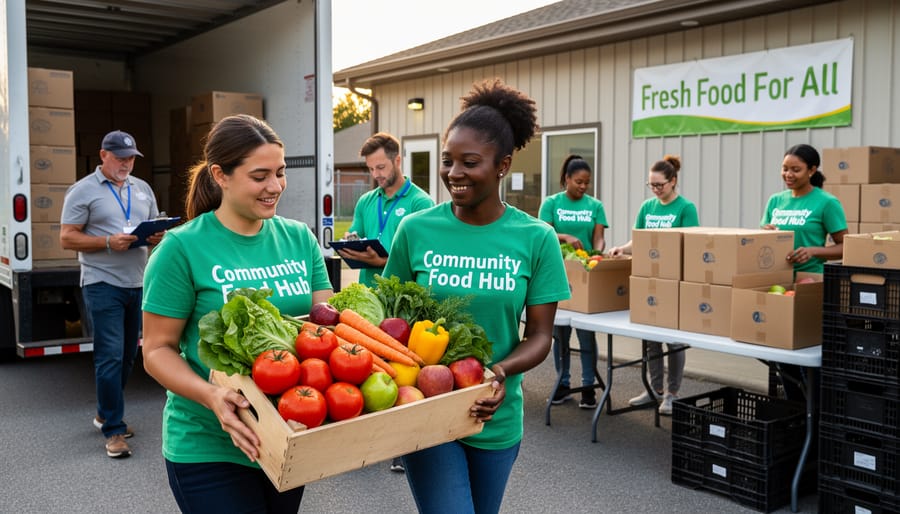
The Food Hub tackles food insecurity through three interconnected distribution channels. Emergency food clients receive immediate support through the program’s partnership with Union-Snyder Community Action Agency, which operates the hub from the Cornerstone Kitchen facility. Walk-in customers can access shelf-stable fresh meals and produce without advance registration, removing common barriers that prevent people from seeking help when they need it most.
Beyond direct service, the hub extends its reach through the Union-Snyder Hunger Coalition network. This redistribution system moves donated product to multiple community food programs, multiplying the hub’s impact far beyond what any single distribution point could achieve. Rather than duplicating infrastructure, participating programs receive coordinated deliveries that reduce transportation costs and administrative burden.
This layered approach addresses both crisis situations and ongoing food access challenges. Emergency clients get immediate relief, while the broader coalition network ensures that donated food reaches diverse populations across Union and Snyder counties. The model demonstrates how a centralized hub can efficiently serve multiple customer types without requiring separate facilities or duplicate staff for each program component.
The Pop-Up Produce Stand: Universal Access Model
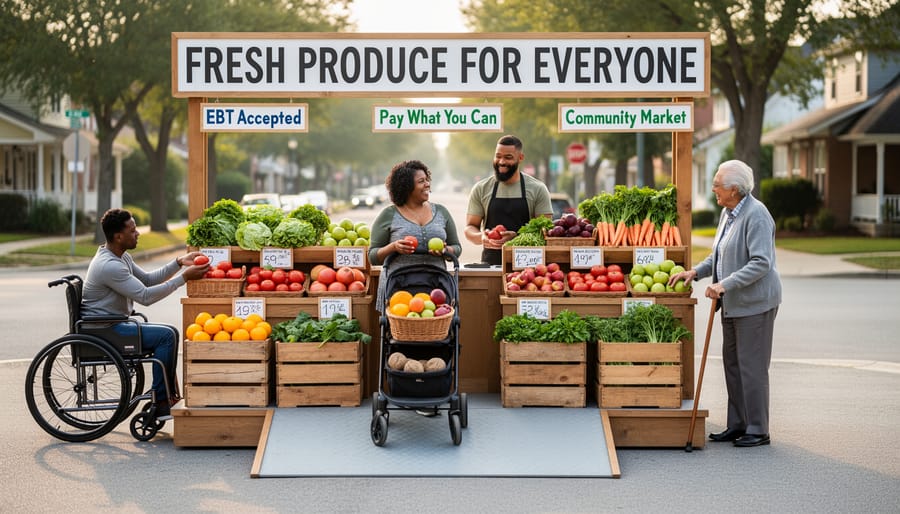
The Pop-Up Produce Stand represents the hub’s most accessible initiative, a seasonal free produce distribution that eliminates income requirements entirely. Running from May through October each year, the stand operates from Miller Center for Recreation and Wellness in Lewisburg, positioning fresh food where community members already gather for activities and programs.
This universal access approach removes the documentation barriers and stigma often associated with food assistance. Anyone can stop by during operating hours to collect fresh produce, whether they’re a family stretching a tight budget or simply looking to supplement their grocery shopping with local items. The no-questions-asked model recognizes that food insecurity doesn’t always align with traditional eligibility criteria, and seasonal abundance from local farms makes broad distribution feasible.
For Alberta communities considering similar programs, the Pop-Up model offers a scalable template. A seasonal stand requires less infrastructure than year-round operations while matching regional growing patterns. Placing distribution at existing community facilities, recreation centers, libraries, farmers’ markets, reduces overhead costs and normalizes participation. The key insight is treating fresh food access as a community resource rather than charity, which increases uptake across income levels and strengthens connections between local growers and residents.
Local Food Marketplace Function
Beyond its emergency food role, the Food Hub operates a marketplace that directly connects Union County growers with local buyers. This platform gives farmers a structured channel to reach both commercial customers and individual consumers without managing multiple separate relationships or delivery arrangements.
The marketplace model addresses a common rural challenge: small and mid-sized producers often struggle to access wholesale markets efficiently while consumers want local options but don’t know how to find them. By centralizing these connections, the hub creates economic opportunity for area farmers while expanding local food availability.
Businesses looking to source local ingredients and growers wanting to sell can register through the Food Hub’s system. This registration process matches supply with demand, helping restaurants, institutions, and retailers find consistent local sources while giving producers predictable sales outlets.
For consumers, the marketplace provides access to hundreds of locally produced items ranging from seasonal vegetables and fruits to value-added products like preserves and baked goods. This breadth demonstrates how cooperative infrastructure can aggregate diverse small-scale production into a viable market presence that individual farms couldn’t achieve alone.
The marketplace function shows how food hubs serve dual purposes: they’re not just distribution points but active market-makers that strengthen the local food economy.
Why This Model Works: Key Success Factors
The Union County Food Hub succeeds because it addresses multiple problems with a single integrated system rather than treating food access and local agriculture as separate issues. By analyzing what works in this model, other communities can identify which elements might translate to their own contexts.
At its core, the hub operates through what could be called strategic simplicity: it uses what’s already there rather than building from scratch. The partnership with Union-Snyder Community Action Agency provides established community trust and administrative infrastructure, while the Cornerstone Kitchen at Miller Center offers commercial-grade facilities without requiring capital investment in a dedicated building. This facility-sharing approach cuts the largest barrier most food hub proposals face, which is startup costs for physical space.
The dual-purpose programming creates efficiency that makes the model financially sustainable. The same storage, kitchen, and distribution systems serve emergency food provision, the seasonal produce stand, and the local food marketplace. Staff time and operational costs support multiple functions simultaneously, meaning no single program needs to carry the full overhead burden. For farmers interested in similar ventures, this multi-revenue-stream approach matters because it reduces dependence on any one funding source.
Several structural elements stand out as particularly effective:
- Embedding the hub within an established community agency rather than creating a new standalone organization
- Leveraging shared-use infrastructure at existing recreation and wellness facilities
- Running year-round core services with seasonal enhanced programming that matches regional growing cycles
- Creating direct producer-buyer connections through the marketplace platform without complex intermediary steps
- Implementing truly no-barrier access points like the income-blind produce stand that eliminates qualification requirements
The income-blind access policy for the Pop-Up Produce Stand deserves particular attention. By removing qualification barriers, the hub eliminates the administrative burden of verifying eligibility and reduces the stigma that keeps some people from accessing food programs. This builds broader community participation and strengthens the hub’s role as a community asset rather than just a service for those in need.
What makes these factors replicable is that none depends on unique local conditions. Partnership structures, facility sharing, diversified programming, and accessible policies can work in communities of different sizes and agricultural contexts. The key is adapting the specific implementation to local infrastructure and needs rather than copying the exact structure.
Translating This Approach to Alberta and Canadian Contexts
Adapting the Union County model to Alberta requires thoughtful consideration of regional differences while preserving its core strengths. The framework is remarkably transferable, but success hinges on addressing specific Canadian realities rather than copying the approach wholesale.
Alberta’s shorter growing season immediately changes the operational calendar. Where Union County runs its produce stand May through October, Alberta communities need to compress this window or shift focus to cold-hardy crops that extend into fall. Root vegetables, brassicas, and storage crops become more central to the offering, while early-season greens and late-harvest squash bookend the distribution period. The hub model works, but the product mix and timeline must reflect what local growers can actually produce in Zone 3 or 4 conditions.
Rural population density across the prairies presents both challenge and opportunity. Lower density means longer travel distances for both producers and consumers, which increases logistics costs and reduces spontaneous foot traffic. However, Alberta’s existing cooperative culture, rooted in grain cooperatives and agricultural service co-ops, provides organizational infrastructure that Union County built from scratch. Farmers here already understand collective action and shared facilities, which accelerates partnership development.
Provincial food security programs create different partnership opportunities than their American counterparts. Alberta’s Community Food Centres, regional food banks, and municipal social services operate under distinct mandates and funding structures. A successful Canadian food hub needs to map these existing programs first, identifying where a hub fills gaps rather than duplicating services. Integration with rural-urban partnerships becomes particularly valuable, as urban buyers provide consistent demand that stabilizes cash flow while rural communities gain improved access.
The dual-purpose approach, serving both emergency needs and market functions, translates well to Canadian communities where food insecurity exists alongside strong local food movements. The key is matching facility partnerships to local assets. Where Union County uses a recreation center kitchen, Alberta hubs might partner with community halls, agricultural societies’ facilities, or underutilized commercial kitchens in rural towns. The principle remains: leverage existing infrastructure rather than building from zero.
Metric measurements, Canadian food safety regulations, and provincial cooperative legislation shape implementation details but don’t fundamentally alter the model’s viability. The Union County blueprint works because it addresses universal challenges through adaptable structures.
Building Your Own Community Food Hub: Where to Start
Starting a community food hub requires careful planning, but the process doesn’t demand massive capital or complex infrastructure. Most successful hubs, including Alberta’s KC Food Hub began with committed people and shared resources rather than purpose-built facilities.
The development process follows a logical sequence that balances community needs with practical capacity:
- Conduct a community food assessment to identify specific gaps. Survey local farmers about production capacity and market challenges, and talk to residents about food access barriers. Document what’s missing: is it fresh produce availability, emergency food support, market access for growers, or all three?
- Identify potential partners before building anything. Approach municipal recreation departments, health authorities, agricultural societies, existing food banks, and community action organizations. The Union County model works because multiple entities share responsibility and resources.
- Map existing infrastructure that could be shared or repurposed. Commercial kitchens in community centres, unused warehouse space, farmers’ market structures, or cooperative facilities often sit idle during certain hours or seasons. Sharing cuts costs dramatically and accelerates launch timelines.
- Design your initial programs based on what resources and partnerships you’ve secured. If you have kitchen access, consider prepared food distribution. If you have outdoor space and willing growers, start with a seasonal produce stand. Union County’s dual approach emerged from their specific facility and partner mix.
- Build your grower and buyer networks simultaneously. Recruit 5-10 committed producers who can supply consistently, even in small volumes. Identify anchor buyers like restaurants, institutions, or food programs that provide stable demand. Individual consumers follow once the system functions reliably.
- Launch small, measure results, and adapt based on what you learn. Track participation numbers, volumes moved, producer satisfaction, and community feedback. Most hubs expand services gradually as they prove viability and identify additional needs.
The biggest mistake communities make is waiting for perfect conditions or comprehensive funding before starting. Begin with one program that matches your available resources. A summer produce stand operating two days weekly creates momentum, builds relationships, and demonstrates need for expanded services. The infrastructure and complexity can grow as your network strengthens and proves its value to both producers and the community it serves.
Expert Perspectives on Food Hub Development in Canada
Canadian agricultural experts consistently emphasize that food hub success depends on understanding regional market dynamics before infrastructure investment. Dr. Sarah Chen, a cooperative development specialist with the Alberta Farm Fresh Producers Association, notes that many communities rush to replicate models without assessing whether local producer capacity and consumer demand can sustain operations year-round.
The climate factor shapes Canadian food hub viability more than communities often realize. Manitoba food systems researcher James Kowalski points out that six-month growing seasons require different operational models than year-round programs, typically necessitating value-added processing capabilities or strategic partnerships with storage facilities to maintain consistent supply. His research suggests successful prairie hubs integrate winter greenhouse growers or preserved goods producers to bridge seasonal gaps.
Producer participation represents the most critical challenge according to cooperative specialists. Saskatchewan farmer and food hub organizer Marie Leblanc explains that farmers need clear evidence of financial benefit before committing product, which creates a startup dilemma: hubs need committed supply to attract buyers, yet farmers hesitate without proven markets. She advocates for pilot programs with pre-committed anchor buyers, institutional purchasers like schools or hospitals, to demonstrate viability and reduce farmer risk.
Food security professionals see dual-purpose models as particularly promising for rural Canada. The approach mirrors insights from the food hub case study documented in Wisconsin, where serving both emergency food access and commercial markets creates operational resilience. This strategy addresses funding challenges while building community support that sustains programs through difficult periods.
Infrastructure sharing emerges as the key cost barrier solution. Community development officers report that partnerships with existing facilities, recreation centers, commercial kitchens, agricultural societies, dramatically improve financial feasibility compared to purpose-built structures. Alberta examples show shared-space arrangements reduce overhead by sixty to seventy percent, making operations sustainable at lower volumes that match rural population densities.
The Union County Food Hub proves that cooperative distribution networks aren’t just theoretical solutions, they’re practical systems that work right now to strengthen both farm businesses and community resilience. By combining emergency food provision with a local marketplace and barrier-free produce distribution, this model demonstrates how a single hub can serve multiple community needs while creating reliable markets for regional growers.
For Alberta farmers, the message is clear: food hubs represent both a viable business opportunity and a chance to address genuine community challenges. You don’t need to choose between profitability and service. The cooperative approach creates stable demand for your products while building the kind of local food infrastructure that benefits everyone, including your own operation during uncertain times.
Start by connecting with existing food security projects in your region to understand current gaps and partnerships. Talk with neighbouring producers about shared distribution challenges and opportunities. Reach out to community organizations, health centres, or municipal recreation facilities that might have underutilized commercial kitchen space. Attend cooperative development workshops offered through agricultural extension services.
The Union County example shows that food hubs don’t require massive initial investment or complex bureaucracy. They require committed producers, willing community partners, and a clear understanding of local food access barriers. Your region’s specific model will look different, but the core principles, cooperation, accessibility, and mutual benefit, translate directly. The question isn’t whether this approach can work in Alberta communities. It’s whether you’re ready to help build it.