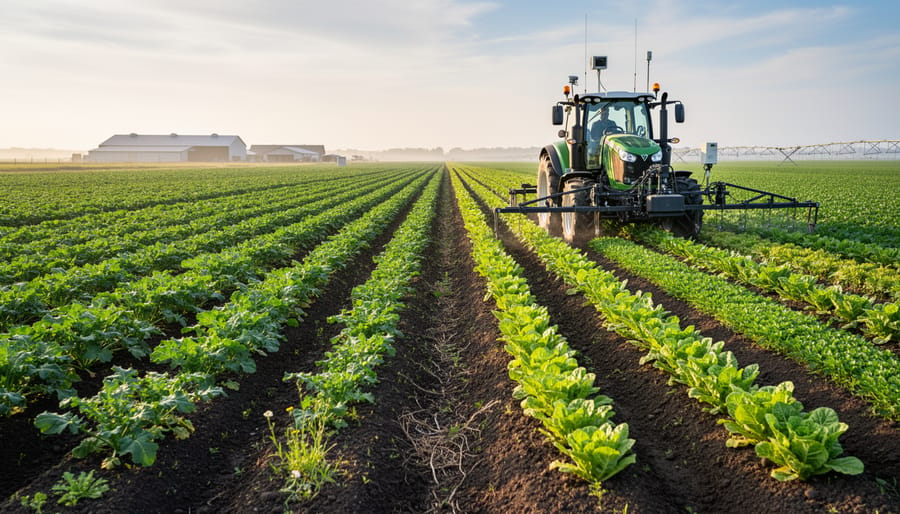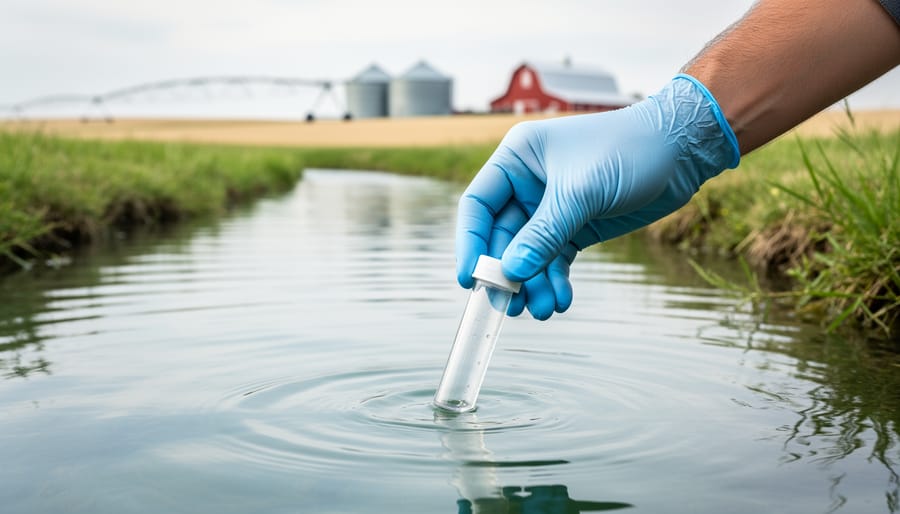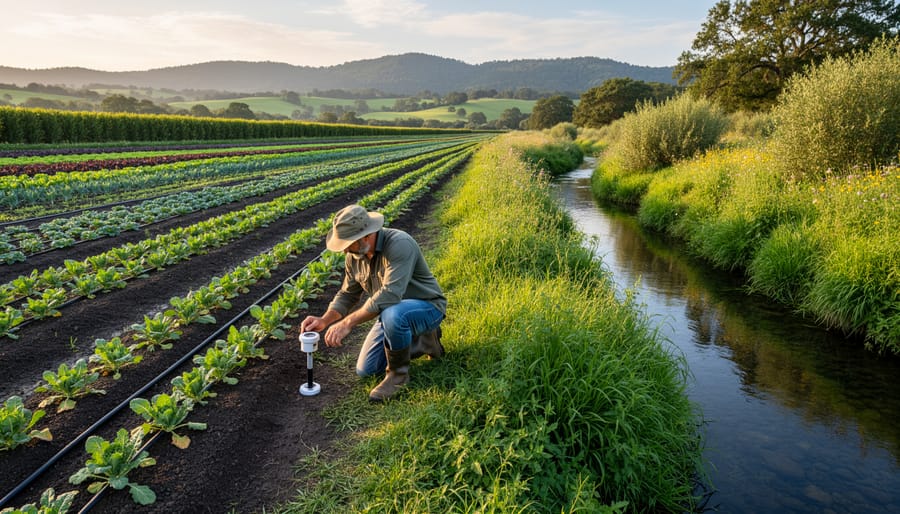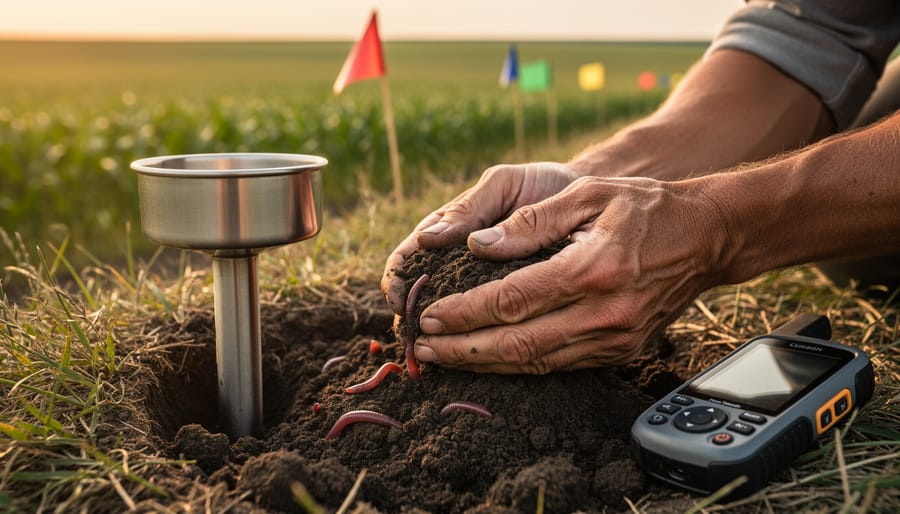
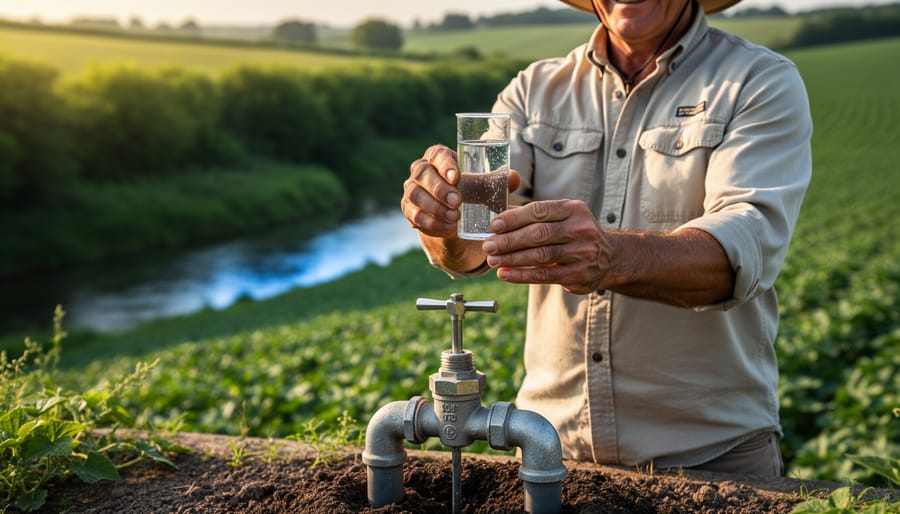
Understand that the National Organic Program (NOP) standards establish clear benchmarks for water quality and conservation that go beyond basic environmental compliance. The organic certification requirements specify that your water sources must be free from prohibited substances, tested regularly for contaminants, and managed to prevent pollution from neighboring conventional operations.
Document your water sources comprehensively by mapping all irrigation wells, dugouts, and surface water access points on your farm. Test each source at least annually for nitrates, heavy metals, and pesticide residues, keeping detailed records that certification inspectors will review. This baseline data protects your certification status and helps identify potential contamination risks before they jeopardize your organic designation.
Implement physical buffers between your organic fields and conventional neighbors by establishing minimum 8-metre vegetative zones along property lines where water runoff may occur. These barriers, consisting of native grasses or hedgerows, filter potential spray drift and chemical runoff that could compromise your organic integrity. Alberta farmers near intensive livestock operations or conventional grain farms particularly benefit from wider 15-metre buffers.
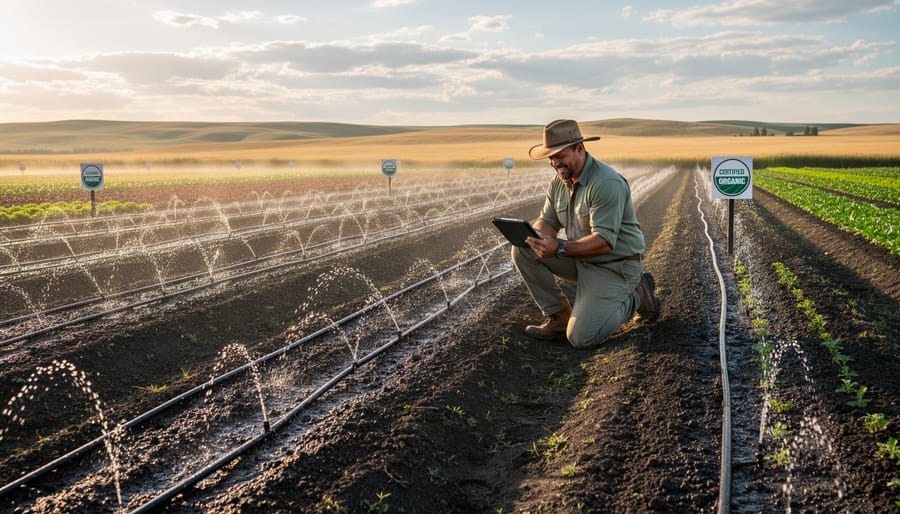
Monitor irrigation practices to demonstrate responsible water stewardship through soil moisture testing and weather-based scheduling systems. The NOP doesn’t mandate specific conservation measures, but certification bodies increasingly expect documented efforts to minimize water waste. Install simple tensiometers in key field locations and maintain irrigation logs showing application rates, timing, and decision rationale.
Create a written water management plan that addresses source protection, testing schedules, contamination prevention strategies, and conservation goals. This living document evolves with your operation and serves as your primary reference during annual certification inspections, demonstrating your commitment to maintaining the highest organic standards while stewarding this essential resource for future generations.
What the National Organic Program Actually Requires for Water Management
Core Water Quality Standards Under NOP
Under the National Organic Program, water quality stands as a foundational pillar of organic certification. The standards require that agricultural water used for irrigation, crop spraying, or livestock operations must not compromise the organic integrity of your farm.
The NOP mandates that irrigation water comes from approved sources and remains free from contaminants that could transfer prohibited substances to crops or soil. While the program doesn’t prescribe specific testing frequencies for all situations, organic farmers must assess water quality based on their unique risk factors. Consider factors like proximity to conventional farms, industrial facilities, or livestock operations when determining your testing schedule.
Prevention is equally important as testing. Your organic system plan must outline measures to prevent contamination from runoff, spray drift, or groundwater pollution. This includes maintaining buffer zones between water sources and potential contamination points, which is particularly relevant for Alberta farmers near conventional canola or grain operations.
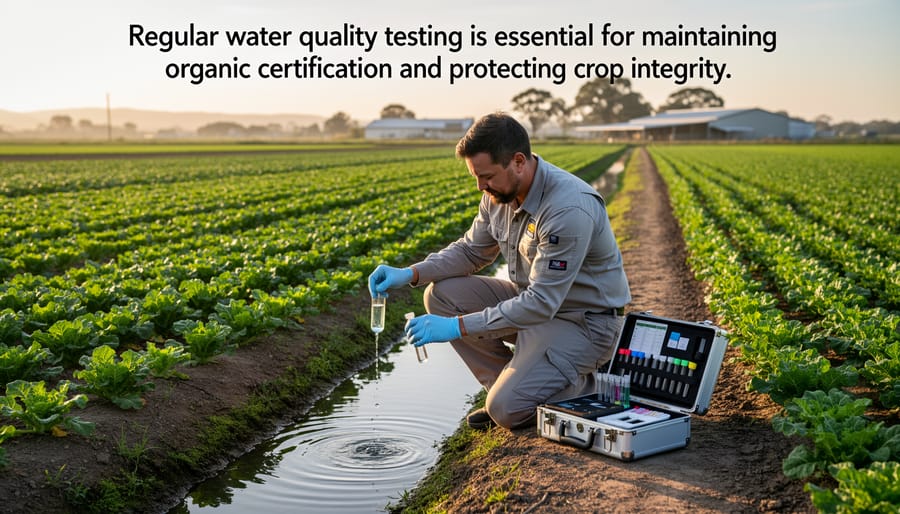
Testing protocols should focus on biological contaminants, heavy metals, and chemical residues. Many Alberta organic farmers work with local laboratories familiar with agricultural water testing, typically analyzing samples annually or when conditions change. For instance, Red Deer organic vegetable producer Sarah Chen tests her irrigation water each spring and after significant flooding events, ensuring her certification remains secure.
Documentation proves crucial. Keep detailed records of water sources, testing results, and any corrective actions taken. This paper trail demonstrates your commitment to water stewardship and satisfies certification body requirements during annual inspections. Remember, proactive water management protects both your organic status and your farm’s long-term productivity.
Buffer Zones and Water Source Protection
Protecting your organic crops from contaminated water sources requires thoughtful planning and clear boundary establishment. Under organic certification standards, you need to demonstrate that your water sources won’t compromise crop integrity through drift, runoff, or contamination from conventional operations.
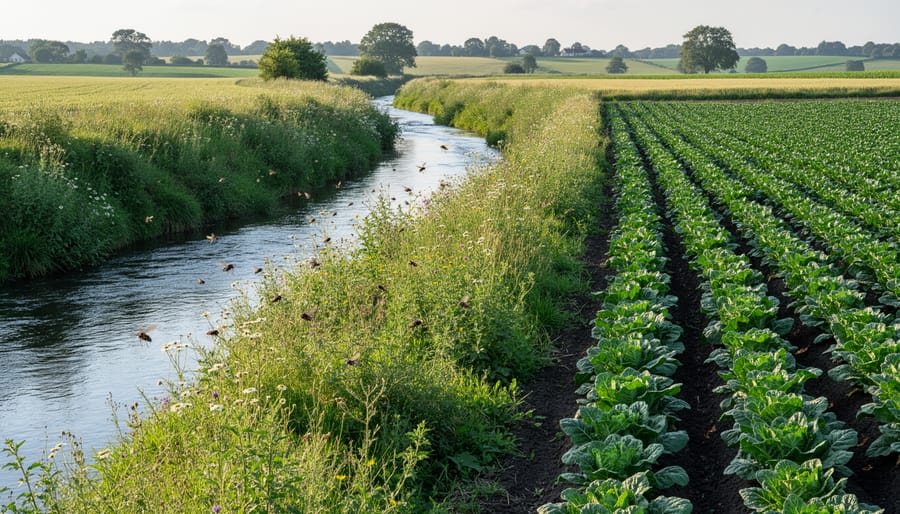
Buffer zones serve as your first line of defense. While specific distances aren’t always prescribed in certification standards, you’ll need adequate separation between organic fields and potential contamination sources. Many Alberta farmers successfully maintain 8-10 metre buffer zones between organic crops and conventional fields, though your certifier may require adjustments based on your specific situation. These buffers can include windbreaks, hedgerows, or dedicated vegetation strips that actively filter potential contaminants.
Water source protection goes beyond just physical distance. Document where your irrigation water originates and test it regularly for prohibited substances. Sarah Chen, an organic grain farmer near Lethbridge, shares her approach: “We mapped every water source on our operation, from dugouts to irrigation wells. Testing twice yearly gives us confidence and documentation for our annual inspection.”
If you’re using surface water from streams or ponds, consider whether upstream activities could affect water quality. Municipal water sources generally meet organic standards, but well water from your own property often provides the most reliable, controllable option.
Your organic system plan should include detailed maps showing water sources, flow directions, and buffer placement. This proactive documentation demonstrates your commitment to maintaining organic integrity and typically speeds up the certification review process.
How Canadian Standards Align (and Where They Differ)
COS Water Stewardship Requirements
Canada’s Organic Regime (COR) includes specific water stewardship provisions that work alongside NOP standards to address our unique environmental conditions. While the Canadian Organic Standards share many similarities with NOP requirements, they place additional emphasis on protecting Canada’s freshwater resources and managing water in colder climates.
Under COS requirements, organic farmers must demonstrate water conservation practices suited to their regional context. In Alberta, this means accounting for drought conditions, snowmelt management, and irrigation efficiency. You’ll need to document your water sources, usage rates measured in litres per hectare, and any potential contamination risks from neighbouring conventional operations.
The COS framework requires buffer zones between organic land and potential water contamination sources, with specific distance requirements varying by province. For Alberta producers, this often means maintaining 8 to 15 metres of vegetation along waterways, though your certifying body may recommend wider buffers based on local topography.
Additionally, COS standards mandate soil management practices that improve water retention and reduce runoff, complementing NOP soil health requirements. This integrated approach helps you meet both certification systems while building resilience against our increasingly variable prairie weather patterns. Your certification inspector will review these practices during annual inspections alongside standard NOP compliance checks.
Navigating Dual Certification
For Canadian farmers exporting organic products to the United States, pursuing dual certification under both the Canadian Organic Standards and the National Organic Program makes excellent business sense. The key to success lies in understanding that when standards differ between countries, you must meet the stricter requirement to maintain both certifications.
Start by comparing the specific water-related requirements under each program. For instance, while both programs require contamination prevention, the NOP may have different documentation expectations than Canadian standards. Your certification body can provide a detailed comparison chart highlighting these differences.
When differences exist, always default to the higher standard. If USDA organic certification requires more frequent water testing than Canadian standards, adopt that testing schedule for your entire operation. This approach simplifies record-keeping and ensures compliance across both programs without maintaining separate protocols.
Work closely with certification bodies approved under both systems. Many certifiers offer streamlined dual certification processes, reducing paperwork and inspection costs. They understand the nuances of both programs and can identify potential compliance gaps before they become problems.
Consider connecting with other Alberta farmers who’ve successfully navigated dual certification. Their practical insights about managing different inspection timelines, documentation requirements, and annual fees prove invaluable for newcomers to the process.
Alberta’s Unique Water Challenges for Organic Farmers
Alberta’s organic farmers face distinctive water challenges that set this region apart from other Canadian agricultural areas. The province’s semi-arid climate, combined with increasing weather variability, creates a complex landscape for maintaining National Organic Program compliance while ensuring productive farming operations.
Water scarcity stands as the primary concern for many Alberta producers. Southern Alberta receives an average of only 300-450 millimetres of precipitation annually, making irrigation essential for most organic operations. Yet irrigation water allocations from rivers like the Bow and Oldman are increasingly restricted during drought years. This creates a delicate balance between meeting crop water needs and adhering to sustainable water stewardship practices required under organic standards.
Groundwater quality presents another layer of complexity. Some areas of Alberta have naturally occurring high salinity or elevated mineral content in aquifers, which can affect both irrigation suitability and compliance with organic water quality expectations. Farmers near intensive livestock operations or conventional farms may also face contamination risks from neighbouring properties, requiring regular monitoring to ensure their water sources remain free from prohibited substances.
Seasonal timing compounds these challenges. Alberta’s short growing season means farmers often need intensive irrigation during peak summer months, precisely when water availability is lowest. This concentration of water demand requires careful planning and efficient irrigation systems to maximize every drop while maintaining soil health and preventing runoff.
The province’s expanding organic sector also faces infrastructure limitations. Many older irrigation systems lack the precision technology needed for optimal water use efficiency. Upgrading to drip irrigation or soil moisture monitoring systems represents a significant investment, though one that typically pays dividends through reduced water consumption and improved certification compliance.
Understanding these regional realities helps Alberta organic farmers develop practical strategies that meet NOP standards while working within the province’s unique environmental constraints. Success requires adapting general organic principles to local conditions through careful planning, appropriate technology, and community knowledge-sharing among producers facing similar challenges.
Making Your Water Management Plan Certification-Ready
Essential Documentation Your Certifier Wants to See
Your organic certifier will ask for specific documentation to verify your water stewardship practices align with NOP standards. Start with a detailed farm map showing all water sources, including wells, dugouts, irrigation infrastructure, and drainage patterns. Mark distances between water sources and potential contamination risks like conventional fields or livestock areas.
Maintain water quality testing records that demonstrate compliance. Most certifiers recommend baseline testing before certification and annual monitoring thereafter. Track parameters like nitrate levels, bacteria counts, and potential chemical residues. Alberta farmer Jim Patterson from Red Deer County shares, “We test our irrigation well twice yearly and keep a simple binder with all results. Our certifier appreciates the consistency.”
Document your Organic System Plan’s water management section thoroughly. Include irrigation schedules, water conservation methods, and how you prevent contamination. If using shared water sources, provide written agreements with neighboring landowners outlining organic compliance measures.
Keep records of any water treatment systems, including filter maintenance and cleaning protocols. For those using municipal water, obtain annual quality reports from your supplier.
Agricultural consultant Maria Santos notes, “Canadian farmers should also document winter water management practices and spring runoff controls, as these are unique considerations for our climate.” Organized, accessible records make certification reviews straightforward and demonstrate your commitment to protecting this essential resource.
Water Testing Protocols and Frequency
Organic certification requires proactive water monitoring to demonstrate your water sources meet safety standards. The National Organic Program doesn’t mandate specific testing frequencies, but most certifying bodies recommend annual testing as a baseline, with additional testing if you suspect contamination or make infrastructure changes.
Your testing protocol should cover three key areas: biological contaminants like E. coli, chemical residues including pesticides and heavy metals, and physical parameters such as pH levels. For Alberta farmers, spring testing captures potential runoff impacts from neighbouring conventional operations, while fall testing evaluates irrigation water quality after the growing season.
Work with an accredited laboratory familiar with organic standards to ensure your results meet certification requirements. Keep detailed records including test dates, results, and any corrective actions taken. If contamination is detected, document your response immediately – whether that’s switching water sources, installing filtration systems, or adjusting buffer zones.
Many Alberta producers find success testing quarterly during their first certification year to establish baseline data, then moving to annual testing once patterns are understood. Remember that preventive testing protects both your certification status and your investment in organic production. Your certifying body can provide specific guidance tailored to your operation’s unique water sources and risk factors.
Conservation Practices That Check All the Boxes
Smart irrigation systems offer Alberta organic farmers measurable results while ticking certification boxes. Drip irrigation reduces water use by 30-50% compared to conventional sprinklers, with installation costs ranging from $1,200-$2,500 per hectare depending on field size and crop type.
Consider implementing soil moisture sensors at 15-30 centimetre depths to prevent over-watering. These devices, costing approximately $150-$400 each, help you meet NOP’s resource conservation standards while cutting water bills. Place sensors strategically across different soil types in your fields for accurate readings.
Mulching remains one of the most cost-effective practices, reducing evaporation by up to 70%. Organic mulches like straw cost around $80-$120 per large square bale and satisfy certification requirements for biodegradable inputs.
Schedule irrigation during early morning hours (5-8 AM) when evaporation rates drop by 25-30%. This simple timing adjustment costs nothing but delivers significant water savings.
Track your water usage monthly using simple spreadsheets or farm management apps. Documentation proves compliance during inspections and helps identify improvement opportunities. Many Alberta farmers report 20-40% reductions in water consumption within the first growing season after implementing these combined practices, while simultaneously strengthening their organic certification status.
Real Alberta Farms Getting It Right
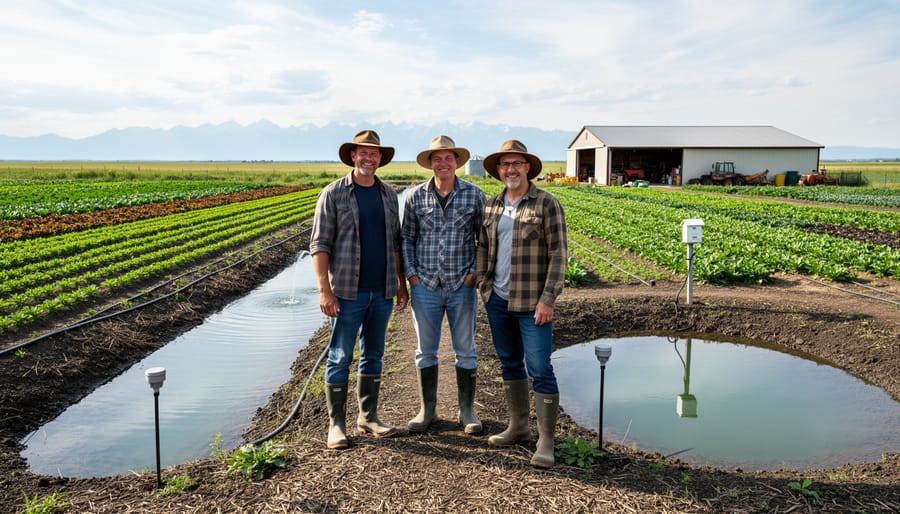
When Sarah Chen took over her family’s 65-hectare mixed vegetable operation near Lacombe in 2018, she knew water management would be critical to achieving organic certification. Four years later, Rolling Hills Organic Farm not only meets National Organic Program standards but has become a regional model for water stewardship that goes well beyond minimum requirements.
“The NOP standards gave us a baseline, but we quickly realized that truly sustainable water practices meant thinking holistically about our entire ecosystem,” Sarah explains during a walk through her irrigation system. “We’re not just checking boxes—we’re building resilience into every aspect of our operation.”
The farm faced significant challenges common to Alberta producers. Unpredictable precipitation patterns, increasing summer heat, and pressure on local aquifer resources meant Sarah needed to maximize every drop while preventing contamination. Her solution combined practical infrastructure with careful monitoring.
Sarah installed a closed-loop irrigation system fed by rainwater collection and a licensed dugout, reducing groundwater dependence by 60 percent. She established 15-metre vegetable-free buffer zones around all water sources—exceeding typical recommendations—and planted native grasses and shrubs to filter runoff and provide wildlife habitat.
“The buffers were actually our biggest initial challenge,” she recalls. “That’s productive land we’re not farming. But within two years, we saw measurable improvements in water clarity and reduced sediment movement. Our testing showed nitrate levels in runoff dropped by 40 percent.”
Agricultural water specialist Dr. Michael Kowalski, who consulted on the project, notes that Sarah’s approach represents best practices for certified organic operations. “She maintains detailed records of water quality testing quarterly, tracks every irrigation application, and documents her soil moisture levels weekly. This documentation not only satisfies NOP certification requirements but gives her valuable data for making management decisions.”
The farm’s success extends beyond compliance. Sarah’s water conservation measures reduced irrigation costs by 35 percent annually, while improved soil moisture retention increased yields by 22 percent across her main crops. She now mentors other Alberta farmers transitioning to organic production, sharing both her challenges and solutions. Her message is clear: meeting standards is achievable, and the benefits extend far beyond certification.
What Happens When Water Standards Aren’t Met
Water testing violations don’t automatically mean the end of your organic certification journey. Understanding what happens when standards aren’t met helps you respond effectively and maintain your operation’s integrity.
If water testing reveals contamination exceeding National Organic Program thresholds, your certifying agent will work with you to address the situation. The response depends on the severity and nature of the violation. Minor exceedances or first-time issues typically trigger a corrective action plan rather than immediate decertification. You’ll need to identify the contamination source, implement remediation measures, and demonstrate through retesting that water quality has been restored.
Alberta organic farmer James Richardson faced this challenge when nitrate levels in his irrigation well exceeded standards during routine testing. “My certifier didn’t pull my certification immediately,” he explains. “Instead, we developed a plan together. I installed filtration systems, switched to a different well for sensitive crops, and conducted monthly testing for six months to prove the problem was resolved.”
The remediation process requires documentation at every step. You’ll maintain detailed records of corrective actions, retest results, and any changes to water sources or treatment systems. This transparency demonstrates your commitment to organic integrity and helps rebuild confidence in your water management practices.
Prevention remains your best strategy. Regular testing beyond minimum requirements, maintaining buffer zones around water sources, and monitoring neighboring land uses all reduce violation risks. Many successful Alberta operations conduct quarterly testing even when annual testing meets certification requirements, catching potential issues before they become compliance problems.
Remember that certifying bodies want you to succeed. They provide technical support, connect you with water quality specialists, and offer reasonable timelines for remediation. Open communication with your certifier throughout the process ensures you’re taking appropriate steps and understand expectations clearly.
Embracing proactive water stewardship under National Organic Program standards isn’t just about maintaining your certification—it’s an investment in your farm’s long-term economic viability and environmental health. Canadian organic farmers who prioritize water management consistently report benefits that extend well beyond compliance, including reduced input costs, improved soil health, and increased resilience against the climate variability we’re experiencing across the prairies.
The economic case is compelling. By implementing water conservation practices and preventing contamination, you’re protecting your organic premium, which can represent a 30-50% price increase over conventional products. You’re also building soil structure that requires less irrigation over time and reducing the risk of costly certification issues that could jeopardize your market access.
From an environmental perspective, your commitment to NOP water standards makes you a steward of one of our most precious resources. Every measure you take to protect water quality benefits your local watershed, supports biodiversity, and contributes to the sustainability of agriculture for future generations.
Your next steps are straightforward. Start by reviewing your current water management practices against NOP requirements. Document what you’re already doing well, identify any gaps, and create a simple action plan. Connect with your certification body for guidance, and consider reaching out to fellow organic farmers in your area who’ve successfully navigated these same challenges.
Remember, every farm’s journey is unique, but the destination is the same: a certified organic operation that’s both environmentally responsible and economically strong. Your commitment to proper water management strengthens the entire organic community.