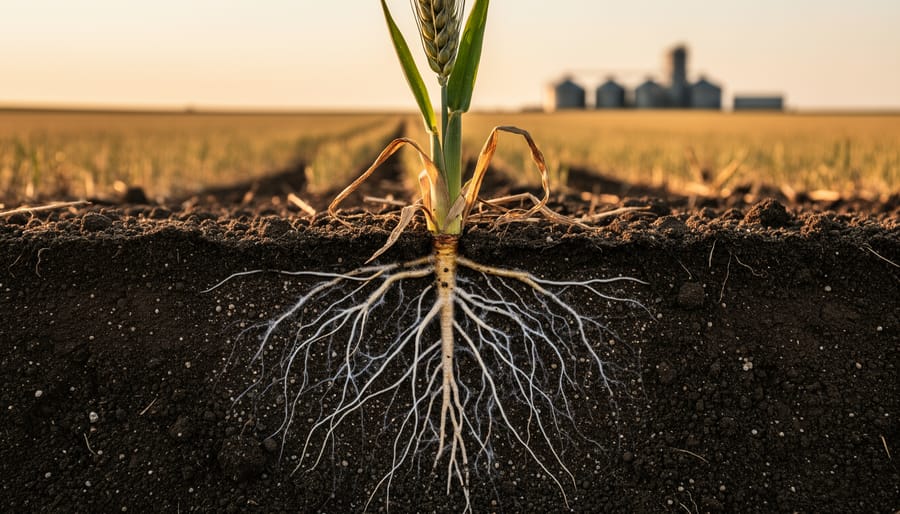
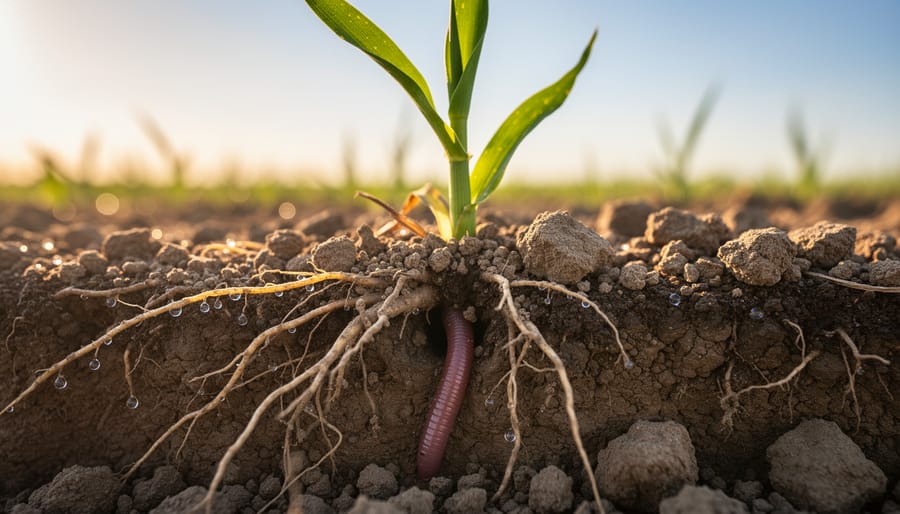
Healthy soil doesn’t happen by accident—it requires understanding and managing five interconnected components that work together to support vigorous crop growth and long-term farm productivity. Whether you’re transitioning to organic methods or refining your current practices, knowing what makes soil truly healthy gives you the power to make informed decisions that improve yields, reduce input costs, and build resilience against Alberta’s unpredictable weather patterns.
The foundation starts with soil organic matter, the living and decomposing material that feeds beneficial microorganisms and stores nutrients. Across the prairies, farmers increasing organic matter from 2% to 4% report better water retention during dry spells and improved soil structure that withstands heavy equipment without compaction. This connects directly to the second component: soil structure, which determines how air, water, and roots move through your fields.
The third component, soil biology, represents the invisible workforce of bacteria, fungi, earthworms, and other organisms that cycle nutrients and suppress disease. A single teaspoon of healthy soil contains more microorganisms than people on Earth, and these workers perform tasks no fertilizer can replicate. The fourth and fifth components—nutrient balance and water management—depend heavily on the first three. Nutrients must be available in proper ratios, while water needs to infiltrate quickly, store in root zones, and drain excess to prevent disease.
Understanding these five components transforms soil management from guesswork into a systematic approach that builds farm profitability season after season.
The Five Essential Components Your Soil Can’t Live Without
Healthy soil isn’t just about having the right dirt in your field. It’s a living, breathing system where multiple components work together to create the foundation for successful organic farming. Think of your soil like a well-coordinated team, where each player has a specific role, but it’s the teamwork that wins the game.
In organic systems, five essential components form the backbone of soil health: soil organic matter, biological life, mineral balance, soil structure, and water management. None of these elements work in isolation. Instead, they interact and depend on each other in ways that can make or break your growing season here in Alberta.
Soil organic matter acts as the energy source and warehouse for nutrients. It feeds the biological life, which includes everything from bacteria and fungi to earthworms and beneficial insects. These organisms, in turn, help break down organic matter, making nutrients available to your crops while improving soil structure. Good soil structure creates the pore spaces that allow for proper water infiltration and air circulation. When water management is balanced, it supports both plant roots and soil biology while preventing erosion and nutrient loss.
Here’s what makes this interconnected system so powerful: improving one component often creates positive ripple effects throughout the others. For example, when you increase organic matter, you’re simultaneously feeding soil biology, enhancing water-holding capacity, and building better soil structure. The reverse is also true. Neglecting one component can undermine your efforts in other areas.
Understanding how these five components work together gives you a roadmap for building truly resilient soil that can withstand Alberta’s variable weather patterns and support productive organic farming for years to come.
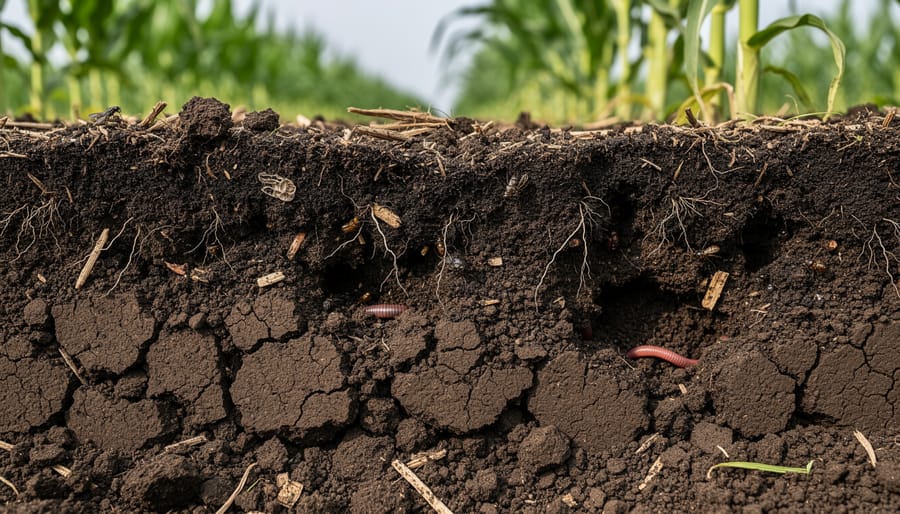
Soil Organic Matter: The Foundation of Fertility
What Organic Matter Actually Does for Your Fields
Organic matter is the powerhouse behind productive Alberta soils, and understanding how organic matter transforms productivity can help you make better management decisions. Think of it as your soil’s multitasking champion, working overtime to support your crops in several critical ways.
For nutrient retention, organic matter acts like a sponge for essential nutrients. Research from Alberta Agriculture shows that for every 1% increase in organic matter, your soil can hold approximately 10 additional kilograms of nitrogen per hectare. This means fewer nutrients washing away with spring melt and more available when your crops need them most.
Water holding capacity improves dramatically too. Each 1% increase in organic matter allows soil to hold an additional 170,000 litres of water per hectare in the top 15 centimetres. During Alberta’s dry spells, this extra moisture retention can be the difference between a struggling crop and a thriving one.
Soil structure benefits are equally impressive. Organic matter acts as a binding agent, creating stable aggregates that improve root penetration and air circulation. Fields with 4% organic matter versus 2% show measurably better water infiltration rates, reducing runoff and erosion during heavy rains.
The typical Alberta soil contains between 2-4% organic matter in the topsoil, though this varies by region and management history. Building even half a percentage point takes time, but the cumulative benefits make it worth the investment.
Building Organic Matter in Alberta’s Climate
Alberta’s short growing season presents unique challenges for building organic matter, but local farmers are proving it’s entirely achievable with the right approach. The key lies in maximizing every opportunity to feed your soil during our compressed timeline.
Start by incorporating cover crops immediately after harvest. Even a 60-day window before freeze-up allows species like winter rye or hairy vetch to establish roots and add biomass. These crops protect soil over winter and contribute organic matter when terminated in spring. Many Alberta farmers are also finding success with reduced tillage practices, which preserve existing organic matter while gradually building reserves.
Diversifying crop rotations makes a significant difference. Including perennial forages for even one year in a rotation cycle adds substantial root mass and helps break up compaction. Livestock integration, where feasible, accelerates the process through manure application and managed grazing.
Tom Hewitt, an organic grain farmer near Lacombe, demonstrates what’s possible with commitment and strategic planning. Starting with just 2% organic matter in 2018, Tom implemented a four-part strategy: annual cover cropping after cereals, incorporating a two-year alfalfa phase every six years, applying composted manure at 10 tonnes per hectare every third year, and minimizing tillage depth to 10 centimeters or less.
By 2023, soil tests confirmed his organic matter had reached 4.5%. Tom notes the transformation wasn’t just in the numbers. His soil now holds moisture better during dry spells, requires less external fertility inputs, and shows improved structure that makes seeding operations smoother.
The timeline requires patience, but consistent effort compounds. Even incremental annual increases of 0.3 to 0.5% create measurable improvements in soil function and crop resilience within Alberta’s climate realities.
The Underground Workforce: Biological Life in Soil
Meet Your Soil’s Microbial Team
Think of your soil as a bustling underground city, where billions of microscopic workers collaborate to keep your crops thriving. Understanding these key players helps you make decisions that support their essential work.
Bacteria are your soil’s rapid-response team. These single-celled organisms break down organic matter faster than any other microbe, releasing nutrients like nitrogen and phosphorus that plants can immediately absorb. In Alberta’s shorter growing season, active bacterial populations give you a crucial edge by accelerating nutrient availability when your crops need it most.
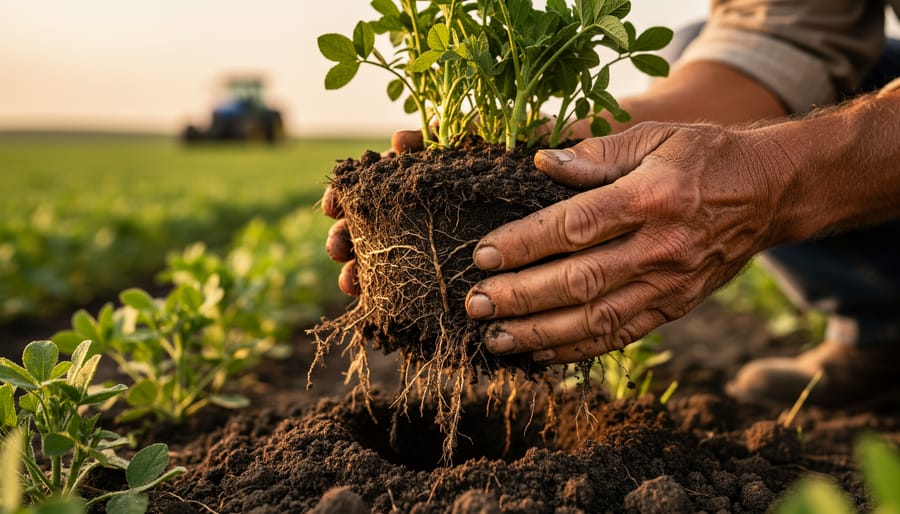
Fungi act as your soil’s infrastructure builders. Their thread-like structures, called hyphae, create networks extending far beyond plant roots – sometimes up to 100 metres from a single root system. These networks improve water retention and help transport nutrients across greater distances. Mycorrhizal fungi, a specialized group, form partnerships with plant roots, exchanging nutrients for sugars.
Protozoa and nematodes serve as quality control managers. By consuming bacteria and fungi, they release excess nitrogen in plant-available forms while keeping microbial populations balanced. Beneficial nematodes also suppress disease-causing organisms, providing natural pest protection.
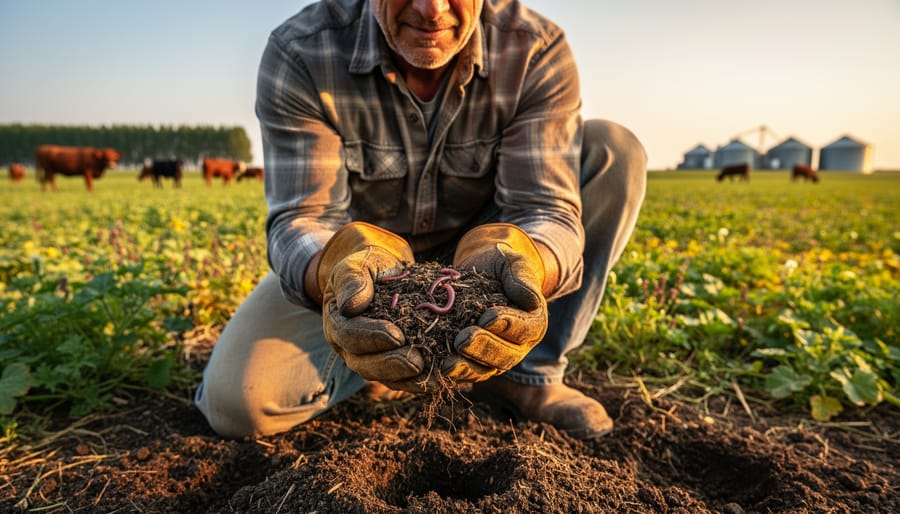
Earthworms are your soil’s engineers, creating channels that improve drainage and aeration. A healthy prairie soil typically contains 500,000 to 2 million earthworms per hectare.
Alberta farmer James Chen from Lacombe noticed a 15 percent yield increase after implementing practices supporting microbial diversity. “Once I understood these organisms weren’t just there – they were actively working for me – everything changed,” he explains.
Feeding the Biology That Feeds Your Crops
Your soil biology works hard for you—now it’s time to return the favor. Think of feeding soil microbes like running a successful farm: consistent nutrition delivers consistent results.
Start with strategic cover crop selection. Winter rye and hairy vetch provide steady organic matter while protecting soil during Alberta’s harsh winters. These crops feed microbes year-round, building populations that benefit your cash crops.
Compost tea applications offer a direct microbial boost, especially during spring when populations are rebuilding. Apply 200-400 liters per hectare every two to three weeks during the growing season. Quality matters more than quantity—ensure your compost source is biologically active before brewing.
Dr. Sarah Chen, a soil microbiologist at the University of Alberta, emphasizes the importance of minimizing disturbance: “Every tillage pass sets back microbial communities by weeks. We’re seeing Alberta farmers who’ve switched to no-till or reduced tillage operations increase their active carbon by 15-20 percent within three years. The biology recovers quickly when you stop disrupting it.”
Consider timing your field operations when soil is dry enough to prevent compaction. Wet soil compresses easily, crushing the pore spaces where microbes live and oxygen flows.
Small changes compound over seasons. Reduce tillage depth by 5 centimeters this year. Add one cover crop species to your rotation. Each step strengthens the biological foundation supporting your crops.
Signs Your Soil Biology Is Thriving (Or Struggling)
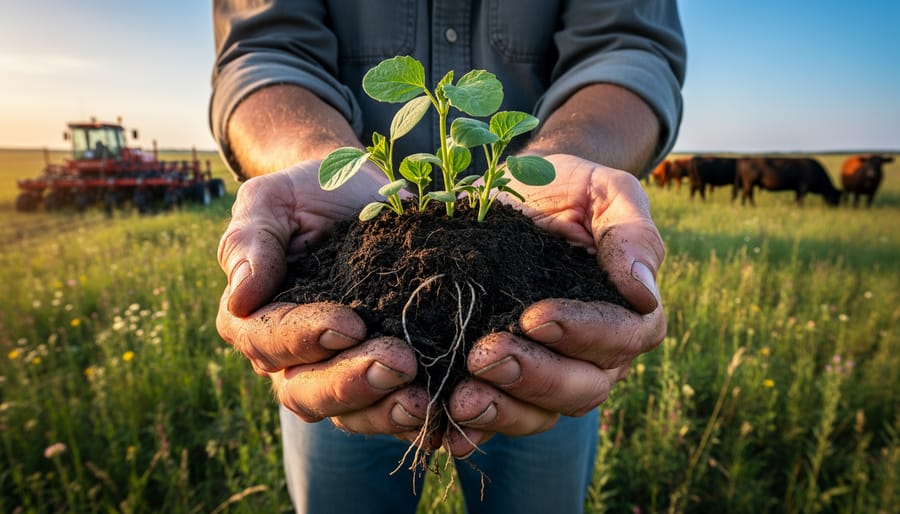
Your soil’s biological health reveals itself through simple observations you can make during regular field work. Healthy soil crumbles easily in your hand and has an earthy, fresh smell—never sour or ammonia-like. Look for earthworms; finding 10 or more in a 30 cm x 30 cm x 15 cm deep sample indicates thriving biology. Check crop residue breakdown—stalks from last season should decompose within 12-18 months in Alberta’s climate.
Dark, rich colour and good water infiltration (water disappearing within minutes, not hours) signal active microbial communities. Struggling soil appears compacted, drains poorly, and shows slow residue decomposition.
“I tell producers to trust their observations first,” notes Dr. Monika Gorzelak, soil ecologist at the University of Alberta. “If your crops look stressed despite adequate moisture and fertility, that’s when lab testing for microbial biomass and fungal-to-bacterial ratios becomes worthwhile.”
Consider professional testing when implementing major management changes or if visual indicators suggest problems you can’t explain through basic soil tests.
Getting Your Mineral Balance Right
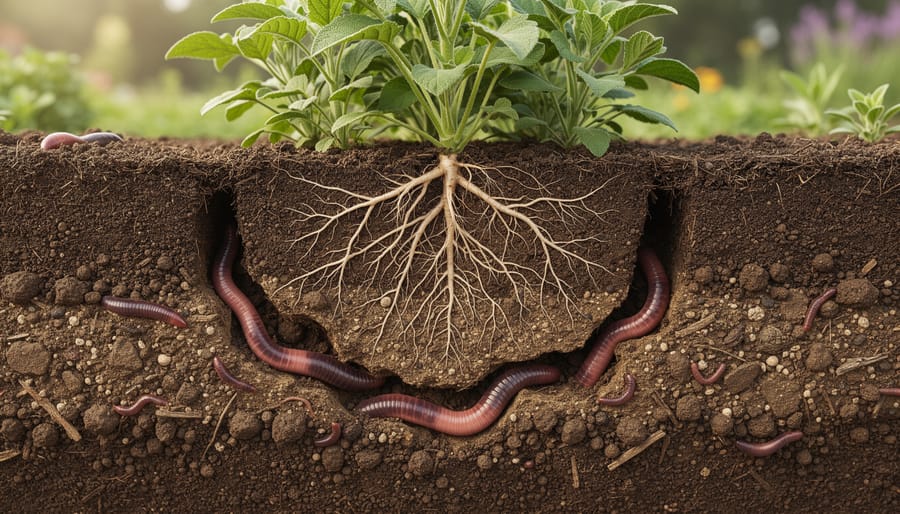
The Minerals That Matter Most
Your soil’s mineral content directly influences crop yield and quality. While plants need 17 essential nutrients, a few deserve special attention in Western Canadian soils.
Nitrogen drives leaf growth and protein development, though Alberta soils often run low after harvest. Phosphorus supports root development and energy transfer, but cold spring soils limit its availability even when present. Potassium strengthens disease resistance and winter hardiness, critical traits for our climate. Calcium structures soil particles and supports nutrient uptake, while magnesium anchors chlorophyll production.
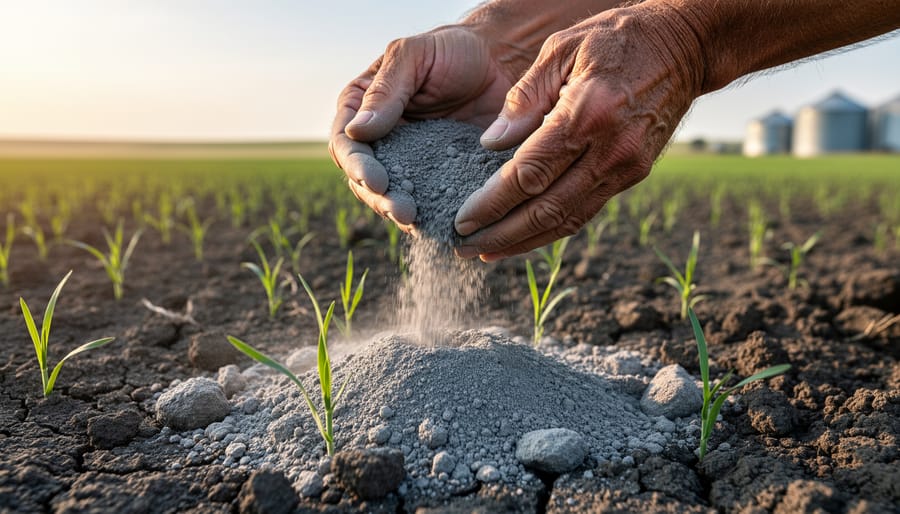
Western Canadian soils frequently show deficiencies in sulphur, particularly in canola production areas where crop removal exceeds natural replenishment. Boron shortages appear in sandy or high-pH soils, affecting seed development. Zinc deficiency surfaces in alkaline conditions common across the prairies, stunting early growth.
Red Deer agronomist Sarah Chen notes that “testing reveals most Alberta farms are adequate in potassium but marginal in available phosphorus and sulphur.” Her clients who conduct biennial soil tests make targeted amendments rather than blanket applications, saving input costs while addressing specific deficiencies.
Understanding your soil’s mineral profile through regular testing helps you make informed decisions about amendments and crop rotations. This targeted approach builds long-term soil health while optimizing your investment in nutrients.
Reading Your Soil Test Like a Pro
When your soil test results arrive, focus on these key numbers to make informed decisions. Start with pH levels—Alberta soils typically range from 6.0 to 8.0, with most crops preferring 6.5 to 7.5. If your pH falls outside this range, consider adding organic matter like compost rather than quick fixes, as it naturally buffers pH over time.
Next, examine your organic matter percentage. Anything below 3% signals a need for improvement through cover cropping or compost applications. Healthy prairie soils should aim for 4-6% organic matter.
For nutrient levels, compare your nitrogen, phosphorus, and potassium readings against crop-specific recommendations. Red Deer farmer James Chen shares his approach: “I don’t chase perfect numbers immediately. Instead, I create a three-year plan, addressing the most limiting factor first—usually nitrogen in our region.”
Use this simple framework: If a nutrient reads “low,” plan for amendment this season. “Medium” readings mean maintain current practices. “High” levels suggest you can reduce inputs and let your soil biology do the work.
Remember, soil testing is seasonal. Test in fall after harvest for the most accurate baseline, then verify improvements each spring before seeding.
Organic Amendments That Work in Our Climate
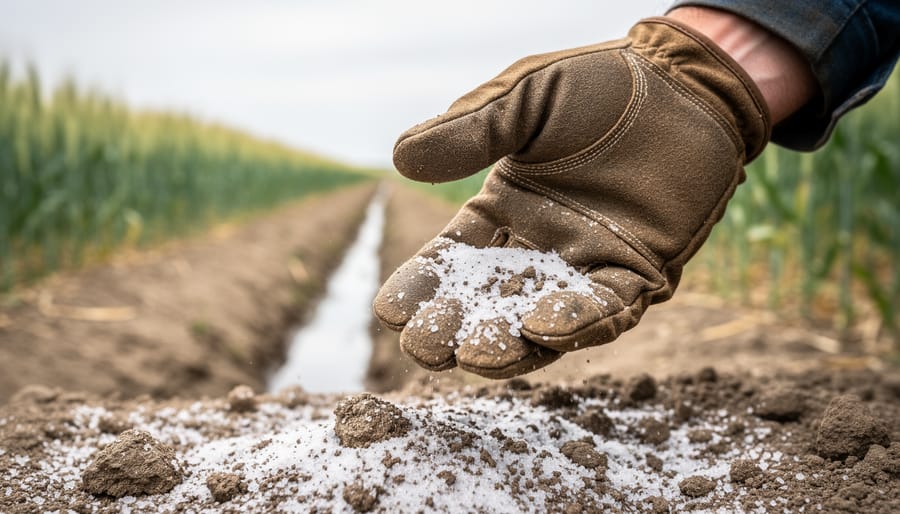
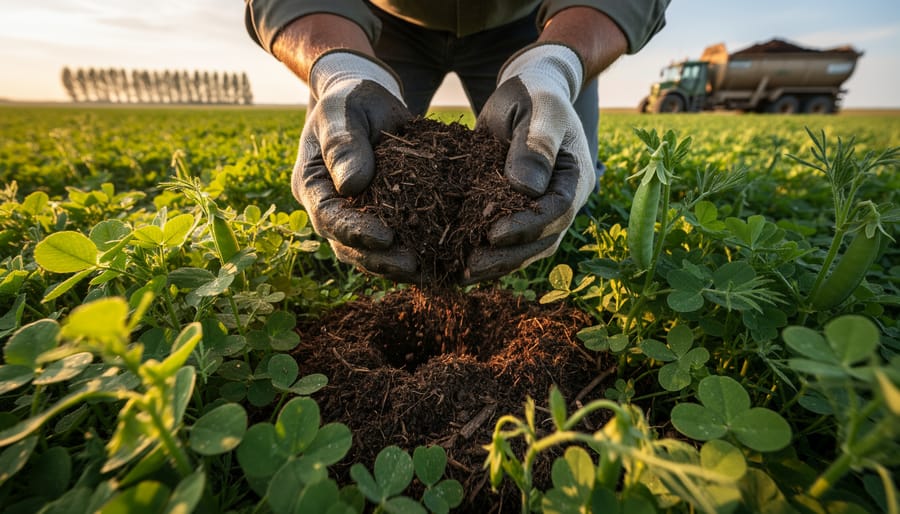
In Alberta’s climate, well-aged cattle or composted manure remains the gold standard amendment, applied at 20-30 tonnes per hectare in fall to allow winter breakdown. Compost works best when applied in spring at 10-15 tonnes per hectare, giving microbes time to activate before seeding. For phosphorus-deficient soils common in our region, rock phosphate applied at 250-500 kg per hectare provides slow-release nutrition over several seasons.
Green manures deserve special attention here. Fall rye planted in late August protects soil through winter and adds organic matter when tilled in spring. Red clover and field peas fix nitrogen while improving soil structure, with typical biomass contributions of 3-5 tonnes per hectare. Grande Prairie farmer Tom Henderson reports his oat-pea green manure blend reduced fertilizer needs by 40% within three years. Time green manure incorporation at least three weeks before planting your cash crop to prevent nitrogen tie-up. Consider your rotation carefully since green manures require dedicating a growing season to soil building rather than cash crops.
Building Soil Structure That Lasts
Why Structure Matters More Than You Think
Good soil structure does more heavy lifting on your farm than you might realize. When soil particles clump together properly into aggregates, they create a network of pores that acts like a natural insurance policy against Alberta’s weather extremes.
Consider drainage: well-structured soil can absorb 25 millimetres of rain in 15 minutes, while compacted soil might take hours. This matters during those intense June thunderstorms common across the prairies. During dry spells, that same pore network allows roots to reach deeper moisture reserves, helping crops survive without irrigation.
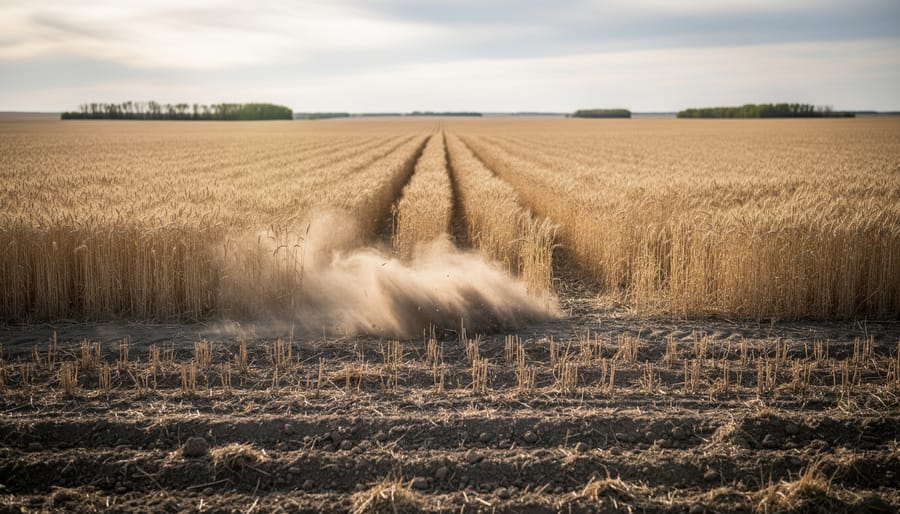
Red Deer region farmer Tom Hendricks noticed a dramatic difference after three years of building soil structure through cover cropping. “My wheat fields now withstand those chinook wind events without the topsoil blowing away like they used to,” he explains. His erosion losses dropped by 60 percent.
Structure also affects your bottom line through workability. Properly aggregated soil requires less fuel for tillage and creates better seedbeds with fewer passes. Spring fieldwork becomes possible earlier because structured soil drains faster, extending your planting window when timing is everything in our short growing season.
Protecting Structure Through Organic Practices
Protecting your soil’s structure starts with smart timing. Work fields when soil moisture levels are appropriate—not too wet, not too dry. Squeeze a handful of soil; if it forms a ball that crumbles easily when poked, conditions are generally right for field operations. Working wet soil creates compaction that can persist for years, collapsing the pore spaces where air, water, and roots need to travel.
Reducing compaction goes beyond timing. Consider controlled traffic patterns that limit where heavy equipment travels, and use wider tires or tracks to distribute weight. Each pass with machinery puts pressure on soil aggregates, so combine operations when possible. For example, some growers seed cover crops immediately after harvest using the same equipment pass.
Ground cover acts as nature’s armor for soil structure. Whether through cover crops, crop residue, or living mulches, keeping soil covered protects aggregates from raindrop impact and temperature extremes. Even a thin layer of residue makes a significant difference in maintaining structure through Alberta’s freeze-thaw cycles.
Saskatchewan organic grain farmer Dale Laturnus has built remarkable soil structure by feeding soil biology. “We focus on keeping living roots in the ground as long as possible,” he explains. “The mycorrhizal fungi and bacteria produce sticky substances that glue soil particles together into stable aggregates.” His operation uses diverse crop rotations including pulses and oilseeds, with periodic green manure crops specifically to boost biological activity. After a decade of these practices, Laturnus reports improved water infiltration even during heavy rainfall events, with minimal surface crusting or erosion.
Water Management: Making Every Drop Count
How Healthy Soil Handles Drought and Deluge
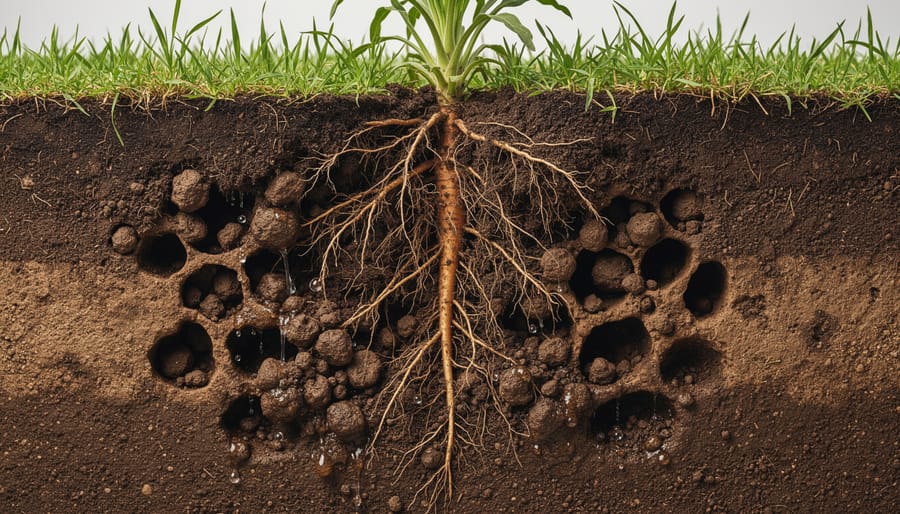
When soil contains 5% organic matter compared to just 1%, it can hold an additional 150,000 litres of water per hectare. That’s the equivalent of 38 millimetres of rainfall stored right where your crops need it. For Alberta farmers facing increasingly unpredictable weather patterns, this buffering capacity makes all the difference.
Healthy soil structure acts like a sponge with good drainage. The aggregate particles created by organic matter and beneficial soil life form pathways that improve water infiltration during heavy rains while simultaneously holding moisture during dry spells. Research from Alberta Agriculture shows that well-structured soils can reduce runoff by up to 70% during intense rainfall events.
The key lies in those soil aggregates we discussed earlier. They create pore spaces of varying sizes: large pores allow excess water to drain away, preventing waterlogging and erosion, while smaller pores hold water against gravity, keeping it available for plant roots. A soil rich in organic matter maintains this balanced structure season after season, protecting your investment whether you’re dealing with spring flooding or summer drought.
Organic Practices That Improve Water Resilience
Building water resilience into your soil doesn’t require expensive infrastructure. Three foundational practices work exceptionally well in Alberta’s variable climate.
Cover cropping is your first line of defense against both drought and flooding. Winter rye, hairy vetch, or oilseed radish planted after harvest create living roots that hold soil structure intact. When spring rains arrive, those root channels become pathways for water to infiltrate rather than run off. Red Deer region farmer James Chen reports his cover-cropped fields absorb 30% more water during heavy rains compared to bare fields.
Mulching with organic materials like straw or wood chips acts as a protective blanket, reducing evaporation by up to 50% during hot, dry periods. Apply 7-10 centimetres around crops and in pathways. The mulch gradually breaks down, feeding soil biology while moderating temperature swings that stress plants.
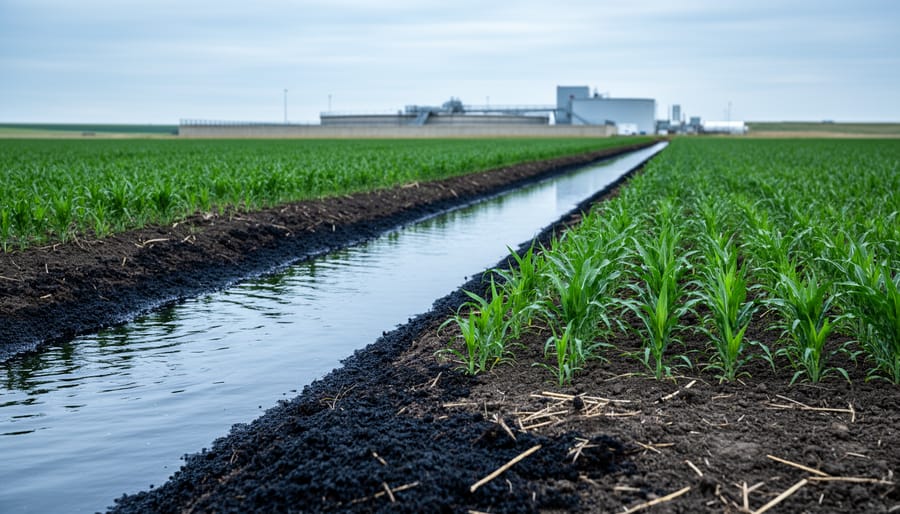
Contour management involves working with your land’s natural topography. On slopes greater than 3%, plant rows perpendicular to the slope and consider creating shallow swales every 30-40 metres. These simple earth formations slow water movement, giving it time to soak in rather than carrying precious topsoil away. This practice proved invaluable during the 2021 heavy rainfall events across southern Alberta, where contour-managed fields showed minimal erosion compared to conventionally tilled neighbours.
Putting It All Together: Your Soil Health Action Plan
Now that you understand the five essential components of healthy soil, it’s time to create a practical roadmap for your operation. Building soil health isn’t about perfecting everything at once—it’s about steady, strategic improvements that compound over time.
Start with a thorough soil health assessment to establish your baseline. This means testing beyond basic NPK values to include organic matter content, biological activity indicators, soil structure evaluation, and water infiltration rates. On the prairies, aim to conduct this assessment in late spring or early fall when soil conditions are most representative of your field’s true state.
Once you’ve identified your starting point, prioritize improvements based on what will deliver the greatest impact for your specific situation. If your organic matter sits below 3 percent, focus there first through cover cropping or reduced tillage. Poor water infiltration? Address compaction and work on building soil structure. Low biological activity? Consider diversifying your rotation and incorporating more plant diversity.
Timing matters significantly in our climate. Plan cover crop seeding for late summer to early fall when moisture is more reliable. Schedule any major soil amendments for spring application when you can incorporate them effectively. Fall is ideal for deeper interventions like subsoiling if compaction is limiting your productivity.
Set realistic expectations for your timeline. You’ll see some improvements within the first growing season, particularly in soil structure and water management. However, significant organic matter increases typically take three to five years of consistent management. Biological community recovery happens gradually—expect noticeable changes in two to three years.
Alberta farmer Tom Richardson from Lacombe County reminds us: “We didn’t degrade our soil overnight, and we won’t rebuild it overnight either. But every season of better management moves us forward.”
Track your progress annually with simple field observations—earthworm counts, how quickly water infiltrates after rain, and crop resilience during dry spells—alongside periodic laboratory testing. This combination of quantitative data and field-level observations gives you the complete picture of your soil’s journey toward improved health.
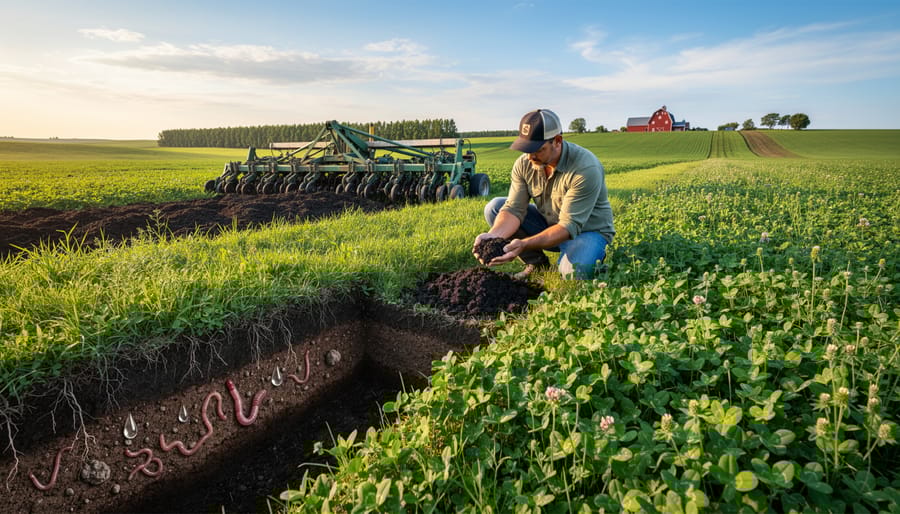
Understanding the components of healthy soil can feel overwhelming at first, but remember that these elements don’t work in isolation. Your soil’s biology, organic matter, mineral balance, structure, and water retention all work together as a connected system. When you improve one aspect, you often see positive ripple effects throughout the entire soil ecosystem. The beauty of this interconnectedness is that you don’t need to tackle everything at once.
Start where it makes the most sense for your operation. Maybe that’s adding a simple cover crop mix this fall, or adjusting your tillage practices on a small test plot. Perhaps it’s sending in a soil sample to understand your current mineral profile, or reaching out to a fellow farmer who’s successfully transitioned to regenerative practices. Small, manageable changes compound over time into significant improvements.
Consider soil health as one of your most important long-term investments. Healthy soil doesn’t just produce better yields today; it builds resilience against drought, reduces input costs, and increases your farm’s profitability year after year. Alberta farmers who’ve committed to improving their soil health consistently report not just better production, but greater peace of mind knowing their land can handle whatever weather challenges come their way.
You’re not alone in this journey. Our platform connects you with experienced farmers, agronomists, and researchers who understand the unique challenges of Canadian agriculture. Whether you need advice on cover crop selection for short growing seasons or want to learn from someone who’s successfully improved their soil organic matter, there’s a community here ready to support you. Your healthier soil starts with that first step.