Climate risk insurance is specialized coverage designed to protect farms and agricultural operations against production or revenue losses caused by specific weather events or climate-related perils, often using parametric triggers rather than traditional loss adjustment.
For Canadian farmers facing increasingly unpredictable weather patterns, this type of insurance represents a strategic shift from waiting for disaster to strike. Traditional crop insurance covers yield loss after the fact. Climate risk products can pay out automatically when a predetermined weather threshold is breached, whether that’s insufficient rainfall during a critical growth window, an early killing frost, or excessive heat days that stress livestock. The payout arrives based on objective data from weather stations, not farm-by-farm inspections.
This matters because climate volatility now threatens not just individual harvests but long-term farm viability and the ability to invest in sustainable practices. A producer considering the transition to regenerative methods or diversified cropping needs financial certainty to absorb the learning curve and upfront costs. Climate risk insurance provides that buffer, allowing operations to pursue soil health improvements, cover crop experiments, or integrated livestock systems without gambling the entire season’s cashflow on weather cooperation.
In Alberta, where spring moisture deficits, summer hail corridors, and early fall freezes create distinct risk windows, parametric products can complement existing Agriculture Financial Services Corporation programs. They fill gaps traditional policies don’t address well, such as preventing planting losses, forage quality degradation, or heat stress in confined livestock.
This article explains how climate risk insurance works mechanically, the types of coverage available across Canadian agriculture in 2026, and how to evaluate whether parametric or hybrid products fit your operation’s risk profile and sustainability goals. You’ll gain clarity on trigger structures, premium considerations, and the practical role this coverage plays in building economic resilience alongside environmental stewardship.
What Climate Risk Insurance Means for Canadian Farmers
Climate risk insurance is a specialized form of protection designed to help farmers offset financial losses when extreme or adverse weather disrupts crop production. Unlike traditional crop insurance, which typically reimburses you for documented yield shortfalls after an adjuster inspects your field, climate risk insurance can include products that pay out automatically when specific weather conditions occur, whether or not you file a claim. This difference matters because it provides faster liquidity when you need it most, and it shifts the focus from post-harvest loss assessment to proactive risk management.
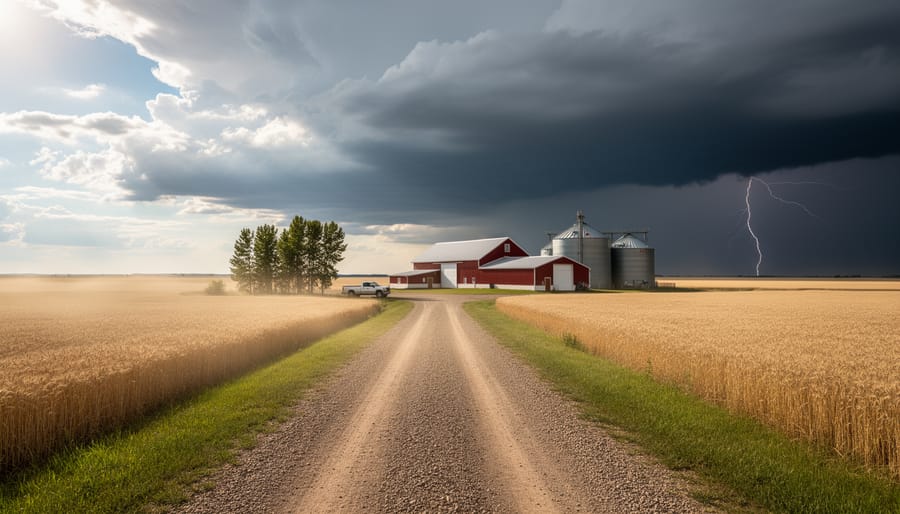
For Canadian farmers, particularly those operating in Alberta’s variable climate, this insurance addresses perils that have become more frequent and severe: prolonged drought that stunts cereals, excessive spring moisture that delays seeding or causes root rot, late-spring or early-fall frosts that damage emerging or maturing crops, and hail that can obliterate an entire field in minutes. Each of these events can derail a growing season, but their unpredictability makes planning difficult. Climate risk insurance helps bridge that gap by transferring some of the financial uncertainty to an insurer.
- Climate risk insurance
- Coverage that protects farmers against financial losses caused by specific weather events or climate-related perils, often using automated triggers rather than traditional loss assessment.
- Parametric insurance
- A policy that pays a predetermined amount when a measurable weather variable (such as rainfall or temperature) crosses a defined threshold, without requiring proof of actual crop damage.
- Index-based insurance
- Coverage tied to a regional weather index (like rainfall totals or growing degree days) rather than individual farm losses, offering faster payouts based on objective data.
- Indemnity insurance
- Traditional insurance that compensates you for documented losses after an adjuster verifies the damage, typically used in government crop insurance programs.
- Risk pooling
- The insurance principle of spreading risk across many policyholders, allowing individual farmers to pay manageable premiums while sharing the cost of claims when weather events strike.
Why does this matter for sustainable agriculture and economic resilience? When you invest in practices like cover cropping, reduced tillage, or diverse rotations, all of which build long-term soil health and climate adaptability, you may face variable yields in the transition years. Climate risk insurance provides a financial safety net during that period, making it easier to commit to practices that strengthen your operation over time. It also stabilizes cash flow when extreme weather hits, allowing you to meet loan payments, purchase inputs for the next season, and avoid liquidating assets at unfavorable prices. In a region where a single hailstorm or drought year can erase profit margins, this type of coverage isn’t just about recovering losses, it’s about maintaining the financial stability that lets you farm for the long term.
How Climate Risk Insurance Works in Practice
Traditional Indemnity-Based Coverage
Traditional indemnity-based coverage forms the foundation of crop insurance in Canada. When you file a claim under this model, an adjuster physically visits your fields to document the extent of damage or yield loss. The insurer compares your actual harvested yield against your historical production baseline, typically an average of your last several growing seasons, and calculates your loss based on that shortfall.
This approach requires thorough record-keeping on your end: seeding reports, input receipts, harvest documentation, and field maps. You’ll report the damage within specified timelines, often within days of discovering the loss, and the adjuster will assess whether the cause falls under covered perils like drought, excess moisture, hail, or frost. The payout reflects the difference between your insured yield and what you actually harvested, multiplied by a coverage price set at the start of the season.
While this system provides comprehensive protection tailored to your operation’s actual performance, the claims process can take weeks to months from initial report to final payment. Adjusters must schedule visits, assess multiple claims during peak damage periods, and verify documentation. For many Alberta farmers enrolled in AFSC programs, this remains the default structure, reliable but dependent on manual assessment and individual farm-level loss verification.
Index and Parametric Triggers
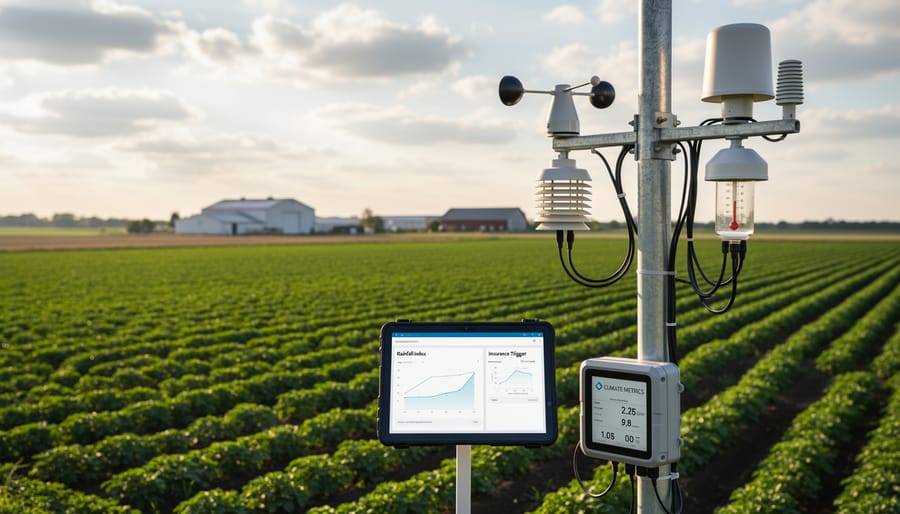
Index and parametric insurance flips the traditional model on its head. Instead of sending an adjuster to walk your fields after a drought, these products monitor objective data points, rainfall totals from nearby weather stations, satellite-measured vegetation indexes, or accumulated growing degree days, and pay out automatically when a predetermined threshold is breached.
Here’s how it works in practice: You select coverage tied to a specific metric, such as total precipitation during the growing season. The policy sets a trigger point, perhaps 60% of the thirty-year average rainfall for your region. If the weather station closest to your operation records below that threshold, the payout is triggered. No claim forms. No field inspections. The satellite or station data speaks for itself.
This approach trades precision for speed. Your neighbour might receive identical coverage even if your microclimate differs slightly. But parametric products deliver cash flow when you need it most, often within weeks of the trigger event, giving you working capital to replant, adjust inputs, or simply keep the operation running through a tough season. For farmers managing sustainability transitions that require consistent cash flow, that timing can be the difference between staying the course and abandoning practices mid-stream.
The Claims and Payout Timeline
When a covered climate event hits your farm, what actually happens next? The claims process varies by insurance type, but understanding the general timeline helps set realistic expectations.
For traditional indemnity coverage through AFSC, you’ll typically file a notice of loss within a few days of the damage. An adjuster schedules a field visit, often within one to two weeks during busy periods, to assess actual yield or quality impacts. Full settlement usually arrives four to eight weeks after harvest, once final yields are confirmed. Documentation requirements include production records, field maps, and sometimes soil moisture readings or weather station data.
Index and parametric products work differently. Once regional weather data confirms a trigger event, say, rainfall drops below the predetermined threshold, payouts process automatically, often within two to four weeks. You won’t need an adjuster visit or extensive paperwork; the weather station data speaks for itself. This speed advantage makes parametric insurance particularly valuable when you need cash flow quickly to replant, adjust inputs, or cover operating loans.
Private parametric policies sometimes pay out even faster, within days in some cases, since there’s no field assessment required. However, remember the trade-off: if your field experiences localized damage that doesn’t match the regional index, you won’t receive a payout under parametric coverage even though your crop suffered.
Keep copies of all communications, policy documents, and any weather records from your own station. If questions arise, having your own data alongside regional metrics strengthens your position and speeds resolution.
Types of Climate Risk Insurance Available in Canada
Production Insurance Programs
Production insurance programs through the Agriculture Financial Services Corporation (AFSC) form the backbone of climate risk coverage for Alberta farmers. These government-supported products protect against yield losses from drought, excess moisture, hail, frost, disease, and other perils that can devastate a harvest. AFSC’s Crop Insurance program covers most major crops grown in the province, calculating premiums based on each farm’s historical yields, selected coverage level (typically 50% to 90% of average production), and regional risk factors.
The program pays out when your actual harvested yield falls below your insured production level, regardless of the specific cause within covered perils. This multi-peril approach differs from single-event coverage by protecting against the full range of weather risks a growing season might bring. Farmers often combine this baseline protection with investments in precision agriculture and smart water economics to reduce their exposure while maintaining coverage for catastrophic losses.
Premium costs vary by crop, region, and your farm’s loss history, but government subsidies cover roughly 60% of the premium. This makes production insurance accessible even for operations with tight margins, providing a safety net that supports both immediate recovery after poor years and long-term planning for sustainable practices.
Weather Index Insurance
Weather index insurance operates on measured regional data rather than individual farm inspections. When rainfall at designated weather stations falls below a set threshold, say 75% of the 30-year average during the critical June growing window, payouts trigger automatically for all enrolled farms in that zone. The same principle applies to temperature extremes, accumulated growing degree days, or frost events tracked by Environment Canada stations. This approach speeds up claims processing dramatically because there’s no need to send adjusters to each field.
For Alberta farmers, index products work particularly well for widespread risks like drought or delayed spring warmth that affect entire districts. The trade-off is basis risk: your specific field might perform differently than the regional average. A farm with heavier soils or natural windbreaks might sustain less frost damage than the area trigger suggests, while a low-lying quarter could suffer worse moisture stress than the zone’s rain gauge records. Evaluate whether the weather stations used actually represent your farm’s microclimate. Some producers layer index insurance with traditional coverage or use it strategically for perils that rarely hit just one farm in isolation. The faster payouts can provide crucial cash flow when transitioning to regenerative agriculture practices that may take several seasons to stabilize yields.
Private Parametric Products
Private companies are starting to offer parametric insurance products tailored to individual farm operations. Unlike government programs with standardized coverage, these products let you choose specific triggers, rainfall totals, heat units, frost dates, that match your biggest climate vulnerabilities. A grain producer might select a policy that pays out when May precipitation drops below 20 millimeters in their region, while a cattle rancher could trigger coverage based on pasture moisture index thresholds.
The key advantage is speed. Because payouts are automatic when the predetermined weather metric is hit, you typically receive funds within days or weeks rather than months. There’s no adjuster visit, no yield documentation, no disputed loss assessment. The weather station data triggers the payment.
These products work best as supplements to production insurance, filling specific gaps or providing immediate cash flow when climate events hit. Premiums tend to be higher than government programs because you’re buying precision and speed, but some producers find the customization worth it for their highest-risk exposures. Availability varies by region and provider, so check what’s accessible in Alberta through agricultural insurance brokers who specialize in farm risk products.
Using Climate Risk Insurance in Your Farm Operation

Integrating Insurance with Other Risk Tools
Climate risk insurance works best as part of a layered strategy rather than as your only safety net. Think of it as one layer in a multi-tool approach to farm resilience that addresses different types of risk from different angles.
Crop diversification reduces your exposure to any single weather event or market downturn, while insurance backstops yield shortfalls when conditions turn extreme. If you grow wheat, canola, and pulses instead of monoculture wheat, a hailstorm might devastate one field but leave others intact. Insurance then covers the specific loss on the damaged crop, rather than bearing the full weight of your operation’s income.
Water management infrastructure like dugouts, tile drainage, and moisture conservation practices give you physical control over water availability during dry spells or excess moisture events. Insurance complements this by covering losses when even good infrastructure cannot prevent damage from exceptional drought or flooding beyond normal variability.
AgriStability provides whole-farm income support when your margin drops below historical averages, regardless of cause. Climate risk insurance addresses specific perils and typically pays out faster, giving you immediate cash flow to replant, purchase feed, or cover operating expenses while AgriStability processes year-end claims.
Cash reserves and operating lines of credit handle routine gaps and smaller setbacks. Insurance preserves those reserves for opportunities and manageable challenges, rather than depleting them during catastrophic weather years that could otherwise threaten your solvency.
The goal is redundancy with purpose: each tool covers what the others cannot, building comprehensive protection without expensive overlap.
Supporting Sustainable Agriculture Transitions
Transitioning to regenerative practices, cover cropping, reduced tillage, diverse rotations, perennial integration, often means accepting yield variability in the first few years as soil biology rebuilds and new systems stabilize. Climate risk insurance creates a financial buffer during this adjustment period, making it easier for Alberta farmers to commit to practices that improve long-term resilience without gambling the farm’s immediate viability on perfect weather during the transition.
When you shift from monoculture canola to a four-crop rotation that includes pulses and cover crops, early-season yields on some crops may fluctuate as you learn optimal seeding rates, nutrient cycling, and pest dynamics in the new system. Production insurance or weather index coverage protects against climate-related shortfalls during these learning years, ensuring a drought or unexpected frost doesn’t derail the entire transition before the soil health benefits materialize. The coverage doesn’t penalize you for trying something new; it underwrites the experimentation necessary for sustainable intensification.
Insurance also supports capital investments that enable regenerative systems. Installing water-efficient irrigation, fencing for rotational grazing, or equipment for interseeding cover crops requires upfront spending that pays off over multiple seasons. Knowing you have climate risk coverage in place reduces the financial exposure if extreme weather hits in year one or two, when the new infrastructure hasn’t yet delivered its full economic return. You’re more likely to invest in a no-till drill or a compost spreader if you know a single hailstorm won’t wipe out both the crop and your ability to service the equipment loan.
For farmers integrating livestock into cropping systems or converting annual cropland to perennial forages, climate insurance can cover feed production risks while the grazing system matures and soil organic matter accumulates. This combination of risk transfer and long-term soil investment is foundational to sustainable agro-economics in a climate-volatile region.
Expert Perspective: Climate Insurance and Farm Resilience
Dr. Sarah Chen, an agricultural economist specializing in climate adaptation at the University of Alberta, spends considerable time working with Alberta producers on risk management strategies. Her perspective cuts through the hype around climate insurance products.
“Insurance is a financial backstop, not a farm management strategy,” she explains. “The farmers who get real value from climate risk coverage are those who’ve already done the hard work of understanding their operation’s specific vulnerabilities.”
Chen emphasizes that climate risk insurance works best when integrated into comprehensive agro-finance planning rather than treated as a standalone solution. She recommends producers start by identifying which climate perils genuinely threaten their operation’s viability versus those that cause inconvenience but not existential risk.
“A parametric drought product might be perfect for a dryland grain operation where spring moisture determines the whole season,” she notes. “But it’s wasted money for an irrigated vegetable producer whose main climate risk is late-spring frost damage to high-value crops.”
The economic value equation shifts significantly when producers are transitioning to practices with uncertain short-term returns. Chen points to regenerative agriculture adopters who face variable yields during the transition period while soil health improves.
“That’s where insurance really earns its premium,” she says. “It buys you time to let those ecological investments mature without financial panic if you hit a bad weather year early in the transition.”
She cautions against viewing insurance as permission to skip other resilience measures. Diversification, improved water management, and financial reserves all remain critical. Insurance complements these tools but can’t replace them.
Looking forward, Chen sees climate risk products becoming more sophisticated and tailored. Weather station density is improving across Alberta, enabling more accurate index triggers. Satellite technology allows better differentiation between farms in the same postal code.
“The producers who’ll benefit most are those who engage actively with their insurance advisors, ask detailed questions about what specific triggers mean for their fields, and treat the coverage as one piece of a larger resilience puzzle,” she concludes. “That’s where the real risk management happens.”
Common Questions About Climate Risk Insurance
Farmers evaluating climate risk insurance often weigh cost against peace of mind, wondering whether premiums justify the protection and how coverage fits with existing programs. The answers depend on your operation’s specific vulnerabilities, financial structure, and long-term goals.
How much does climate risk insurance cost?
Premiums vary widely based on your region, crop mix, coverage level, and recent loss history, typically ranging from 2% to 8% of insured value for government programs. Private parametric products may cost more but offer faster payouts and customizable triggers.
Does climate risk insurance replace my crop insurance or supplement it?
Most climate risk products supplement rather than replace traditional crop insurance. Production insurance through AFSC covers yield shortfalls from multiple causes, while specialized climate products address specific perils or provide faster income replacement during recovery periods.
What weather events are typically covered?
Common covered perils include drought, excess moisture, unseasonable frost, hail, and heat stress during critical growth stages. Index and parametric products often focus on measurable weather variables like rainfall totals, temperature extremes, or growing degree days rather than crop damage per se.
How quickly do payouts arrive after a trigger event?
Traditional indemnity products require field assessments and documentation, often taking weeks or months. Parametric and index products can pay within days or weeks of confirmed weather data, since they rely on third-party weather stations rather than individual farm inspections.
When comparing products, focus first on what gaps exist in your current risk management. If you already carry production insurance but worry about cash flow during extended droughts, a parametric product triggered by rainfall deficits could provide working capital faster than traditional claims. If your operation is transitioning to cover crops or reduced tillage, look for products that recognize these practices in premium calculations rather than penalizing unfamiliar techniques.
Cost considerations extend beyond the premium itself. Calculate potential payouts against realistic scenarios for your region, not just catastrophic losses. A product that costs less but rarely triggers may offer false economy compared to higher-premium coverage with well-calibrated thresholds. Ask insurers or AFSC agents for historical trigger frequency in your area to gauge value.
For organic and regenerative operations, eligibility varies by program. Government production insurance in Alberta covers organic acres, though premium rates and coverage levels reflect organic yield patterns. Some private parametric products are crop-neutral, focusing purely on weather metrics, which can suit diversified farms with non-traditional rotations.
Farms in historically low-risk zones face a different calculation. Premiums may be affordable, but infrequent payouts mean you are essentially banking against future climate volatility rather than insuring against regular losses. For some operations, directing those dollars toward soil health infrastructure or water storage yields better resilience returns than insurance premiums that seldom pay out. Others view insurance as essential backup while they build long-term adaptive capacity through management changes.
The decision ultimately hinges on your financial cushion, debt load, and tolerance for variability. Highly leveraged operations or those with tight margins often find insurance valuable for protecting lender relationships and avoiding forced sales during recovery years. Well-capitalized farms with diverse income streams may self-insure or purchase only catastrophic coverage, accepting manageable losses in exchange for lower annual costs.
Climate risk insurance isn’t a silver bullet, but it’s a valuable piece of the risk management puzzle for Alberta farmers navigating increasingly unpredictable weather. When paired with diversification, water infrastructure, soil health investments, and sound financial reserves, it creates a stronger foundation for long-term farm viability. The key is treating it as part of a broader strategy rather than a standalone solution.
Start by honestly assessing your operation’s specific vulnerabilities. What weather events keep you up at night? Which crops or fields are most exposed? What financial buffer do you have if a bad season hits? These answers will help you determine whether climate risk insurance makes sense for your farm and which type of coverage aligns with your needs.
Reach out to Agriculture Financial Services Corporation or a trusted insurance advisor who understands Alberta agriculture. Ask questions, compare options, and make sure you understand what triggers payouts and what doesn’t. The right coverage should fit your operation’s reality, not just sound good on paper.
For those transitioning to regenerative practices or investing in sustainability improvements, climate insurance can provide the breathing room to take calculated risks that benefit your land and your bottom line over time. It’s about protecting your ability to farm the way you want, through whatever weather patterns come next.
Alberta’s agricultural community has always adapted and innovated. Climate risk insurance is simply another tool in that ongoing effort, helping you build resilience today while working toward the farm you want tomorrow.