Your soil holds more than crops—it’s sitting on a potential revenue stream worth $15 to $40 per tonne of carbon dioxide stored. Canadian farmers are already earning carbon credits by changing how they manage their land, and the financial opportunities are expanding as corporations and governments race to meet climate commitments.
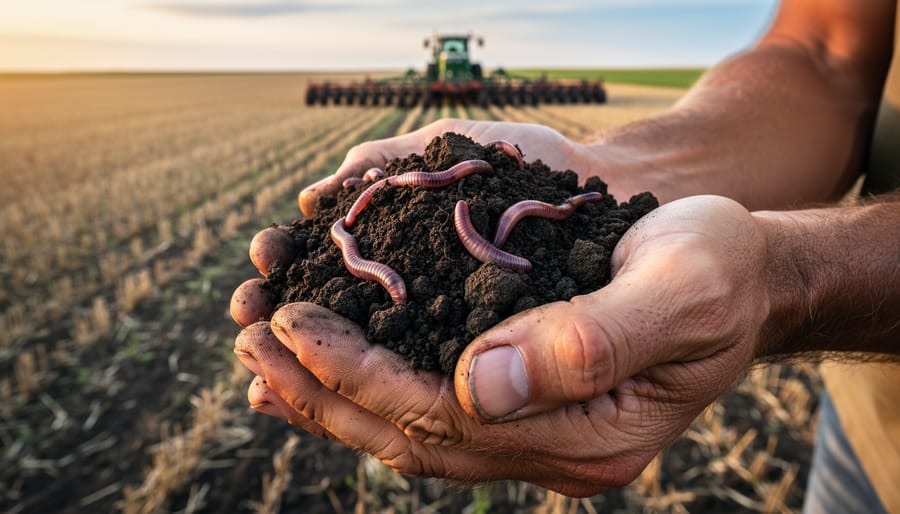
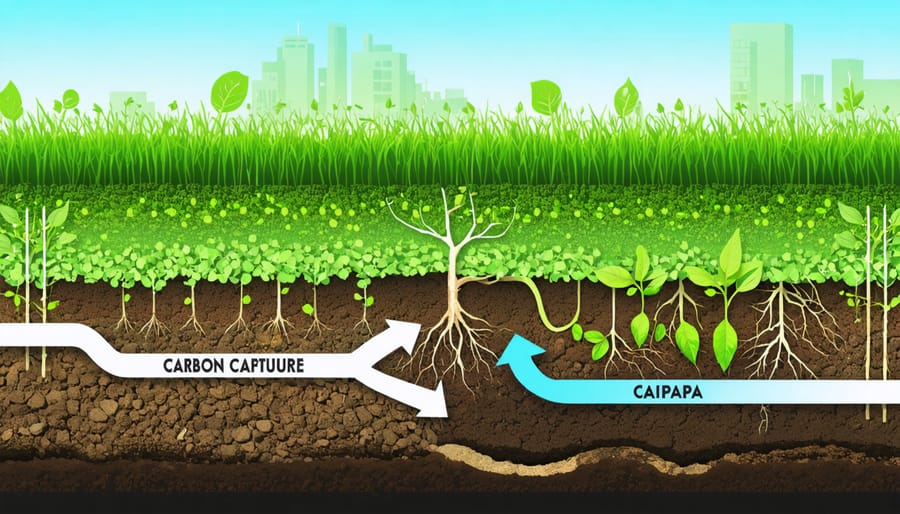
Carbon in soils exists as organic matter from decomposed plants, roots, and organisms. When you adopt practices like reducing tillage, planting cover crops, or improving grazing management, you capture atmospheric carbon dioxide and lock it underground for decades. This process, called carbon sequestration, now translates directly into marketable credits through provincial and private programs.
The economics make sense for many operations. Alberta’s Emission Offset System and private aggregators like Carbon by Indigo offer payments that can cover transition costs within two to three years. Saskatchewan farmer James Bekkering increased his organic matter from 3.2% to 4.8% over six years using no-till and diverse rotations, earning $12,000 annually in carbon credits while cutting fuel costs by 40%.
Understanding incentive structures requires cutting through complexity. Payment rates vary by program, verification costs differ, and contract lengths range from three to fifteen years. Some protocols credit only new practice changes, while others reward existing conservation efforts. The following breakdown clarifies what each major program offers, what commitments they require, and how to determine if carbon credits fit your operation’s financial reality.
Understanding Soil Carbon: What You’re Actually Storing
How Carbon Gets Into Your Soil (And Stays There)
Understanding carbon sequestration processes starts with recognizing that your soil is like a savings account for carbon—and you make deposits every growing season.
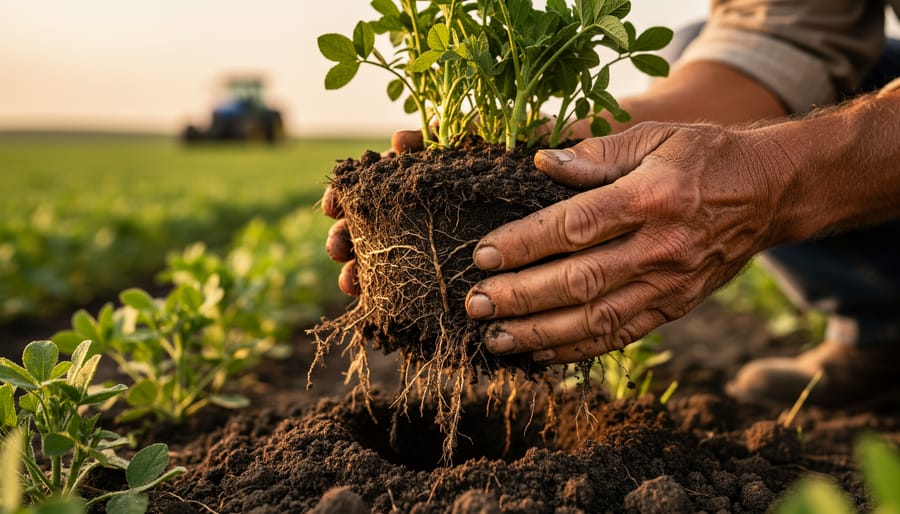
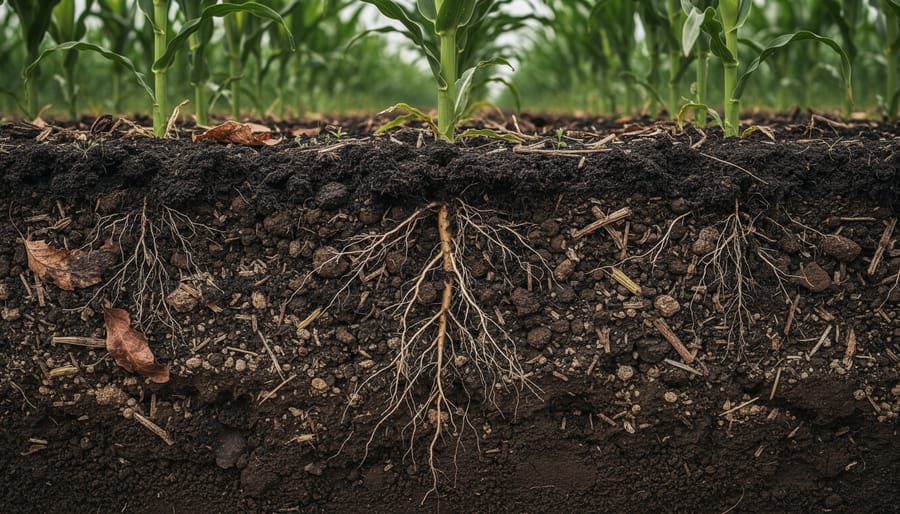
When crops grow, they pull carbon dioxide from the air through photosynthesis. About 40% of that carbon travels down through the roots, where it’s released into the soil as sugars and compounds that feed beneficial microbes. This living root system is your most active carbon pump, working throughout the growing season.
After harvest, crop residues—stubble, chaff, and roots—become the raw material for building soil organic matter. In Alberta’s climate, decomposition happens more slowly than in warmer regions, which actually works in your favor. The key is managing that residue properly. Leaving stubble standing over winter protects the soil, while those plant materials gradually break down into stable carbon compounds.
Here’s where it gets interesting: not all carbon sticks around equally. Fresh residues decompose quickly, but some carbon binds with soil minerals and gets tucked into tiny soil aggregates where it can remain for decades. The microbes doing this work need food year-round, which is why practices like extending your growing season with cover crops or reducing tillage make such a difference.
In practical terms, every tonne of crop residue you return to the soil contains roughly 400 to 500 kilograms of carbon. Protect those residues, keep living roots in the ground longer, and you’re building your soil’s carbon bank account.
Measuring What You Can’t See
Understanding how your soil carbon is measured is essential before joining any carbon program. Think of it like getting a baseline health check – you need to know where you’re starting from to track improvements over time.
Most programs use standardized soil sampling protocols that test carbon levels at specific depths, typically 0-15 cm and 15-30 cm. A qualified agrologist or technician will collect multiple samples from representative areas of your field, creating a composite sample that reflects your soil’s carbon content. These samples are then analyzed in certified laboratories using methods like dry combustion or loss-on-ignition to determine organic carbon percentages.
The process might seem straightforward, but accuracy matters enormously. Your baseline measurements lock in your starting point, and subsequent tests – usually conducted every three to five years – track changes. This data determines your carbon credit payments, so working with experienced professionals is worth the investment.
Many Alberta farmers report that establishing their baseline costs between 15 to 25 dollars per hectare, though some programs cover these initial testing costs. The key is ensuring your sampling follows the program’s specific protocols from day one. Poor initial sampling can disqualify you from future credits, even if you’ve improved your practices.
Remember, soil carbon changes slowly. Program administrators understand natural variability exists between years due to weather and other factors. That’s why verification protocols typically average results over time, giving you a fair assessment of your carbon sequestration efforts rather than penalizing single-year fluctuations.
Current Incentive Programs Available to Canadian Farmers
Federal and Provincial Government Programs
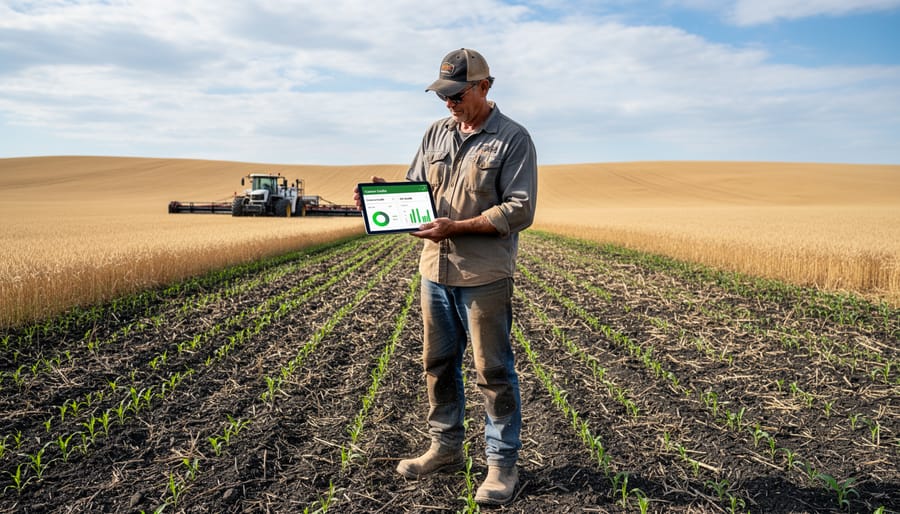
Canadian farmers have several government-backed programs designed to support soil carbon initiatives, making it easier to adopt beneficial practices while receiving financial support.
The Canadian Agricultural Partnership (CAP) provides cost-share funding for implementing beneficial management practices that enhance soil health and carbon storage. Through CAP, eligible producers can access funding covering up to 50-70% of project costs for activities like establishing cover crops, improving grazing systems, and transitioning to reduced tillage operations. Individual projects typically receive between $5,000 and $100,000, depending on the practice and scale. Eligibility generally requires you to be a Canadian citizen or permanent resident operating a farm business, with specific requirements varying by province.
In Alberta, the On-Farm Climate Action Fund represents a significant opportunity for producers. This federal initiative specifically targets emission reduction and carbon sequestration practices. Alberta farmers can receive direct payments for adopting nitrogen management strategies, cover cropping, and rotational grazing systems. Payment rates vary based on practice type and acreage, with cover cropping incentives typically ranging from $25 to $50 per acre.
Alberta’s Agricultural Service Board also administers region-specific programs through local municipalities. These programs often provide technical support alongside financial incentives, helping you understand which practices work best for your operation and soil conditions.
When applying for government programs, be prepared to provide baseline soil assessments, farm management plans, and commit to maintaining adopted practices for specified periods, usually three to five years. Most programs operate on a first-come, first-served basis with annual application deadlines, so connecting with your local agricultural fieldman early in the planning season helps ensure you don’t miss opportunities.
The Growing Forward 3 framework, currently under development, promises expanded support for soil carbon initiatives, potentially offering increased payment rates and streamlined application processes for producers already participating in carbon projects.
Private Carbon Market Opportunities
Beyond compliance markets, voluntary carbon programs offer flexible entry points for farmers interested in generating revenue from soil carbon sequestration. These private market opportunities have grown significantly, with several aggregator programs now operating across Canada.
Voluntary carbon markets connect farmers with corporations seeking to offset their emissions. Companies like Microsoft, Shopify, and major food brands purchase credits to meet sustainability goals. For Canadian farmers, this translates into payment opportunities ranging from $15 to $40 per tonne of CO2 equivalent, depending on the program and verification standards used.
Aggregator programs simplify participation by pooling credits from multiple farms. Nori, Indigo Carbon, and Radicle Balance have all launched programs accepting Canadian farmers. These platforms handle verification, credit registration, and buyer connections. Typical contract terms run 10 to 15 years, with farmers maintaining operational control while committing to specific practices like reduced tillage or cover cropping.
Alberta-based aggregator programs like those through Climate Action Incentive Fund partners offer regional advantages. Local agronomists understand prairie soil conditions and can provide tailored guidance. Payment structures vary—some programs offer upfront payments of $10-15 per acre with additional payments upon verification, while others pay annually based on measured carbon accumulation.
One mixed grain operation near Red Deer joined an aggregator program in 2021, transitioning 400 acres to no-till with diverse rotations. Their first-year payment covered transition costs, and projected five-year revenue could reach $25,000. The farm also gained access to agronomic support and soil testing through the program.
Before committing, compare contract terms carefully. Review payment schedules, practice requirements, data collection obligations, and what happens if you need to exit the program. Some aggregators charge enrollment fees or take percentage cuts from credit sales, while others offer simpler flat-rate structures. Understanding these details ensures the program aligns with your operation’s goals and cash flow needs.
What Makes a Soil Carbon Project Financially Viable
Upfront Costs and Ongoing Expenses
Before committing to a soil carbon program, it’s important to understand the financial investment required. Entry costs vary significantly depending on the program and your operation’s size, but transparency about these expenses helps you make informed decisions.
Verification and testing represent the most significant upfront costs. Baseline soil sampling typically ranges from $1,500 to $5,000 for an average farm, depending on field size and sampling intensity. Most programs require samples every 100 acres, with costs around $50-75 per sample when factoring in laboratory analysis. You’ll face these testing costs again during verification periods, usually every three to five years.
Administrative requirements add another layer of expense. Many programs charge enrollment fees between $500 and $2,000, plus annual administrative fees of $300-800. You’ll need to maintain detailed records of all management practices, which may require new software or additional time investment. Budget approximately 10-20 hours annually for documentation and reporting requirements.
Practice changes themselves carry implementation costs. Cover cropping might add $30-60 per acre initially, though many farmers offset this through reduced tillage savings. Transitioning to no-till can require equipment modifications ranging from $5,000 to $50,000, depending on your current setup.
Consider aggregator services if managing everything independently feels overwhelming. These organizations handle paperwork and verification for 10-20 percent of carbon credit revenues, reducing your administrative burden while ensuring compliance. Many Alberta farmers find this worthwhile, especially when starting out.
Revenue Streams and Payment Timelines
Understanding the financial reality of carbon credit programs helps you make informed decisions for your operation. Current carbon credit prices in Alberta typically range from $15 to $40 per tonne of CO2 equivalent, though prices fluctuate based on market conditions and program specifics. Most soil carbon projects can sequester between 0.5 to 2 tonnes of CO2 per hectare annually, depending on your baseline practices and the improvements you implement.
Payment timelines vary significantly between programs. Some initiatives offer annual payments once verification is complete, while others operate on multi-year cycles. Expect verification costs to reduce your net revenue by $3 to $8 per hectare. Many programs also require a commitment period of 5 to 25 years, during which you must maintain the carbon-storing practices.
Compared to traditional crop returns, carbon credits typically represent supplemental income rather than a primary revenue source. For context, if you sequester 1 tonne of CO2 per hectare and receive $25 per credit, that’s $25 per hectare annually before verification costs. This won’t replace your crop income, but it can provide meaningful additional revenue, especially when combined with other benefits like improved soil health and potential yield improvements over time.
Payment schedules also depend on verification timing. Most programs pay within 60 to 120 days after successful verification, which often occurs annually or biennially. Factor these timelines into your cash flow planning, as upfront costs for practice changes may precede your first carbon payment by 12 to 24 months.
Farming Practices That Qualify for Carbon Credits
No-Till and Reduced Tillage Systems
Conservation tillage practices, particularly no-till farming, are among the most recognized methods for qualifying in carbon credit programs. These systems build soil carbon by leaving crop residue on the field and minimizing soil disturbance, which helps preserve organic matter and reduce carbon loss.
To qualify, most programs require at least three years of documented conservation tillage practices. Transitioning from conventional tillage doesn’t have to happen overnight. Many Alberta farmers start with reduced tillage on a portion of their land, gradually expanding as they fine-tune their equipment and seeding techniques.
Take the example of the Johnson family farm near Lethbridge, who transitioned 400 hectares to no-till over five years. They report improved soil moisture retention and reduced fuel costs by 40 percent, while building eligibility for carbon programs. Similarly, a mixed grain operation in Red Deer County documented their transition journey, showing how strategic equipment investments and patience during the learning curve paid off both agronomically and financially. The key is maintaining detailed records from day one, including baseline soil samples, tillage operations, and crop yields to verify your carbon sequestration claims.
Cover Cropping and Crop Rotation Strategies
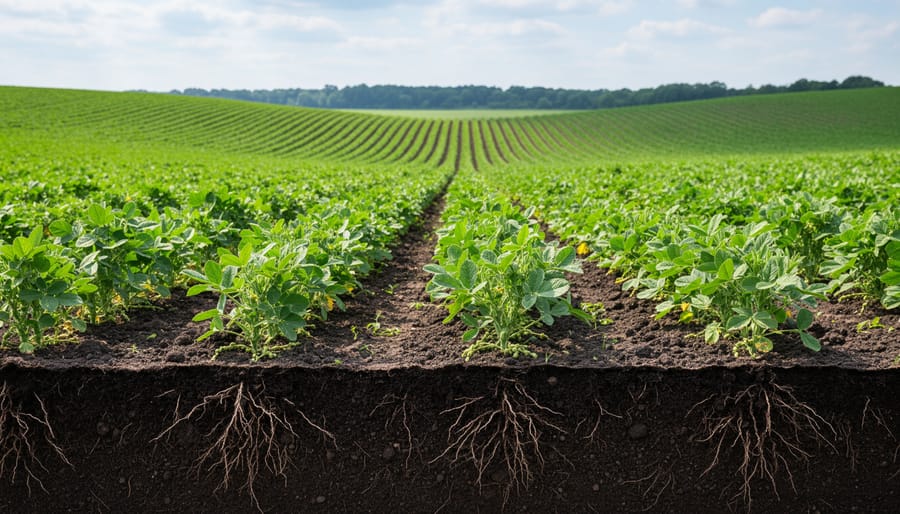
Selecting the right cover crops can significantly boost your soil carbon levels while complementing your existing rotation. In Alberta’s short growing season, winter-hardy species like fall rye and winter wheat work exceptionally well, capturing carbon through fall and early spring growth before spring seeding. These cereals can add 500 to 1,000 kilograms of organic matter per hectare annually.
For summer cover cropping after early cereals, consider fast-growing species like oats, peas, or radish. Mixing legumes with grasses provides dual benefits: legumes fix nitrogen while grasses contribute high-carbon residues. A blend of oats, peas, and radish can establish quickly in Alberta’s conditions and add substantial biomass before winter.
Strategic crop rotation amplifies carbon storage. Alternating cereals with oilseeds and pulses creates varied root systems that build carbon at different soil depths. Including perennial forages for even two years in rotation can dramatically increase soil organic matter, with some Alberta farms reporting carbon gains of 1 to 2 tonnes per hectare during the forage phase.
Central Alberta producer James Morrison reports that adding fall rye as a cover crop between canola and wheat increased his soil organic carbon by 0.3 percent over five years while reducing his spring workload and weed pressure.
Integrating Livestock and Grazing Management
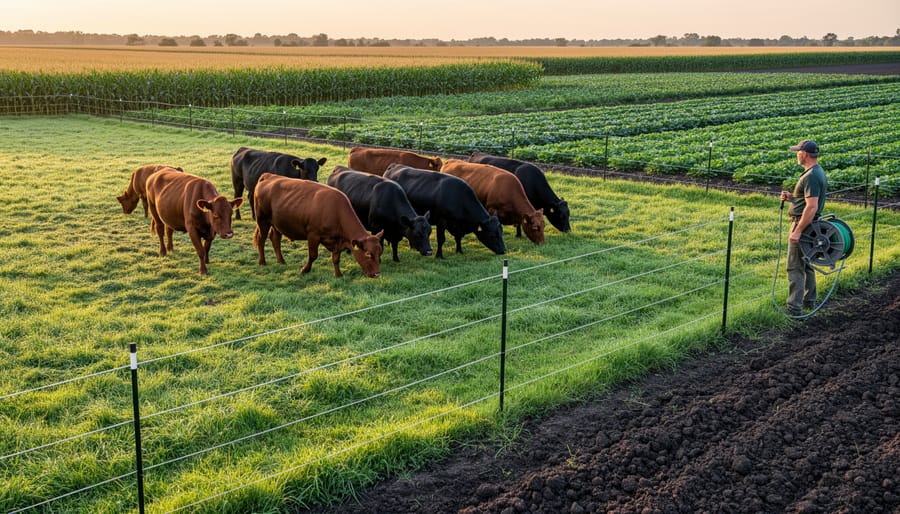
Livestock integration offers Alberta farmers a practical pathway to build soil carbon while accessing incentive programs. Rotational grazing systems, where animals are moved regularly between paddocks, stimulate plant growth, increase root biomass, and naturally incorporate manure into the soil—all actions that sequester carbon. Many farmers report improved soil structure and water retention within just two to three years of implementing these practices.
Integrated crop-livestock systems qualify for various carbon credit programs, including federal and provincial initiatives. These operations typically see higher carbon accumulation rates compared to crop-only systems, with measurements showing increases of 0.5 to 1.0 tonnes of carbon per hectare annually. Programs value this approach because livestock provide natural fertilization and soil disturbance that enhances microbial activity and carbon storage.
To qualify for incentives, you’ll need to document grazing plans, stocking rates, and rotation schedules. Baseline soil testing establishes your starting point, with follow-up testing demonstrating carbon gains. The combination of potential carbon credit revenue and improved forage productivity makes this strategy increasingly attractive for mixed operations across the prairies.
Navigating Contracts and Commitments
What to Watch for in Program Agreements
Before you sign on the dotted line with any carbon program, you need to understand what you’re committing to. These agreements can lock you into practices for years, so knowing the fine print makes all the difference.
Permanence requirements are one of the biggest considerations. Most programs require you to maintain increased carbon levels for 15 to 25 years. This means if you decide to change practices or sell your land, that agreement typically transfers to the new owner. Ask yourself: can you realistically commit to these practices for that timeline?
Additionality clauses determine whether your practices qualify for credits. Essentially, you need to prove you’re doing something beyond your current management. If you’ve already been using no-till for five years, some programs won’t consider that additional. Understanding what counts as baseline versus additional is critical to knowing if you’ll actually qualify.
Reversal risks matter too. If future soil testing shows carbon levels have decreased, whether from drought, flood, or management changes, you might be required to repay credits or purchase replacement credits. Some programs maintain buffer pools to cover these situations, while others place the risk squarely on you.
Finally, examine exit strategies carefully. Can you leave the program early? What penalties apply? What happens if the program itself folds? Alberta farmer Tom Henderson learned this lesson when his program changed ownership mid-contract, creating months of uncertainty. Clear exit terms protect your operation’s flexibility and give you options if circumstances change.
Verification and Compliance Requirements
Participating in carbon programs means committing to regular documentation that tracks your soil health journey. Most programs require soil sampling every three to five years, with samples taken from the same GPS-marked locations each time to ensure accurate comparison. Plan for these sampling costs in your budget – typically between $50 to $150 per sample, with most farms needing 10 to 20 samples depending on field variability.
You’ll submit annual reports detailing your management practices, including seeding dates, crop types, fertilizer applications, and tillage activities. Many Alberta farmers find this easier than expected, especially if they already use farm management software. Digital platforms provided by most programs allow you to upload this information directly, often integrating with equipment you’re already using.
Third-party verification visits happen periodically, usually every few years. A verifier will visit your operation to confirm reported practices and review your records. Think of this as similar to an agronomic consultation – verifiers understand farming realities and work collaboratively.
Keep detailed records from day one. Photograph conservation practices, save equipment receipts, and document field activities consistently. Several Alberta producers recommend creating a simple digital folder system organized by year and field, making annual reporting straightforward. This documentation protects your credits and simplifies the verification process considerably.
Real Stories from Alberta Farms
When Derek Thompson from Lethbridge County enrolled 240 hectares of his mixed grain operation into a soil carbon project in 2019, he wasn’t expecting immediate riches. What he found was a learning curve steeper than his rolling farmland, but ultimately, a program that made sense for his operation’s future.
“The paperwork was honestly the biggest shock,” Thompson shares. “Between baseline soil sampling, documentation of practices, and verification visits, I spent about 40 hours in year one just on administration.” His operation needed soil samples from 15 different zones across his enrolled acres, with each sample requiring precise GPS coordinates and depth measurements to 30 centimetres.
The financial picture took patience to materialize. Thompson’s upfront costs included $3,200 for baseline soil testing and aggregator fees of $1,800 annually. His first carbon credit payment arrived 18 months after enrollment, netting $4,800 for practices he’d already started implementing, including reduced tillage and cover cropping on specific fields.
By year three, Thompson’s operation generated credits worth approximately $18 per hectare annually. While not transformative money, it covered his costs for cover crop seed and provided modest additional income. More valuable was the detailed soil analysis he received through the program, revealing compaction issues in two fields that were limiting yields.
“The carbon credits are nice, but understanding my soil health better has been the real payoff,” Thompson notes. He’s since adjusted his crop rotation and reduced passes across problem areas, seeing yield improvements of 8 to 12 percent in previously underperforming zones.
His advice for farmers considering enrollment? Start with fields where you’re already implementing qualifying practices. Understand the commitment period, typically five to ten years for most programs. Keep meticulous records from day one. And don’t expect carbon payments alone to revolutionize your bottom line. Think of them as one piece of a broader soil health strategy that pays dividends through improved productivity and long-term sustainability.
Expert Perspective: Making Incentive Programs Work for Your Operation
We spoke with Jennifer Matthews, an agrologist and carbon program administrator with over 15 years of experience helping Alberta farmers navigate soil carbon initiatives, to get her perspective on making these programs work effectively.
“The biggest mistake I see is farmers choosing a program based solely on the payment rate,” Matthews explains. “You need to look at the whole picture: contract length, practice flexibility, verification costs, and how the program fits with your long-term farm plans.” She recommends farmers start by identifying which practices they’re already doing or planning to implement, then find programs that align with those goals rather than changing operations to chase credits.
When it comes to avoiding pitfalls, Matthews emphasizes the importance of understanding baseline requirements. “Some producers get excited about payments, then discover their current practices already exceed the baseline, leaving little room to generate credits. Others don’t realize they’ll need historical records going back three to five years.” She suggests having a detailed conversation with program representatives and potentially consulting an agronomist before signing any agreements.
Matthews is particularly enthusiastic about the potential for stacking benefits. “Smart producers are looking at soil carbon programs as one piece of their sustainability strategy. You’re improving soil health, which often means better water retention, reduced input costs, and potentially higher yields over time. The carbon payment is bonus income, not the sole justification.”
Her final advice? Start small and learn. “If you’re uncertain, enroll a portion of your land first. Get comfortable with the monitoring requirements and see how the program fits your operation before committing everything. These are long-term contracts, so taking time to make an informed decision protects your operation’s profitability and flexibility.”
Getting Started: Your Next Steps
Ready to explore soil carbon opportunities on your farm? Start by taking an honest look at your current operation and management practices. Document your existing tillage methods, crop rotations, and any conservation practices already in place—this baseline information will be valuable when applying to programs.
Your first practical step is reaching out to programs accepting Alberta participants. Connect with the Canadian Agricultural Partnership office in your region or contact organizations like Farmers for Climate Solutions. Many programs offer free initial consultations to help you understand eligibility requirements and potential returns. The Agriculture Carbon Alliance also provides resources specifically designed for Prairie farmers.
Consider scheduling a soil test to establish your current carbon levels. While not always required upfront, understanding your soil’s baseline helps you set realistic expectations and choose appropriate practices. Local agronomists familiar with carbon projects can guide you through this process and help interpret results within the context of carbon sequestration potential.
Connect with other farmers already participating in carbon projects. Alberta has a growing network of producers willing to share their experiences—both successes and challenges. These conversations often provide the most practical insights about time commitments, paperwork requirements, and actual financial returns. Your local agricultural extension office can help facilitate these connections.
Review your farm’s record-keeping systems. Successful participation requires tracking management practices, input applications, and field operations. If your current system needs improvement, now’s the time to upgrade. Digital farm management tools can simplify this process considerably.
Remember, you don’t need to transform your entire operation overnight. Many farmers start with a pilot project on a portion of their land, testing practices and program requirements before expanding. This measured approach reduces risk while building your knowledge and confidence in soil carbon management.
Soil carbon projects represent a genuine opportunity for Canadian farmers to align environmental stewardship with economic viability. While these programs won’t transform your operation overnight, they can provide meaningful additional income streams while supporting practices many producers already value. The key is finding an approach that fits your existing management style and operational goals.
Start by taking inventory of what you’re already doing. Many farms across Alberta are implementing carbon-friendly practices without yet participating in formal programs. Conservation tillage, cover cropping, rotational grazing, and improved nutrient management all contribute to soil health while potentially qualifying for carbon credits. Understanding your baseline puts you in a stronger position to evaluate which programs make sense for your operation.
The landscape of soil carbon incentives continues to evolve, with government programs, private aggregators, and corporate partnerships all offering different pathways. Some require minimal documentation and offer straightforward payments, while others involve more comprehensive monitoring but potentially higher returns. There’s no one-size-fits-all solution, which means you have the flexibility to choose what works for your farm.
Connect with other producers who’ve already entered these programs. Their experiences, both successes and challenges, provide invaluable insight beyond what any promotional material can offer. Agricultural extension offices, commodity groups, and local agronomists can also help navigate the options specific to your region and crop system.
Ultimately, soil carbon projects represent an investment in both your land’s future productivity and your farm’s economic resilience, creating benefits that extend well beyond the immediate payment cycle.