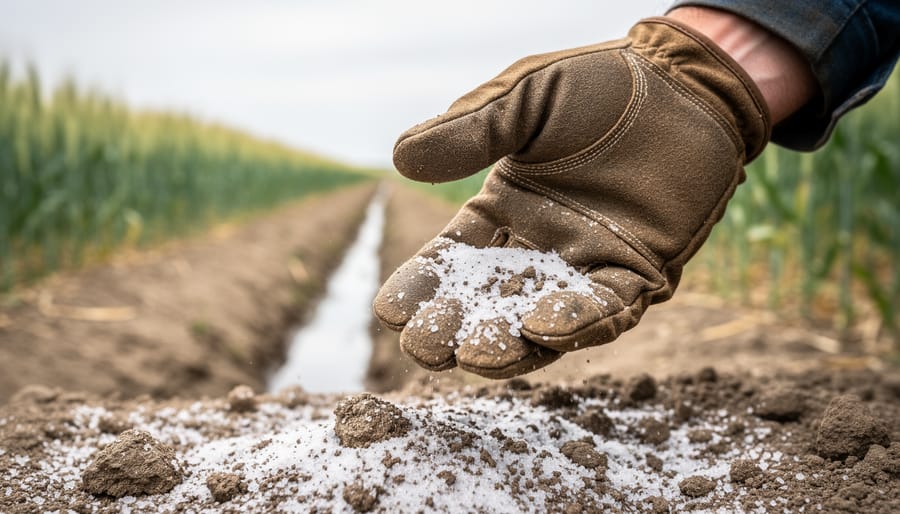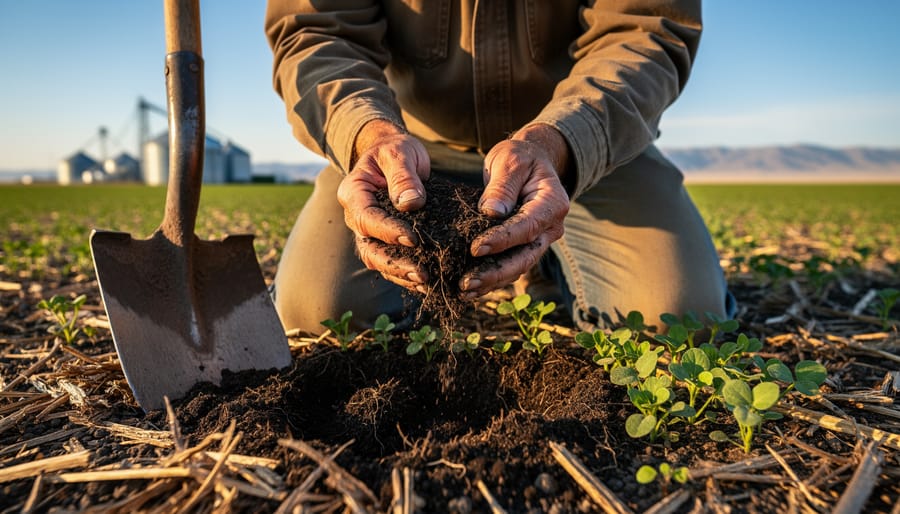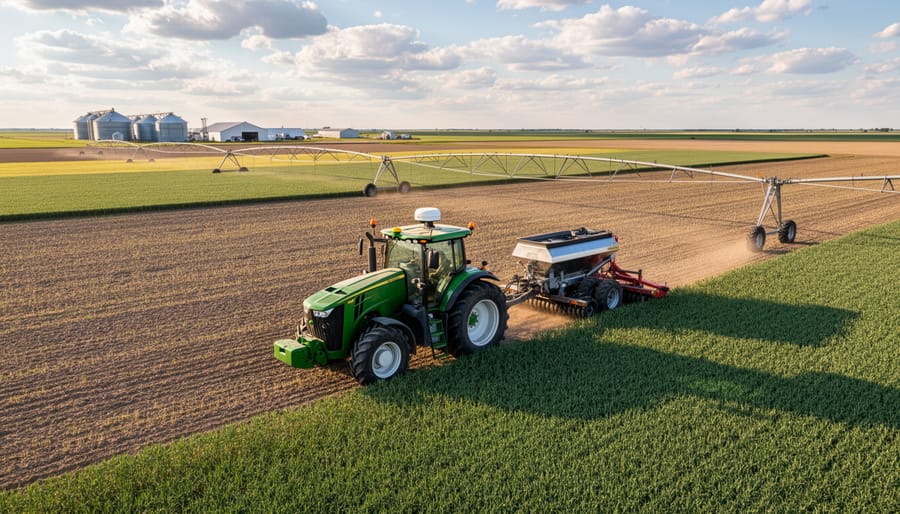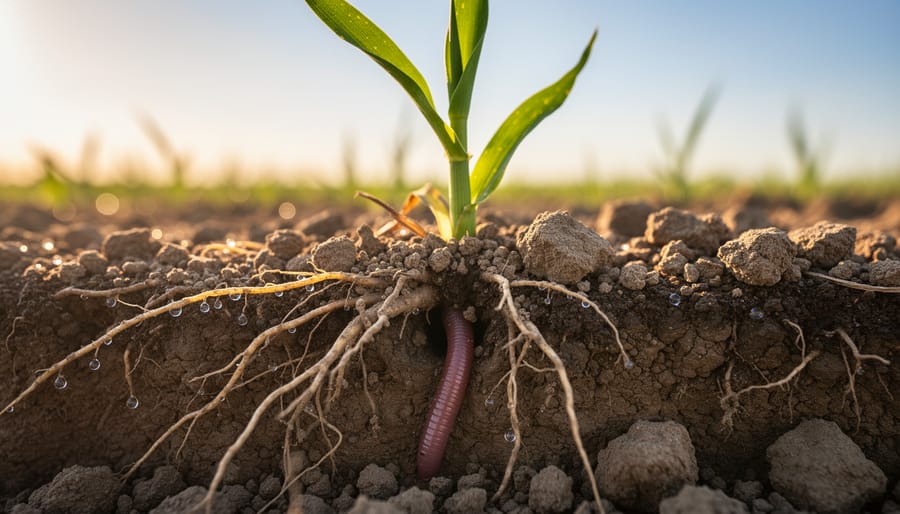
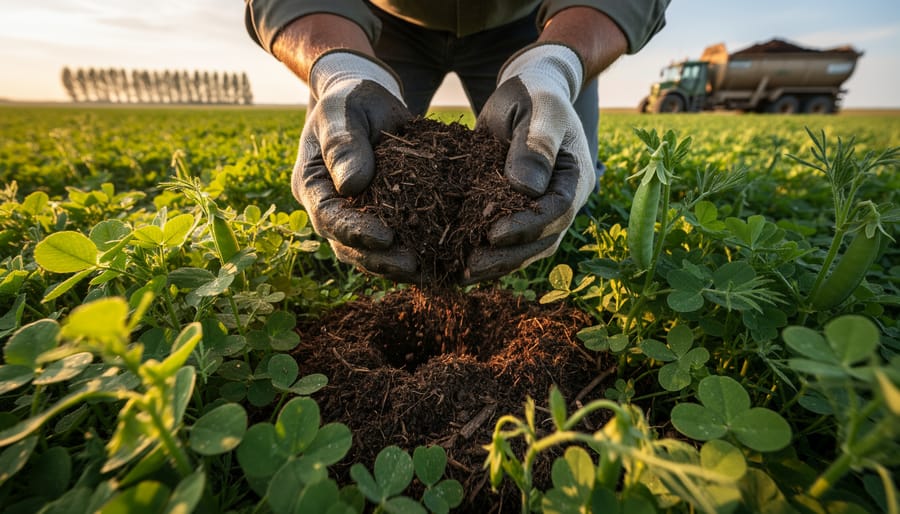
Build your soil’s micronutrient reserves by composting crop residues and livestock manure directly back into your fields—this creates a closed-loop system that recycles zinc, copper, manganese, and boron without purchasing external inputs. Test your soil every three years using accredited labs to identify specific deficiencies before they impact yields, focusing on chelated micronutrients that remain available in Alberta’s often alkaline soils.
Source micronutrients from approved organic materials already present on Canadian farms: kelp meal delivers a broad spectrum of trace minerals, rock phosphate provides sustained micronutrient release over multiple seasons, and green manure crops like clover and field peas actively mine subsoil nutrients while fixing nitrogen. Alberta producers have successfully reduced micronutrient costs by 40-60% through strategic crop rotation with deep-rooted cover crops that bring locked-away minerals to the surface layer.
Monitor plant tissue at critical growth stages rather than waiting for visible deficiency symptoms—early detection allows foliar applications of organic fish hydrolysate or seaweed extracts that correct issues within days. Maintain detailed records of which fields receive composted materials, as uneven distribution creates nutrient hotspots and depleted zones that undermine whole-farm nutrient cycling.
The transition to circular micronutrient management typically requires two to four growing seasons as soil biology establishes and organic matter levels increase, but the long-term benefits include reduced input costs, improved soil structure, and greater resilience during drought conditions—outcomes consistently reported by organic operations across the Canadian Prairies.
What Makes a Micronutrient ‘Organic’ in Canadian Farming
The Essential Micronutrients Your Soil Actually Needs
Understanding which micronutrients your soil needs starts with recognizing that Alberta soils have distinct characteristics. Our alkaline soils, common across much of the prairies, can lock up certain nutrients, making them unavailable to crops even when they’re present.
Iron deficiency shows up frequently in Alberta, particularly in high pH soils above 7.5. You’ll notice it first in canola and soybeans through yellowing between leaf veins. Zinc is another critical player, especially for cereal crops and corn during early growth stages. Research from Alberta Agriculture shows that up to 40 percent of our cultivated soils test low in available zinc.
Manganese becomes limited in alkaline conditions and organic soils. If you’re growing cereals, oats are particularly sensitive to manganese deficiency, which appears as grey speck on leaves. Copper deficiencies commonly affect cereals and canola in our organic-rich black soils, reducing grain fill and overall yield.
Boron deserves special attention for canola growers, as this crop requires more boron than most field crops. Deficiency leads to flower abortion and poor seed set. According to Tom Jansen, a soil health specialist working with organic producers near Lacombe, “We’re seeing boron response in about one in three canola fields tested, particularly where farmers have been building organic matter without monitoring micronutrients.”
Molybdenum requirements are generally met in Alberta’s neutral to alkaline soils, but pulse crops like lentils and peas need adequate levels for nitrogen fixation. The key is testing your soil every three to four years and understanding your specific crop rotation needs, as requirements vary significantly between cereals, oilseeds, and pulses.
Organic Certification Requirements in Canada
In Canada, organic micronutrient sources must meet specific standards set by the Canadian Organic Standards, overseen by the Canadian Food Inspection Agency. Understanding these requirements helps you maintain certification while effectively managing your soil’s micronutrient levels.
Approved organic micronutrient sources fall into several categories. Naturally occurring mineral sources like rock phosphate, gypsum, and langbeinite are generally permitted when they haven’t been treated with prohibited substances. Composted manures and plant materials provide micronutrients in forms that integrate well with organic management planning. Many Alberta farmers successfully use locally sourced compost blends that provide zinc, copper, and boron while building soil organic matter.
Kelp and seaweed products are widely accepted organic sources, offering a broad spectrum of micronutrients in chelated forms that plants readily absorb. Wood ash can supply potassium and calcium but requires careful application to avoid pH imbalances.
Before applying any micronutrient product, verify its listing on the Permitted Substances List maintained by the Canadian Organic Standards. Your certification body can confirm whether specific products meet requirements. Products labeled as “OMRI Listed” or “CDFA Listed” are often approved, though checking with your certifier remains essential.
Keep detailed records of all micronutrient applications, including product names, sources, application rates in kilograms per hectare, and dates. This documentation supports your annual certification renewal and demonstrates your commitment to maintaining organic integrity while caring for your soil’s long-term health.
Circular Nutrient Management: Closing the Loop on Your Farm
On-Farm Waste Streams as Micronutrient Sources
Looking around your farm, you’re sitting on valuable micronutrient resources that might currently be going to waste. Those crop residues, livestock manure piles, and composting areas aren’t just disposal sites—they’re potential micronutrient reservoirs that can help you close the loop on nutrient management.
Crop residues from cereal and oilseed harvests contain significant amounts of zinc, copper, manganese, and boron. When you leave straw on fields or incorporate it into compost, you’re recycling these micronutrients back into your system. Alberta farmers growing wheat and canola have found that returning residues to the soil can contribute 0.5 to 2 kilograms per hectare of zinc annually, depending on yield and management practices.
Livestock manure is particularly rich in copper and zinc, especially from cattle and hog operations. A dairy farmer near Red Deer shared that by properly composting manure and applying it strategically across fields, he reduced his need for purchased micronutrient amendments by nearly 40 percent over three years. Properly composted cattle manure typically provides 20 to 100 parts per million of zinc and 10 to 50 parts per million of copper.
The key is understanding what you have. Different waste streams offer different micronutrient profiles. Poultry manure tends to be higher in manganese and zinc compared to cattle manure, while legume crop residues offer more boron than cereal residues.
Start by taking inventory of your waste streams and their volumes. Consider working with your local agrologist to test representative samples of your manure or compost for micronutrient content. This baseline information helps you calculate how much micronutrient value you’re currently producing on-farm and guides strategic application decisions. Many Alberta producers are discovering that with thoughtful management, their waste streams can cover a substantial portion of their micronutrient requirements while reducing disposal costs and external input expenses.
Community-Scale Nutrient Cycling
Building a stronger approach to micronutrient cycling doesn’t have to happen in isolation. Across Alberta and throughout Canada, farmers are discovering that regional partnerships and shared infrastructure can dramatically improve access to organic micronutrients while reducing costs.
Community composting facilities represent one of the most effective shared resources for micronutrient management. These operations combine organic materials from multiple sources—livestock operations, food processors, municipalities, and crop residues—creating diverse compost products with broader micronutrient profiles than single-farm systems can typically achieve. The Highmark Renewables facility near Calgary processes over 45,000 tonnes of organic material annually, producing nutrient-rich compost available to area farmers. By pooling resources, participating farms access professionally managed composting that meets organic certification standards without individual capital investment in equipment.
Municipal biosolids programs offer another collaborative pathway. Many Alberta municipalities now provide treated biosolids to agricultural producers through formalized programs. While organic certification requirements limit biosolids use, conventional farmers transitioning toward organic methods can utilize these materials during conversion periods to build micronutrient reserves. Red Deer’s biosolids program has partnered with over 80 area farms, providing micronutrient-rich amendments at minimal cost while diverting waste from landfills.
Inter-farm collaboration creates additional opportunities. Livestock operations generate manure rich in zinc and copper, while grain farms produce straw and chaff. Trading these materials—manure for bedding, for example—allows both operations to improve micronutrient cycling. The Bow Valley Growers Cooperative in southern Alberta facilitates such exchanges, connecting members through an online platform that matches available resources with farm needs.
Regional agronomists and extension specialists can coordinate soil testing initiatives, negotiate bulk pricing on approved amendments, and share knowledge about micronutrient management strategies specific to local soil conditions. Working together, farming communities build resilience while strengthening the circular economy that sustainable agriculture depends upon.
Practical Sources of Organic Micronutrients for Alberta Farms
Compost and Vermicompost: Your Micronutrient Factory
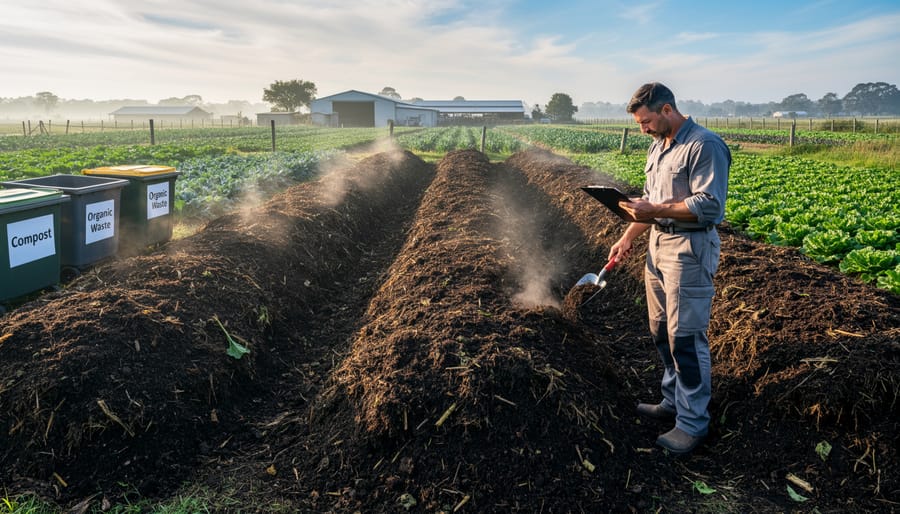
Composting transforms organic materials into a powerhouse of available micronutrients while building the foundation for healthy soil. Whether you’re working with plant-based composting or adding worms through vermicomposting, these systems concentrate micronutrients that might otherwise be lost from your farm.
In Alberta’s climate, successful composting requires adapting techniques to work with temperature extremes. During active composting, maintain internal pile temperatures between 55-65°C to ensure proper decomposition while preserving heat-sensitive micronutrients like boron and molybdenum. Monitor moisture levels at 40-60 percent – comparable to a wrung-out sponge – as our dry prairie conditions can quickly dehydrate piles.
Vermicomposting offers particular advantages for micronutrient availability. Worm castings contain enzymes that chelate micronutrients, making iron, zinc, and manganese more accessible to plants. Red wiggler worms thrive in temperatures between 15-25°C, making indoor or insulated systems practical year-round options for Alberta producers.
To maximize micronutrient content, diversify your feedstock. Combine nitrogen-rich materials like manure with carbon sources, but also incorporate micronutrient-dense additions such as rock dust, kelp meal, or saved crop residues from diverse plantings. This variety ensures your finished compost delivers a broad spectrum of trace elements.
Testing your finished compost provides baseline data for micronutrient content, helping you understand how your system performs and where adjustments might benefit your specific soil needs.
Green Manures and Cover Crops as Micronutrient Miners
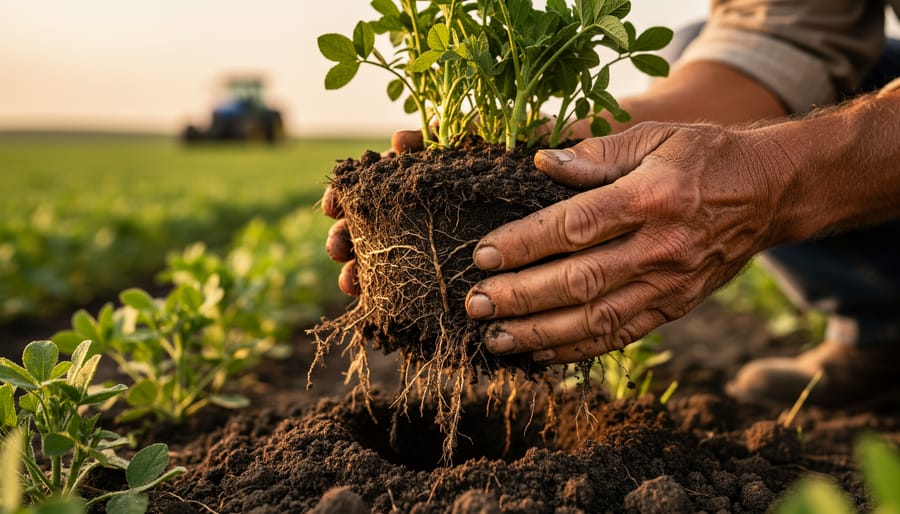
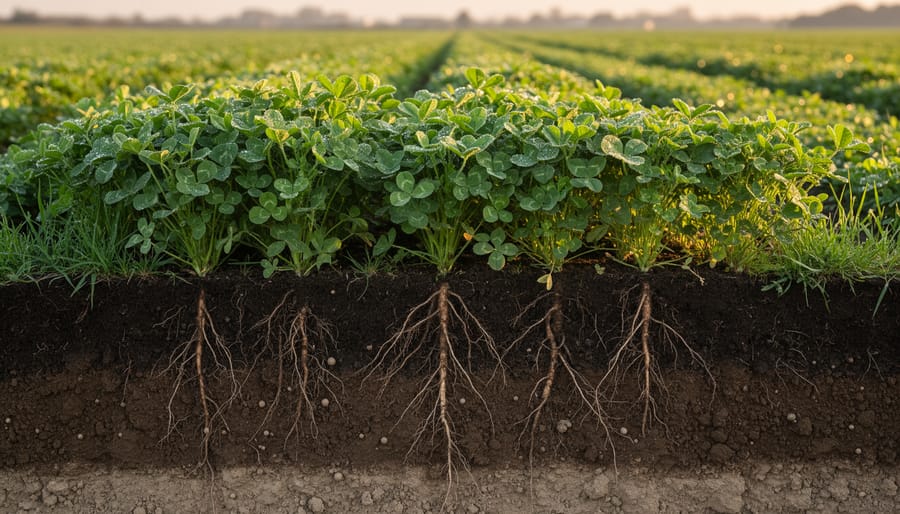
Certain cover crop species act as biological miners, sending deep roots into the soil to access micronutrients that cash crops can’t reach. When these plants decompose, they release accumulated nutrients in the topsoil where your main crops need them most.
Daikon radish stands out as an exceptional micronutrient miner for Alberta conditions. This fast-growing crop develops a taproot extending 60-90 centimetres deep, pulling up iron, manganese, and zinc. Plant daikon between late July and mid-August to maximize growth before frost. The crop winter-kills naturally, leaving organic matter rich in micronutrients for spring planting.
Alfalfa’s extensive root system, reaching depths of 2-3 metres, makes it valuable for mining calcium, boron, and other trace elements. While it requires a longer establishment period, a two-year alfalfa stand significantly improves micronutrient availability. Consider incorporating alfalfa into your rotation on fields showing micronutrient deficiencies.
Sweet clover adapts well to Alberta’s climate and accumulates substantial amounts of sulphur, boron, and molybdenum. Seed this biennial in early spring, allowing it to grow through the season and winter over. Terminate before it goes to seed the following summer.
Thoughtful cover crop selection based on your specific micronutrient needs creates a self-sustaining system. Combine different species in mixes to target multiple micronutrients simultaneously while building soil structure and organic matter. This approach reduces reliance on purchased amendments while strengthening your soil’s natural nutrient cycling capacity.
Rock Dusts, Kelp, and Other Approved Amendments
Several commercially available organic amendments can effectively address micronutrient deficiencies while supporting circular nutrient management on Canadian farms.
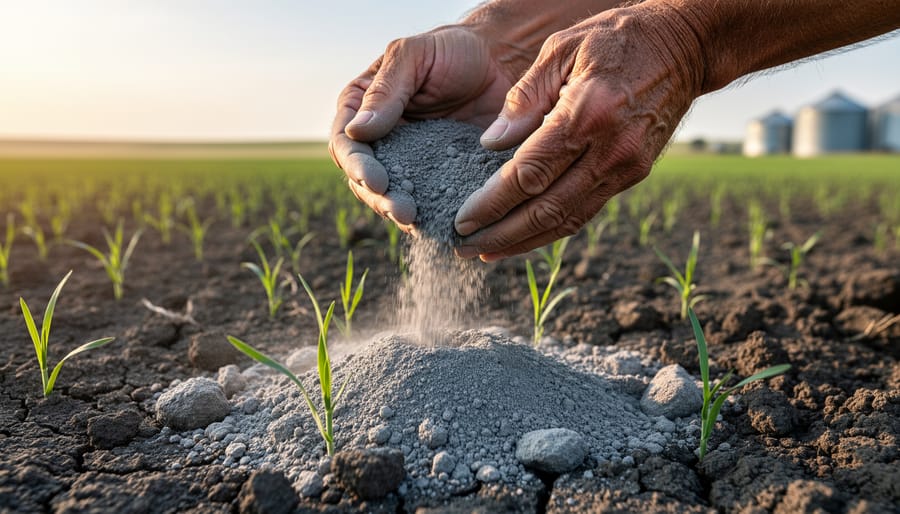
Rock dusts, including basalt and granite meals, provide slow-release micronutrients like iron, manganese, and zinc. These amendments work best when applied at 450-900 kg per hectare, incorporated during fall tillage or spread before planting. Alberta producers report noticeable soil structure improvements within two growing seasons. Costs range from $150-$300 per tonne, making them economical for larger operations when purchased in bulk.
Kelp meal stands out as a micronutrient powerhouse, containing over 60 trace elements along with natural growth hormones. Application rates typically range from 90-225 kg per hectare for field crops, or 450-900 kg for intensive vegetable production. Though pricier at $800-$1,200 per tonne, kelp’s concentrated nutrition means you need less material. Many organic farmers in central Alberta blend kelp with compost to stretch their investment while maintaining effectiveness.
Greensand offers potassium along with iron and magnesium, applied at 450-2,250 kg per hectare depending on soil tests. It releases nutrients gradually over several years, reducing annual input costs.
For small-scale operations under 20 hectares, purchasing pre-blended organic fertilizers containing these amendments often proves more practical than buying individual products. Mid-sized farms benefit from creating custom blends based on soil test results, while larger operations typically achieve better economics purchasing amendments separately in bulk quantities. Remember that combining these amendments with on-farm compost and green manures maximizes nutrient cycling while minimizing external inputs.
Testing and Monitoring: Know What Your Soil Really Needs
Understanding what’s actually happening in your soil is the foundation of effective micronutrient management and connects directly to soil health fundamentals. Rather than guessing or applying blanket treatments, targeted testing helps you make informed decisions that save money and improve outcomes.
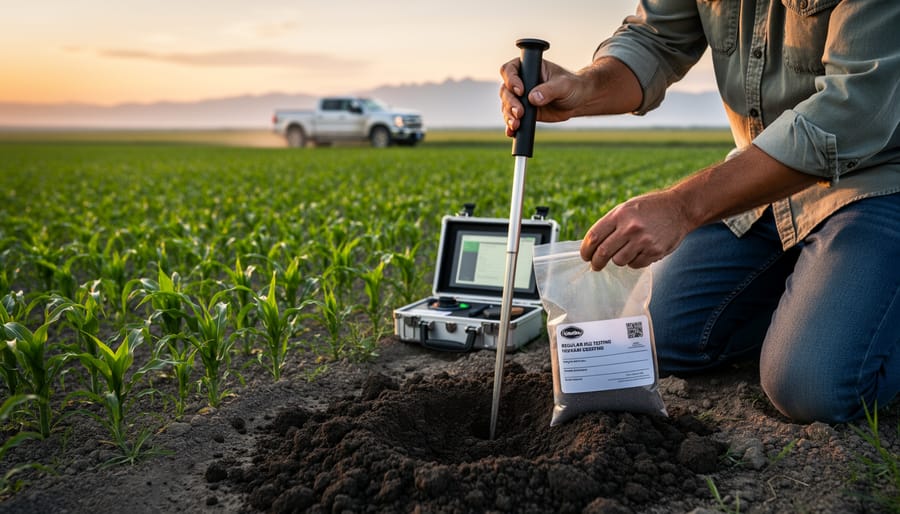
Start with a comprehensive soil test every three to four years, or annually if you’re actively addressing deficiencies. In Alberta, several accredited labs offer testing services, including ALS Environmental in Edmonton, Exova in Calgary, and A&L Canada Laboratories, which serves farmers across Western Canada. Most charge between $30 to $80 for basic micronutrient panels covering zinc, manganese, copper, boron, iron, and molybdenum.
When collecting samples, timing matters. Sample in fall after harvest or early spring before planting, avoiding recently fertilized areas. Take 15 to 20 cores from different spots across each management zone, mixing them together for a representative sample. Dig 15 centimetres deep for most annual crops, deeper for perennials and pastures.
Tissue testing complements soil analysis by showing what plants actually absorb. This real-time snapshot catches problems during the growing season when you can still intervene. Sample at specific growth stages recommended for your crop—often mid-season when nutrient demand peaks. The same labs that handle soil samples typically process plant tissue as well.
Interpreting results requires context. A reading labeled “sufficient” on paper might still limit yields if you’re targeting high production. Work with an agronomist familiar with organic systems, as conventional recommendations don’t always translate directly. They’ll consider your crop rotation, organic matter levels, pH, and soil texture alongside the numbers.
Saskatchewan organic farmer James Peterson discovered through testing that his manganese levels were borderline despite no visible symptoms. By addressing it proactively with compost applications, he prevented the yield losses his neighbour experienced the following year. Testing isn’t just problem-solving—it’s preventative care for your soil.
Alberta Case Study: Circular Micronutrient Management in Action
When the Hoffmann family transitioned their 800-acre mixed farm near Lacombe to organic certification in 2018, they quickly discovered that managing micronutrients would require a different approach than their conventional days. Like many Alberta producers, they faced the challenge of maintaining adequate zinc, boron, and manganese levels in their sandy loam soils while staying within organic regulations.
“We knew we couldn’t just order a micronutrient blend anymore,” explains Sarah Hoffmann, who manages the farm with her husband Mark. “We had to think about where these nutrients were going and how to keep them cycling on our land.”
The Hoffmanns implemented a circular nutrient strategy centered on three key practices. First, they integrated livestock by running a 50-head cattle operation alongside their grain production. All manure is composted for 12 months before field application, which testing showed increased plant-available zinc by 18 parts per million and boron by 0.9 ppm over three years.
Second, they established relationships with local food processors, sourcing spent grain and vegetable waste. This partnership provided 40 tonnes of organic matter annually while solving a disposal problem for nearby businesses. Laboratory analysis revealed these materials contributed significant micronutrients, particularly manganese and copper.
The biggest challenge came in year two when tissue testing showed iron deficiency in their barley crop despite adequate soil levels. Working with an organic agronomist, they identified pH imbalances limiting iron availability. Rather than adding external inputs, they adjusted their composting process to include more acidifying materials like pine needles from a local landscaper.
Results have been measurable. Soil testing conducted every spring now shows zinc levels stabilized at 3.2 ppm (up from 1.8 ppm pre-transition), while boron maintains at 1.4 ppm. Crop yields recovered to match their conventional benchmarks by year four, with wheat averaging 52 bushels per acre and canola at 38 bushels per acre.
“The initial soil testing seemed expensive at 180 dollars per field annually,” Sarah notes, “but catching problems early saved us from yield losses that would have cost thousands. Now it’s just part of our regular management.”
The Hoffmanns estimate their circular approach saves approximately 8,000 dollars yearly in purchased inputs while building long-term soil health.
Common Challenges and How to Overcome Them
Managing Micronutrients in Cold Climate Conditions
Prairie winters present unique challenges for maintaining micronutrient availability in organic systems. When soil temperatures drop below 5°C, biological activity slows dramatically, reducing nutrient cycling and plant uptake. Frozen soil periods, which can extend from November through March across Alberta, essentially halt microbial processes that make micronutrients plant-available.
The most effective strategy involves fall applications of organic micronutrient sources before freeze-up. Incorporating compost or manure amendments in September or early October allows partial breakdown before winter, positioning nutrients for spring availability. Products like kelp meal and rock dusts applied in fall can slowly release micronutrients as soil warms.
Spring poses timing challenges. Applying liquid organic amendments too early on frozen ground risks runoff, while waiting for complete thaw delays nutrient availability during critical early growth. Many successful Alberta producers now use foliar applications of fish hydrolysate or liquid kelp in May and June, bypassing cold soil limitations entirely.
Consider split applications: base amendments in fall, supplemented with foliar feeds during the growing season. This approach addresses both the frozen soil challenge and peak nutrient demand periods. Monitor soil temperatures using simple probe thermometers to optimize application timing, ensuring amendments are applied when biological activity can begin processing them effectively.
Balancing Cost and Effectiveness
Managing micronutrient programs doesn’t need to strain your farm budget. The most cost-effective approach starts with soil testing to identify actual deficiencies rather than applying products blindly. For small to mid-sized operations across Alberta, prioritize rock dusts like basalt or greensand, which provide long-term micronutrient release at relatively low costs compared to chelated products.
Livestock-based farms have a built-in advantage. Your composted manure already contains micronutrients that animals concentrate from their feed. A dairy farmer near Red Deer reduced external micronutrient purchases by 60% after properly managing manure application based on nutrient content analysis.
Consider forming buying cooperatives with neighboring farms to purchase bulk quantities of approved organic amendments at better rates. Several producer groups in southern Alberta have successfully negotiated group pricing on kelp meal and rock phosphate.
Start with crops that show the greatest response to micronutrient applications in your soil type. Pulse crops like lentils and chickpeas often respond dramatically to zinc and boron, delivering measurable yield increases that justify the investment. For farms transitioning to organic practices, focus first on building soil biology through compost and cover crops, which naturally improves micronutrient availability before investing in purchased amendments.
Adopting circular micronutrient management delivers both environmental stewardship and economic advantages for your operation. By recycling nutrients already present on your farm, you reduce dependence on external inputs while building soil health for the long term. Alberta farmers implementing these strategies report input cost savings of 15-30% within three years, alongside improved soil resilience during challenging growing seasons.
The key to success is starting small rather than overwhelming yourself with too many changes at once. Choose one or two strategies that align with your current operation. Perhaps you’ll begin composting plant residues this season while conducting a soil micronutrient test to establish your baseline. Next year, you might introduce cover crops or explore partnerships with local livestock operations for manure exchange. This gradual approach allows you to learn what works for your specific soil conditions and cropping system.
Your local agricultural extension office offers valuable support for getting started. Many Alberta communities have established nutrient management planning services that provide personalized guidance at minimal cost. Consider connecting with farmer-led organizations like the Alberta Reduced Tillage Linkages or local Soil Conservation Councils, where experienced producers share practical insights from their own transitions.
Remember, circular nutrient management is a journey, not a destination. Each small step contributes to building a more sustainable and profitable farming system. The farmers who’ve successfully made this transition emphasize patience and community connection as essential ingredients. You’re not alone in this process, and the resources available continue growing as more producers recognize the value of working with nature’s nutrient cycles.