Calculate your potential revenue by multiplying your farm’s sequestration capacity—typically 0.5 to 1.5 tonnes of CO2 per hectare annually through no-till practices—by current carbon credit prices of $35-50 per tonne in Alberta’s market. A 400-hectare operation transitioning to regenerative practices can generate $7,000-$30,000 annually in carbon credits while reducing fuel costs by 30-50% and fertilizer expenses by up to 25%.
Document your baseline soil organic carbon levels immediately through accredited soil testing, as programs like the Alberta Emission Offset System require three years of verified data before issuing credits. This upfront investment of $15-25 per hectare pays dividends when you enter carbon markets, and several aggregators now cover these costs for participating farmers.
Adopt proven practices that maximize both carbon capture and economic returns: integrating cover crops adds $40-75 per hectare in soil health benefits while sequestering an additional 0.3-0.8 tonnes of CO2 annually, and strategic grazing rotations on mixed operations increase sequestration rates by 20-35% compared to continuous grazing systems.
Connect with experienced Alberta farmers who’ve already monetized their carbon—like operations near Red Deer reporting three-year returns of $45,000 on initial investments of $18,000, or mixed grain-livestock producers in the Peace Country achieving break-even on practice changes within 18-24 months. The financial case for carbon sequestration strengthens yearly as markets mature, input costs rise, and soil health compounds.
This isn’t about environmental altruism competing with profitability. Carbon sequestration represents a measurable income stream that rewards the soil-building practices many progressive farmers already implement, turning conservation into quantifiable economic advantage.
What Carbon Sequestration Really Means for Your Farm
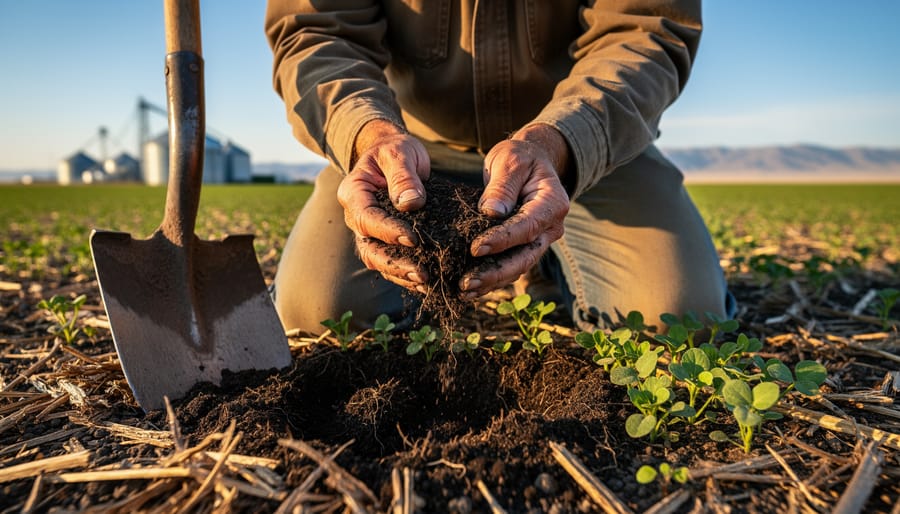
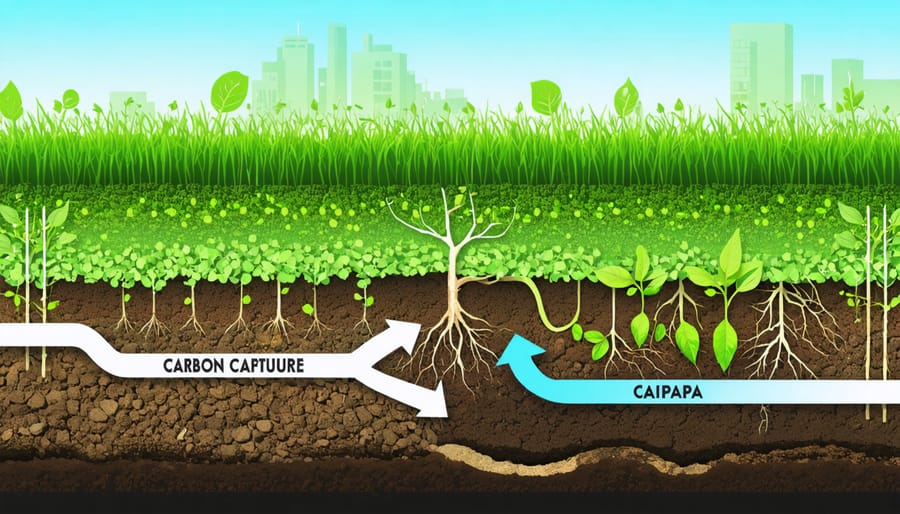
Carbon sequestration isn’t a radical new concept—it’s something your soil does naturally every growing season. When plants photosynthesize, they pull carbon dioxide from the atmosphere and convert it into sugars. Some of that carbon travels down through the roots and into the soil, where it can remain stored for decades or even centuries. Your role as a farm manager is simply to create conditions that maximize this natural process.
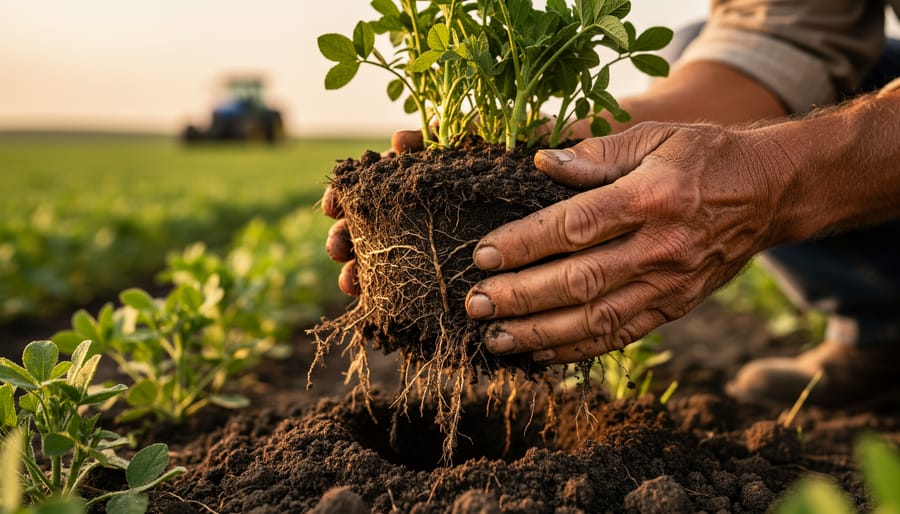
Here’s what’s happening beneath your fields: plant roots release carbon compounds into the surrounding soil, feeding billions of microorganisms. These microbes, along with fungi and other soil life, process this carbon and incorporate it into stable soil organic matter. The more diverse and active your soil biology, the more carbon gets locked away. Think of your soil as a living carbon vault that grows stronger with the right management practices.
Alberta’s soils hold particular promise for carbon storage. Our climate, with distinct freeze-thaw cycles, actually helps stabilize carbon in soil aggregates. The province’s clay-rich soils in many regions have a natural capacity to bind carbon molecules, making them effective long-term storage sites. Additionally, Alberta’s agricultural land represents roughly 21 million hectares—that’s significant carbon storage potential when managed strategically.
The science becomes practical when you consider everyday decisions. Every time you minimize tillage, you’re reducing the exposure of stored carbon to oxygen, which would otherwise release it back to the atmosphere. When you plant cover crops, you’re extending the period when living roots are feeding carbon into your soil. Adding livestock through managed grazing introduces another carbon pathway through plant consumption and manure deposition.
What matters most is understanding that you’re not starting from zero. Your land already captures carbon during every growing season. The question isn’t whether to participate in carbon sequestration—you already are. The real opportunity lies in optimizing these natural processes to benefit both your soil health and your bottom line.
The Direct Financial Benefits You Can Measure
Reduced Input Costs That Show Up Immediately
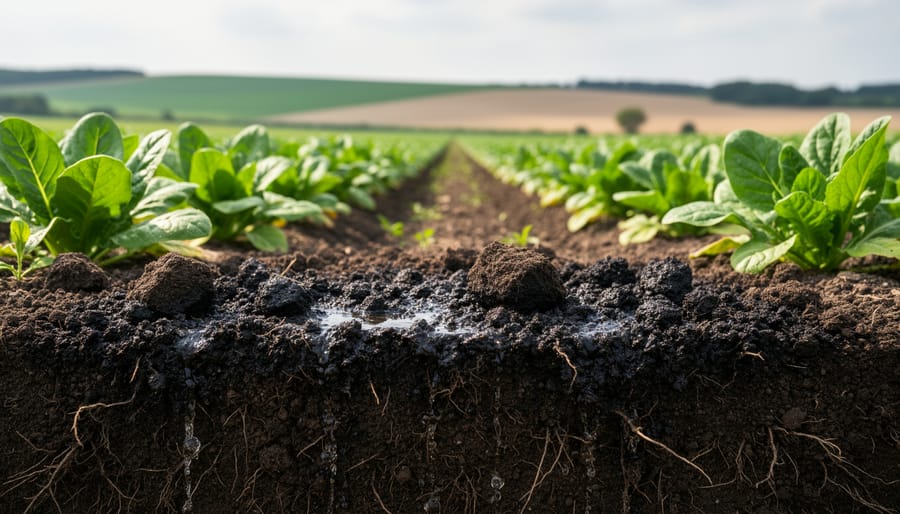
One of the most immediate financial benefits you’ll notice from carbon sequestration practices is the reduction in input costs. When you build organic matter in your soil through cover cropping, reduced tillage, and improved rotation strategies, your fields become more efficient at retaining nutrients and moisture.
Let’s look at the numbers. A mixed grain operation near Red Deer transitioned to no-till practices combined with diverse cover crops in 2019. By year two, the farm reduced synthetic nitrogen fertilizer applications by 30 kilograms per hectare, saving approximately $45 per hectare. Across their 400-hectare operation, that translated to $18,000 in annual fertilizer savings. Their soil tests showed increased nitrogen availability from improved microbial activity and organic matter decomposition.
Water retention improvements deliver tangible savings too. A cattle and grain producer in the Lethbridge region reported reducing irrigation frequency by 25 percent after three years of implementing carbon-focused practices. With irrigation costs averaging $75 per hectare annually in their area, the farm saved nearly $7,500 across their 400 irrigated hectares.
These aren’t isolated examples. Research from Alberta Agriculture and Forestry indicates that each one percent increase in soil organic matter can reduce fertilizer requirements by 15 to 20 percent while improving water-holding capacity by approximately 75,000 litres per hectare.
The key is understanding these savings compound over time. Your initial investment in cover crop seed or equipment modifications gets offset relatively quickly, while the benefits continue growing as your soil health improves year after year.
Increased Yields and Crop Resilience
Building soil carbon doesn’t just benefit the environment—it directly improves your bottom line through stronger yields and more resilient crops. When you increase organic matter in your soil, you’re creating a natural system that helps your crops thrive even in challenging conditions.
Research from Agriculture and Agri-Food Canada shows that increasing soil organic carbon by just 1% can boost water retention by up to 170,000 litres per hectare. This translates to measurable yield improvements, with studies documenting increases of 5-15% for major crops like wheat and canola when soil carbon levels improve from 2% to 3.5%.
The real results from Alberta farmers demonstrate these benefits clearly. During the 2021 drought, producers who had been building soil carbon for five years or more reported wheat yields averaging 40 bushels per acre, while neighbouring fields with conventional practices averaged just 28 bushels per acre.
Carbon-rich soils also reduce crop failure rates significantly. Data from Saskatchewan shows that farms with higher organic matter experienced 30% fewer complete crop losses over a ten-year period compared to farms with depleted soils. This resilience comes from improved soil structure, better nutrient cycling, and enhanced microbial activity—all natural byproducts of carbon sequestration practices.
For Alberta producers facing increasingly variable weather patterns, these improvements in drought resistance and yield stability represent tangible financial security beyond any carbon credit payments.
Carbon Credit Revenue Opportunities
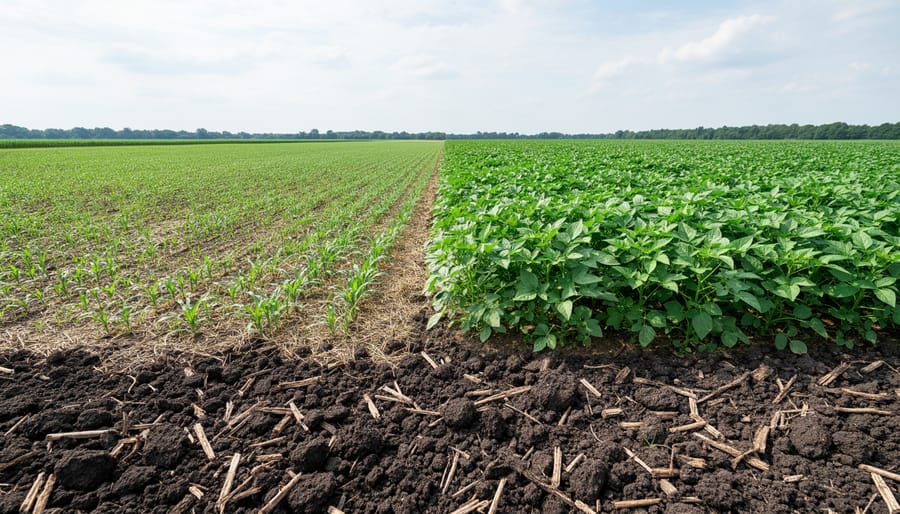
Canadian farmers have several legitimate pathways to generate revenue through carbon sequestration, though it’s important to approach these opportunities with realistic expectations rather than viewing them as a primary income source.
Currently, carbon credit programs in Canada operate through both compliance and voluntary markets. The federal government’s Agricultural Clean Technology program and provincial initiatives in Alberta provide frameworks for farmers to monetize soil carbon storage. Programs like Nutrien’s carbon program and ALUS (Alternative Land Use Services) offer practical entry points for producers.
Revenue potential typically ranges from $10 to $40 per tonne of CO2 equivalent sequestered, depending on the program and market conditions. For a typical Alberta grain farm adopting practices like reduced tillage and cover cropping, this translates to approximately $15 to $50 per acre annually. While these numbers won’t replace crop income, they can meaningfully offset the costs of implementing new practices.
The enrollment process generally requires baseline soil testing, practice documentation, and third-party verification. Most programs work on three to five-year contracts, providing stability but also requiring commitment. Administrative requirements are manageable but do demand accurate record-keeping of field operations and input use.
A Saskatchewan farmer interviewed for our research noted that carbon credit revenue covered roughly 60 percent of his cover crop seed costs in the first year, with potential for full coverage as soil carbon levels increase. The key is viewing carbon credits as a bonus for good agronomic practices rather than a standalone profit center. Programs continue evolving, with improved measurement protocols and streamlined verification making participation increasingly practical for average-sized operations.
Understanding the Real Costs and Investment
Upfront Transition Expenses
Let’s talk honestly about what it takes to get started. While carbon sequestration delivers real financial returns, understanding the transition costs upfront helps you plan effectively.
For cover crop seeds, expect to invest between $37 to $75 per hectare, depending on your chosen species mix. Red clover and hairy vetch typically run higher, while oats and fall rye offer more budget-friendly options. A 160-hectare operation would allocate roughly $6,000 to $12,000 for initial seeding.
Equipment modifications vary considerably. Many Alberta farmers already own suitable seeders, but you might need to adjust settings or add attachments. Budget $2,000 to $8,000 for minor modifications. Some producers invest in specialized no-till equipment, which can run $15,000 to $40,000, though this often isn’t necessary in year one.
The learning curve represents a hidden cost. Expect to dedicate 20 to 40 hours in your first year researching techniques, attending workshops, and consulting with agronomists familiar with regenerative practices. This time investment pays dividends as you avoid costly mistakes.
Smaller operations (under 80 hectares) typically face total first-year transition expenses between $4,000 and $10,000. Mid-sized farms (160 to 320 hectares) should budget $10,000 to $25,000, while larger operations (640+ hectares) might invest $30,000 to $60,000. These figures assume gradual implementation rather than whole-farm conversion, which most Alberta producers find more manageable.
Time Investment and Learning Curve
Let’s be honest: transitioning to carbon-focused practices requires a genuine time commitment. Most Alberta farmers report spending 15-30 hours initially learning about soil carbon management, testing protocols, and program requirements. This investment happens alongside your regular operation, which can feel overwhelming during busy seasons.
The learning curve varies considerably. Farmers already using no-till practices typically adapt within one growing season, while those implementing cover crops or rotational grazing may need 2-3 years to feel confident with new systems. “The first year felt like drinking from a fire hose,” admits Brandon Thiessen, a mixed farmer near Innisfail. “By year two, the practices became routine and actually saved me time.”
Alberta offers substantial support to ease this transition. The Agricultural Carbon Registry provides free webinars and field days throughout the province. Regional Ag-Info Centres connect you with specialists who understand local conditions. Many farmers find peer learning groups invaluable—connecting with neighbours who’ve already navigated the process accelerates your understanding significantly.
Results don’t appear overnight. Measurable soil carbon increases typically take 3-5 years, though some operational benefits like improved water infiltration appear sooner. The key is viewing this as a gradual integration rather than a dramatic overhaul. Most successful adopters recommend starting with one field or practice, building confidence before expanding across your entire operation.
Government Support and Funding Programs
The financial transition to carbon sequestration practices doesn’t have to happen alone. Several Canadian government programs actively support farmers making this shift.
Agriculture and Agri-Food Canada’s Agricultural Climate Solutions initiative offers up to $50,000 per project for implementing practices like cover cropping and rotational grazing. The program covers soil testing, equipment purchases, and technical consultations that might otherwise create financial barriers.
Alberta’s Emission Offset System provides a direct revenue stream through carbon credit sales. Farmers who adopt verified soil carbon practices can generate offset credits worth approximately $30-50 per tonne of CO2 sequestered, creating an additional income source beyond traditional crop yields.
The Canadian Agricultural Partnership delivers cost-share funding for conservation projects, typically covering 50-70% of eligible expenses. This significantly reduces upfront investment concerns when transitioning to regenerative practices.
Technical assistance programs through provincial agriculture departments connect farmers with agrologists and soil specialists at no cost. These experts help design site-specific sequestration strategies and navigate carbon credit verification processes.
For Alberta producers specifically, the On-Farm Climate Action Fund provides financial support for adopting nitrogen management practices and cover cropping systems. Applications are processed regionally, with priority given to projects demonstrating measurable carbon benefits.
Contact your local agricultural fieldman to explore which programs align best with your operation’s specific needs and timeline.
Running the Numbers: What a Five-Year Outlook Actually Shows
Let’s look at what an actual Alberta grain farm might experience financially when implementing carbon sequestration practices. This composite example draws from operations across the province that have adopted cover cropping and reduced tillage on 400 hectares.
Year One typically requires the highest investment. Budget approximately $12,000-$15,000 for initial soil testing, baseline carbon assessments, and equipment modifications or rental. Cover crop seed costs run $37-$62 per hectare depending on your mix, totaling $14,800-$24,800. First-year revenue from carbon credits usually sits around $4,000-$6,000, creating a net cost of roughly $21,000-$34,000. This isn’t trivial, but understanding these investment models helps you plan appropriately.
By Year Two, you’ll see costs dropping significantly. Annual soil monitoring runs about $3,000-$4,000, and you’ve refined your cover crop program, potentially reducing seed costs by 15-20%. Carbon credit revenue typically increases to $8,000-$10,000 as practices mature. Your net position improves to a cost of $10,000-$15,000.
Year Three marks a turning point for many operations. Annual operating costs stabilize around $20,000-$25,000 total, while carbon credit payments climb to $12,000-$15,000. More importantly, you’ll likely notice yield improvements of 3-5% on treated acres from better soil health, adding $15,000-$25,000 in crop revenue. Combined benefits now exceed costs.
Years Four and Five show accelerating returns. Carbon sequestration rates peak, pushing credit payments to $15,000-$20,000 annually. Yield improvements compound as soil structure continues improving. Reduced fertilizer needs save an additional $5,000-$8,000 yearly. Total annual benefits frequently reach $35,000-$50,000 against operating costs of $22,000-$27,000.
The cumulative picture over five years shows initial investment of $20,000-$35,000 typically recovered by Year Four. By Year Five, most farms achieve net positive returns of $25,000-$40,000 when factoring carbon credits, yield improvements, and input savings together.
Individual results vary based on soil type, rainfall, crop rotation, and carbon pricing fluctuations. However, this timeline demonstrates that carbon sequestration practices follow a realistic path to profitability rather than requiring indefinite subsidization. The key is viewing this as a medium-term investment in both farm economics and soil capital, not an immediate return proposition.
Beyond the Balance Sheet: Benefits That Build Over Time
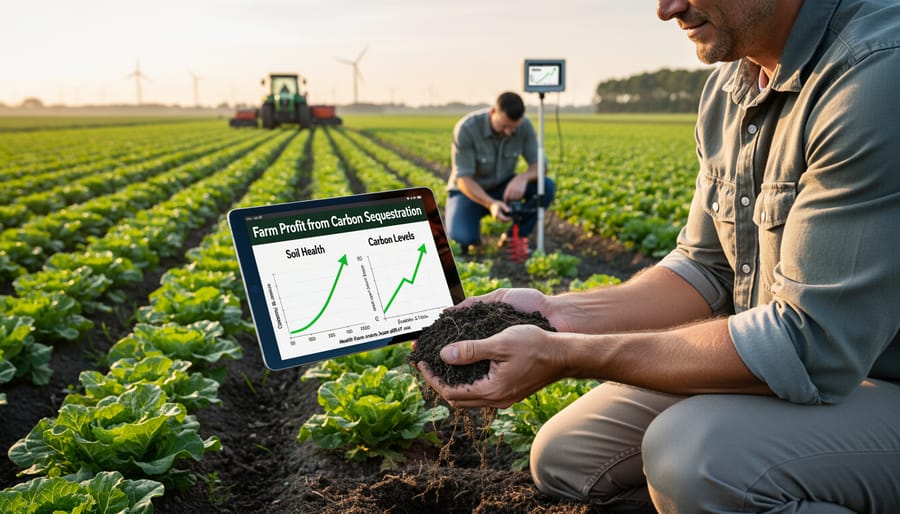
Beyond the immediate financial returns from getting paid to store carbon, several long-term benefits deserve consideration when evaluating carbon sequestration practices.
Land value appreciation represents a tangible benefit many farmers overlook. Properties with documented soil health improvements and established carbon management systems increasingly command premium prices. Alberta real estate data shows farms with verified carbon protocols can see 5-12% higher valuations compared to similar properties without these practices. As carbon markets mature and soil health becomes a standard evaluation metric, this premium is expected to grow.
Risk mitigation provides another layer of value. Improved soil structure and organic matter from carbon sequestration practices create resilience against extreme weather events, which are becoming more frequent across the Prairies. Fields with higher carbon content retain moisture more effectively during droughts and resist erosion during heavy rainfall, reducing crop insurance claims and yield variability.
Community standing matters in rural Alberta, where reputation affects everything from equipment sharing to lending relationships. Farmers implementing carbon sequestration often report stronger connections with buyers seeking sustainable suppliers and improved access to preferential contracts. This social capital translates into practical advantages, though it rarely appears on balance sheets.
Legacy value shouldn’t be dismissed as merely emotional. For multi-generational farms, soil carbon practices represent an investment in the operation’s future viability. You’re not just maintaining soil quality; you’re actively improving the productive capacity your children or successors will inherit. This becomes particularly relevant as younger generations increasingly prioritize environmental stewardship alongside profitability when deciding whether to continue farming operations.
These benefits compound over time, creating value that extends well beyond annual carbon credit payments.
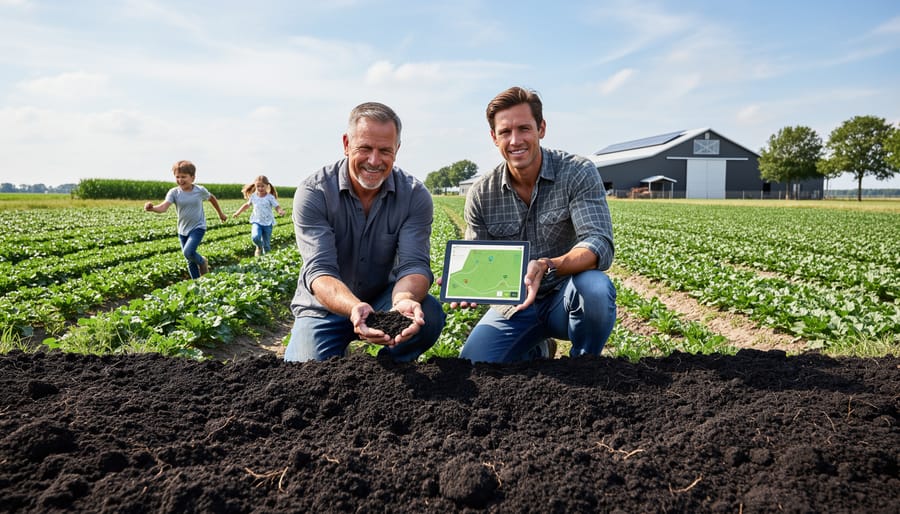
Soil carbon sequestration represents a genuine economic opportunity for Canadian farmers, though it requires patience and perspective. The financial benefits – from reduced input costs to potential carbon credit revenue – are real and measurable, but they unfold over years rather than months. This isn’t a quick fix for cash flow challenges, but rather a strategic investment in your operation’s long-term profitability and resilience.
If you’re ready to explore carbon sequestration on your farm, start small. Begin by getting a baseline soil test to understand your current carbon levels. Connect with your local agricultural extension office or agronomist to discuss which practices best suit your specific operation. Many Alberta farmers have found success by implementing one or two changes initially – perhaps reducing tillage on a portion of their acres or experimenting with cover crops on marginal land.
You don’t have to navigate this transition alone. Alberta Agriculture and Irrigation offers technical support and resources specifically designed for farmers exploring regenerative practices. Regional farmer networks and soil health groups provide invaluable peer-to-peer learning opportunities where you can learn from neighbours who’ve already taken these steps.
The economics of soil carbon sequestration work best when viewed as part of your farm’s evolution rather than a complete overhaul. Take time to run the numbers for your operation, explore available support programs, and make decisions that align with both your financial reality and long-term goals. The farmers seeing the greatest success are those who approached this transition methodically, with clear objectives and realistic expectations about timelines and returns.