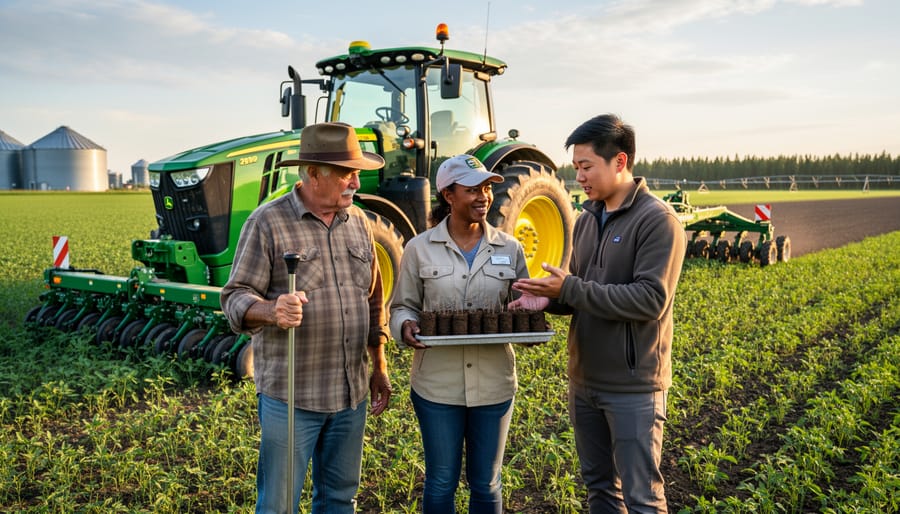
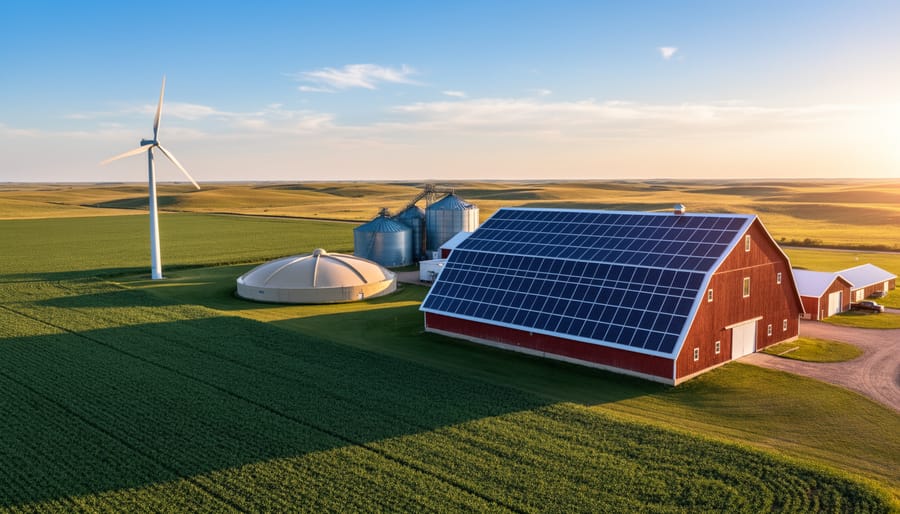
Canadian farms now generate up to 40% of their energy needs through on-site renewable systems, cutting operating costs by $15,000-$50,000 annually while building resilience against rising electricity rates. Solar panels on barn roofs, wind turbines in open fields, and biodigesters converting manure into electricity represent proven technologies already operating on hundreds of Alberta farms—from 160-acre mixed operations near Lethbridge to 2,000-acre grain farms in the Peace Country.
The business case has fundamentally shifted. Solar installation costs have dropped 70% since 2015, making payback periods of 8-12 years realistic even without subsidies. Federal and provincial programs now cover 25-50% of upfront costs through grants and low-interest financing specifically designed for agricultural operations. Saskatoon farmer Tom Bergen installed a 50-kilowatt solar array in 2022 for $85,000, received $32,000 in government support, and now saves $800 monthly on power bills while feeding excess electricity back to the grid.
Beyond financial returns, renewable energy systems provide operational advantages critical to modern farming. Battery storage ensures continuous operation during grid outages that increasingly disrupt irrigation systems and livestock facilities. Biodigesters address manure management challenges while producing revenue-generating electricity. Wind and solar installations require minimal maintenance—typically one service visit annually—and operate reliably for 25-30 years.
The question facing Alberta farmers is no longer whether renewable energy makes sense, but which system best fits individual operations, soil conditions, and energy consumption patterns.
Why Alberta Farms Are Turning to Renewable Energy Now
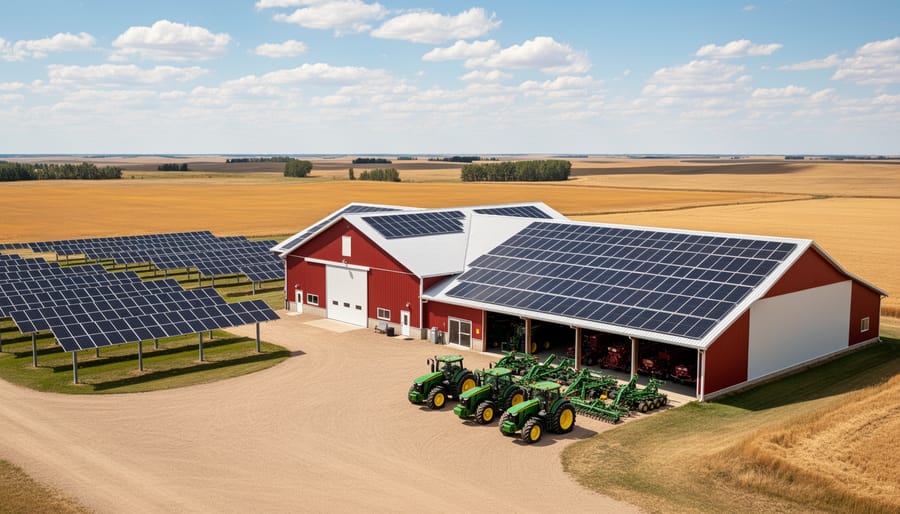
The Real Cost of Traditional Energy on Your Farm
Understanding your current energy costs is the first step toward making informed decisions about renewable options. Let’s look at what Alberta farms typically spend on traditional energy sources.
For dairy operations, energy expenses are substantial year-round. A medium-sized dairy farm with 100 cows can expect monthly electricity bills ranging from $1,200 to $1,800 during summer months for milking equipment, cooling systems, and lighting. Winter pushes these costs higher, often reaching $2,500 to $3,500 monthly when heating systems, water warming, and extended lighting run continuously through Alberta’s harsh cold snaps.
Grain farms face different patterns. During harvest season from August through October, costs spike dramatically. Grain drying alone can add $4,000 to $8,000 monthly to your electricity bill, depending on crop moisture levels and weather conditions. Annual energy costs for a typical 2,000-acre grain operation average $18,000 to $25,000, with natural gas for crop drying representing nearly 40 percent of that total.
Livestock operations see predictable seasonal swings. A 500-head cattle operation might spend $800 to $1,200 monthly in summer, jumping to $2,000 to $3,000 during winter when barn heating, water tank heaters, and ventilation systems work overtime. Hog operations with climate-controlled barns face even steeper bills, averaging $3,500 to $5,500 monthly regardless of season.
These figures don’t include fuel costs for equipment or the impact of rate increases, which have averaged 3 to 5 percent annually across Alberta over the past decade. Many farmers report energy now represents their third-largest operational expense after feed and labour.
Federal and Provincial Support Programs You Can Access Today
Canadian farmers have access to several funding streams that can significantly offset the initial investment in renewable energy systems. Understanding these programs and how to access them is essential for making your green energy project financially viable.
At the federal level, the Canadian Agricultural Partnership offers cost-share funding through programs like the Agricultural Clean Technology Program, which provides up to 50% coverage for eligible clean energy projects. This program specifically targets solar installations, biogas systems, and energy-efficient equipment upgrades on farm operations. Applications are processed through provincial delivery agents, with funding allocated on a competitive basis.
Agriculture and Agri-Food Canada’s On-Farm Climate Action Fund supports practices that reduce greenhouse gas emissions, including renewable energy adoption. Farmers can receive financial assistance for energy audits and implementation of recommended systems, with payments structured to reward measurable emission reductions.
For Alberta producers specifically, the Agricultural Service Board programs in many counties provide additional support. Several municipalities offer grants ranging from $5,000 to $25,000 for solar installations and energy efficiency improvements. Contact your local Agricultural Service Board to learn about region-specific opportunities and application deadlines.
The federal government’s Accelerated Investment Incentive allows farmers to immediately deduct a larger portion of capital costs for clean energy equipment in the year of purchase, improving cash flow during the critical first years of operation.
Emission Performance Credits through Alberta’s Technology Innovation and Emissions Reduction system can generate ongoing revenue for farms implementing renewable energy, particularly biogas operations that reduce methane emissions.
Farm Credit Canada offers specialized financing for green energy projects with competitive rates and flexible repayment terms aligned with agricultural cash flows. Their Environmental Fund provides additional financial incentives for projects demonstrating environmental benefits.
Start by completing an energy audit through a qualified professional to identify which programs best match your planned improvements and maximize your available funding support.
Green Energy Solutions That Actually Work on Canadian Farms
Solar Power: Beyond Just Rooftop Panels
When most people think solar, they picture rooftop panels. But for Alberta farmers, solar power offers much more versatile opportunities that extend far beyond your barn roof.
Solar photovoltaic (PV) systems remain the workhorse of farm renewable energy, converting sunlight directly into electricity. Ground-mounted arrays often make more sense than rooftop installations on agricultural properties, offering easier maintenance access and optimal positioning. Yes, Alberta’s winter conditions present challenges—snow accumulation can reduce output by 30-50% during December and January—but modern panels actually perform more efficiently in cold temperatures. Annual production remains strong because our long summer days compensate for shorter winter ones.
The real innovation happening on Canadian farms is agrivoltaics, where elevated solar panels create dual-use land. Near Lethbridge, a demonstration project has sheep grazing beneath solar arrays while panels provide shade that reduces heat stress and water evaporation. This approach addresses the common concern about losing productive farmland to energy generation. Some crops, particularly shade-tolerant vegetables and berries, actually thrive in the dappled light beneath panels.
Solar water heating systems deserve consideration for livestock operations. These simple, proven technologies can reduce propane or electricity costs for heating water by 50-70% during the growing season. Bob Richardson, who runs a dairy operation near Red Deer, installed solar thermal collectors in 2021: “Even in March and October, we’re getting usable hot water. The payback period was about seven years, but with rising energy costs, I’m glad we made the investment.”
Solar-powered irrigation systems offer independence from grid connections for remote fields. Battery storage allows these systems to pump water when needed, not just when the sun shines. For quarter-sections far from power lines, solar pumping eliminates expensive line extension costs that can exceed $30,000 per kilometre.
Wind Energy for Prairie and Foothills Operations
Prairie and foothill regions of Alberta offer excellent wind potential for farm operations, though success depends heavily on your specific location and energy needs. The province’s wind patterns, particularly the notorious Chinook winds and consistent westerlies, create opportunities for small-scale wind generation that many farmers are beginning to explore.
Small-scale wind turbines suitable for farm operations typically range from 5 to 100 kilowatts. These systems work best when you have average wind speeds of at least 4 metres per second at hub height. Before investing, conduct a proper site assessment by installing an anemometer to measure wind speeds for at least one year. Position it at the proposed turbine height, away from buildings and tree lines that create turbulence. Local agricultural fieldmen can often recommend qualified assessors familiar with prairie conditions.
Wind makes economic sense when several factors align: consistent wind resources, high electricity costs, available space at least 150 metres from obstacles, and manageable interconnection costs to the grid. Alberta’s microgeneration regulation allows systems up to 5 megawatts to feed excess power back to the grid, receiving credit on your utility bill.
Tom Schneider, a mixed grain farmer near Pincher Creek, installed a 10-kilowatt turbine in 2019. “Our wind assessment showed average speeds of 6.5 metres per second. The turbine now covers 60 percent of our annual electricity needs,” he explains. His payback period is projected at twelve years, factored with available federal incentives.
Consider combining wind with solar systems for year-round generation balance, as wind often produces more energy during winter months when solar output drops.
Biogas: Turning Your Waste Into Power
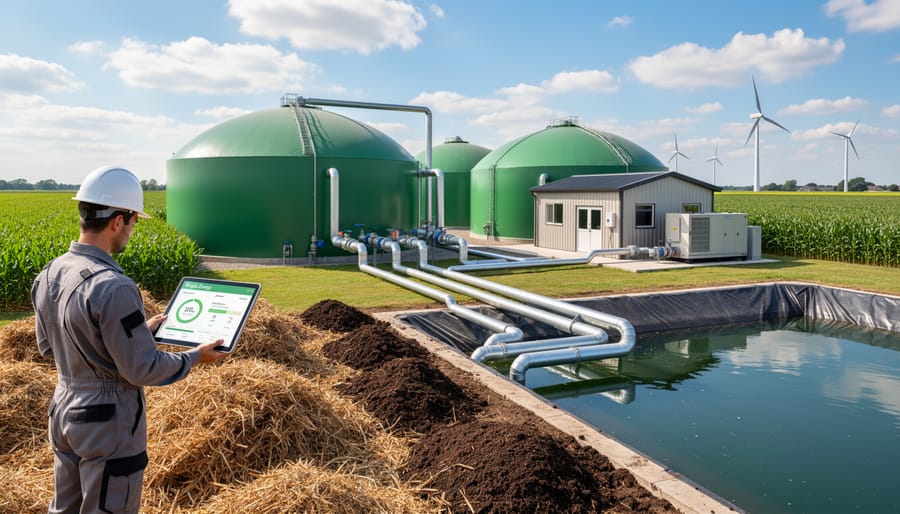
If you’re managing livestock or growing crops that generate significant organic waste, an anaerobic digestion system could transform what you currently view as a disposal problem into a valuable energy asset. These systems work by breaking down manure, crop residues, and other organic materials in oxygen-free tanks, producing biogas that generates electricity and heat for your operation.
Alberta farmer Jim Hendrickson installed a 100-kilowatt anaerobic digester on his 500-head cattle operation near Red Deer in 2021. “We’re now producing enough electricity to power our entire farm with surplus going back to the grid,” he explains. “Plus, the digestate that remains makes excellent fertilizer, completing our circular agriculture model.”
System sizing depends on your waste volume and energy needs. A typical dairy operation with 200 cows produces enough manure to generate 30-50 kilowatts continuously. Mixed farming operations can supplement manure with crop residues like corn silage or vegetable waste to boost output. Most Alberta systems range from 50 to 250 kilowatts, with installation costs between $8,000 and $12,000 per kilowatt of capacity.
Daily maintenance is minimal but crucial. You’ll need to monitor temperature (ideally 35-40°C), feed the system consistently, and check gas production levels. Plan for quarterly professional inspections and annual deep cleaning. Most farmers report spending 30-60 minutes daily on system management once established.
Beyond energy production, digesters significantly reduce greenhouse gas emissions from manure storage and virtually eliminate odour issues. The processed digestate retains nitrogen and other nutrients while being pathogen-free and easier to handle than raw manure. Many operations recover their investment within 8-12 years through energy savings, renewable energy credits, and premium fertilizer production.
Geothermal Systems for Year-Round Climate Control
Ground-source heat pumps offer Alberta farmers a practical solution for managing extreme temperature swings, from minus 40°C winters to plus 30°C summers. These systems use the earth’s constant underground temperature (typically 8-10°C at depths of 2-3 metres) to efficiently heat greenhouses and cool livestock facilities year-round.
The installation process involves drilling vertical boreholes or installing horizontal loops beneath frost lines. For a typical 100-square-metre greenhouse operation, expect upfront costs between $25,000 and $40,000, depending on soil conditions and system complexity. While this represents a significant initial investment, the payback period typically ranges from 8 to 12 years through reduced energy consumption.
Red Deer-area greenhouse operator Janet Morrison saw her heating costs drop 65 percent after installing a geothermal system in 2019. “We’re saving approximately $8,000 annually, and the system maintains consistent temperatures that our plants love,” she explains.
These systems require minimal maintenance—primarily annual filter changes and occasional fluid level checks. They operate quietly with no combustion, eliminating carbon monoxide concerns in enclosed spaces. Energy efficiency ratings typically reach 300-500 percent, meaning you receive three to five units of heating or cooling for every unit of electricity consumed. Several Alberta municipalities now offer property tax incentives for geothermal installations, further improving the financial case.
How to Integrate Renewable Energy Into Your Farm Operations
Conducting Your Farm Energy Audit
Before investing in renewable energy systems, you need a clear picture of where your farm currently uses electricity and where opportunities exist. A thorough energy audit forms the foundation of any successful green energy project.
Start by gathering 12 months of utility bills to identify seasonal patterns. Most farms experience peak demand during specific operations—dairy producers during milking, grain operations during drying season, and livestock facilities during extreme weather. Understanding these patterns helps you right-size renewable systems and avoid costly oversizing.
Walk through your entire operation with a critical eye. Note the age and efficiency of major equipment like motors, pumps, heating systems, and lighting. Older equipment often consumes significantly more power than necessary. Document operating hours for each system, as equipment running during off-peak hours presents different opportunities than daytime loads.
Canadian farmers have access to excellent free resources. Many provincial utilities offer complimentary farm energy assessments—Alberta’s Energy Efficiency Alberta previously provided these services, and similar programs continue through local utilities. The Canadian Agricultural Partnership also funds energy advisors in many regions. These professionals bring thermal imaging cameras and monitoring equipment you wouldn’t purchase yourself.
Consider how precision agriculture technologies already track operational data that reveals energy patterns. Your existing farm management software may contain valuable insights about when and where energy demands peak.
Document everything in a simple spreadsheet. Track monthly kilowatt-hour consumption, associated costs, and specific operations during high-use periods. This baseline becomes essential when calculating potential renewable energy savings and payback periods.

Matching Energy Solutions to Your Farm’s Needs
Choosing the right renewable energy system starts with understanding your operation’s unique characteristics. Begin by auditing your current energy consumption—track electricity and fuel usage across different seasons and activities. A 400-hectare grain operation will have vastly different needs than a 50-hectare greenhouse or dairy farm.
Location plays a crucial role in technology selection. Southern Alberta farms benefit from excellent solar potential, averaging 2,300 hours of sunshine annually, making photovoltaic systems highly effective. Prairie operations with consistent wind patterns above 5 meters per second should consider wind turbines. Livestock operations with available organic waste are prime candidates for biogas systems.
Farm size directly impacts system scale and financial viability. Smaller operations under 100 hectares often find rooftop solar most practical, while larger farms can dedicate land to ground-mounted arrays or utility-scale wind installations. Mid-sized mixed farms between 200-500 hectares frequently benefit from hybrid systems combining solar panels with small wind turbines.
Hybrid approaches deserve serious consideration. Saskatchewan farmer James Morrison integrated a 50-kilowatt solar array with a 10-kilowatt wind turbine on his 350-hectare operation, achieving 85 percent energy self-sufficiency. “The wind picks up when the sun goes down, providing consistent power year-round,” Morrison explains.
Energy storage transforms renewable systems from supplemental to primary power sources. Battery systems now offer 10-15 year lifespans with declining costs. Calculate your critical loads—irrigation pumps, grain dryers, livestock ventilation—to determine appropriate storage capacity. Most agricultural operations require 8-12 hours of backup power for essential systems.
Consider working with agricultural energy consultants who can conduct detailed site assessments and model different scenarios based on your specific circumstances.
Working With Installers and Navigating Grid Connection
Finding the right installer makes all the difference in your renewable energy project. Start by requesting quotes from at least three certified contractors with experience in agricultural installations. Ask candidates about their familiarity with Alberta’s Micro-Generation Regulation, which allows systems up to 5 megawatts to feed power back to the grid. Request references from farming operations similar to yours and verify their licensing with the Safety Codes Council.
Red flags include contractors who pressure immediate decisions, lack proper insurance, or can’t provide detailed timelines and warranties. Southern Alberta farmer James Chen recommends asking about post-installation support: “Our solar installer visits annually to check performance, which gives us peace of mind.”
Understanding net metering is essential. Your local distribution company must be notified before installation, and meters will track both consumption and export. Most Alberta utilities offer streamlined connection processes for systems under 150 kilowatts. Connection timelines typically range from 30 to 90 days after application approval. Review your utility’s specific interconnection agreement carefully, noting any standby charges or export rate structures. Agricultural energy consultant Maria Torres advises documenting everything: “Keep all correspondence with your installer and utility. Clear communication prevents costly delays and ensures your system meets both regulatory and operational requirements.”
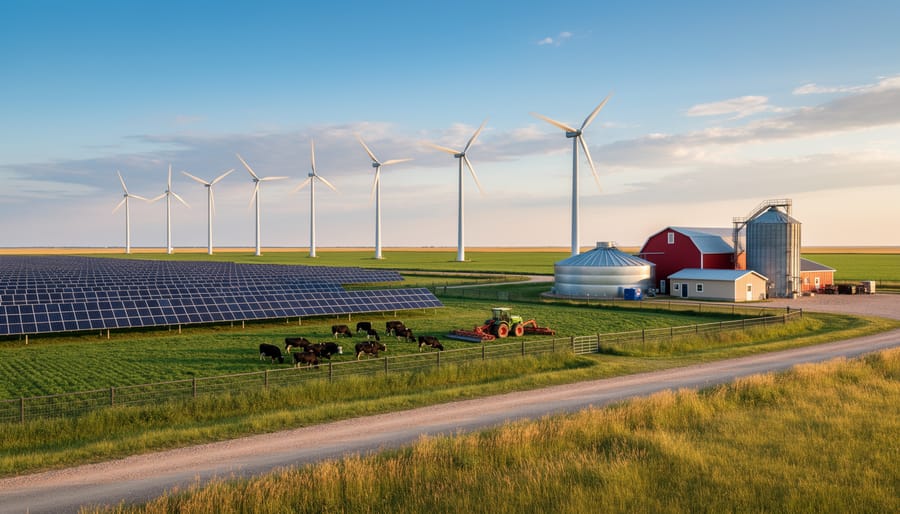
Real Alberta Farms Making Green Energy Work
The Vanderlaan family’s 650-hectare grain operation near Lethbridge has been running largely on solar power since 2019. They installed a 50-kilowatt solar array on their main shop building at a cost of $75,000. With federal and provincial rebates covering roughly 35% of the upfront investment, their out-of-pocket expense came to about $49,000. Today, the system generates approximately 65,000 kilowatt-hours annually, saving them around $6,500 per year on electricity costs. Beyond the financial return, patriarch John Vanderlaan notes an unexpected benefit: “We’ve been able to run our grain dryers during peak harvest times without worrying about demand charges. That alone has changed how we manage our operation during those critical weeks.”
The system paid for itself in seven years, and John estimates they’ll save over $150,000 over the 25-year lifespan of the panels. His advice for other farmers? “Start with an energy audit to understand your consumption patterns. We discovered we were using far more electricity than necessary in our shop heating system. Fixing those inefficiencies first made our solar investment even more effective.”
Up near Westlock, the Morrison Cattle Company took a different approach. They installed a 10-kilowatt wind turbine in 2020 to power their cattle operation, which includes heated waterers, barn lighting, and feed processing equipment. The $35,000 turbine, reduced to $24,000 after incentives, generates about 18,000 kilowatt-hours annually in their windy location. Ranch manager Sarah Morrison explains: “Wind made more sense for us than solar because our peak energy needs occur during winter months when solar production drops. The turbine performs beautifully during those cold, windy prairie winters.”
Combined with energy-efficient LED lighting throughout their barns and a programmable thermostat system for waterers, the Morrisons have cut their electricity bills by 60%. Sarah emphasizes the importance of proper site assessment: “We had a wind resource assessment done for $1,200 before committing to the turbine. Best money we spent because it confirmed our site had consistent wind speeds above 4.5 meters per second.”
Both operations have also explored how renewable energy complements integrated farm systems, creating more resilient and sustainable operations overall. The key lesson from both families? Start with understanding your energy consumption, investigate what renewable resources your specific location offers, and connect with other farmers who’ve already made the transition.
The Bigger Picture: Sustainability Beyond Energy Production
Renewable energy on your farm isn’t just about reducing electricity bills—it’s a foundational piece of a comprehensive sustainability strategy that touches every aspect of your operation. When you integrate solar panels, wind turbines, or biogas systems into your farm, you’re creating positive ripple effects that extend far beyond energy production.
Consider how green energy connects to soil health. Biogas digesters, for example, transform livestock manure into energy while producing nutrient-rich digestate that improves soil structure and fertility. This circular approach reduces chemical fertilizer dependency and strengthens the biological foundation of your land. One Manitoba mixed farm reported a 15% improvement in soil organic matter within three years of implementing a biogas system alongside regenerative practices.
Water management also benefits from renewable energy integration. Solar-powered irrigation systems allow you to implement precision water conservation strategies in remote fields where grid connections aren’t practical. These systems can reduce water usage by 20-30% compared to conventional methods while maintaining crop yields.
The carbon footprint reduction is substantial. A 250-acre grain farm in Alberta that installed a 50-kilowatt solar array offset approximately 65 tonnes of CO2 emissions annually—equivalent to taking 14 cars off the road. When combined with regenerative agriculture practices, your farm can move from carbon contributor to carbon sink.
Perhaps most importantly, renewable energy builds farm resilience. During extreme weather events or grid failures, on-site power generation keeps essential operations running. Your cold storage stays operational, livestock watering systems continue functioning, and grain drying doesn’t stop. This operational security becomes increasingly valuable as climate patterns shift and weather becomes less predictable.
Green energy isn’t an isolated decision—it’s a strategic investment that strengthens every dimension of your farm’s long-term sustainability and viability.
Overcoming Common Barriers to Green Energy Adoption
Many Alberta farmers initially hesitate to adopt renewable energy due to concerns about upfront costs. While solar panel systems typically range from $15,000 to $40,000 depending on size, and small wind turbines start around $30,000, various financing solutions make these investments manageable. The Canadian Agricultural Partnership and Alberta’s On-Farm Solar Photovoltaics Program offer grants covering up to 25-35% of project costs. Additionally, Farm Credit Canada provides specialized green energy loans with favorable terms, and many farmers lease equipment to spread costs over time.
Technical complexity often feels overwhelming, but modern systems are designed for simplicity. “Most farmers already troubleshoot complex equipment daily,” explains renewable energy consultant Mark Peterson from Red Deer. “Solar panels require minimal intervention—essentially, keep them clear of snow and debris.” Many Alberta suppliers include installation, monitoring systems, and training as part of their packages. Local agricultural co-ops now offer peer support networks where experienced farmers mentor newcomers through the process.
Winter reliability remains a legitimate concern in Alberta’s harsh climate. However, case studies from the Lethbridge region demonstrate that properly installed solar systems perform efficiently even at minus 30 degrees Celsius. Snow actually slides off angled panels more easily than expected, and cold temperatures can improve panel efficiency. Battery storage systems ensure power availability during shorter daylight hours, while hybrid systems combining solar with biogas or grid connection provide backup.
Maintenance requirements are surprisingly minimal. Solar systems typically need professional inspection every 2-3 years, costing around $200-400. Most components carry 20-25 year warranties, with inverters requiring replacement around year 10-15. The key is selecting equipment rated for Canadian winters and working with certified installers familiar with Alberta’s agricultural conditions.
Integrating renewable energy into your farm operation represents more than just an environmental commitment—it’s a smart business decision that delivers measurable returns. From reducing operational costs by 30-50% on energy expenses to creating new revenue streams through energy sales, the financial case is compelling. You’ll also build resilience against rising energy prices while reducing your carbon footprint by thousands of tonnes annually.
The environmental benefits extend beyond your property line, contributing to cleaner air and water for your community while positioning your operation as a leader in sustainable agriculture. Meanwhile, operational advantages like energy independence and reduced maintenance costs strengthen your bottom line year after year.
Taking the first step doesn’t have to be overwhelming. Start by requesting a free energy assessment through Alberta Agriculture and Irrigation or the Canadian Agricultural Partnership. Connect with farmers in your area who’ve already made the transition—their experiences offer invaluable insights. Contact local renewable energy installers for site evaluations and cost estimates specific to your operation.
The transition to green energy is happening now across Alberta farms. Whether you start small with solar panels on a single barn or plan a comprehensive wind-solar hybrid system, every step forward strengthens your operation’s sustainability and profitability. Your farming future begins with the decision you make today.