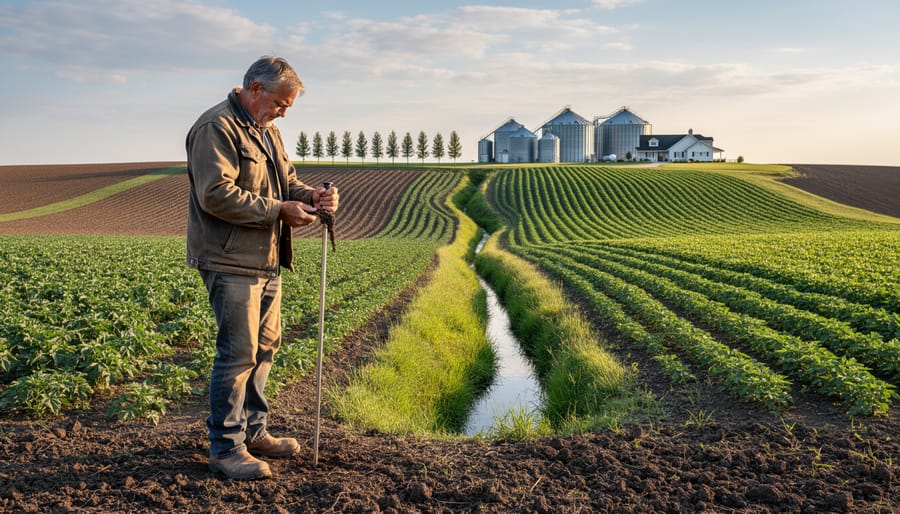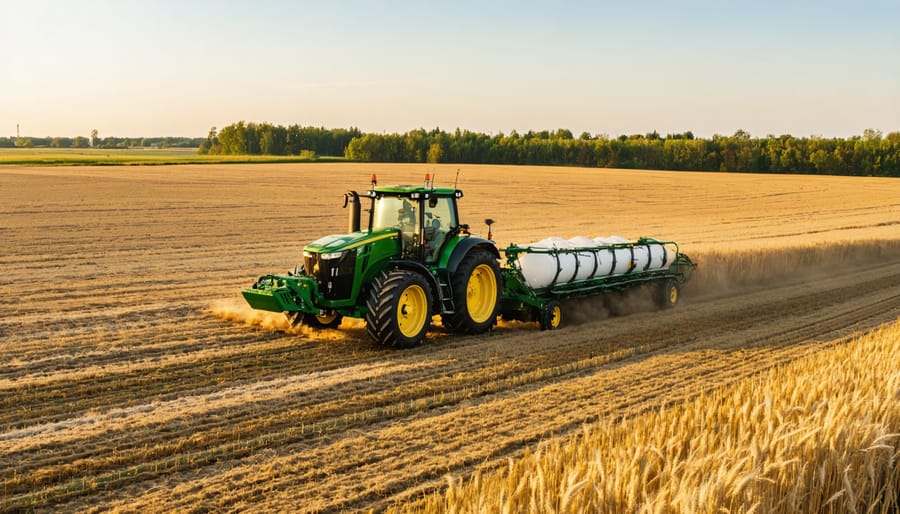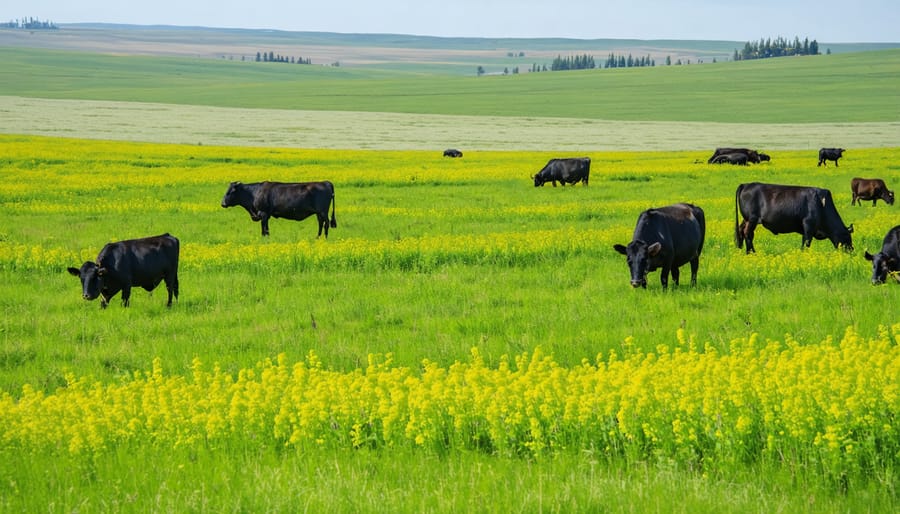
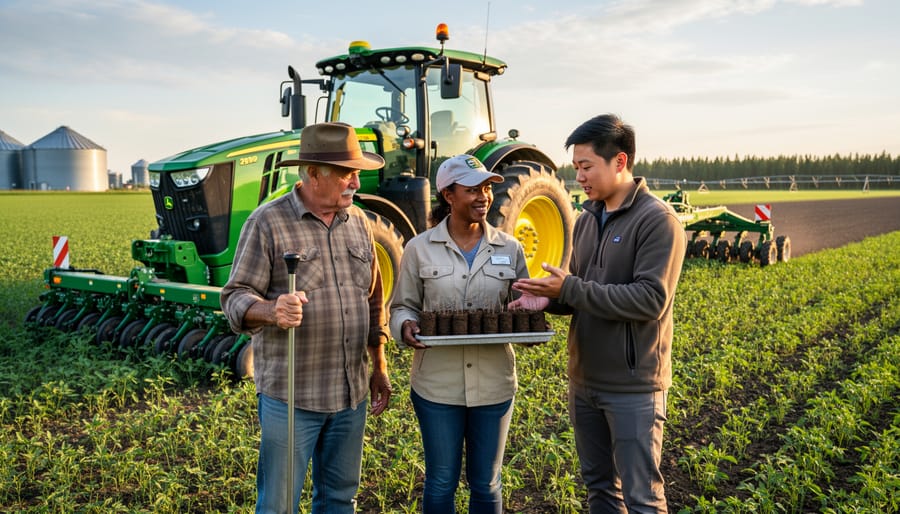
Join local agricultural networks where farmers share equipment, reducing capital costs by 30-40% while building relationships that lead to knowledge exchange about soil health practices and crop rotation strategies. These collaborations create immediate cost savings and position your operation to adopt proven sustainability methods already working on neighboring farms.
Connect with regional conservation groups and university extension programs that offer free soil testing, watershed management resources, and grants for sustainable infrastructure improvements. Alberta farmers working with organizations like the Agricultural Research and Extension Council have accessed funding for beneficial management practices including riparian restoration and precision agriculture technology that individually would strain farm budgets.
Participate in farmer-led research cooperatives where members test sustainable practices on small plot trials before full-scale implementation. This community approach reduces individual risk while generating locally relevant data about cover cropping, integrated pest management, and water conservation techniques specific to Prairie growing conditions. When Tom Henderson’s southern Alberta grain operation joined a peer learning network, he reduced synthetic fertilizer use by 25% in two seasons based on insights from neighboring farms’ nitrogen management trials.
Establish marketing cooperatives that enable direct access to sustainability-focused buyers willing to pay premiums for environmentally responsible production. Collective marketing strengthens negotiating power while sharing transportation and processing costs makes value-added opportunities financially viable for mid-sized operations. Community-supported agriculture models and regional food hub partnerships provide stable revenue streams that support long-term investment in regenerative practices, creating economic resilience alongside environmental stewardship.
Why Going It Alone Doesn’t Work Anymore
Modern farming presents challenges that would have seemed unimaginable just a generation ago. While independence has always been a hallmark of Canadian agriculture, today’s sustainability issues have grown too complex for individual operations to tackle effectively on their own.
Consider the reality facing Alberta producers right now. Climate patterns are shifting faster than any single farmer can adapt to, requiring localized knowledge about which crop varieties perform best under changing conditions. Water management has become increasingly technical, demanding expertise in everything from soil moisture monitoring to irrigation efficiency that goes well beyond traditional practices. Meanwhile, new pest pressures and diseases don’t respect property lines, making individual control efforts less effective without coordinated regional responses.
The financial barriers compound these challenges significantly. Installing renewable energy systems, upgrading to precision agriculture technology, or transitioning to regenerative practices requires substantial upfront investment. Most individual farms simply can’t justify the cost of specialized equipment that might only be used seasonally, or afford the risk of experimenting with new approaches without support networks to fall back on.
Knowledge gaps present another significant hurdle. Staying current with evolving sustainability practices, regulatory requirements, and market expectations demands time that most farmers don’t have during growing season. One producer might excel at soil health management while struggling with marketing sustainable products. Another might understand carbon sequestration but lack connections to programs that reward these practices financially.
The isolation factor matters too. Rural producers often work long hours with limited opportunities to share experiences, troubleshoot problems, or learn from others facing similar situations. This isolation can lead to duplicated efforts, missed opportunities, and the frustration of reinventing solutions that neighbouring operations have already developed.
These aren’t failures of individual capability. They’re simply reflections of how dramatically agriculture has evolved. The producers finding the most success with sustainability aren’t necessarily the largest or most technologically advanced. They’re the ones recognizing that collective approaches multiply resources, spread risk, accelerate learning, and create the critical mass needed to influence markets and policy effectively.
What Makes a Farming Community Sustainable
Shared Knowledge Networks
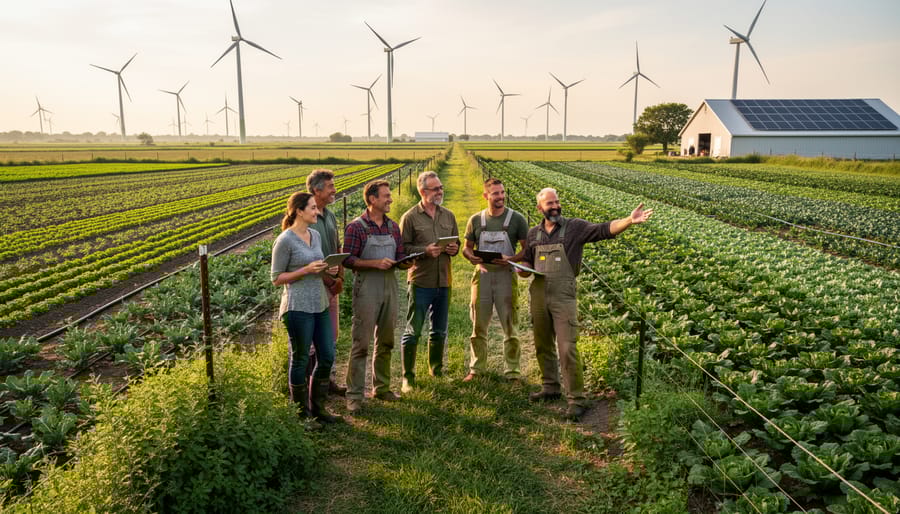
When farmers share their knowledge and experiences, everyone grows stronger. Across Alberta, producer networks and peer-to-peer learning groups are transforming how agricultural communities approach challenges. These collaborative spaces allow farmers to openly discuss what works and what doesn’t, creating a living library of practical wisdom that no single operation could develop alone.
Through field days, informal coffee meetings, and digital forums, farmers exchange insights on everything from soil health improvements to water conservation techniques. A producer who successfully implemented cover cropping can share specific seed varieties, planting rates per hectare, and actual yield impacts with neighbours considering the same approach. Similarly, when an experiment with sustainable practices doesn’t deliver expected results, discussing why helps others avoid costly mistakes.
Alberta’s farming networks demonstrate how shared knowledge accelerates innovation. Producers report that learning from peers feels more accessible than formal research findings, as fellow farmers understand local soil conditions, climate challenges, and economic realities. This collective intelligence helps operations adopt new methods with greater confidence, reducing the trial-and-error period and financial risk that can discourage change. Knowledge sharing ultimately strengthens the entire agricultural community’s capacity to adapt and thrive.
Collective Resource Management
Sharing resources among farming operations has become a practical solution for reducing both costs and environmental footprint across Alberta’s agricultural landscape. Rather than each farm investing in expensive equipment that sits idle much of the year, communities are pooling their resources to maximize efficiency.
Equipment sharing cooperatives represent one of the most successful models. In central Alberta, several grain farming communities have established co-ops where members jointly purchase and schedule use of specialized machinery like combine harvesters, grain dryers, and GPS-guided planters. This approach allows farms to access modern, fuel-efficient equipment without shouldering the full financial burden. A typical combine harvester costs upwards of $500,000, but when split among ten operations, the investment becomes manageable while reducing the total number of machines manufactured and maintained.
Infrastructure sharing extends beyond equipment. Several livestock operations in southern Alberta have collaborated to build shared processing facilities and cold storage units. These centralized facilities meet food safety standards that would be prohibitively expensive for individual farms while reducing the energy consumption per kilogram of product processed. Transportation costs also decrease when producers coordinate deliveries through shared trucking arrangements.
Input purchasing cooperatives help members secure volume discounts on seeds, fertilizers, and animal feed while negotiating for environmentally certified products. One Red Deer area cooperative reported members saving 15-20 percent annually on input costs while transitioning to organic-certified suppliers.
Water management infrastructure, including shared irrigation systems and dugouts, demonstrates how communities address resource scarcity collectively. These systems reduce water waste through coordinated scheduling and modern distribution technology that individual operations might not afford independently.
Community Models That Work in Alberta
Farmer-Led Learning Circles
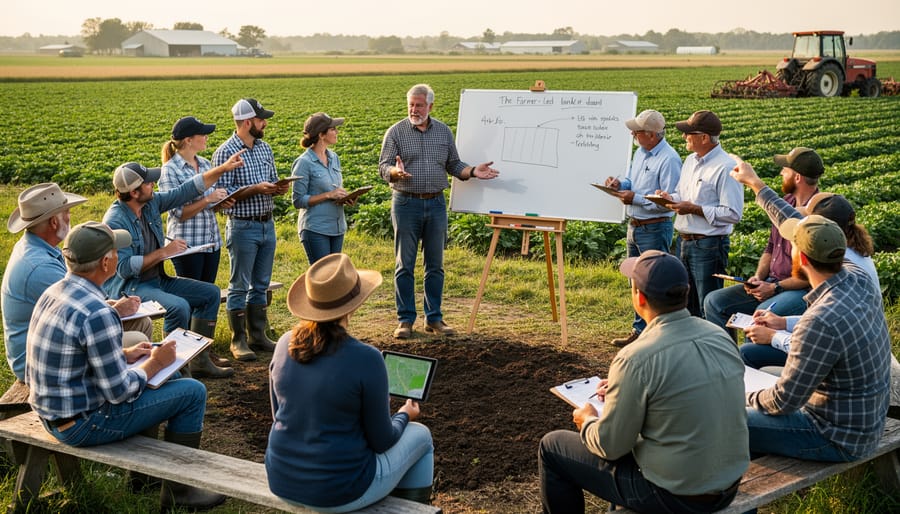
Farmer-led learning circles are transforming how agricultural knowledge spreads across the Prairies. These peer-to-peer groups bring together farmers who meet regularly to tackle shared challenges, experiment with sustainable practices, and learn from each other’s successes and setbacks. Unlike traditional extension services, learning circles put farmers in the driver’s seat, allowing them to set priorities based on what matters most to their operations.
The structure is straightforward but effective. Groups of 8 to 15 farmers typically gather monthly during the growing season, rotating meetings between member farms. These gatherings combine classroom-style discussions with hands-on field days where participants can see practices in action. One central Alberta learning circle focused on soil health has been meeting for four years, with members collectively reducing fertilizer costs by 18 percent while maintaining yields through cover cropping and reduced tillage experiments.
What makes these circles particularly valuable is the shared experimentation approach. Rather than one farmer taking all the risk, members each test variations of a practice on small plots, then pool their data. This distributed trial system generates locally relevant results much faster than waiting for research station findings. A southern Alberta group testing intercropping methods documented results across seven different soil types in a single season, giving members confidence to scale up successful combinations.
The learning extends beyond agronomy. Farmers share equipment, bulk-purchase inputs, and discuss financial strategies for transitioning to regenerative practices. This peer support network reduces the isolation many farmers feel when adopting unfamiliar methods, creating accountability and encouragement that keeps momentum going through challenging years.
Cooperative Buying and Marketing Groups
Pooling resources through cooperative buying and marketing groups offers farming communities substantial economic and environmental advantages. When farmers unite to purchase inputs like seed, fertilizer, or equipment, they gain negotiating power that individual operations simply cannot match. This collective approach often reduces costs by 15-30% while enabling access to sustainable products that might otherwise be financially out of reach.
In Alberta, several cooperative models have demonstrated impressive results. The Highwood Grazing Co-op near Longview successfully negotiates bulk purchases of organic-approved soil amendments for its 12 member ranches, saving each operation approximately $3,000 annually while maintaining their commitment to regenerative practices. Similarly, Peace Country grain farmers have formed purchasing collectives that source certified seed varieties at competitive rates.
Marketing cooperatives provide equally valuable benefits. By combining harvest volumes, smaller farms can meet buyer minimums and access premium markets previously unavailable to them. The Alberta Organic Producers Marketing Co-op helps members navigate organic certification processes collectively, sharing audit costs and technical expertise. This group approach reduces individual certification expenses by nearly 40% while maintaining rigorous standards.
Getting started requires commitment but needn’t be complicated. Begin by identifying 5-10 neighbouring producers with aligned values and complementary needs. Establish clear purchasing or marketing goals, create a simple cost-sharing agreement, and designate a coordinator to manage logistics. Many successful groups start with a single shared purchase to build trust before expanding operations.
Consider connecting with existing agricultural service boards or extension offices who can provide templates and guidance for forming these beneficial partnerships.
Watershed and Soil Health Collaboratives
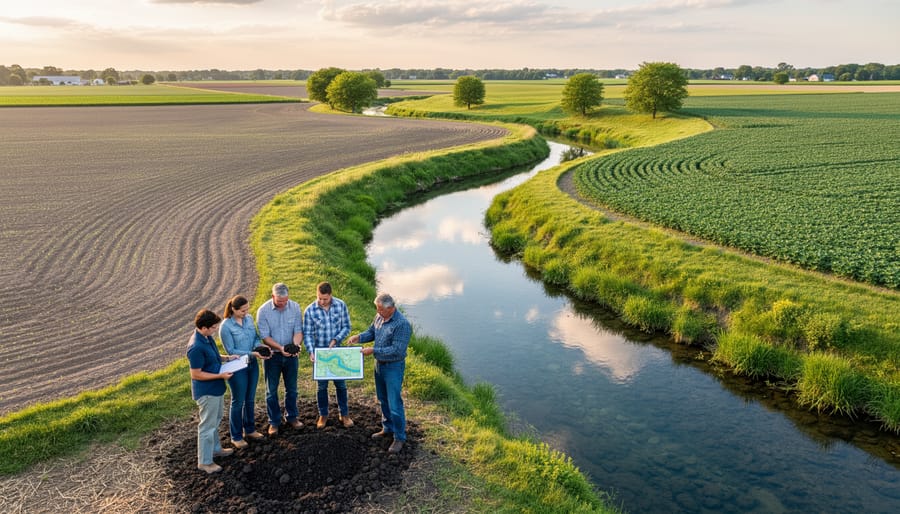
Across Alberta, forward-thinking farmers are discovering the power of working together on shared environmental challenges. Watershed and soil health collaboratives bring neighboring operations together to tackle issues that cross property lines, from groundwater protection to erosion control.
These regional initiatives recognize that water quality doesn’t respect fence boundaries. When multiple farms in a watershed coordinate their efforts, the collective impact on stream health and aquifer recharge multiplies significantly. In the Battle River watershed, for example, twelve cattle operations partnered to implement rotational grazing systems that reduced nutrient runoff by 40% within three years.
The practical benefits extend beyond environmental outcomes. Members share equipment costs for soil conservation projects, pool knowledge about what works in local conditions, and access group funding opportunities unavailable to individual operations. One collaborative near Red Deer secured provincial grants totaling $180,000 for riparian restoration that benefited 22 farms.
Starting a collaborative typically involves identifying 5-10 neighboring farms facing similar challenges, establishing clear goals, and meeting quarterly to share results. Many groups begin with simple projects like coordinated soil testing or shared cover crop trials before tackling larger watershed-scale initiatives.
Technical support from organizations like agricultural fieldmen and conservation districts helps collaboratives access expertise without overwhelming volunteer coordinators. The key is keeping initial commitments manageable while building trust and demonstrating tangible results that motivate continued participation.
Equipment Sharing Arrangements
Sharing specialized sustainable farming equipment among community members significantly reduces both capital costs and environmental impact. Rather than each farm purchasing expensive machinery that sits idle most of the year, groups of 4-8 farms can co-own high-efficiency seeders, renewable-powered grain dryers, or precision application equipment. In central Alberta, the Lacombe County Equipment Co-op demonstrates this model successfully, with 12 member farms sharing a no-till drill and cover crop roller. Members coordinate usage through a simple online scheduling system, typically booking 2-3 weeks ahead during peak seasons. This arrangement cuts individual equipment costs by 60-75% while reducing the carbon footprint associated with manufacturing multiple machines. The approach works best when members farm similar crops on comparable acreage and establish clear maintenance responsibilities and usage fees upfront.
Starting a Community Initiative on Your Own Farm
Finding Your People
Start by reaching out to your local agricultural society or county office—these organizations often maintain member directories and host events where you can meet neighbouring producers. In Alberta, attending regional agriculture conferences, field days, and winter workshops creates natural opportunities to connect with farmers who share your sustainability interests. Many regions also have commodity-specific groups where producers gather to discuss common challenges.
Consider joining online communities like provincial farming Facebook groups or agricultural forums where you can ask questions and identify farmers experimenting with similar practices. Don’t overlook your local agricultural fieldmen or extension specialists—they regularly connect with innovative farmers and can make valuable introductions.
When initiating conversations, be genuine about your goals and challenges. Share what you’re hoping to achieve through collaboration, whether it’s sharing equipment, bulk purchasing inputs, or learning from each other’s experiences. Most farmers appreciate honest dialogue about trying new approaches.
Visit farms during slower seasons and ask for brief tours. Attending local agricultural trade shows and equipment demonstrations also provides casual settings for discussion. Remember, building trust takes time—start with small conversations about shared interests before proposing larger collaborative projects. The key is consistent, authentic engagement with your farming neighbours.
Setting Clear Goals Together
Successful community sustainability initiatives start with conversations where everyone has a voice. Begin by organizing an informal gathering—whether at a community hall or farm kitchen—where members can openly discuss their priorities. What matters most to your neighbours? Water conservation? Soil health? Reducing input costs? These initial discussions help identify common ground.
When facilitating these conversations, focus on measurable outcomes that matter locally. For Alberta farmers, this might mean reducing water usage by 15% over three years or improving soil organic matter by 1% annually. Break larger goals into quarterly milestones that allow the group to celebrate progress and adjust approaches as needed.
A successful example comes from the Olds region, where a group of grain farmers established shared objectives around cover cropping. They started with modest targets—10% of acreage in the first year—which built confidence and allowed for learning together. This incremental approach reduced the risk of failure and kept everyone motivated.
Document your community’s goals in writing, but keep the language straightforward and actionable. Include specific metrics, timelines, and individual responsibilities. Review these objectives seasonally, recognizing that farming realities shift with weather, markets, and personal circumstances. Flexibility within structure creates sustainability that works for real farm operations.
Building Trust and Commitment
Building strong farming communities requires intentional effort to establish trust and ensure everyone remains committed to shared goals. Start by creating clear agreements that outline expectations, responsibilities, and decision-making processes. Alberta’s Community Supported Agriculture networks often use written agreements that specify harvest sharing protocols, work contributions measured in hours per season (typically 20-40 hours annually), and communication schedules.
Transparency forms the foundation of accountability. Consider implementing regular information-sharing sessions where members discuss challenges, successes, and resource allocation. The Olds College Smart Farm, for example, hosts quarterly gatherings where participants review data on water usage (measured in litres per hectare), crop yields, and collective purchasing savings. These meetings keep everyone informed and invested in outcomes.
Digital tools can strengthen transparency without adding burden. Simple shared spreadsheets tracking equipment usage, bulk order quantities (such as seed purchases in kilograms), or volunteer hours help members see their contributions matter. Several Alberta grain cooperatives use basic online platforms where farmers log their activities and access real-time updates.
Long-term engagement grows when members see tangible benefits. Celebrate milestones together, whether reducing input costs by 15% through group purchasing or successfully implementing a new conservation practice across multiple farms. Recognition reinforces commitment and reminds everyone why collaboration matters. Remember, trust develops gradually through consistent, honest communication and delivered promises.

Accessing Support and Resources
Canadian farmers have access to numerous funding opportunities and technical resources designed to support community-based farm sustainability initiatives. Agriculture and Agri-Food Canada offers the Canadian Agricultural Partnership, which provides cost-share funding for collaborative projects focused on environmental stewardship and innovation. Provincial programs like Alberta’s Environmental Stewardship and Climate Change Program deliver additional financial support for group initiatives addressing soil health, water management, and biodiversity.
Beyond grants, farmers can tap into technical assistance through organizations like the Organic Agriculture Centre of Canada and regional agricultural service boards. These groups connect producers with agronomists, soil scientists, and sustainability experts who provide hands-on guidance tailored to local conditions. Many agricultural extension offices also facilitate peer learning networks where farmers share practical knowledge and troubleshoot challenges together. Consider reaching out to your local agricultural fieldman or watershed stewardship group to explore what resources are available in your area and how neighbouring farms have successfully accessed support.
Expert Voices: What Works in Community-Based Sustainability
We spoke with agricultural professionals and farmers who are leading sustainability efforts across Alberta to understand what truly makes a difference when communities work together.
Sarah Chen, an agrologist with 15 years of experience working alongside Central Alberta producers, emphasizes the importance of peer-to-peer learning. “When farmers see their neighbours successfully implementing a new practice, the adoption rate increases dramatically. It’s not about top-down expertise—it’s about trusted relationships and shared problem-solving,” she explains. Chen has facilitated numerous soil health workshops where experienced farmers demonstrate cover cropping techniques they’ve refined over seasons. “The questions asked in these settings are more honest, more specific to local conditions, and the answers carry weight because they come from someone who understands your exact challenges.”
The Peace Country Regenerative Agriculture Network offers a practical example of this approach in action. Tom Becker, a founding member, notes that their monthly field days have become invaluable learning opportunities. “We rotate between member farms, and everyone brings something to the table. Last month, we walked through three different approaches to integrating livestock into crop rotation. You can read about these practices all day, but seeing them on your neighbour’s land, asking about their actual costs and labour requirements—that’s where real implementation begins.”
Agricultural economist Dr. Michelle Dubois has studied collaborative farming initiatives across the province. Her research highlights three consistent factors in successful community-based sustainability efforts. First, groups that establish clear, measurable goals see better participation and outcomes. “When a group says ‘we want to improve soil health,’ it’s too vague. When they say ‘we’ll increase organic matter by one percent over three years and measure it,’ members stay engaged,” she notes. Second, successful collaboratives maintain regular communication schedules, whether monthly meetings or weekly online check-ins. Third, they celebrate incremental progress rather than waiting for major transformations.
James Kowalski, who farms 800 hectares near Lethbridge, credits his equipment-sharing arrangement with four neighbouring farms for making precision agriculture accessible. “We couldn’t individually afford variable-rate application technology. Sharing the equipment and the learning curve made it feasible. Our combined efficiency improvements paid for the investment within two growing seasons.”
The common thread across these voices is clear: sustainability advances most effectively when farmers support each other through shared knowledge, resources, and accountability. As Chen summarizes, “The strongest farming communities don’t just share information—they build trust that makes trying new approaches less risky and more rewarding.”
The evidence is clear: when farmers work together, they achieve what individuals cannot accomplish alone. Community-based approaches to sustainability aren’t just about environmental stewardship—they’re about building economically resilient operations that weather market fluctuations, climate challenges, and resource constraints more effectively than isolated farms.
Throughout Alberta and across Canada, farming communities are already demonstrating this power. From equipment-sharing cooperatives that cut capital costs by 40 percent to knowledge networks that accelerate the adoption of regenerative practices, collaborative efforts deliver measurable results. These aren’t theoretical benefits—they’re documented improvements in soil health, water conservation, biodiversity, and farm profitability.
The first step doesn’t require a major commitment. Start small: reach out to a neighboring farmer about sharing equipment or coordinating crop rotation strategies. Attend a local agricultural meeting or join an existing sustainability initiative in your region. Many provincial agriculture departments and farm organizations facilitate these connections, making it easier than ever to find like-minded producers.
Consider this: the most successful farms in the coming decades won’t be those that operated in isolation, but those that built strong networks of mutual support and shared innovation. The environmental challenges we face demand collective action, and the economic opportunities favor those who collaborate.
Your community is waiting. Whether you’re managing 50 hectares or 5,000, your experience and your willingness to connect add value. Take that first step today—reach out to a neighbor, join a local farming group, or start a conversation about collaboration. The future of sustainable agriculture depends on farmers working together, and that future begins with your decision to connect.