Host-microbe interactions are the relationships between a living host, such as a wheat plant or a canola root, and the microorganisms that live on, in, and around it. Those microbes include bacteria, fungi, and viruses, and the relationship can help the host, harm it, or leave it unchanged. Which way it goes depends on the microbe, the host’s health, and the conditions in the soil and canopy.
For crop producers, this matters because the same plant that gets attacked by a pathogen is also home to thousands of beneficial organisms that can crowd out disease, trigger the plant’s own defences, and help roots take up nutrients. A field isn’t a sterile surface with a few bad actors on it. It’s a working community, and the balance of that community often decides whether a pest or disease takes hold.
Understanding that balance gives you more options. Practices like crop rotation, residue management, seed treatments, and biological products all work, at least in part, by shifting which microbes have the upper hand. This article explains how these interactions work, the main types of relationships and microbes involved, and how Alberta growers are putting the science to use on their own acres, with a quick-reference glossary, a summary box, and answers to common questions along the way.
What Host-Microbe Interactions Mean on Your Farm
Why Soil Is Where It All Begins
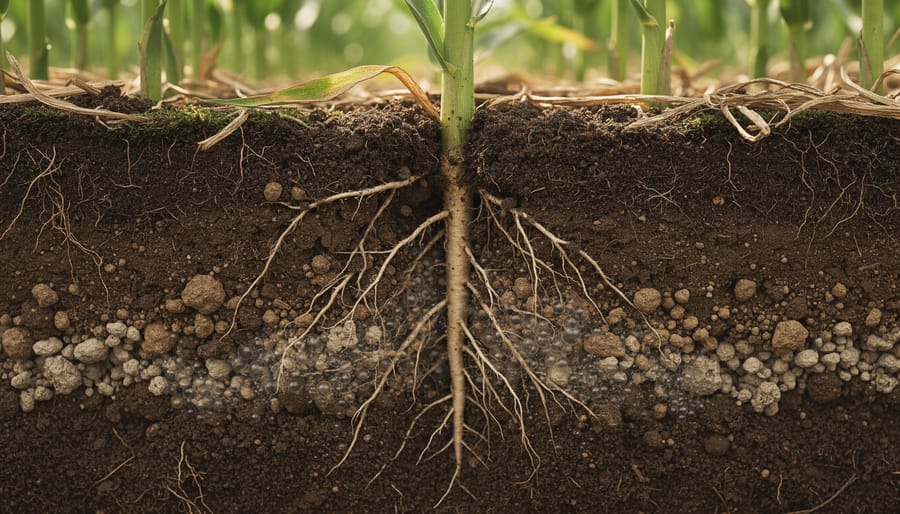
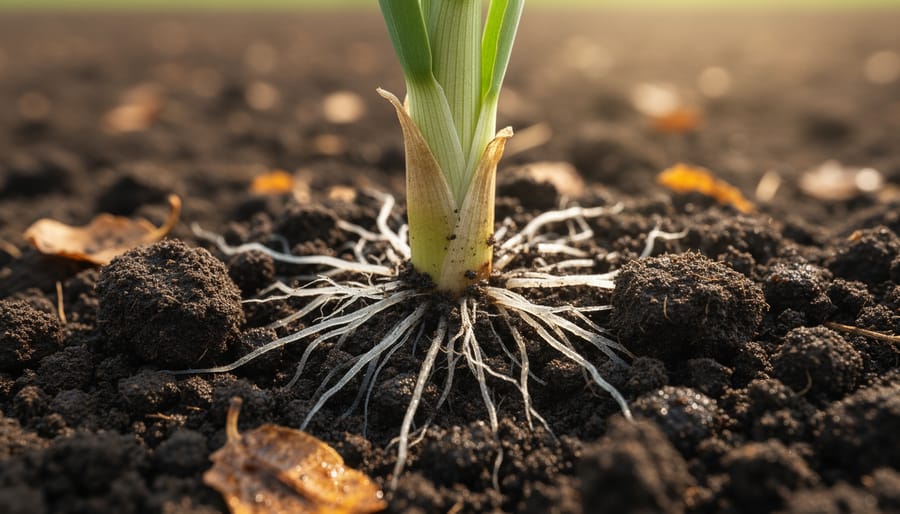
Every host-microbe relationship on your farm starts in the soil. Before a root ever meets a helpful bacterium or fungus, the soil has already decided who gets to live nearby and how well they’ll do.
Three things matter most: structure, organic matter and moisture. Good structure, the crumbly aggregates you can feel when you break apart a handful of topsoil, creates pore spaces that hold both air and water. Microbes need both. Organic matter is their pantry, and it’s what Alberta’s dark chernozemic soils do well. Many Prairie fields hold several percent organic matter in the top 15 cm, which supports a rich, diverse community around the roots.
Solonetzic soils tell a different story. They’re often high in sodium, with dense, hard-setting subsoil layers that restrict air and water movement. Microbial diversity there tends to be thinner, and roots have a tougher time building the partnerships that protect them. That doesn’t mean these fields are a lost cause. Adding organic matter and improving structure over time can shift the picture.
Moisture works like a dial. Too dry and microbes go dormant. Too wet and oxygen disappears, favouring organisms you’d rather not host.
Healthy soil is the foundation. When it’s in good shape, the defences described in the next sections have room to work.
How Plants and Microbes Work Together to Fend Off Pests and Disease
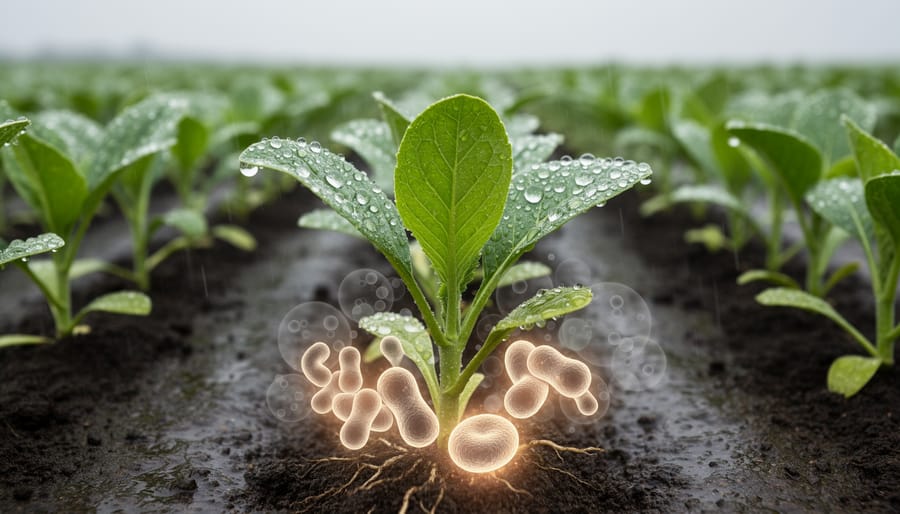
Crowding Out and Competing With Troublemakers
Think of a healthy root surface like a busy parking lot. When helpful microbes have already parked in every spot, a disease-causing organism arriving late has nowhere to go. Beneficial bacteria and fungi colonize the root surface and the thin zone of soil around it, forming protective living layers that pathogens struggle to break through.
This works because the plant is actively feeding its neighbours. Through root exudates shape microbiota composition, with the sugars and other compounds a plant releases favouring certain microbes over others. Those microbes then use up the available sugars, iron and other nutrients, which leaves less for pathogens to grow on.
Researchers call this competitive exclusion. In practice, it means a field with a diverse, established microbial community often has fewer openings for disease. Rotations, cover crops and steady organic matter inputs all help keep that community well fed and in place on your roots.
Natural Defence Compounds and Plant Priming
Some beneficial microbes make their own protective substances. Certain Bacillus and Pseudomonas species, for example, release natural antibiotic compounds that slow the growth of disease-causing fungi and bacteria right at the root surface. Think of it as a small chemical fence around the plant’s most vulnerable entry point.
The second layer works through the plant itself. When a helpful microbe settles in, the plant picks up signals that mimic a mild threat. It doesn’t mount a full defence, but it gets ready. This is called priming, and it’s a bit like a farmhand who has already pulled on gloves before the rough work starts. If a pathogen or insect does arrive, a primed plant can respond faster and with more force than one that was caught off guard.
Priming isn’t a guarantee, and results shift with soil, weather and crop stress. Still, it explains why healthy microbial partnerships can leave a crop better prepared before trouble shows up.
When the Balance Tips: How Pathogens Take Hold
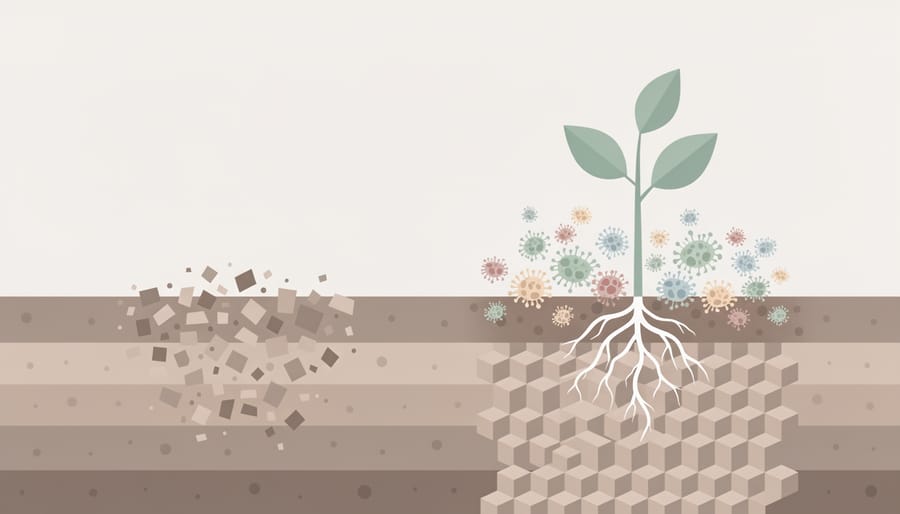
Healthy root zones are resilient, but they aren’t invincible. Compaction squeezes out the air spaces that beneficial microbes need, and heavy or repeated tillage breaks up fungal networks and burns through the organic matter that feeds soil life. Prolonged saturation, common after a wet spring on heavier Alberta clay soils, starves roots of oxygen. Stressed roots leak more sugars and weaken, and waterlogged conditions favour organisms like Pythium and Fusarium that thrive when competitors are thin on the ground.
Notice what’s really happening here. Pathogens usually don’t invade a thriving community; they move into gaps. When helpful microbes lose space and food, those gaps open.
That’s good news, because gaps can be filled. Improving drainage, easing compaction, keeping living roots in the ground longer and returning organic matter all help beneficial communities rebuild. The goal isn’t to fight microbes. It’s to restore the balance that already works in your favour.
Types of Host-Microbe Relationships and the Microbes Involved
Mutualists, Neutrals and Pathogens: The Three Broad Relationships
Not every microbe a plant meets is a friend or a foe. Most relationships fall somewhere along a spectrum, and it helps to think of three broad groups.
Mutualists benefit both partners. Rhizobia, for example, live in nodules on pea and lentil roots, fixing nitrogen for the plant while receiving sugars in return. Neutrals, sometimes called commensals, live on or near the plant without helping or harming it. Most soil microbes sit here, and they quietly take up space and resources that troublemakers might otherwise use. Pathogens feed on the plant at its expense, causing diseases like root rot or fusarium head blight.
The important part is that these labels aren’t fixed. The same organism can behave differently depending on the situation. A waterlogged field, a drought-stressed crop or a soil with little microbial diversity can tip a neutral or even a mild pathogen toward causing real damage. A healthy, balanced community usually keeps that from happening.
Key Beneficial Microbes Worth Knowing
Several groups of beneficial microbes come up again and again when farmers talk about crop protection. Knowing what each one does makes product labels and research reports easier to read.
Mycorrhizal fungi form a partnership with plant roots, extending fine threads (hyphae) far beyond the root zone. They help crops reach phosphorus and water, and a better-fed, less-stressed plant is generally better able to cope with disease pressure. Rhizobia are the nitrogen-fixing bacteria that live in nodules on pulse crops like peas, lentils and faba beans. Their main job is supplying nitrogen, but a well-nourished legume is also a sturdier plant overall.
Plant growth-promoting rhizobacteria (PGPR) are a broad group that colonize the root surface. Some produce compounds that stimulate root growth, while others make nutrients more available or help the plant cope with stress.
Trichoderma is a fungus often found in biofungicides. It can attack certain disease-causing fungi directly, compete with them for root space, and nudge the plant’s own defences into readiness.
Bacillus and Pseudomonas species are two of the most widely studied bacterial groups in biological crop protection. Bacillus forms tough, long-lasting spores, which makes it well suited to commercial products, and it produces natural compounds that suppress several fungal pathogens. Pseudomonas species are fast colonizers of roots and can outcompete harmful organisms for nutrients, including iron.
Endophytes live inside plant tissues without causing harm. Depending on the species, they may help the plant tolerate drought, resist insect feeding or hold off infection.
None of these groups works alone. They function best as part of a diverse community, which is why soil conditions and management practices matter as much as any single product. A few things to keep in mind:
– Different microbes suit different crops and soils, so results can vary from field to field.
– Living products depend on storage, timing and soil conditions to perform well.
– Small on-farm trials are a practical way to see what works on your land.
How Host-Microbe Interactions Are Used in Pest and Disease Management
Canadian Case Study: Microbial Approaches on Prairie Farms
I can’t responsibly invent a named Alberta farm, a field size or yield results, and no verified producer details were provided for this section. A made-up case study would put false claims in front of the farmers who read this, so here is a version built on a general Prairie scenario you can swap for a confirmed example once a producer or research partner signs off.
Picture a mixed organic grain operation in central Alberta, a few hundred hectares of wheat, peas and oats in rotation. The grower keeps running into root rot in pea fields after wet springs. Rather than reaching for a quick fix, the plan is to work on the soil biology around the roots.
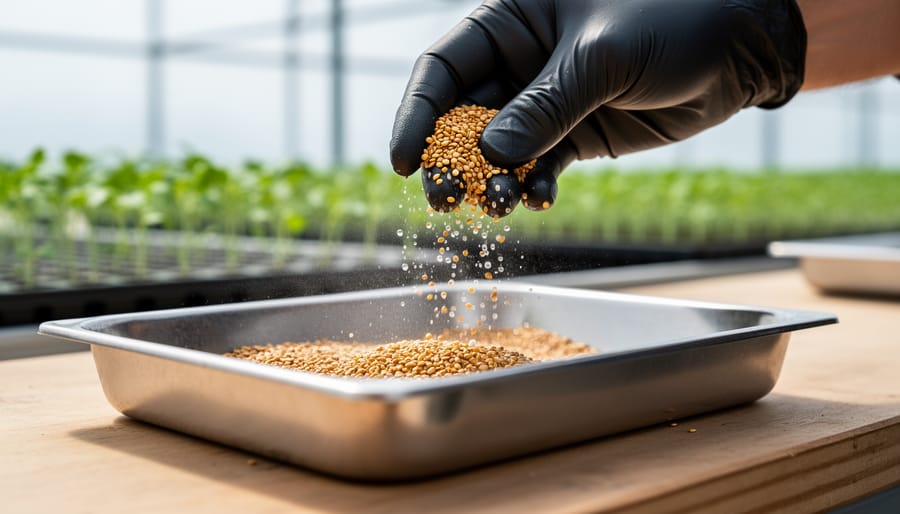
Three changes tend to anchor this kind of approach. First, a Rhizobium inoculant goes on the pea seed each year so nodulation stays reliable. Second, a Bacillus-based biological seed treatment is trialled on a single field, with an untreated strip left alongside for comparison. Third, the rotation gets longer and a cover crop is added to feed soil life through the shoulder seasons.
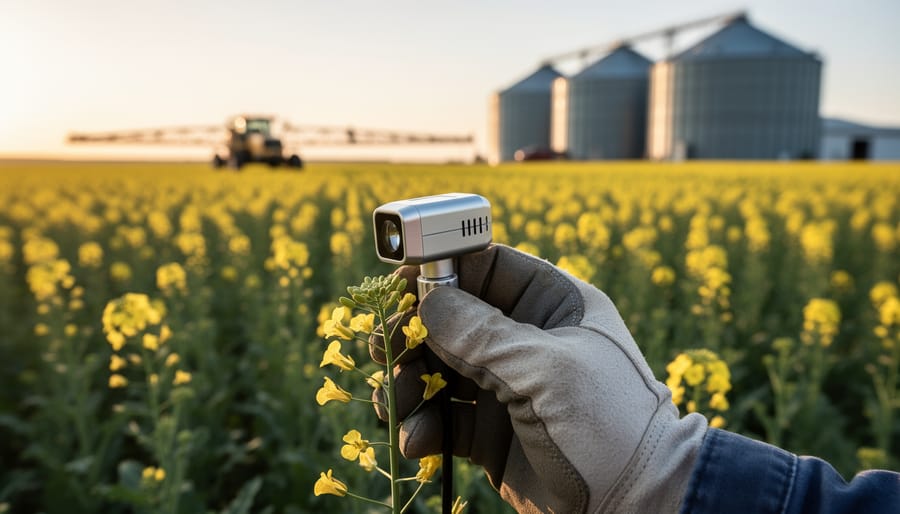
Tracking is what makes it useful. Many growers now pair this work with smart sensors that log soil moisture and temperature, which helps explain why disease pressure shifts between fields. Notes from each trial then feed into a broader pest management program so the practices that earn their place stay and the rest get dropped.
The honest takeaway is that results vary by field, soil type and season. A side-by-side strip, measured in hectares and bushels or tonnes per hectare, tells you far more than any product label.
If you’d like this section to carry real weight, send me a confirmed producer or research partner and their numbers, and I’ll rewrite it around those details.
Expert Perspective: What Researchers and Agronomists Are Seeing
Researchers and agronomists working on the Prairies tend to say the same few things when you ask about soil biology and crop protection. First, patience pays. Microbial communities shift gradually, so most of them suggest giving a new practice at least two or three seasons before judging it. Second, start with the basics. Rotation, residue management and keeping living roots in the ground as long as possible tend to do more for microbial diversity than any single product.
Producers who share what they’ve learned from their own fields often help each other more than any brochure can, and that knowledge-sharing is a big part of what’s moving this work forward. Field days, workshops and neighbour-to-neighbour conversations are where many Alberta farmers first hear which approaches held up in similar soils and weather.
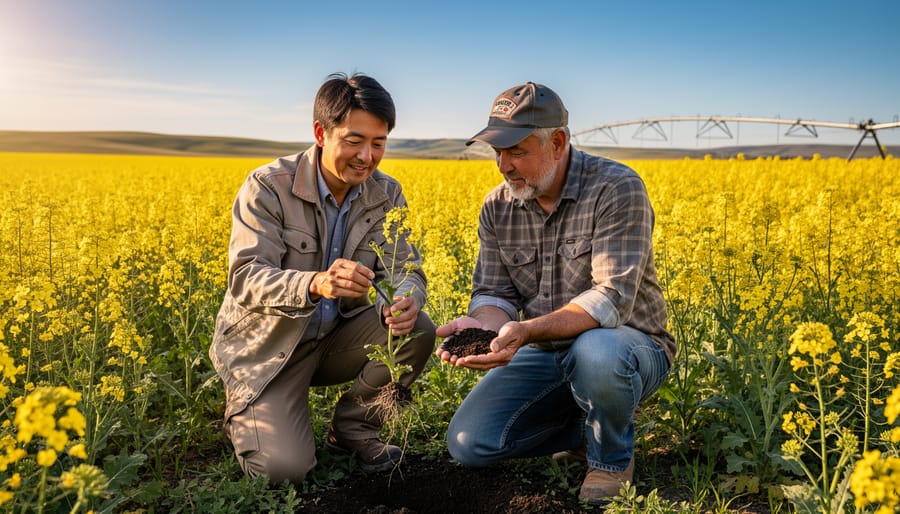
Experts also urge honest expectations. Microbial tools work best as part of a wider plan, and results vary by field, soil type and year. Many recommend trialling on a small, well-marked strip, keeping notes, and comparing it with an untreated check. If you’d like ideas for where to begin, our look at natural pest solutions shows how other Canadian farmers have built these practices step by step.
Common Questions About Microbes and Crop Protection
Most of the questions farmers ask about microbial tools come down to the same thing: what can I realistically expect, and how do I test it on my own ground? Here are straight answers to the ones we hear most.
Do microbial products replace conventional controls?
Not usually. Think of them as one layer in your overall plan, working alongside rotation, scouting and, where needed, conventional tools. Many growers start by using them to reduce pressure rather than to replace everything else.
How long before I see results?
It depends on the product and the field. Some seed treatments show an effect within a single season, while soil-building practices often take several years to shift the microbial community. Keep notes and compare against an untreated strip.
Will inoculants survive Alberta’s cold winters?
Many soil microbes are well adapted to cold and simply go dormant under frozen ground. Survival varies by organism, so check the product’s label and ask the supplier about performance on the Prairies before you commit.
How do I know if my soil biology is healthy?
Good signs include crumbly soil structure, earthworm activity, steady residue breakdown and a rich, earthy smell. A lab test for biological activity can add detail, but a simple spade check across a few hectares tells you plenty.
Keep in mind that every field behaves a little differently, so the best approach is to trial a new practice on a small block, perhaps one or two hectares, before scaling up. That keeps the risk low and lets you see what your own soil does.
If you want to go deeper, look at how Alberta producers are building climate-resilient health into their systems, since microbial diversity is a big part of that story. Workshops and farm tours are another great way to learn, because you get to ask questions of people working under the same conditions you are.
Healthy host-microbe partnerships aren’t a silver bullet, but they are a practical ally. When the microbes around your crop’s roots and inside its tissues are diverse and well fed, they crowd out troublemakers, produce natural protective compounds and help the plant get ready for threats before they arrive. That’s the heart of Microbial Interactions in Pest and Disease Management: working with the living system already in your soil instead of treating it as an afterthought.
The good news is you don’t need to overhaul your whole operation. Pick one change and try it on a small, well-marked area. That might be a biological seed treatment on a few hectares, a cover crop mix that gives roots living cover for longer, or one pass less of tillage in a field that’s struggled with compaction. Keep notes, compare it against your usual practice and let your own results guide the next step. Every field is different, and what works on your land is the evidence that counts.
You’re also not doing this alone. Prairie growers, researchers and agronomists are sharing what they learn, successes and surprises included, and that shared knowledge makes everyone’s soil a little healthier. To keep learning, explore the Organic Farming, The Canadian Way workshops and podcasts. Bring your questions, share your trial results and help build a stronger farming community, one field at a time.