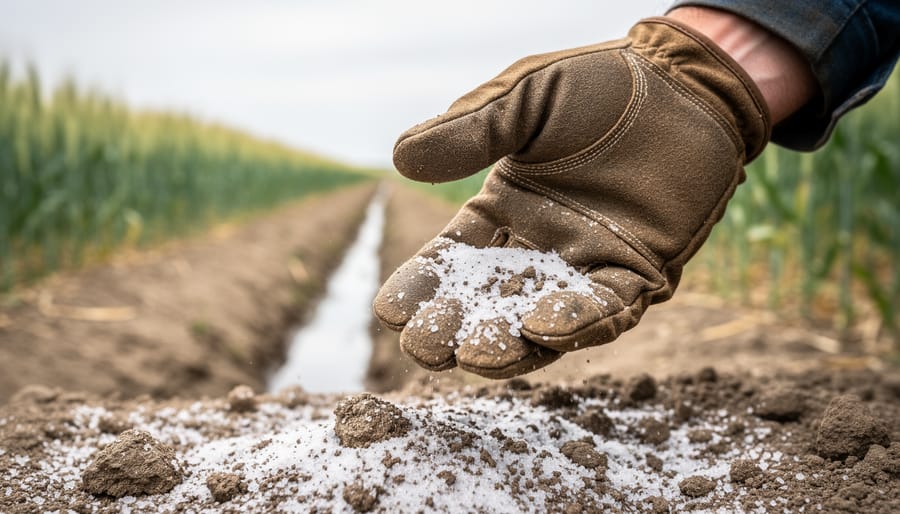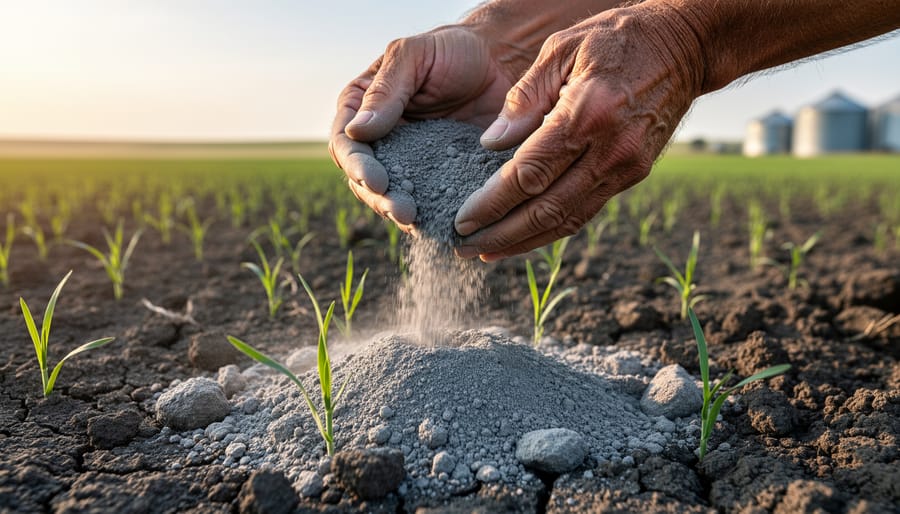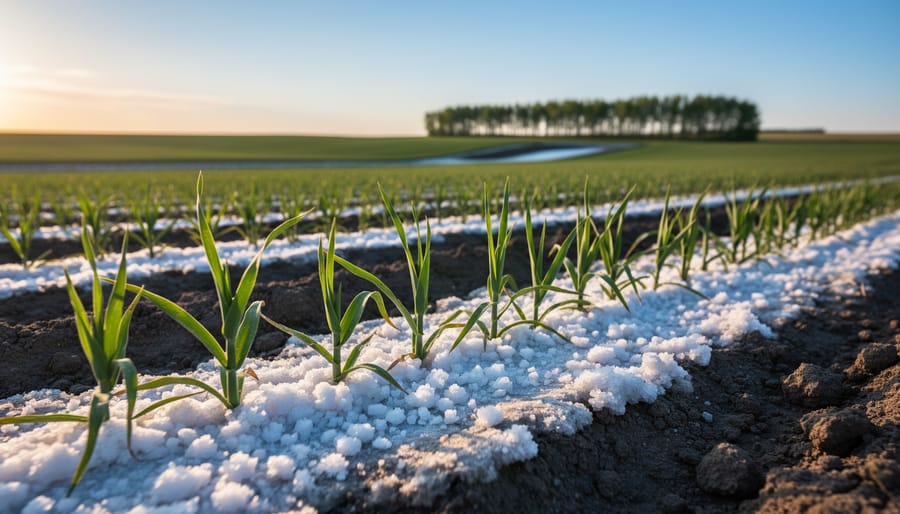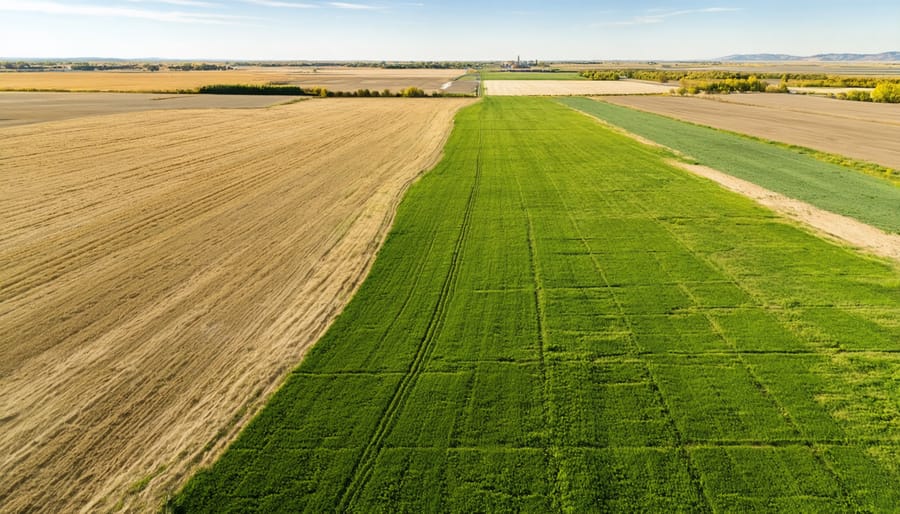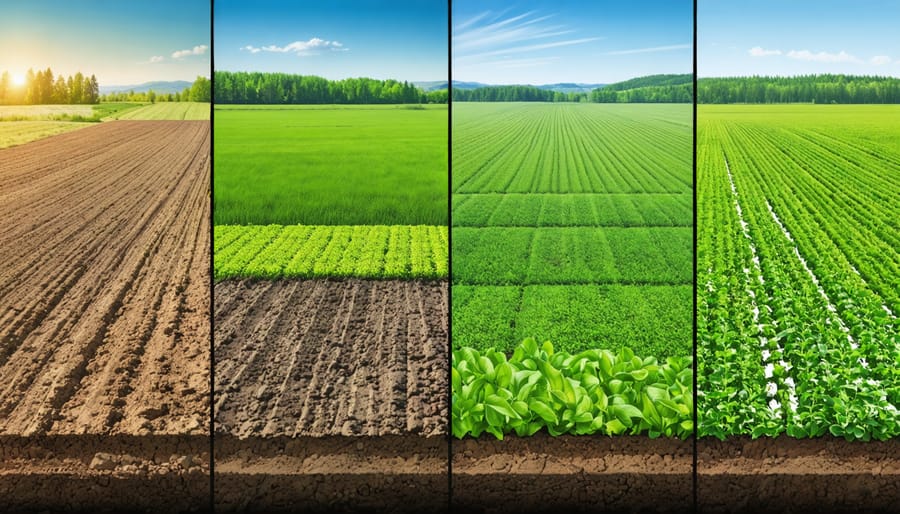
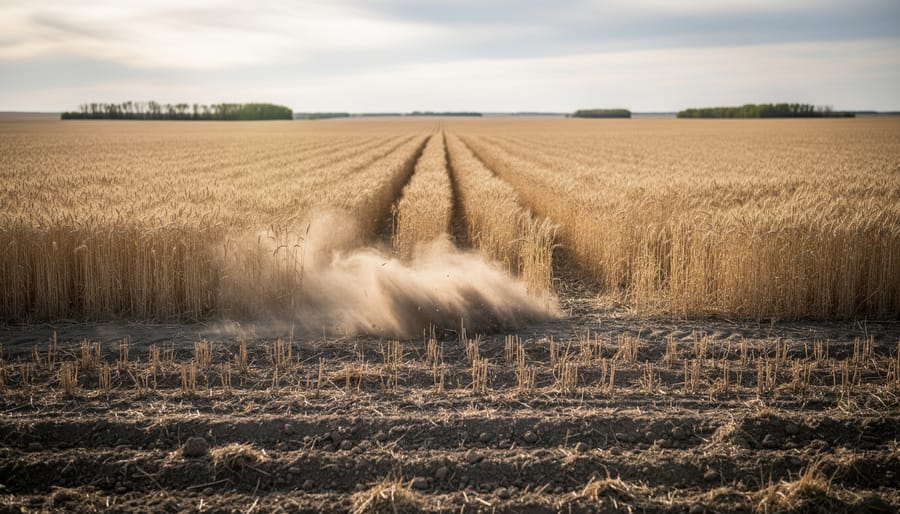
Wind erosion strips soil from fields through three distinct mechanisms: suspension, saltation, and surface creep (or sometimes called rolling). These aren’t just academic categories. They’re the three ways your topsoil literally leaves your farm, and each operates differently, affects different particle sizes, and demands its own approach to control.
Across Alberta’s prairies, wind erosion removed an estimated 1.8 million tonnes of soil from agricultural land in 2025 alone. That’s fertility, organic matter, and years of careful soil health processes disappearing into the wind. Understanding which type of erosion you’re facing makes the difference between effective intervention and wasted effort.
Suspension carries the finest particles, clay and silt under 0.1 millimetres, high into the atmosphere where they can travel hundreds of kilometres. You’ve seen it as dust plumes on dry spring days. Saltation moves medium sand particles in a characteristic hopping pattern, accounting for 50 to 75 percent of total soil movement in most erosion events. Surface creep pushes the largest particles, those too heavy to lift, along the ground in a slow roll.
Each type responds to different wind speeds, affects different soil fractions, and leaves behind distinct field signatures. Producers who can identify all three in their fields, and understand why they matter, are better equipped to protect their land. Here’s what you need to recognize and why the distinction matters for your operation.
Why These Three Types Matter: How We Classified Wind Erosion for Prairie Farmers
Understanding how wind erosion actually removes soil isn’t just academic, it’s the foundation for protecting your fields. Scientists classify wind erosion into three types based on particle size and how those particles move during wind events, a framework established through decades of Agriculture and Agri-Food Canada research on prairie soils. This classification system directly reflects what’s happening in your fields when the wind picks up: clay and silt particles (less than 0.1 mm) become airborne in suspension, medium-sized sand particles (0.1-0.5 mm) bounce along in saltation, and larger aggregates and sand grains (0.5-2.0 mm) roll across the surface in creep.
For Alberta farmers, this breakdown matters because each type causes different damage and responds to different management practices. Suspension steals your nutrient-rich soil the finest organic matter and clay fractions that hold fertility, and carries it off your land entirely. Saltation, the bouncing action of sand-sized particles, accounts for most of the soil movement you see during erosion events and physically damages emerging crops. Surface creep redistributes heavier materials within and around your fields, creating uneven surfaces and nutrient imbalances.
This particle-based classification gives you a diagnostic tool. When you see dust clouds, you’re witnessing suspension. When you notice sand accumulation along fence lines or crop damage that looks like sandblasting, that’s saltation at work. Recognizing these patterns on your specific soil type, whether you’re farming the lighter-textured soils of the Special Areas or the heavier loams of central Alberta, guides you toward the mitigation approaches that will actually work for your situation.
1. Suspension: When Your Topsoil Disappears Into the Sky
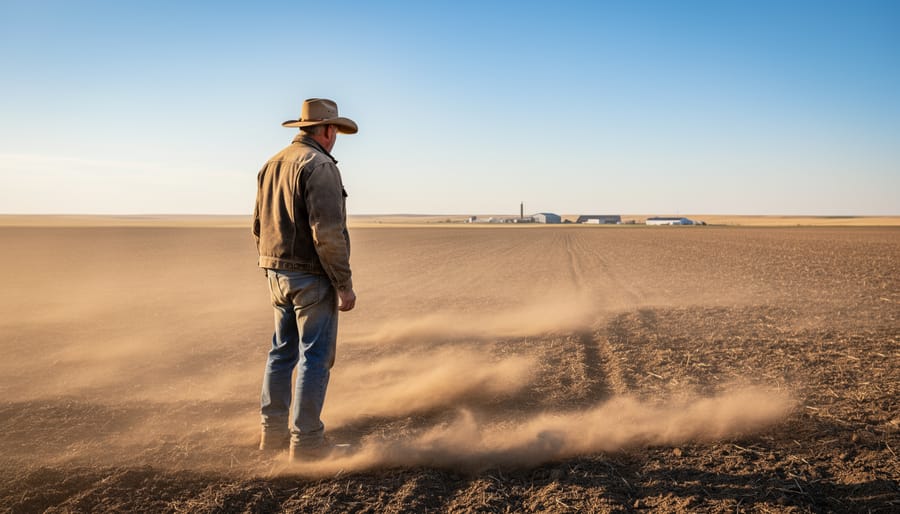
Alberta Case Study: 2024 Dust Storms in the Special Areas
In April 2024, a series of powerful dust storms swept across Alberta’s Special Areas, a region already familiar with erosion challenges due to light-textured soils and persistent westerly winds. Mark Henderson, a third-generation grain farmer near Hanna, watched helplessly as dark clouds of topsoil lifted from his 400-hectare wheat field and disappeared into the sky. “I could barely see the fence line 50 metres away,” he recalls. “You know it’s bad when the dust makes it into town and people are calling to ask if you’re okay.”
Soil sampling after the event revealed Henderson lost an estimated 12 tonnes of topsoil per hectare from his most exposed fields, primarily the fine clay and silt fractions that hold nutrients and water. With these particles accounting for roughly 40% of his soil’s cation exchange capacity, the economic hit extended beyond the visible damage. He calculated immediate crop yield losses at 15% for that season, plus long-term fertility decline requiring additional fertilizer inputs worth approximately $85 per hectare annually.
Henderson’s recovery strategy focused on what works: he terminated plans for spring tillage, planted a cover crop mix of fall rye and hairy vetch on the worst-affected acres, and invested in a strip-till system for future seasons. “I can’t control the wind,” he says, “but I can control whether my soil is sitting there waiting to blow away.” While saltation dominates wind erosion overall, Henderson’s experience illustrates suspension’s devastating capacity to strip away a farm’s most valuable asset in a matter of hours.
2. Saltation: The Bouncing Grains That Drive Most Prairie Erosion
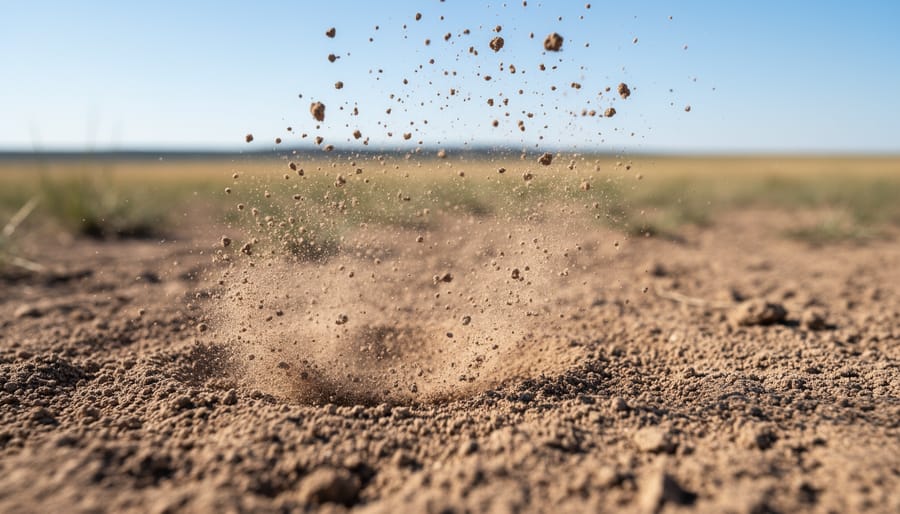
Expert Perspective: Soil Scientist on Saltation Dynamics
Dr. Sarah Chen has spent fifteen years studying wind erosion patterns across Alberta’s grain belt from her base at Lethbridge Research and Development Centre. When I asked her what farmers should watch for during windy conditions, she didn’t hesitate.
“The most telling sign is that distinctive hissing sound when wind moves across bare soil, that’s saltation in action,” she explains. “If you crouch down and look across a field at eye level on a windy day, you’ll see a brown haze moving about ankle to knee height. Those are your sand-sized particles bouncing along, and they’re doing more damage than most farmers realize.”
I pressed her on the moisture question that comes up constantly in producer meetings. Her answer surprised me with its precision.
“Soil moisture is your emergency brake. When the top two centimeters of soil hold above twelve percent moisture, saltation basically stops, the particles are too heavy to lift. But here’s the problem: on a sunny April day with fifteen-kilometer winds, that surface layer can dry from safe to vulnerable in three hours. I’ve measured it.” She pauses for emphasis. “That’s why you’ll see erosion starting mid-afternoon even when morning conditions looked fine. The soil isn’t just dry, it’s exactly the wrong texture at exactly the wrong depth.”
Chen’s advice? Check surface moisture before noon, not field average moisture. That top layer tells the whole story.
3. Surface Creep: The Slow-Moving Soil Redistribution You Might Miss
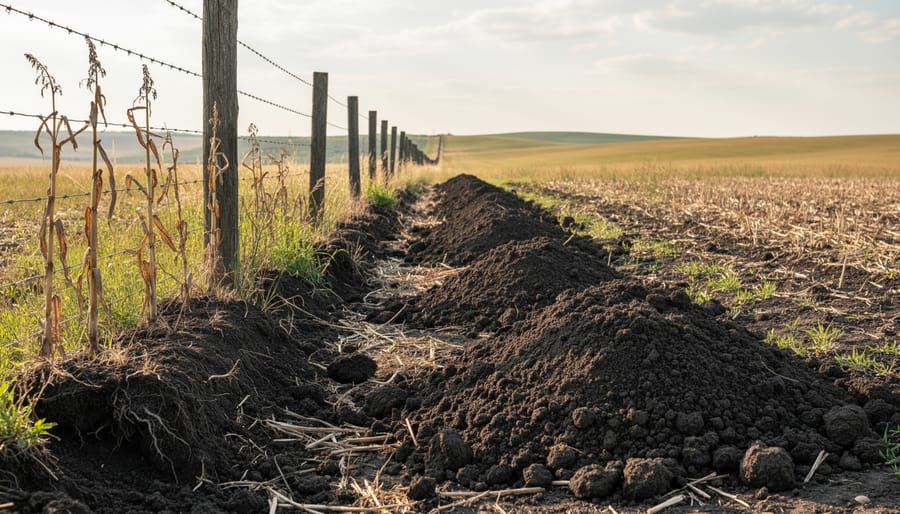
Surface creep operates below most farmers’ radar because it lacks the dramatic visual impact of dust clouds or the obvious damage of sandblasted seedlings. Yet this slow-motion redistribution of coarse sand and fine gravel particles accounts for 5 to 25 percent of total soil movement during wind events across Alberta’s prairies. Unlike suspension and saltation, surface creep involves particles too heavy to lift off the ground. These larger soil fragments, typically between 0.5 and 2.0 millimetres in diameter, roll, slide, and tumble along the surface, pushed forward by the bombardment of saltating grains hitting them from behind.
The mechanism works like a chain reaction. When medium-sized particles bounce along in saltation, they strike larger particles with enough force to nudge them forward. Each impact moves a coarse grain a few centimetres. Over the course of a windy afternoon, those incremental shifts add up to substantial soil redistribution within your fields. The process continues as long as wind speeds remain above threshold and saltation persists, making it a cumulative problem throughout Alberta’s dry, windy spring months.
Because surface creep moves material short distances rather than lifting it away entirely, its economic impact differs from suspension’s nutrient loss. Instead, you’re dealing with soil redistribution that creates management headaches. Watch for these telltale signs in your fields:
- Soil piled against fence posts and building foundations
- Exposed roots on knolls and high points where creep removed surface layers
- Burial of crop residue in low spots and field corners
- Uneven seed depth across fields, with some areas planted too shallow and others too deep
These field indicators reveal patterns you might have attributed to equipment issues or natural settling. The uneven surfaces complicate planting operations, forcing depth adjustments mid-field and creating variable emergence that persists through harvest. The nutrient redistribution matters too, those accumulated piles along edges contain organic matter and fertility that’s no longer where your crops need it.
How These Three Types Work Together to Damage Prairie Fields
When a strong spring wind sweeps across an exposed Alberta field, it rarely triggers just one erosion type. Instead, you witness a destructive cascade that unfolds in predictable stages, each mechanism amplifying the others.
The sequence typically starts with saltation. Once wind speeds exceed the threshold velocity for your soil type, often around 20 km/h for dry, fine-textured prairie soils, medium-sized sand particles begin their characteristic bouncing motion. These saltating grains become the engine that drives the other two processes.
As saltating particles leap and crash back to the surface, they strike smaller clay and silt particles with enough force to launch them skyward. This bombardment effect is what initiates suspension. Without saltation providing that initial energy, many fine particles would remain grounded despite strong winds. Simultaneously, the same saltating grains collide with larger aggregates and pebbles, pushing them into surface creep along the ground.
The result is a soil transport system working at three levels: fine nutrients disappearing into dust clouds above, sand grains sandblasting your crop residue at mid-height, and coarse material redistributing along the surface. A single wind event can move tonnes of soil through this combined action, with each type removing different particle sizes and therefore different nutrient fractions.
Over a season, repeated wind events don’t just remove soil, they fundamentally alter what remains. Your field loses its finest, most fertile components through suspension while accumulating coarse, less productive material in drift areas. This is why effective wind erosion shield strategies and comprehensive erosion solutions must interrupt this cascade at multiple points rather than targeting a single erosion type.
Connecting Erosion Types to Mitigation: Your Next Steps
Understanding how suspension, saltation, and surface creep interact on your land reveals which mitigation strategies will deliver the best results. Different approaches target different erosion mechanisms, and the most effective protection comes from matching your strategy to the dominant type affecting your fields.
Cover crops and residue management primarily combat suspension by keeping fine particles anchored to the soil surface. These practices increase surface roughness and organic matter, making it harder for wind to lift clay and silt into the air. Windbreaks reduce wind speed at ground level, which cuts down saltation across wide field zones, remember that saltation needs specific wind velocities to start the bouncing motion. Reduced tillage addresses all three types simultaneously by maintaining soil structure and leaving crop residue intact, but it’s particularly effective against saltation since it preserves the protective crust that prevents medium particles from moving.
Your first step is diagnosing which erosion pattern dominates on your operation. Walk your fields after wind events and look for the telltale signs: dust clouds signal suspension, sand-blasted crop damage points to saltation, and soil piled along fence lines indicates surface creep. Most Alberta farms face a combination, but one type usually leads.
Which erosion type is most common in Alberta?
Saltation accounts for the majority of soil movement on prairie farms, typically representing 50-75% of total erosion during wind events. It often triggers the other two types as well.
Can I stop one type without addressing the others?
Not effectively. The three types work together, saltation drives suspension and surface creep, so strategies need to tackle the system as a whole for lasting protection.
How do I know which type is affecting my fields?
Observe conditions after windstorms: airborne dust indicates suspension, sandblasted crops show saltation, and soil accumulation along edges reveals surface creep. Most fields show multiple types.
When is wind erosion risk highest on the prairies?
Early spring and late fall present peak risk when fields are bare, soil moisture is low, and winds are strong. Dry conditions in summer can also create vulnerability.
Once you’ve identified your erosion patterns, prioritize strategies that address your most severe type while building overall soil resilience. The comprehensive approaches outlined in wind erosion mitigation resources provide detailed implementation guidance tailored to Alberta’s prairie conditions, helping you move from diagnosis to action with confidence.
How We Chose This List
Our selection of these three wind erosion types reflects both scientific consensus and practical relevance for Alberta’s agricultural landscape. We prioritized the classification system most widely used by Agriculture and Agri-Food Canada and provincial soil conservation programs because it directly aligns with how farmers observe and diagnose erosion in their fields.
The primary criterion was distinct physical mechanisms. Each type represents a fundamentally different process of soil particle movement, determined by particle size and aerodynamic behavior. This distinction matters because each mechanism responds differently to mitigation strategies.
We also weighted observability and economic impact. These three types account for virtually all measurable soil loss during wind events, with clear visual indicators that farmers can recognize without specialized equipment. The classification needed to be actionable, not just academically precise.
Finally, we focused on Alberta-specific applicability. Our prairie soils, climate patterns, and farming systems make all three types significant threats during critical periods. We excluded theoretical classifications that rarely occur in our region or lack practical implications for management decisions.
Understanding suspension, saltation, and surface creep as distinct yet interconnected forces gives you the knowledge to protect your land with precision rather than guesswork. Each type removes soil differently, but they work together during wind events to strip away your most valuable asset. Recognizing the signs, dust clouds signaling suspension loss, sandblasted seedlings revealing saltation damage, sediment accumulating at field edges from surface creep, means you can diagnose problems early and choose mitigation strategies that address your specific erosion patterns.
Alberta’s farming community has weathered countless challenges, and soil protection is no different. You’re not starting from scratch. Proven techniques exist, research continues to refine best practices, and your neighbours are implementing solutions that work. Whether you’re managing a quarter section or several thousand acres, the resources to combat wind erosion are within reach in 2026.
Your topsoil didn’t disappear overnight, and rebuilding resilience won’t happen instantly either. But every windbreak planted, every acre of residue left standing, and every pass you skip with the cultivator protects the soil that sustains your operation. The knowledge you’ve gained here is the foundation. Now it’s time to put it to work.