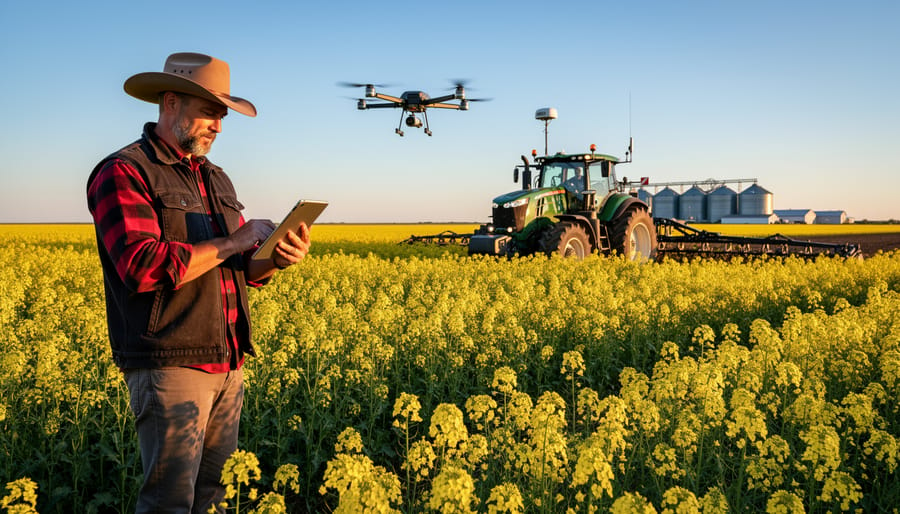
Electric tractors, utility vehicles, and implements are commercially available today through major manufacturers like John Deere, Kubota, and Monarch Tractor, with models specifically tested in Canadian Prairie conditions ranging from -30°C winters to demanding harvest seasons. Start by assessing your operation’s daily power requirements—most electric compact tractors deliver 25-60 horsepower with 4-8 hours of runtime, adequate for livestock operations, vegetable farms, and orchard work, though large-scale grain operations may need to phase implementation strategically.
Pair your electric equipment with on-farm solar installations sized to offset charging demands. A typical 40-horsepower electric tractor requires approximately 50-80 kWh daily, which a 15-20 kW solar array can supply during growing season while feeding excess power back to the grid. Alberta farmers report 3-7 year payback periods when combining federal Clean Technology Investment Tax Credits (30% of project costs) with provincial agriculture grants and avoided fuel expenses of $8,000-$15,000 annually per diesel tractor replaced.
Cold-weather performance remains the primary Canadian concern, yet recent field trials in Saskatchewan demonstrate lithium iron phosphate batteries maintaining 70-85% capacity at -25°C with proper thermal management systems. Ontario vegetable grower Tom Bruulsema reduced his operation’s fuel costs by 60% after transitioning three tractors to electric power paired with a 25 kW solar system, a practical example of renewable integration achieving both environmental and economic returns.
The transition requires systematic planning rather than wholesale replacement, beginning with equipment used in predictable daily patterns near charging infrastructure before expanding to field operations.
Why Electric Farm Machinery Makes Sense for Canadian Operations

The Real Cost Savings: Beyond Fuel
When comparing electric to diesel equipment, fuel savings tell only part of the story. The real financial advantage emerges when you examine the complete operating picture over time.
Electric motors have significantly fewer moving parts than diesel engines. There’s no oil to change, no filters to replace, and no diesel particulate filters to maintain. Sarah Thompson, who farms near Lethbridge, Alberta, notes that her electric utility vehicle requires servicing just once annually compared to multiple oil changes and filter replacements on her diesel equivalent. “I’m saving about $800 yearly just on routine maintenance,” she explains.
Parts longevity differs dramatically between the two systems. Regenerative braking on electric equipment reduces brake wear substantially. Electric drivetrains typically last 15-20 years with minimal intervention, while diesel engines often need significant rebuilds or replacement after 10,000 hours of operation.
Looking at Canadian pricing, a mid-sized electric tractor might cost $15,000-$25,000 more upfront than a comparable diesel model. However, the maintenance savings average $1,200-$2,000 annually. Combined with fuel cost reductions of approximately $3,000-$5,000 per year for a farm running 500 hours annually, you’re looking at a payback period of 4-7 years.
The calculation becomes even more favourable when you factor in current federal and provincial incentive programs. Alberta’s On-Farm Solar Photovoltaics Program and federal carbon tax exemptions for farm fuel can further improve your return on investment, particularly when pairing electric equipment with on-site renewable energy generation.
Performance in Prairie Conditions
Cold weather performance remains a primary concern for Alberta farmers considering electric equipment, and rightfully so. Modern lithium-ion batteries do lose efficiency in extreme temperatures, typically experiencing 20-30% reduced capacity when temperatures drop below -20°C. However, manufacturers have responded with sophisticated thermal management systems that pre-condition batteries and maintain optimal operating temperatures.
Jim Peterson, who operates a mixed grain farm near Red Deer, shares his experience: “I was skeptical about winter performance, but our electric utility tractor has exceeded expectations. The battery warming system activates automatically, and we keep it plugged in overnight during cold snaps. We’ve worked through -25°C days without significant issues.”
Most current electric farm machinery includes heated battery packs, insulated compartments, and smart charging systems that monitor temperature conditions. Some operators find advantages in winter use, including instant torque without waiting for diesel engines to warm up and elimination of gelling fuel concerns.
Practical strategies for prairie winters include indoor equipment storage when possible, maintaining charge levels above 20% to prevent deep-freeze damage, and scheduling energy-intensive tasks during warmer daylight hours. Several Alberta dealers now offer cold-climate packages specifically designed for Canadian conditions, demonstrating the industry’s commitment to making electric machinery viable across our diverse climate zones.
Electric Equipment Options Available Today
Tractors and Utility Vehicles
Electric tractors are making significant inroads on Canadian farms, with several models now proving their worth in real-world conditions. Understanding the specifications and applications of these machines helps you determine which options align with your operation’s needs.
Most electric tractors currently available range from 25 kW to 100 kW (roughly 34 to 134 horsepower equivalents). Compact models like the Solectrac e25 deliver 25 kW with a 28 kWh battery pack, ideal for small-scale operations, greenhouse work, and orchards. These units typically provide 4-6 hours of continuous operation on a single charge, depending on workload. For medium-sized farms, models in the 40-60 kW range offer versatility for tasks like hay raking, light tillage, and general transport duties.
Battery capacities vary considerably across models. Entry-level tractors feature 20-30 kWh batteries, while larger units incorporate 80-130 kWh systems. A practical rule of thumb: expect approximately 1-2 hours of operation per 10 kWh under moderate load conditions.
Alberta farmer James Chen, who operates a 160-hectare mixed farm near Lethbridge, adopted a 55 kW electric tractor in 2023. “We use it primarily for daily feeding operations and lighter fieldwork,” Chen explains. “The battery range handles our morning and afternoon routines comfortably, and we recharge during lunch using our solar array. Operating costs dropped by approximately 70 percent compared to our diesel equivalent.”
For operations under 100 hectares focusing on vegetable production, orchards, or specialty crops, current electric tractors provide excellent utility. Larger grain operations may find them suitable for yard work and secondary tasks while diesel equipment handles heavy field operations.
Smaller Equipment Making the Switch
While large tractors grab headlines, smaller electric equipment offers the quickest path to reducing on-farm emissions today. Electric ATVs and side-by-sides are already proving themselves on Canadian operations, with models from manufacturers like Polaris offering 80-kilometre ranges perfect for checking cattle, inspecting fields, or moving between buildings. These units charge overnight using standard 240-volt outlets, making them ideal candidates for solar integration.
Electric zero-turn mowers have become workhorses around farmyards, with commercial-grade options running 4-6 hours on a single charge. Saskatchewan farmer Dale Pettinger switched his acreage maintenance to electric mowers two years ago, noting the immediate benefit: “No more storing jerry cans or dealing with carburetor issues. I just plug in after each use.”
Battery-powered sprayers and spreaders for smaller applications are gaining traction too. Walk-behind and ATV-mounted electric sprayers eliminate fuel mixing concerns while providing consistent pressure control. The simplicity matters during busy seasons when equipment needs to work reliably without fuss.
These smaller conversions build your confidence with electric technology while generating immediate fuel savings. They’re also easier to justify financially, with payback periods often under five years when factoring in eliminated fuel and reduced maintenance costs.
What’s Still in Development
While smaller electric equipment is readily available today, heavy machinery like combines and large tractors remain in development stages. Major manufacturers including John Deere and Case IH are actively testing electric and hydrogen-powered prototypes, but most experts project commercial availability 5-10 years out. The challenge lies in battery capacity—a combine requires immense power during harvest, making current battery technology insufficient for full-day operation. Saskatchewan-based agricultural engineer Dr. Maria Chen notes, “We’re seeing promising advances in quick-charge systems and battery swapping technology, but the infrastructure needs to catch up.” Some manufacturers are exploring hybrid models as a bridge solution. For Alberta farmers planning long-term fleet transitions, experts recommend starting with smaller equipment now while monitoring heavy machinery developments. The technology is progressing steadily, but patience and realistic timelines are essential for those eager to electrify their entire operation.
Integrating Renewable Energy Systems on Your Farm

Solar Power: Alberta’s Untapped Resource
Alberta receives an average of 2,300 hours of sunshine annually, making it one of Canada’s best provinces for solar energy generation. For farmers considering electric machinery, solar panels can significantly reduce operating costs while providing clean, reliable power.
System sizing depends on your operation’s energy demands. A typical farm running electric utility vehicles and smaller equipment might start with a 10-15 kilowatt system, while larger operations incorporating electric tractors could require 50-100 kilowatts or more. Track your current diesel consumption and work hours to estimate your electricity needs—most solar installers offer free assessments to determine optimal system size.
Grid-tied systems remain the most practical choice for Alberta farms. They allow you to draw power when needed and sell excess energy back to the grid during peak production hours. This arrangement provides reliability without expensive battery storage. Off-grid systems suit remote operations but require substantial battery banks, increasing upfront costs by 40-60 percent.
Installation considerations include roof condition, ground-mounting options, and equipment placement. South-facing installations with minimal shading deliver best results. Winter snow typically slides off tilted panels, though occasional clearing maximizes production during shorter days.
Alberta offers several incentives making solar adoption more affordable. The federal government’s Canada Greener Homes Grant provides funding for renewable energy projects, while some rural municipalities offer property tax exemptions for solar installations. The solar power investment benefits extend beyond incentives—reduced electricity costs and potential carbon credit revenue create long-term financial advantages.
Working with solar installers experienced in agricultural applications ensures proper system design. They understand farming’s unique power demands and can optimize panel placement around existing buildings and operations.
Wind Energy Potential
Prairie farms, particularly across Alberta and Saskatchewan, possess excellent potential for small-scale wind generation to power electric farm machinery. The open, elevated terrain and consistent wind patterns create ideal conditions for turbines rated between 10 to 100 kilowatts, sufficient to charge equipment batteries and offset grid consumption.
Modern farm-scale wind turbines have become increasingly practical, with installation costs ranging from $40,000 to $250,000 depending on capacity. When properly sited on ridges, hilltops, or exposed areas away from shelterbelts, these systems can generate substantial energy throughout the year. Understanding wind energy for farms helps determine whether your property has adequate wind resources, typically requiring average speeds above 5 meters per second.
Integration with existing electrical infrastructure presents fewer challenges than many farmers expect. Most systems connect directly to your farm’s electrical panel through a properly sized inverter, allowing excess generation to flow back to the grid through net metering agreements available in most Canadian provinces. Battery storage systems can store wind-generated power for charging equipment during calm periods, creating a reliable energy supply for your electric machinery fleet. Consult with certified renewable energy installers to conduct proper wind assessments before investing.
Battery Storage and Smart Charging
Stationary battery systems are becoming practical energy storage solutions for farms with electric machinery. These systems store power generated from solar panels or wind turbines during off-peak hours when electricity rates are lowest, then provide that stored energy when equipment needs charging or during peak-rate periods.
Time-of-use charging strategies can significantly reduce operating costs. Most Canadian utilities offer lower rates overnight or during off-peak hours. By scheduling equipment charging during these windows, Alberta farmers report savings of 30-40% on electricity costs compared to peak-rate charging.
Modern electric tractors and implements increasingly feature bidirectional charging capability, allowing their batteries to serve dual purposes. During periods of high farm energy demand, these vehicle batteries can discharge power back to the farm’s electrical system, essentially functioning as mobile power banks. This vehicle-to-grid technology helps balance energy loads across your operation.
Farm energy management systems integrate these components, automatically optimizing when batteries charge and discharge based on electricity rates, weather forecasts affecting renewable generation, and scheduled equipment use. Alberta farmer Mark Jensen notes his battery system paid for itself within four years through strategic charging alone, before considering the renewable energy integration benefits.
Canadian Case Study: An Alberta Mixed Farm’s Electric Transition
When Dave and Margaret Thompson began transitioning their 800-hectare mixed grain and cattle operation near Lacombe, Alberta to electric machinery in 2019, they knew they were taking a calculated risk. Four growing seasons later, their experience offers valuable insights for farmers considering a similar path.
The Thompsons started small, replacing their diesel utility tractor with a 75-horsepower electric model and installing a 50-kilowatt solar array on their main barn. “We wanted to test the concept before committing major capital,” Dave explains. “The utility tractor handles daily feeding, light cultivation, and material handling—tasks that don’t require extended range.”
Their initial challenges centered on range anxiety and charging infrastructure. The electric tractor’s 4-hour runtime proved insufficient for larger field work during peak season. The solution came through strategic scheduling and adding a second 25-kilowatt solar installation with battery storage capacity of 100 kilowatt-hours. “We charge overnight and during midday breaks, which actually forced us to plan operations more efficiently,” Margaret notes.
The financial breakdown reveals both opportunities and realities. Total investment included $85,000 for the electric tractor, $95,000 for solar installations, and $45,000 for battery storage—totaling $225,000. However, federal and provincial incentive programs covered $67,500, reducing their actual outlay to $157,500. Annual diesel savings average $8,200, while reduced maintenance costs add another $3,100 yearly. They’re tracking toward full payback within 12 years, though rising fuel prices could accelerate this timeline.
By 2022, the Thompsons added an electric side-by-side for livestock checking and property monitoring. Their solar system now generates surplus power during summer months, which they sell back to the grid through Alberta’s micro-generation program, adding $1,800-2,400 annually in revenue.
Lessons learned include starting with equipment suited to predictable, shorter-duration tasks rather than high-demand field operations. “Don’t try to electrify your entire operation at once,” Dave advises. “Identify specific applications where electric makes sense, then build your infrastructure around those needs.”
Winter operations presented unexpected benefits. The electric equipment starts reliably at -30°C, eliminating block heater requirements and cold-start issues. Battery performance does decrease in extreme cold—roughly 20-25 percent capacity reduction—but cabin heating from grid power rather than engine waste heat proved manageable.
The Thompsons’ journey mirrors broader trends documented in carbon-free farming success stories across the province, demonstrating that thoughtful integration of electric machinery with renewable energy can work in Canadian conditions when approached strategically and scaled appropriately.

Expert Insights: Making the Switch Work
We spoke with agricultural professionals and farmers who’ve already made the transition to electric machinery to gather their best advice for those considering the switch.
“Start small and scale up,” recommends Maria Chen, agricultural engineer at Prairie Energy Solutions. “Don’t try to electrify your entire operation at once. Begin with one or two pieces of equipment that have predictable usage patterns – maybe a utility vehicle or small tractor – and learn from that experience before expanding.”
Tom Broadbent, who operates a 400-hectare mixed farm near Red Deer, emphasizes the importance of thorough planning. “We spent six months analyzing our actual power needs before investing,” he explains. “Track your diesel consumption, map out your daily routines, and really understand when and where you need power. That data is gold when you’re sizing your solar array or planning battery capacity.”
Renewable energy consultant Sarah Kimoto stresses the infrastructure timing. “If possible, get your renewable energy system installed and running before purchasing electric equipment. This lets you understand your baseline energy production and identify any gaps. Plus, you can use that power for existing farm operations while you’re evaluating equipment options.”
For Canadian farmers concerned about cold weather performance, James Patel from Manitoba Agricultural Equipment Testing offers reassurance with caveats. “Modern lithium batteries perform well in cold, but you need heated storage or insulated battery compartments. Some of our test farmers keep smaller equipment in heated sheds overnight, which adds maybe 30 minutes to morning routines but prevents significant range loss.”
Early adopter Susan LaRose from Lacombe shares troubleshooting wisdom: “Join online forums and connect with other electric equipment users. When I had charging issues last spring, another farmer in Saskatchewan helped me diagnose it within hours. The community knowledge is invaluable.”
The consensus among experts? Do your homework, start strategically, and don’t hesitate to reach out for support during the transition.
Financial Support and Incentive Programs
Making the switch to electric farm machinery becomes significantly more affordable when you tap into available financial support programs. Canadian farmers have access to multiple funding streams designed specifically to ease the transition to cleaner equipment and renewable energy systems.
The federal government’s On-Farm Climate Action Fund offers substantial support for emissions-reducing practices, including electric equipment purchases. Farmers can receive cost-share funding to help offset initial investments. The Canadian Agricultural Partnership also provides provincial-specific programs, with Alberta’s Agriculture Financial Services Corporation offering grants and low-interest loans for sustainable equipment upgrades.
For renewable energy installation, the Agricultural Clean Technology Program stands out as a major resource. This program provides up to 25 percent reimbursement on eligible expenses, which can include solar panel installations, battery storage systems, and the electric machinery itself. Some farmers in southern Alberta have secured funding exceeding $50,000 for comprehensive solar-powered equipment transitions.
Provincial programs vary, but Alberta offers additional incentives through Emissions Reduction Alberta for projects that demonstrate measurable environmental benefits. These programs particularly favor farms implementing integrated systems that combine renewable energy generation with electric equipment use.
To maximize your funding potential, start by documenting your current energy use and creating a clear transition plan. Most programs require detailed project proposals showing expected emissions reductions and cost savings. Connect with your local agricultural fieldman or extension office, as they often help streamline applications and identify program combinations.
Sarah Chen, a financial advisor specializing in agricultural transitions, recommends applying to multiple programs simultaneously: “Many farmers don’t realize you can stack certain incentives. One client combined federal and provincial funding to cover nearly 40 percent of their electric tractor and solar array costs.”
Application timelines typically run 8-12 weeks, so plan ahead when budgeting for equipment purchases during optimal buying seasons.

Getting Started: A Practical Roadmap
Making the switch to electric farm machinery doesn’t have to be overwhelming. Here’s a practical roadmap to guide your transition, starting with small, manageable steps that build toward a more sustainable operation.
Begin with an energy audit of your farm. Document your current fuel consumption, equipment usage patterns, and electricity availability. This baseline helps you identify which machinery runs most frequently and where electrification offers the greatest return. Many Alberta farmers discover their smaller utility vehicles and daily-use equipment are ideal starting points. You can conduct a basic audit yourself by tracking fuel receipts and operating hours over a growing season, or hire a certified energy consultant for a more comprehensive assessment.
Next, prioritize your equipment selection. Consider starting with electric UTVs, small tractors, or specialized tools like sprayers and mowers. These typically require less infrastructure investment than larger equipment and let you build confidence with the technology. Look for models with proven performance in Canadian winters, ensuring they include cold-weather battery management systems and adequate range for your field sizes.
Infrastructure planning comes third. Assess your electrical service capacity and determine if upgrades are needed. Most farms can start with standard 240-volt charging for smaller equipment, similar to what powers a grain dryer. For larger machinery, you might need three-phase power installation. Connect with your local utility provider early, as service upgrades can take several months to complete.
Alberta farmers can access support through several channels. The Alberta Agriculture and Irrigation ministry offers transition planning resources, while organizations like the Agricultural Research and Extension Council of Alberta connect farmers with technical experts. Local equipment dealers increasingly stock electric options and provide demonstration opportunities. Don’t hesitate to visit neighboring farms that have already made the transition – the farming community thrives on shared knowledge.
Consider a phased implementation strategy. Start with one or two pieces of equipment, evaluate their performance through a full season, then expand gradually. This approach spreads costs over time, allows your team to develop expertise, and minimizes operational risk. Many successful transitions happen over three to five years, proving that patience and planning lead to lasting results.
Transitioning to electric farm machinery isn’t an all-or-nothing decision. You don’t need to replace your entire fleet overnight or commit to a complete farm overhaul. The beauty of this shift is that you can start small, test what works for your operation, and expand as you gain confidence and see results.
Consider beginning with a single piece of equipment that matches your immediate needs. Many Alberta farmers have found success starting with electric UTVs for daily tasks or battery-powered hand tools. These smaller investments let you experience the benefits firsthand while learning how electric equipment fits into your workflow and how to manage charging alongside renewable energy systems.
As demonstrated by the farmers we’ve featured throughout this article, electric machinery is proving itself viable in Canadian conditions. From Saskatchewan grain operations to Alberta livestock farms, producers are finding practical solutions that reduce costs, lower emissions, and maintain productivity even through our challenging winters.
If you’re ready to explore this option, start by connecting with your provincial agriculture department. Alberta Agriculture and Forestry regularly hosts workshops on sustainable farming technologies. The Canadian Agricultural Partnership also provides information sessions specifically focused on clean technology adoption. Join local farming groups and cooperatives where members share real-world experiences with electric equipment.
Reach out to equipment dealers who can arrange demonstrations on your land, in your conditions. Talk to your accountant about available tax incentives and depreciation schedules. Most importantly, connect with farmers who’ve already made the switch. Their practical insights will prove invaluable as you chart your own path forward.
The transition to electric farm machinery represents an opportunity, not a mandate. Take it at your own pace, make decisions based on your operation’s unique needs, and you’ll find this technology can work for you.