Select crop varieties proven to thrive in water-scarce conditions: forage kochia reduces irrigation needs by 40% compared to traditional alfalfa, while AC Ranger crested wheatgrass establishes deep root systems reaching 2-3 meters to access subsoil moisture. Winter wheat varieties like AAC Brandon require 30% less water than spring wheat while delivering comparable yields across Alberta’s chinook-affected regions.
Implement deficit irrigation strategies during non-critical growth stages. Apply 70% of full water requirements during vegetative phases, reserving full irrigation for flowering and grain fill periods. This approach maintains 85-90% of potential yields while cutting water use by 25%, as demonstrated by irrigation districts in southern Alberta where producers saved 15,000 cubic meters per quarter section last season.
Establish windbreaks and shelter belts using drought-hardy species like caragana and Rocky Mountain juniper. These barriers reduce evapotranspiration rates by 20-35% in adjacent fields while stabilizing soil moisture levels. Lethbridge Research Centre data shows fields protected by mature windbreaks maintain 8-12% higher soil moisture during July and August dry periods.
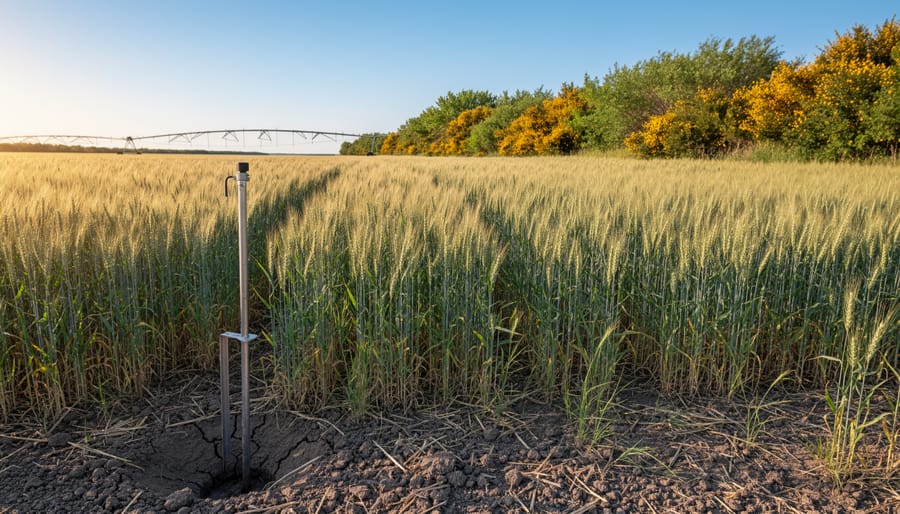
Monitor soil moisture at multiple depths using affordable tensiometers or capacitance probes placed at 15, 30, and 60-centimeter intervals. This precision allows you to irrigate only when root zone moisture drops below 50% of field capacity, eliminating guesswork and preventing both water waste and crop stress. Alberta farmers using soil sensors report average water savings of 18% without yield penalties.
Why Alberta Farmers Need Drought-Resistant Crops Now More Than Ever
The Real Cost of Traditional Crop Varieties in Dry Conditions
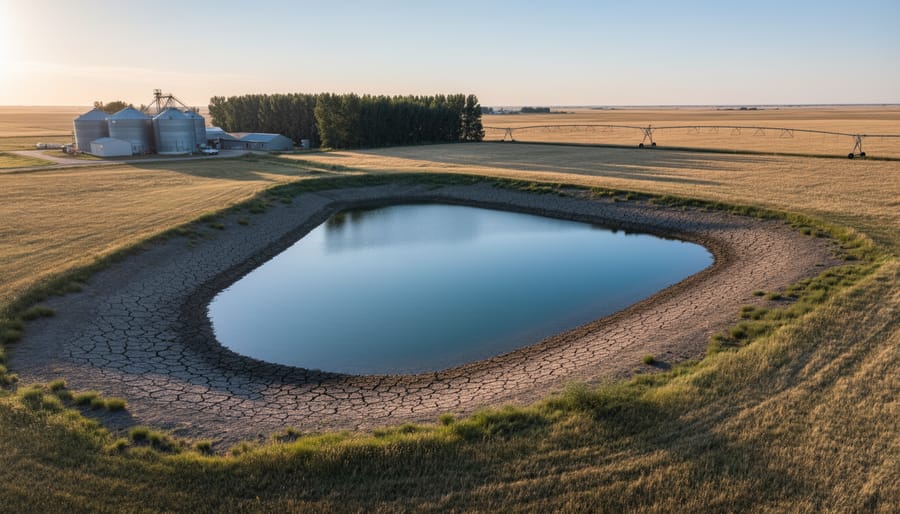
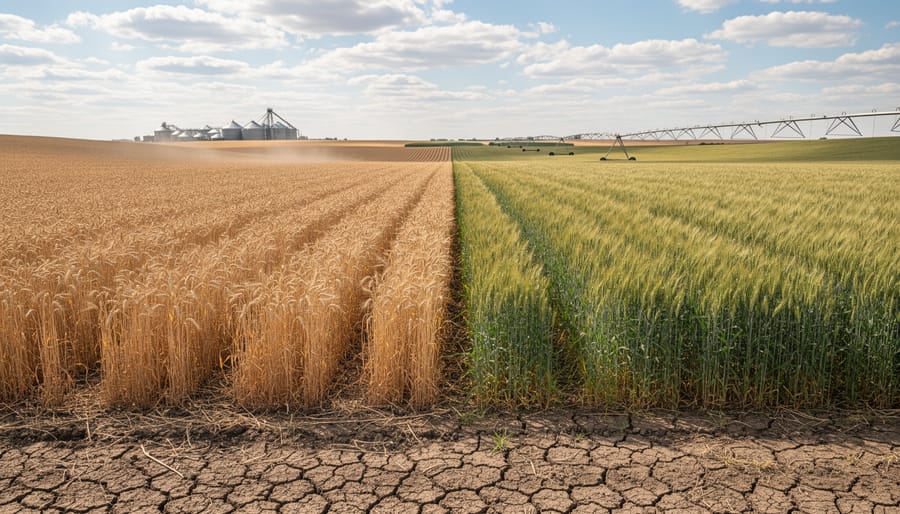
During drought periods, traditional crop varieties can significantly impact your bottom line. Alberta farmers experienced this firsthand during the 2021 growing season when some regions received only 60% of normal precipitation. Conventional wheat varieties saw yield reductions of 30-40%, while canola crops in southern Alberta faced even steeper declines, with some fields producing less than half their typical output.
The financial strain extends beyond reduced yields. Increased irrigation costs add up quickly—farmers using pivot systems reported spending an additional $75-100 per acre in water and energy expenses during extended dry spells. Those without irrigation infrastructure faced complete crop failures in the most affected areas, losing entire investments in seed, fertilizer, and labor.
Traditional barley varieties struggled particularly in the Palliser Triangle region, where moisture deficits became critical by mid-July. Farmers watched their crops wither despite best management practices, highlighting the vulnerability of conventional genetics when nature doesn’t cooperate. These losses ripple through rural communities, affecting equipment purchases, employment, and local economies. The unpredictability of relying on traditional varieties in increasingly variable conditions makes planning nearly impossible, leaving many producers searching for more resilient alternatives.
What Makes a Crop Truly Drought-Resistant
Understanding what makes a crop drought-resistant comes down to four key biological adaptations that work together to help plants survive with less water.
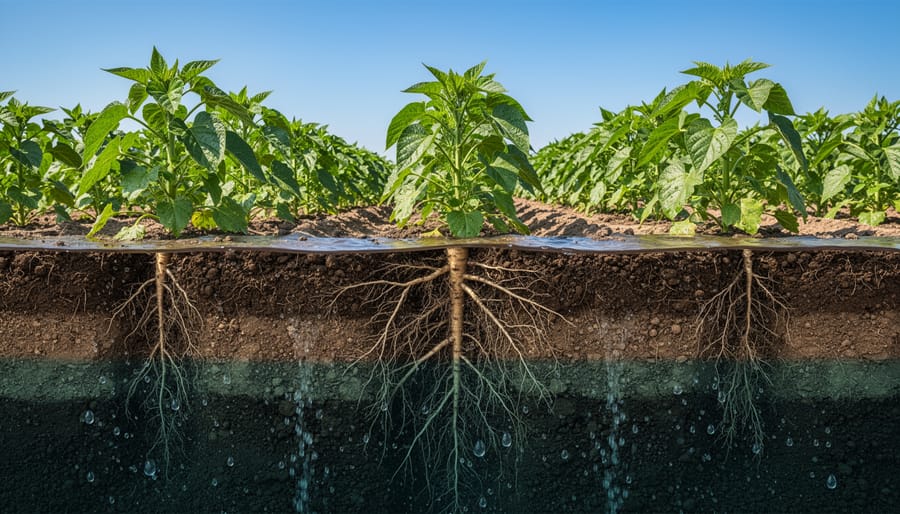
First, deep root systems are game-changers. While conventional wheat might reach down 1.2 metres, drought-resistant varieties can extend roots 1.8 to 2.4 metres deep, accessing moisture reserves that shallow-rooted crops miss entirely. Think of it as having a deeper well on your property – when surface water dries up, you’re still drawing from reserves below.
Second, these crops have evolved mechanisms to reduce water transpiration. They might have smaller leaves, waxy coatings, or the ability to close their stomata (tiny pores on leaves) during the hottest part of the day. This means they’re losing less precious moisture to the atmosphere while still photosynthesizing efficiently.
Third, efficient water uptake sets these varieties apart. Their root hairs and cellular structures are optimized to absorb and transport water quickly when it’s available, making the most of every rainfall or irrigation event.
Finally, stress tolerance mechanisms kick in during dry periods. These plants produce protective proteins and compounds that prevent cellular damage when water is scarce, essentially putting themselves into a survival mode until conditions improve.
For Alberta farmers, these traits translate directly to reduced irrigation costs, more consistent yields during dry years, and less anxiety when watching weather forecasts. A Saskatchewan study showed drought-resistant wheat varieties maintained 75 percent of normal yields during severe drought, while conventional varieties dropped to 40 percent – that’s the difference between breaking even and significant losses.
Proven Drought-Resistant Crop Variants for Alberta Conditions
Cereal Grains That Beat the Heat
When rainfall becomes unpredictable, choosing the right cereal grain varieties can make the difference between a successful harvest and a disappointing one. Alberta farmers have several proven options that deliver consistent performance even when moisture is limited.
For wheat growers, AAC Brandon stands out as a reliable choice. This Canada Western Red Spring variety requires approximately 380-450mm of water throughout the growing season and consistently yields between 3,200-4,000 kg per hectare under moderate drought conditions. You’ll find seed availability through SeCan and most Alberta seed retailers. Another strong performer is AAC Viewfield, which shows excellent drought tolerance during critical growth stages and maintains protein levels even when water-stressed.
In the barley category, CDC Austenson has earned its reputation among Alberta producers. This two-row malt variety needs roughly 350-400mm of seasonal moisture and produces yields of 3,500-4,500 kg per hectare. Its extensive root system helps access deeper soil moisture that other varieties might miss. For feed barley, consider CDC Copeland, which demonstrates remarkable resilience in dry years while maintaining quality standards.
Oat producers should look closely at CDC Haymaker, a hulless variety requiring 380-430mm of water that’s particularly well-suited to the Chinook belt. Recent trials near Lethbridge showed it maintaining yields of 2,800-3,400 kg per hectare during below-average precipitation years.
According to Dr. Maria Santos from the University of Alberta’s Field Crop Development Centre, “These varieties aren’t just drought-tolerant by chance. They’ve been specifically bred to maximize water use efficiency while maintaining the yield and quality standards Alberta farmers need.”
Most seed is available through local co-ops, AgriTrend, or directly from breeding companies like SeCan and CANTERRA SEEDS. Early ordering ensures you’ll have access to certified seed for spring planting.
Pulse Crops Built for Dry Seasons
Pulse crops deserve serious consideration if you’re looking to stretch your water resources further. Lentils, field peas, and chickpeas have proven themselves across the Prairie provinces, requiring roughly 30-40% less water than wheat during the growing season. These hardy crops thrive in Alberta’s variable climate, often succeeding where water availability becomes unpredictable.
The real advantage goes beyond water savings. Pulse crops fix atmospheric nitrogen through their root systems, reducing your fertilizer costs for subsequent crops by approximately 40-80 kilograms per hectare. This nitrogen contribution becomes particularly valuable when planning crop rotations, as the following cereal crop benefits directly from this natural soil enrichment.
Field trials near Lethbridge have demonstrated that chickpeas can produce viable yields with as little as 300 millimetres of growing season moisture, while lentils perform well with 350-400 millimetres. Compare this to canola, which typically requires 450-500 millimetres for optimal production.
Dr. Jennifer Clarke from Agriculture and Agri-Food Canada notes that pulse crops develop extensive root systems early in their growth cycle, allowing them to access deeper soil moisture reserves. “They’re remarkably efficient at converting available moisture into marketable yield,” she explains.
Consider starting with small acreages of CDC Maxim lentils or Carrera chickpeas, both varieties developed specifically for Prairie conditions. These crops integrate well into existing rotations and provide market diversification while building soil health. The initial learning curve pays dividends through reduced input costs and improved drought resilience across your entire operation.
Forage and Cover Crops That Survive on Less
When you’re managing livestock during extended dry periods, selecting the right forage and cover crops can mean the difference between maintaining your herd and making difficult choices. Several proven options have helped Alberta producers keep their operations running through challenging seasons.
For permanent pasture, crested wheatgrass remains a reliable standby. This perennial establishes deep roots reaching over 2 meters, accessing moisture other grasses can’t reach. Russian wildrye offers similar drought tolerance with better palatability for cattle. Many ranchers near Lethbridge have successfully mixed these two varieties to extend their grazing season while reducing supplemental feed costs.
When it comes to hay production, sainfoin deserves attention as an alfalfa alternative. While alfalfa demands consistent moisture, sainfoin thrives on 30 percent less water and provides comparable protein levels. One producer near Medicine Hat shared that switching 40 hectares to sainfoin reduced irrigation requirements without compromising winter feed quality.
For cover cropping, consider mixing drought-hardy species that work together. A blend of hairy vetch, spring triticale, and forage radish creates ground cover that shades soil, reduces evaporation, and improves water infiltration. The radish taproots break up compacted layers, allowing moisture to penetrate deeper into the soil profile. These mixes also add valuable organic matter when terminated, further improving your soil’s water-holding capacity for subsequent crops. Testing small acreages first helps you determine what works best for your specific conditions before committing larger areas.
Emerging Alternative Crops Worth Considering
Beyond traditional staples, several alternative crops are proving their worth across Alberta’s variable climate. Camelina, a cool-season oilseed, has emerged as a standout performer with its deep taproot system that accesses moisture unavailable to shallow-rooted crops. Southern Alberta producer James Kosterski reported yields of 1,120 kilograms per hectare even during the 2021 drought, when canola struggled in adjacent fields.
Proso millet deserves attention for its remarkable 60-day growing season and ability to thrive on as little as 250 millimeters of rainfall. This ancient grain requires minimal inputs and fits well into diverse crop rotations. “We’ve seen proso millet complete its lifecycle using stored soil moisture alone,” explains Dr. Sarah Chen, agronomist at Lethbridge Research Centre.
Specialty pulses like lentils and chickpeas continue gaining market traction while offering nitrogen-fixing benefits. These crops typically require 30 percent less water than wheat and provide protein-rich harvests that command premium prices. Quinoa trials near Brooks have shown promising adaptation to alkaline soils, opening new opportunities for producers seeking diversification. Consider these alternatives as insurance against increasingly unpredictable precipitation patterns while tapping into growing specialty markets.
Water Conservation Strategies That Amplify Your Crop Choices
Soil Health Practices That Hold More Water
Healthy soil acts like a sponge, holding precious water for your crops during dry spells. Several proven practices can significantly boost your soil’s water retention capacity, making drought conditions more manageable.
No-till farming stands out as one of the most effective methods for improving soil moisture retention. By leaving crop residue on the surface and eliminating tillage, you can increase water infiltration by 30-40% compared to conventional tillage. Alberta farmers practicing no-till have reported soil moisture levels remaining 15-20% higher during summer months.
Adding organic matter through compost or manure applications dramatically improves water-holding capacity. For every 1% increase in soil organic matter, your soil can hold an additional 75,000 to 100,000 litres of water per hectare in the top 30 centimetres. Aim for annual applications of 10-20 tonnes per hectare to see meaningful improvements within 3-5 years.
Cover cropping between cash crops prevents moisture loss through evaporation while building soil structure. Winter rye, fall-seeded radish, and clover mixes protect bare soil and can reduce water runoff by up to 50%. These practices complement comprehensive soil and water conservation strategies.
Mulching with straw or wood chips creates a protective barrier that reduces evaporation by 25-30%. Apply a 7-10 centimetre layer around high-value crops or in garden settings for best results.
Smart Irrigation Techniques for Maximum Efficiency
Water delivery systems can make or break your drought-resistant crop success. Even the hardiest varieties need consistent moisture during establishment, and that’s where smart irrigation techniques become essential.
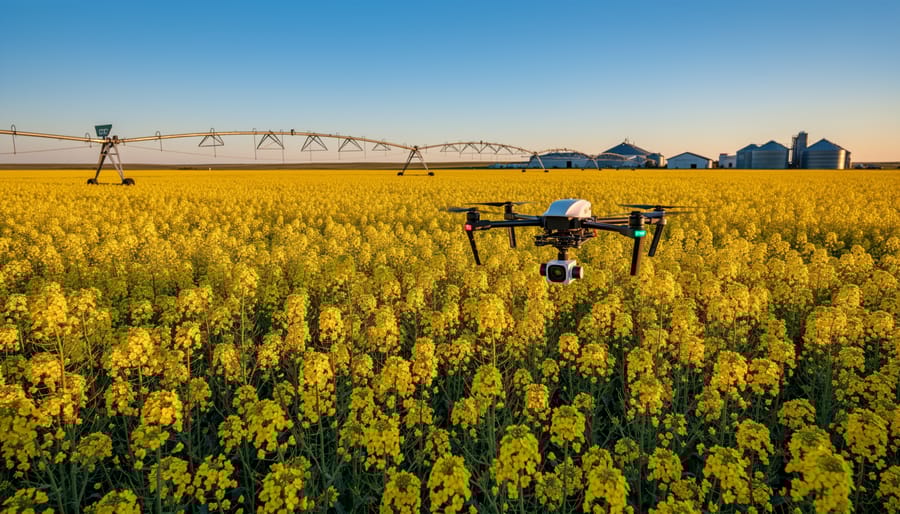
Drip irrigation stands out as the gold standard for water efficiency, delivering moisture directly to plant roots while minimizing evaporation losses by up to 50% compared to overhead systems. Alberta farmer Tom Richardson from Lethbridge reduced his water usage by 40% after switching to drip lines for his drought-tolerant pulse crops. The initial investment pays dividends through lower water bills and healthier plants.
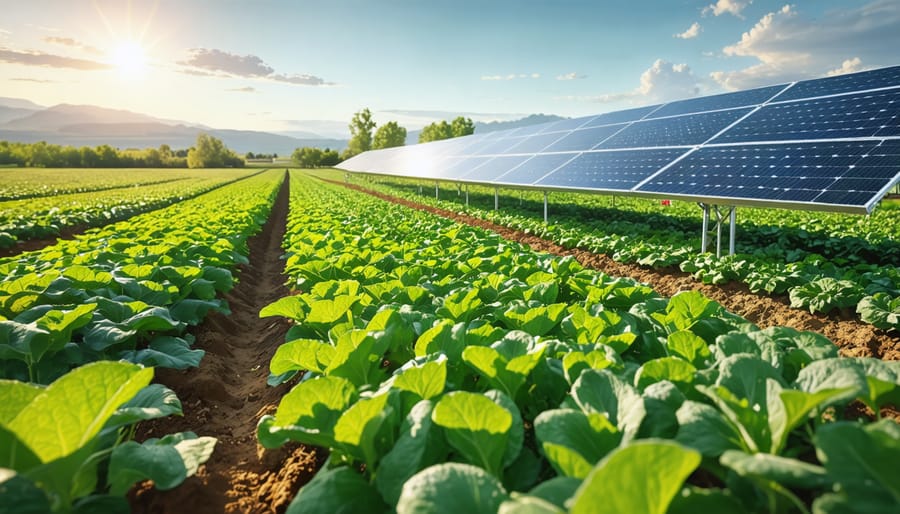
Soil moisture sensors take the guesswork out of irrigation scheduling. These affordable tools, ranging from simple tensiometers at $50 to wireless monitoring systems around $500, tell you exactly when your crops need water. Place sensors at different depths to track moisture availability throughout the root zone.
For operations of any size, irrigation scheduling apps like Alberta Agriculture’s free Growing Season Precipitation Tool help you plan watering based on weather forecasts, soil type, and crop needs. This prevents overwatering during unexpected rainfall and ensures adequate moisture during dry spells.
Start small if budget is a concern. Even converting a single field section to precision irrigation demonstrates water savings and crop performance improvements that justify expanding the system. Many Alberta producers report the investment pays for itself within three growing seasons through reduced water costs and improved yields.
Field Layout and Design for Water Conservation
Smart field design can reduce water needs by 20-30% while protecting drought-resistant crops from environmental stress. Start with contour farming—planting along natural land elevation curves rather than in straight rows. This technique slows water runoff during heavy rains, giving soil more time to absorb moisture. Alberta farmers working rolling terrain have reported significant improvements in soil moisture retention after switching to contour methods.
Windbreaks serve double duty in water conservation. Plant shelterbelts of hardy trees or shrubs perpendicular to prevailing winds, typically from the west and northwest in Alberta. These barriers reduce wind speed across fields by up to 50%, dramatically cutting evaporation rates and protecting plant leaves from desiccation. Position windbreaks 100-150 metres apart for optimal coverage.
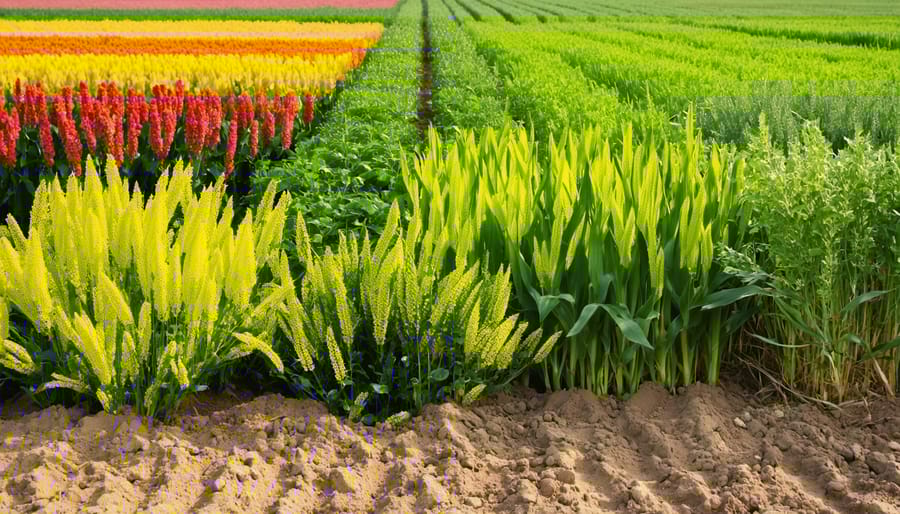
Strategic crop placement makes a measurable difference. Position your most water-demanding varieties in naturally low-lying areas where moisture collects, reserving higher, drier ground for truly drought-resistant species like millet or certain pulse crops. Group plants with similar water requirements together to avoid overwatering drought-tolerant varieties or underwatering thirstier ones. This zoning approach lets you customize irrigation schedules by field section, maximizing efficiency across your entire operation.
How Alberta Farmers Are Making the Switch: Real Success Stories
The transition to drought-resistant crops isn’t just theory in Alberta—it’s happening right now on farms across the province, with producers seeing real results that are changing how they approach water management.
Take the Hendersons from Lethbridge County, who made the switch to drought-tolerant crops three seasons ago. “We were watching our wheat struggle year after year,” explains Tom Henderson, a third-generation farmer managing 800 hectares. “The irrigation costs were eating into our margins, and we knew something had to change.” The family introduced drought-resistant varieties including AC Strongfield durum wheat and CDC Kinley field peas. The result? A 40 percent reduction in water usage and surprisingly consistent yields, even during the 2023 drought that hit southern Alberta hard.
Sarah Mitchell from Vulcan County faced different challenges when she converted 200 hectares to drought-resistant crops. “The biggest hurdle was information,” she says. “I needed to know which varieties would actually work here, not just what looked good on paper.” Working with local agricultural extension services, Sarah planted CDC Sorrel lentils and Canola hybrids bred for water efficiency. Her first-year results showed 15 percent higher yields compared to her conventional crops on the same soil type, with 35 percent less irrigation required. “The economic benefit was clear by harvest time,” she notes. “Lower water bills and better yields meant an extra $75 per hectare in profit.”
The Kowalski family operation near Taber represents another success story. After experiencing consecutive dry years, they dedicated 300 hectares to triticale and forage sorghum for their cattle operation. “We cut our irrigation water use by nearly half,” says Mark Kowalski. “But what really impressed us was how these crops handled heat stress. While neighbours were watching their traditional forages wither, ours stayed productive.” Their cattle maintained body condition through summer grazing, eliminating the need for supplemental feeding they’d relied on in previous drought years.
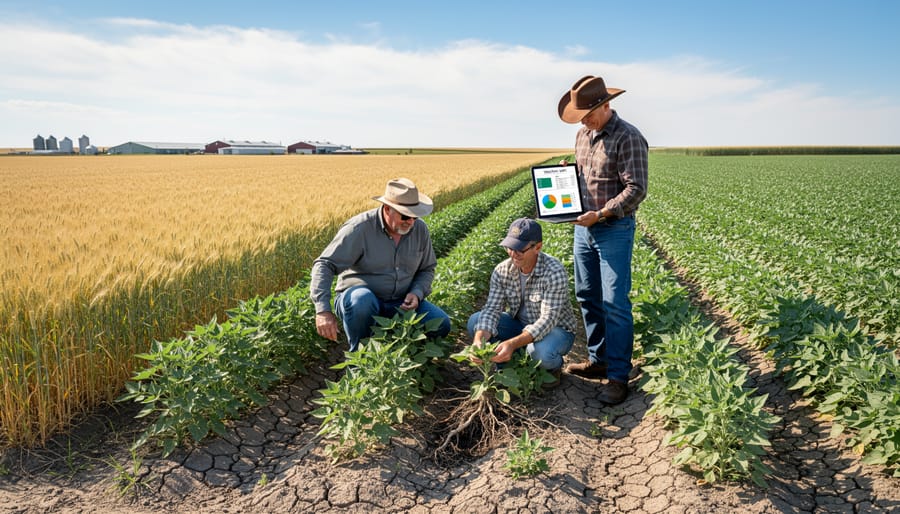
These farmers all emphasize the importance of starting small and scaling up. Henderson suggests converting 10 to 20 percent of your acreage initially to test performance under your specific conditions. Mitchell recommends connecting with other producers who’ve made the switch—local farming networks provided her with invaluable practical advice that research papers couldn’t offer.
The financial picture speaks clearly: reduced input costs, more predictable yields, and improved resilience against increasingly common dry spells make drought-resistant crops a practical choice for Alberta’s agricultural future.

Your Action Plan: Transitioning to Drought-Resistant Varieties
Starting Small: The Trial Plot Approach
Before committing your entire operation to drought-resistant varieties, consider implementing a trial plot approach. This practical strategy allows you to evaluate performance under your specific soil conditions, microclimate, and management practices without significant financial risk.
Start by designating 2-4 hectares of representative land—choose an area that reflects your typical field conditions rather than your best or worst soil. Select 3-5 drought-resistant varieties that interest you, ensuring you maintain proper spacing between test plots for accurate assessment.
During your trial season, track specific metrics including germination rates, days to maturity, water input requirements (measured in millimetres), and yield per hectare. Document weekly observations about plant vigor, pest resistance, and stress responses during dry periods. Compare these results directly against your conventional crops planted in adjacent control plots.
“We tested two teff varieties and one millet strain on just 3 hectares before our full transition,” shares Tom Bergen, an Alberta farmer who successfully adopted drought-resistant crops. “That small investment gave us confidence and practical knowledge about seeding rates and equipment adjustments we needed.”
Calculate your cost-benefit analysis by comparing input costs, labour requirements, and market value of harvested crops. This data-driven approach ensures your larger-scale decisions are grounded in your farm’s reality, not just theoretical possibilities.
Resources and Support Available in Alberta
Making the transition to drought-resistant crops doesn’t mean going it alone. Alberta farmers have access to substantial support networks and resources to guide their journey toward water-efficient agriculture.
Alberta Agriculture and Irrigation is your primary provincial resource, offering technical expertise, research data, and funding programs specifically designed for sustainable farming transitions. Their regional offices throughout the province provide personalized consultations at no cost. Contact them at 310-FARM (3276) for immediate assistance or visit their website for detailed program information.
The Agriculture Financial Services Corporation (AFSC) administers several grant programs that can offset initial costs of transitioning to drought-resistant varieties. Their Farm Water Supply Program has helped hundreds of Alberta producers implement water conservation strategies, with funding covering up to 50 percent of eligible expenses.
For seed sourcing, SeCan Association members across Alberta stock certified drought-resistant varieties tested specifically for prairie conditions. Brett Young Seeds in Lethbridge maintains an extensive catalog of water-efficient forages and grains, with agronomists available for variety selection guidance.
The University of Alberta’s Field Crop Development Centre in Lacombe conducts ongoing trials of drought-resistant varieties. They publish annual variety performance reports and welcome farm visits to discuss research findings directly with producers.
Local consulting firms like Prairie Agricultural Solutions and Agri-Trend Agrology specialize in helping farmers develop customized drought management plans. Many offer initial assessments at reduced rates for first-time clients, making expert guidance accessible regardless of operation size.
The shift toward drought-resistant vegetation isn’t just about surviving the next dry season—it’s about positioning your operation for long-term resilience in an evolving climate. Alberta farmers who adopt these strategies now are already seeing the benefits: reduced water costs, more predictable yields, and greater flexibility when weather patterns become unpredictable. The data is clear: drought-resistant crops can maintain yields with 30-40% less water than conventional varieties, and early adopters are building knowledge and experience that will prove invaluable as climate pressures intensify.
This transition doesn’t require an overnight transformation of your entire operation. Start small with a test plot, connect with your local agricultural extension office, or reach out to neighbours who’ve already made the switch. The Alberta farming community has a strong tradition of supporting one another through shared knowledge and practical advice. Whether you’re considering pulse crops like lentils and chickpeas, exploring drought-tolerant wheat varieties, or experimenting with cover cropping techniques, the resources and expertise you need are within reach.
The question isn’t whether drought conditions will continue to challenge Prairie agriculture—it’s whether you’ll be ready when they do. Take that first step today. Connect with your regional agronomist, attend a local field day, or join an online farming community focused on water conservation. Your future self, and your land, will thank you for the proactive choices you make now.