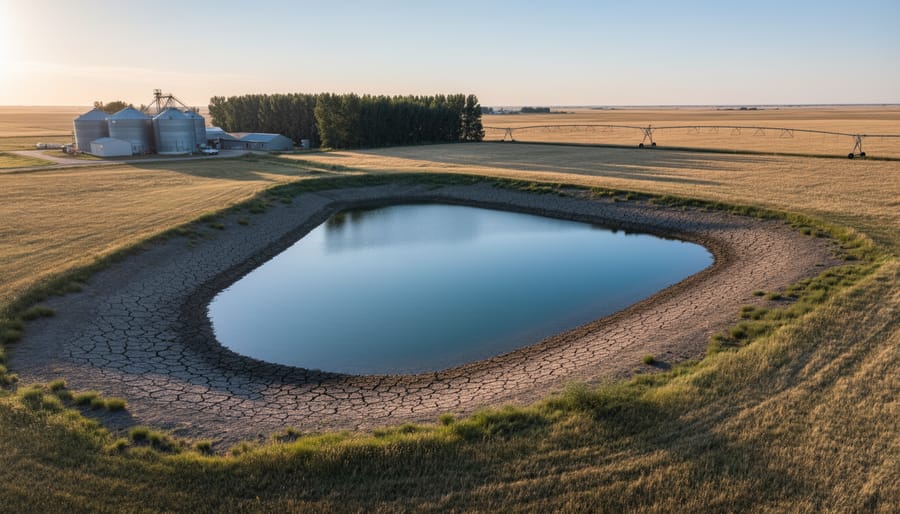
Every year, Canadian farm reservoirs lose up to 1,800 millimetres of water to evaporation—enough to irrigate an additional 40 hectares per dugout in drought-prone regions like southern Alberta. For farmers facing increasingly unpredictable precipitation patterns and extended dry periods, this represents not just wasted water, but lost revenue, reduced crop yields, and compromised livestock operations.
Farm reservoir evaporation suppression isn’t a futuristic concept reserved for large commercial operations. It’s an accessible, proven strategy that prairie farmers are implementing right now to extend their water supplies by 30 to 50 percent during critical growing months. Whether you’re managing a quarter-section mixed operation or a large-scale irrigation enterprise, understanding how evaporation occurs and which suppression technologies fit your specific conditions can transform your water security.
The challenge is real and quantifiable. A standard 0.4-hectare dugout in Alberta loses approximately 720,000 litres annually to evaporation—water that could otherwise support livestock, supplement irrigation systems, or provide emergency reserves during dry spells. Add rising temperatures and increased wind exposure, and these losses compound year after year.
This guide walks you through the science behind reservoir evaporation, evaluates the most practical suppression technologies available to Canadian farmers, and provides a clear framework for selecting and implementing the right solution for your operation. You’ll discover real-world examples from Alberta producers who’ve successfully reduced evaporation losses while maintaining operational efficiency and protecting water quality.
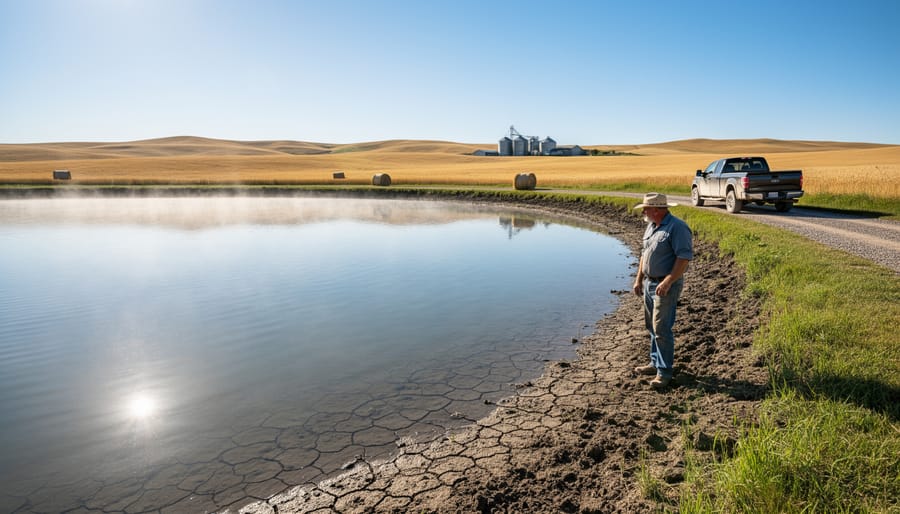
The Real Cost of Reservoir Evaporation on Alberta Farms
How Much Water Are You Actually Losing?
Understanding your actual water loss helps you make informed decisions about evaporation suppression technologies. In Alberta, evaporation rates vary significantly across climate zones, averaging 900 to 1,200 millimetres annually depending on your location.
Let’s break this down with real numbers. A 1-hectare (10,000 square metre) reservoir in central Alberta typically loses between 90,000 to 120,000 litres of water per square metre annually. For the entire reservoir surface, that translates to 9 million to 12 million litres lost each year – enough to irrigate approximately 4 to 5 additional hectares of cropland.
Scale that up to a 5-hectare reservoir, and you’re looking at 45 million to 60 million litres disappearing into the air annually. During peak summer months (June through August), expect daily losses of 4 to 6 millimetres, meaning a 1-hectare reservoir loses roughly 40,000 to 60,000 litres per day.
Southern Alberta producers face even higher rates due to increased wind and lower humidity, sometimes exceeding 1,400 millimetres annually. These aren’t just statistics – they represent real water that could support your livestock, irrigation needs, or provide drought resilience for your operation.
Beyond the Water Bill: Hidden Environmental Impacts
When water evaporates from your farm reservoir, it’s not just about the volume you lose. The water that remains becomes increasingly concentrated with nutrients, minerals, and any other dissolved substances. This process, known as concentration creep, can gradually shift water chemistry beyond optimal ranges for irrigation or livestock use.
Temperature plays a crucial role too. Evaporation naturally cools water surfaces, but shallow reservoirs still experience significant temperature fluctuations throughout the season. Warmer water holds less dissolved oxygen, which affects beneficial microorganisms that help maintain water quality. These temperature swings can also encourage algae blooms, particularly when combined with concentrated nutrients.
The ecosystem balance in your reservoir depends on stable conditions. Rapid evaporation creates stress for aquatic life, from beneficial bacteria to fish populations if you’re managing a dual-purpose system. Understanding these interconnected impacts helps frame evaporation management as part of broader water conservation strategies. Alberta farmers managing reservoirs through hot, dry summers are finding that controlling evaporation supports not just water quantity, but overall system health and long-term sustainability.
What Are Farm Reservoir Evaporation Suppression Technologies?
Physical Barriers: Floating Covers and Shade Structures
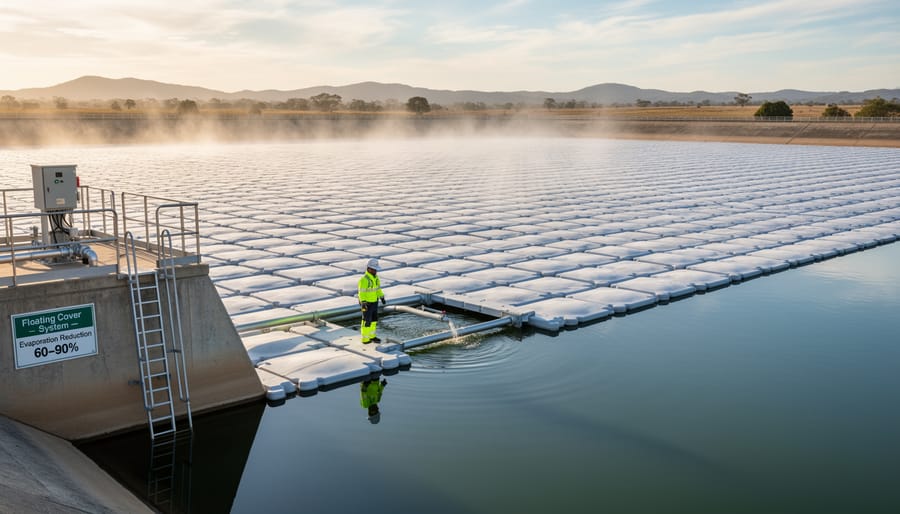
Physical barriers offer some of the most effective evaporation suppression methods available to Canadian farmers, with reduction rates ranging from 60% to 90% depending on the system chosen and local conditions.
Modular floating covers represent the most comprehensive solution. These engineered covers, typically constructed from high-density polyethylene or similar UV-resistant materials, float directly on the water surface and create a physical seal against evaporation. Installation involves anchoring sections together to form a continuous cover across your reservoir. While they require higher upfront investment, typically ranging from $8 to $15 per square metre, they deliver consistent 85-90% evaporation reduction. Many Alberta operations have successfully implemented these systems on dugouts and holding ponds, reporting significant water savings during peak summer months.
Shade balls offer a more budget-friendly alternative. These hollow plastic spheres, approximately 10 centimetres in diameter, cover the water surface when deployed at proper density. They’re particularly effective for irregularly shaped reservoirs where rigid covers prove challenging. Expect evaporation reduction rates of 60-75% with proper coverage density of roughly 400 balls per square metre. Installation is straightforward, simply releasing the balls onto the water surface where they self-distribute.
Engineered shade structures provide another option, using mesh fabric or rigid panels mounted above the reservoir. These systems reduce evaporation by 70-85% while allowing easier water access compared to floating covers. They work particularly well in windy prairie conditions where they also minimize debris accumulation. Local agricultural equipment suppliers can assist with design specifications suited to your specific reservoir dimensions and environmental conditions.
Chemical Suppressants: Monolayer Films
Chemical suppressants offer an innovative approach to reducing water loss from your farm reservoir. These biodegradable monolayer films create an invisible, one-molecule-thick barrier on the water surface that significantly slows evaporation while remaining safe for livestock, wildlife, and irrigation systems.
The most commonly used product is cetyl alcohol, a fatty alcohol derived from natural sources. When applied correctly, these films can reduce evaporation by 25-40%, making them particularly valuable during Alberta’s hot, dry summer months when water conservation becomes critical.
Application is straightforward and doesn’t require specialized equipment. The product typically comes in solid form and disperses naturally across the water surface as it melts, reforming after wind disruption within hours. Most farmers apply suppressants every 2-4 weeks during peak evaporation season, adjusting frequency based on weather conditions and water turnover rates.
Safety testing confirms these films are non-toxic and biodegradable, breaking down naturally without harming water quality. They’re approved for use in reservoirs supplying livestock drinking water and irrigation systems. However, effectiveness depends on factors like wind exposure, water temperature, and reservoir size. Smaller, sheltered reservoirs typically see better results than large, wind-exposed water bodies.
Costs range from 50-150 dollars per hectare of water surface annually, making this one of the most affordable evaporation reduction methods available to Canadian farmers.
Vegetation-Based Solutions: Strategic Windbreaks
Strategic windbreaks serve as one of the most cost-effective and environmentally friendly methods for reducing reservoir evaporation, with properly designed shelterbelts cutting water loss by 15-30%. By positioning trees and shrubs perpendicular to prevailing winds, typically from the west and northwest in Alberta, you create a protective barrier that slows wind speeds across the water surface where evaporation occurs most rapidly.
The key to effective windbreaks lies in proper spacing and height. Research shows that shelterbelts provide maximum protection for a distance of approximately 10 times their mature height on the leeward side. For a 10-metre tall shelterbelt, you’ll see reduced evaporation for up to 100 metres across your reservoir. Multi-row plantings using native species like Manitoba maple, caragana, and Colorado spruce offer the best wind resistance while requiring minimal maintenance once established.
Tom Richardson, a water management specialist working with southern Alberta producers, notes that windbreaks complement other water conservation strategies beautifully. “Farmers who combine shelterbelts with rainwater harvesting systems typically see compound benefits,” he explains. While trees take 5-10 years to reach full effectiveness, the long-term savings in water retention and reduced refilling costs make strategic windbreaks a worthwhile investment for any reservoir farm operation.
Which Technology Works Best for Your Alberta Farm?
Small Reservoirs (Under 1 Hectare): Your Best Options
For smaller reservoirs under 1 hectare, you’ll want cost-effective solutions that deliver real value without breaking the bank. Based on conversations with Alberta farmers managing dugouts and small farm ponds, floating covers offer the best return on investment for this scale.
Modular shade balls are your most budget-friendly option, running approximately $0.30-0.50 per square meter. They’re simple to install yourself—just pour them in—and require minimal maintenance. You’ll reduce evaporation by 80-90% while keeping your water accessible for livestock or irrigation pumps.
Floating covers, either foam-based or plastic sheet systems, cost $2-5 per square meter but provide near-complete evaporation control. A Saskatchewan producer I spoke with recovered his investment in just two seasons on a 0.5-hectare dugout by eliminating the need for expensive water hauling during dry spells.
Chemical monolayers work well for irregularly shaped ponds and cost around $200-400 annually per hectare. They’re practically invisible and won’t interfere with wildlife, though you’ll need to reapply them after heavy winds or significant rainfall.
Installation timing matters. Spring setup, before peak evaporation season hits in June and July, maximizes your water savings when you need them most.
Large Reservoirs (1+ Hectares): Scaling Up Solutions
When your reservoir exceeds one hectare, you’re looking at significant water volumes where the right technology investment can deliver substantial returns. At this scale, hybrid approaches often make the most economic sense, combining multiple suppression methods to maximize effectiveness.
For larger water bodies, mechanical shade structures become viable when paired with modular floating covers on high-evaporation zones. Saskatchewan’s Clearwater Irrigation Cooperative reported 58% evaporation reduction on their 2.3-hectare reservoir using this combined approach, with a projected ROI of 4.2 years based on water savings valued at current Alberta irrigation rates.
Chemical monolayers scale particularly well for large reservoirs. Automated dispensing systems maintain consistent coverage with minimal labour input, costing approximately $800-1,200 per hectare annually. One southern Alberta producer managing a 1.8-hectare dugout calculated his five-year payback period, factoring in reduced pumping costs and extended irrigation capacity during drought periods.
Wind-driven spray systems represent another option, though they require careful site assessment. These work best on reservoirs with consistent wind patterns and cost between $15,000-25,000 installed for systems covering 1-2 hectares.
Consider conducting a water audit before investing. Many regional agricultural service boards offer free assessments that calculate your specific evaporation losses and help determine which technology combination delivers the strongest return for your operation’s unique circumstances.
Real Alberta Success Stories: What’s Working on the Ground
When Bryan Petersen first measured evaporation losses from his 12-hectare irrigation reservoir near Lethbridge, the numbers stopped him cold. “We were losing roughly 1.8 metres of water depth each season,” he recalls. “That’s nearly 216,000 cubic metres just vanishing into thin air.”
After researching options, Petersen implemented a monolayer film system in 2021. The initial application proved challenging. “Wind was our biggest enemy during setup,” he explains. “We had to wait for calm mornings and work quickly.” He also discovered that maintaining consistent coverage required monthly monitoring and reapplication after heavy storms.
The results justified the effort. Water measurements showed a 32% reduction in evaporation over the first season, saving approximately 69,000 cubic metres. “That translated to irrigating an additional 18 hectares of canola without drawing extra water from our allocation,” Petersen notes. His operation now budgets $4,200 annually for the monolayer system, which he considers worthwhile given the water security and production gains.
Dr. Sarah Chen, agricultural water specialist at Olds College, emphasizes the importance of Petersen’s methodical approach. “Successful implementation requires baseline measurements and consistent monitoring. Many farmers apply these technologies without establishing proper metrics, making it impossible to verify results.”
Further north near Westlock, dairy farmer Maria Kowalski took a different route with modular shade structures over her 8-hectare stock watering reservoir. “We needed year-round water access for 450 head, and winter wind was stripping moisture as fast as summer heat,” she says.
Kowalski installed shade netting covering 60% of the reservoir surface in 2022, focusing on the prevailing wind direction. Construction cost $28,000, higher than chemical alternatives, but she valued the permanent infrastructure. “We’ve measured a 27% reduction in evaporation, and the shade keeps water temperatures lower in summer, which the cattle prefer.”
The dual benefits surprised her. “Algae growth dropped significantly with less direct sunlight. We’re treating the water less frequently, which saves money and labour.”
Chen points to Kowalski’s experience as evidence that technology choice depends heavily on operation type. “Stock watering reservoirs benefit from physical barriers that also address water quality. Irrigation reservoirs might prioritize different solutions based on seasonal use patterns.”
Both farmers stress the importance of connecting with others who’ve implemented these systems. “Talk to your neighbours, join local irrigation associations, and don’t hesitate to start small with test areas,” Petersen advises. “Real-world experience beats theoretical calculations every time.”
Getting Started: Your Implementation Roadmap
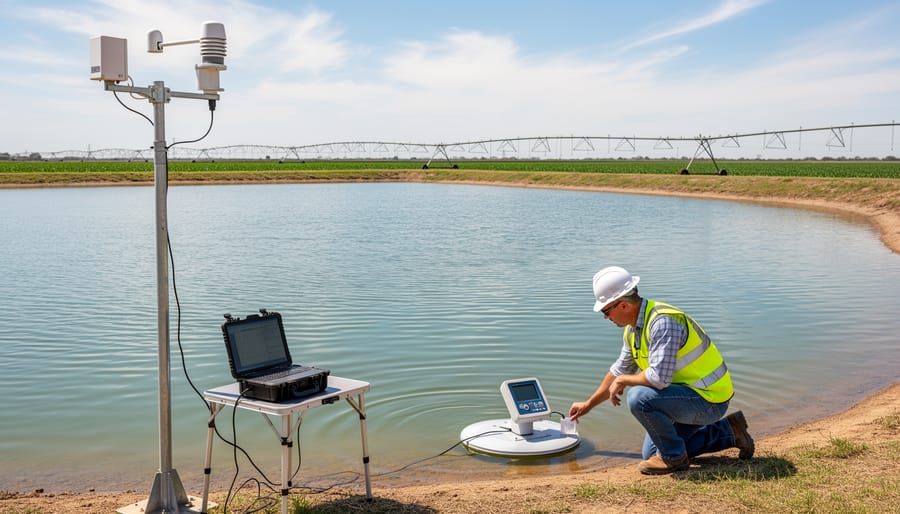
Measuring Your Baseline: Simple Evaporation Tracking
Before investing in evaporation suppression technologies, you need to know exactly how much water you’re losing. Start with a simple pan evaporation test using a shallow container (30-50 cm diameter) filled with reservoir water. Place it near your water body in an open area, mark the initial water level with a ruler or tape measure, and record daily measurements for two weeks during growing season. Calculate the average daily loss in millimetres to establish your baseline.
For larger operations, install a Class A evaporation pan (available through agricultural suppliers for $200-400) following Environment Canada protocols. This standardized approach allows you to compare your data with regional weather stations and other farms.
Track your measurements alongside weather conditions—temperature, wind speed, and humidity all influence evaporation rates. This baseline data becomes essential for evaluating the effectiveness of any agricultural water management solution you implement, helping you calculate actual water savings and return on investment.
Finding Support: Grants and Expert Resources in Alberta
Alberta farmers have multiple avenues for financial support when implementing reservoir and water conservation projects. The Canadian Agricultural Partnership offers cost-share funding through programs like the On-Farm Water Management Program, which can cover up to 50% of eligible project costs. Provincial initiatives administered through Agriculture Financial Services Corporation (AFSC) provide additional assistance specifically for water infrastructure improvements.
Your local agricultural fieldmen and extension specialists through Alberta Agriculture and Irrigation can offer free technical guidance on reservoir design and evaporation reduction strategies. These experts conduct on-site assessments and help determine which technologies suit your operation best. Many municipalities also maintain water conservation grants for agricultural water projects.
The Prairie Agricultural Machinery Institute (PAMI) provides research-based recommendations on water management technologies, while organizations like the Alberta Conservation Association offer support for projects that enhance wildlife habitat alongside water storage. Additionally, irrigation districts often have funding programs for members upgrading their water management systems. Contact your regional agricultural service board to explore available programs in your area and determine eligibility requirements before starting your project.
The evidence is clear: evaporation suppression technologies represent a smart investment for Alberta’s agricultural future. Whether you choose floating covers, biodegradable films, or shade structures, even modest installations can dramatically reduce water loss from your farm reservoirs. The numbers speak for themselves—savings of 40 to 90 percent mean more water available for irrigation during critical growing periods, lower pumping costs, and reduced stress on local water sources.
What makes these solutions particularly attractive is their accessibility. You don’t need to transform your entire operation overnight. Many successful Alberta farmers started with a single reservoir, learned what worked for their conditions, and expanded from there. The initial investment pays dividends year after year through water conservation, and in many cases, qualifies for provincial agricultural sustainability programs.
Consider this your invitation to take action. Walk out to your reservoir this week and observe how much water you’re losing to evaporation. Calculate your potential savings using your reservoir’s surface area and typical evaporation rates for your region. Contact local agricultural extension offices or equipment suppliers who can provide site-specific recommendations. You’re not alone in this journey—you’re joining a growing community of forward-thinking farmers who recognize that water stewardship and farm profitability go hand in hand. Start small, measure your results, and be part of building a more resilient agricultural sector across the prairies.