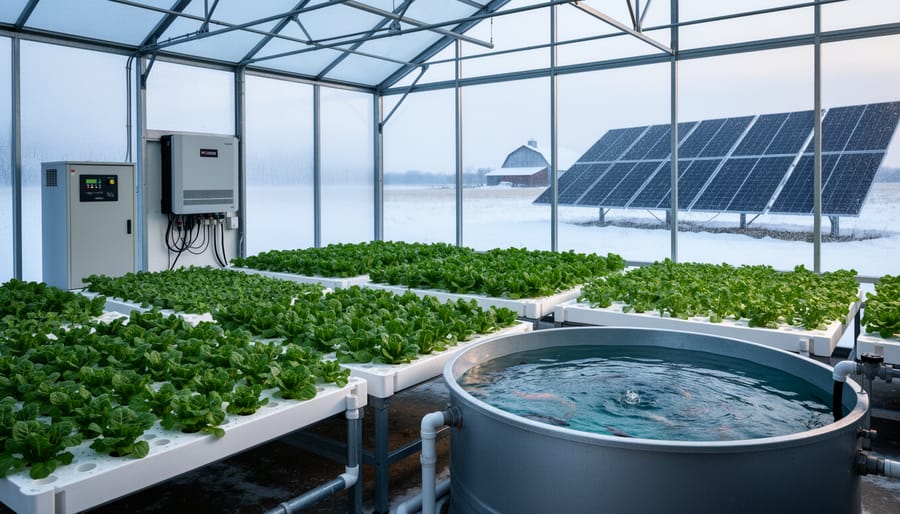
Calculate your energy requirements before selecting any equipment by measuring the wattage of water pumps, aerators, and heating systems—most 100-square-metre systems in Alberta need 2-4 kilowatts of continuous power, plus an additional 6-8 kilowatts for climate control during winter months. Match your solar array or wind turbine capacity to handle peak demand plus 30% buffer, accounting for Alberta’s reduced winter sunlight hours when your heating needs are highest.
Design your system layout to minimize pumping distances and elevation changes, reducing energy consumption by up to 40% compared to conventional configurations. Position grow beds at the same level as fish tanks whenever possible, using gravity-fed drainage systems that require only occasional low-wattage pumps rather than continuous high-power circulation.
Install battery storage equivalent to 48-72 hours of operation to bridge Alberta’s extended cloudy periods and winter storms when renewable generation drops. Lithium iron phosphate batteries withstand cold better than standard lithium-ion and maintain 80% capacity at -20°C, critical for our climate conditions.
Integrate automated monitoring systems that adjust pump schedules and reduce flow rates during low-energy periods without compromising fish health or plant growth. Smart controllers can cut energy use by 25-35% by matching system activity to available renewable power rather than running at constant capacity.
The economic reality matters: renewable-powered aquaponics systems cost 40-60% more upfront than grid-dependent operations, but Alberta farmers report breaking even within 5-7 years through eliminated utility costs and premium pricing for sustainably grown products. This article provides the technical specifications, component selection criteria, and proven design strategies you need to build a profitable, climate-resilient aquaponics operation powered by renewable energy—backed by real examples from Canadian farms already succeeding with this integration.
Why Energy Integration Matters for Canadian Aquaponic Operations
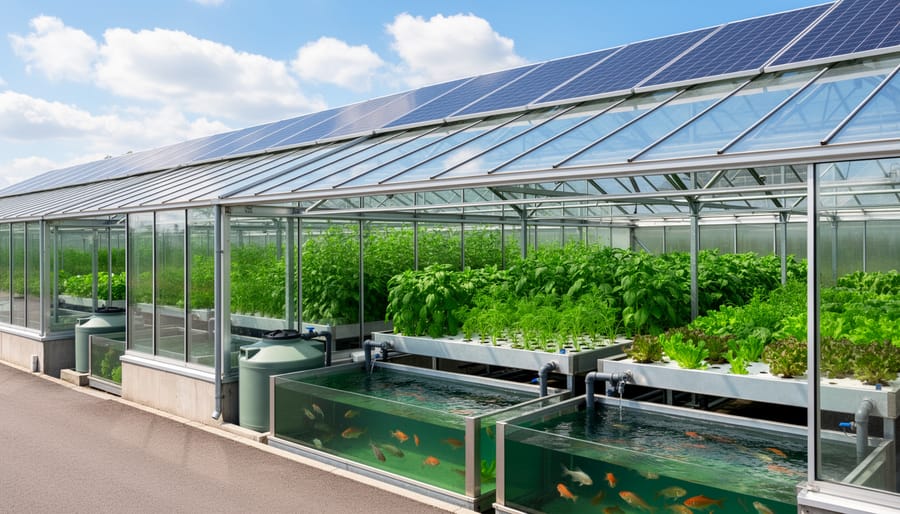
The True Cost of Running Aquaponics in Alberta’s Climate
Understanding the financial reality of aquaponics in Alberta starts with heating costs, which dominate winter operations. A typical 100 square metre system requires approximately 15-25 kWh of electricity daily for heating during January and February when temperatures drop to -15°C or lower. At Alberta’s average rate of $0.13 per kWh, expect monthly heating bills between $58 and $97 during peak winter months.
Water circulation pumps add another layer of expense. Most systems need pumps running continuously, consuming 0.5-1.5 kWh daily depending on system size and vertical height. This translates to roughly $6-18 monthly. Grow lights operating 14-16 hours daily contribute an additional 8-12 kWh per day, adding $30-47 to monthly costs.
Seasonal variations significantly impact your bottom line. Summer months see heating costs drop by 60-80 percent, while shoulder seasons like October and April require roughly half the winter energy input. Over a full year, a moderate-sized system typically consumes 8,000-12,000 kWh total, costing $1,040-1,560 annually in electricity alone.
These numbers don’t include backup heating systems, which many Alberta operators install after experiencing equipment failures during cold snaps. Factor an additional 15-20 percent buffer for emergencies and system redundancy. Local grower Martin Schneider from Lacombe shared that his first winter taught him the importance of proper insulation, which reduced his heating needs by 30 percent after retrofitting his greenhouse with double-wall polycarbonate panels.
How Renewable Energy Changes the Economics
The economics of aquaponics shift dramatically when you integrate renewable energy. A typical grid-dependent 100-square-metre system in Alberta might cost $250-400 monthly in electricity for pumps, heaters, and lighting. Over a year, that’s $3,000-4,800 in operating costs that directly impact your bottom line.
By contrast, a renewable-integrated setup requires upfront investment but reduces those recurring costs significantly. A properly sized solar array with battery backup typically costs $8,000-15,000 for a small-to-medium aquaponic operation. Many Alberta farmers see payback periods of 5-8 years through energy savings alone, with systems lasting 25+ years.
The real game-changer comes from combining energy production with operational flexibility. Grid-tied systems with net metering let you sell excess power back during summer months when production peaks. This approach to solar-powered agriculture means your energy infrastructure supports multiple revenue streams.
Federal and provincial incentives further improve the math. The Canadian Agricultural Partnership offers grants covering up to 25% of renewable energy installations. Combined with the federal investment tax credit for clean technology, your effective investment drops considerably. Factor in protection from rising electricity rates, and renewable integration becomes not just environmentally responsible but financially strategic for long-term farm viability.
Core Components of Renewable-Powered Aquaponic Design
Solar Panel Systems: Sizing and Placement for Year-Round Production
Calculating your energy requirements is the critical first step in sizing a solar array for aquaponics. Begin by totaling the wattage of all system components: water pumps typically draw 50-150 watts, air pumps 15-45 watts per unit, grow lights 100-400 watts per square meter, and climate control systems 500-2000 watts depending on greenhouse size. Add a 20% buffer for efficiency losses and future expansion.
For Alberta’s latitude (49-60°N), solar production varies dramatically by season. Winter months deliver only 25-30% of summer output, making proper sizing essential. A baseline 5 kW system produces approximately 20-25 kWh daily in summer but just 6-8 kWh in December and January. Most year-round operations require 8-12 kW capacity to maintain consistent production through darker months.
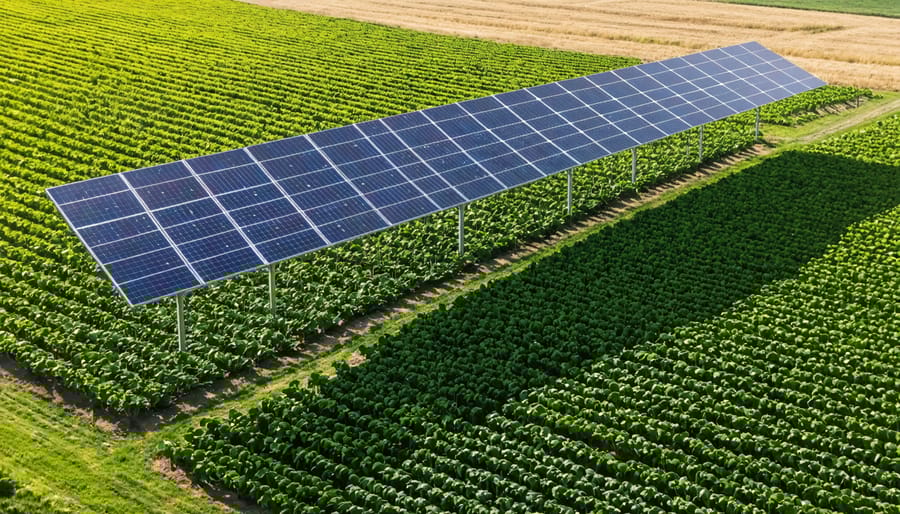
Panel placement significantly impacts performance. South-facing installations at 50-55 degree angles optimize year-round collection in Alberta. For greenhouse integration, mounting panels on rooftop structures provides dual benefits: energy generation and partial shade reduction during intense summer periods. Alternatively, ground-mounted arrays positioned adjacent to greenhouses avoid shading growing areas while simplifying maintenance access during snow accumulation.
Modern solar microgrids with battery storage address seasonal fluctuations effectively. A typical setup pairs 10 kW solar capacity with 15-20 kWh lithium battery storage, allowing systems to draw stored energy during cloudy periods and overnight operations. This configuration supports most small to medium aquaponic operations without grid dependency.
Track your actual consumption monthly during the first year. Many producers discover heating represents 40-60% of winter energy use, making thermal efficiency improvements equally valuable as expanding solar capacity. Adjusting system operations to maximize daytime energy use when solar production peaks further reduces battery storage requirements.
Wind Energy Options for Rural Properties
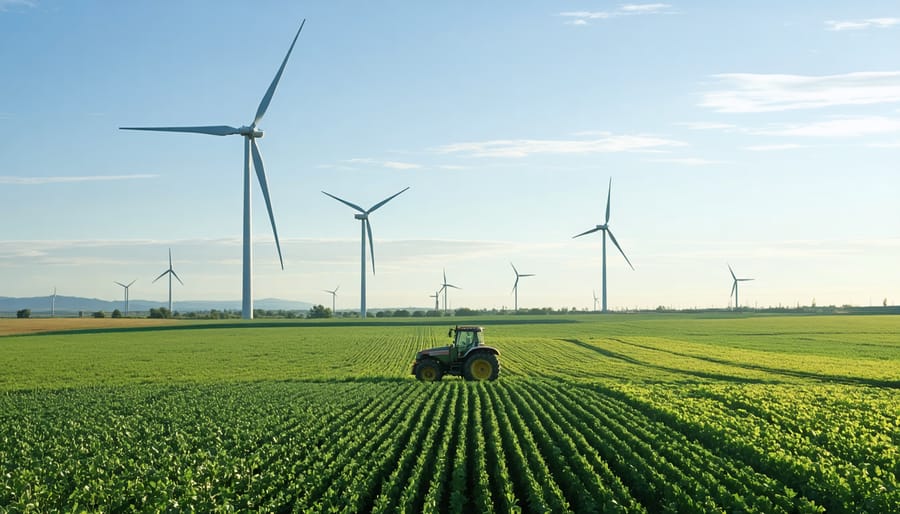
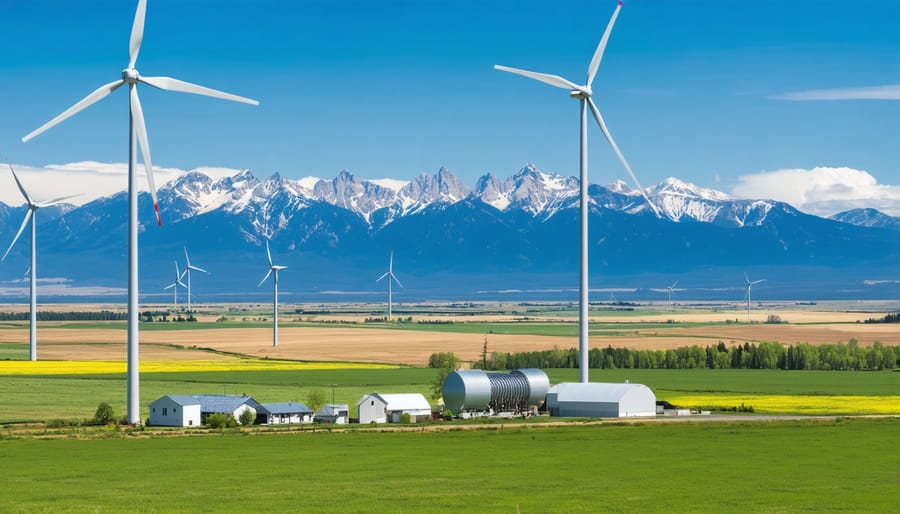
Wind turbines can complement or replace solar panels in Alberta’s prairie regions, particularly where properties experience consistent wind patterns throughout winter months when solar production drops significantly. For aquaponic systems requiring 3-5 kW continuous power, small-scale wind turbines in the 5-10 kW range often make practical sense, though a thorough wind assessment is essential before investing.
Randy Morrison, who operates a 400-square-meter aquaponics facility near Lethbridge, found that his property’s average wind speeds of 18-22 km/h justified adding a 6 kW wind turbine to his existing solar array. “The wind turbine generates about 40 percent of our winter power needs when solar drops off,” Morrison explains. “It’s not cheap upfront, but the hybrid approach gives us much more consistent energy year-round.”
Sizing wind turbines requires professional wind resource assessment over at least three months. Most aquaponic operations benefit from hybrid solar-wind systems rather than wind-only solutions. A typical configuration might include 8 kW of solar panels paired with a 5 kW wind turbine, providing redundancy and seasonal balance. The turbine handles baseload requirements during low-light periods while solar covers peak daytime demands.
Installation costs run approximately 4,000-6,000 dollars per kilowatt for small wind systems, roughly double solar pricing. However, Alberta’s wind resources, particularly in southern regions, can justify the investment for properties with confirmed consistent winds above 15 km/h average. Provincial incentive programs occasionally support hybrid renewable installations, making feasibility assessments worthwhile for serious operations.
Battery Storage and Energy Management
Proper battery storage is essential for maintaining stable conditions in your aquaponic system when solar panels or wind turbines aren’t generating power. Your battery capacity should cover at least 48 hours of system operation, accounting for water pumps, aerators, and monitoring equipment. For a mid-sized system in Alberta, this typically means 10-15 kWh of storage capacity.
When choosing between battery technologies, consider your specific needs and budget. Lithium-ion batteries offer longer lifespans (10-15 years), higher efficiency (95% round-trip), and better cold-weather performance—crucial for Alberta winters. They cost more upfront at $800-1,200 per kWh installed, but require less maintenance. Lead-acid batteries are more affordable initially ($300-500 per kWh) but last only 3-7 years and perform poorly in cold temperatures without proper insulation.
Many Alberta farmers implementing wind energy storage are now pairing it with smart charge controllers that prioritize critical loads during low generation periods. These controllers ensure water circulation and aeration continue uninterrupted while non-essential components like lighting adjust based on available power.
Consider installing your battery bank in a temperature-controlled space. Cold weather reduces battery capacity by 20-40%, so maintaining batteries at 10-25°C protects your investment and ensures consistent system performance. A battery management system with remote monitoring lets you track charge levels, detect issues early, and optimize energy usage patterns based on weather forecasts.
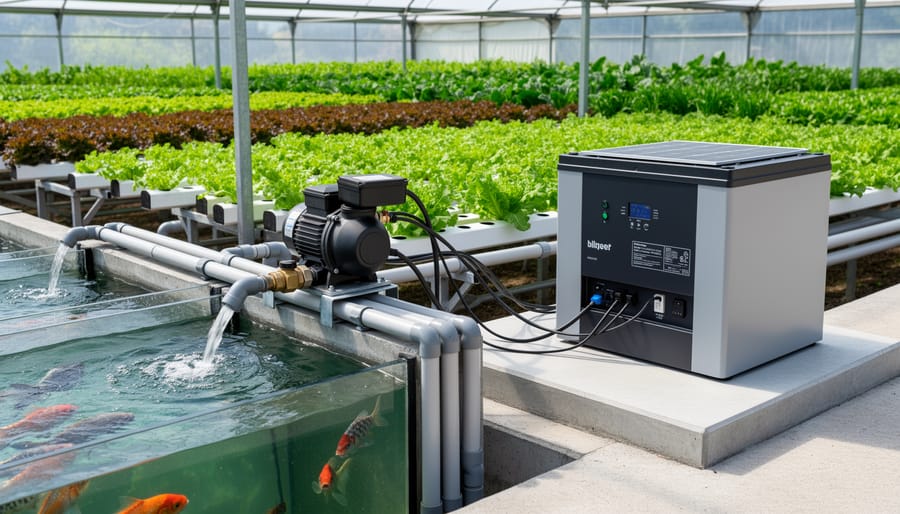
Energy-Efficient System Design Principles
Reducing energy consumption starts with strategic design choices that minimize demand before considering renewable power generation. For Canadian farmers, particularly in Alberta’s climate, thoughtful system design can cut operational costs significantly while improving year-round performance.
Insulation is your first line of defense against Alberta’s temperature extremes. Wrapping greenhouse structures with double or triple-layer polycarbonate panels creates an effective thermal barrier, reducing heating needs by up to 40% compared to single-layer designs. Insulating fish tanks and pipes prevents heat loss, especially critical when water temperatures must stay between 18-24°C for optimal fish health. Consider using rigid foam board insulation around tank exteriors and heat-reflective bubble wrap inside greenhouses during winter months.
Passive solar heating leverages free energy from the sun. Orient your greenhouse to maximize southern exposure, allowing winter sunlight to naturally warm the space. Dark-colored water barrels or concrete blocks placed strategically inside act as thermal mass, absorbing heat during the day and releasing it gradually at night. This simple technique can maintain stable temperatures with minimal active heating, a significant advantage when overnight temperatures drop below -20°C.
Pump selection directly impacts your energy bill since water circulation runs continuously. Variable-speed pumps adjust output based on actual system needs rather than running at full capacity constantly. Look for models rated at 0.5 watts per liter per minute or better. A properly sized system might use a 50-watt pump instead of a standard 100-watt model, cutting pump energy use in half.
LED grow lights have revolutionized supplemental lighting efficiency. Modern full-spectrum LEDs deliver necessary light wavelengths while using 60-75% less electricity than traditional high-pressure sodium or metal halide lamps. For Alberta’s short winter days, this efficiency gain matters enormously.
Implementing smart energy management systems helps monitor consumption patterns and optimize component operation, ensuring every watt counts toward productive growing.
Designing the Water Flow System for Energy Efficiency
Choosing Your System Type: Media Beds, NFT, or Raft
Your choice of aquaponic system significantly impacts energy consumption and renewable energy integration potential. Understanding these differences helps you select the most efficient option for your operation.
Media bed systems use grow beds filled with expanded clay or gravel, requiring moderate pumping energy to flood and drain beds cyclically. These systems typically consume 40-60 watts per square metre but excel in cold climates like Alberta because the thermal mass in media beds helps buffer temperature fluctuations. The cycling nature also allows strategic pump timing during peak solar production hours.
Nutrient Film Technique (NFT) systems circulate a thin film of water through channels, demanding continuous pumping but using less water overall. Energy consumption ranges from 30-45 watts per square metre. However, NFT systems require careful monitoring in variable renewable scenarios since pump interruptions quickly stress plants. They work best with battery backup or hybrid power systems.
Deep Water Culture (raft) systems float plants on foam rafts in large tanks, offering the lowest energy requirements at 25-35 watts per square metre due to efficient water circulation and reduced pumping height. Alberta grower James Chen from Lethbridge switched from NFT to raft systems, reducing his solar array requirements by 35 percent while maintaining production levels.
For renewable-powered operations, media beds and raft systems provide better energy flexibility. Media beds suit smaller operations and offer forgiveness during power interruptions, while raft systems optimize larger commercial setups where maximizing production per watt matters most. Consider your scale, crop selection, and backup power capacity when making this foundational decision.
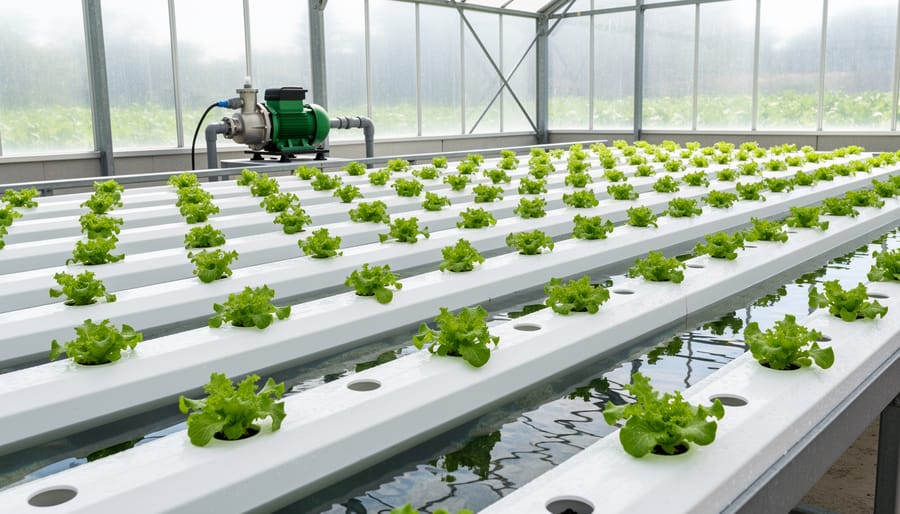
Pump Selection and Placement Strategies
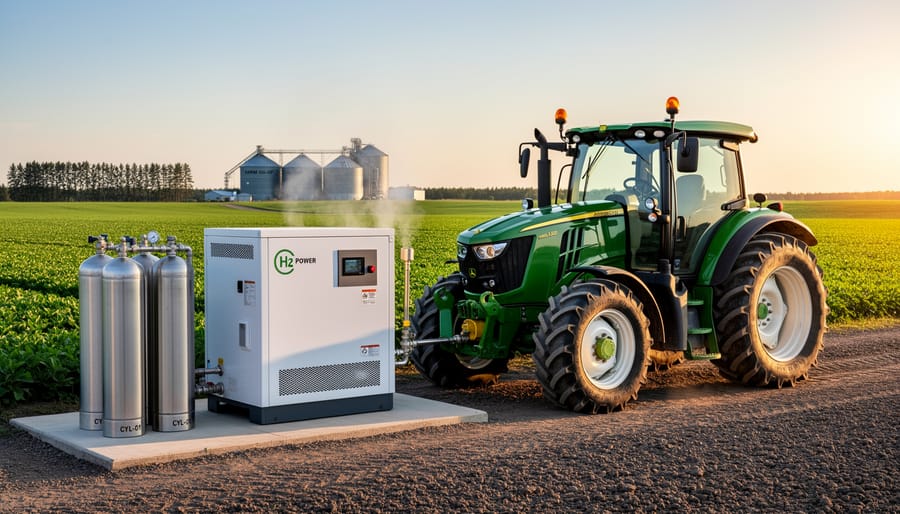
Selecting the right pump is essential for maintaining efficient water circulation while minimizing energy consumption in your renewable-powered aquaponic system. For solar or wind integration, DC pumps offer direct compatibility with battery systems and eliminate the need for inverters, reducing energy losses by 10-15% compared to AC pumps. However, AC pumps may be more cost-effective for larger operations already connected to the grid with renewable supplementation.
Calculate your required flow rate by cycling your total system water volume at least once per hour. For example, a 2,000-litre system needs a minimum 2,000 litres per hour pump capacity. Factor in head height, which is the vertical distance water must travel from the fish tank to your grow beds. Add approximately 100 litres per hour for every 30 centimetres of head height to compensate for gravity resistance.
Strategic placement makes a significant difference in energy efficiency. Position your fish tank at the highest practical point to maximize gravity-assisted drainage back to the sump tank. This approach reduces pump workload and energy draw. Alberta farmer James Chen from Red Deer reduced his pumping energy by 30% simply by elevating his fish tanks 60 centimetres above ground level, allowing gravity to handle most of the return flow while his solar-powered DC pump handles the upward circulation.
Backup Systems and Fail-Safes
Power interruptions pose serious risks to aquaponic systems, where fish depend on continuous water circulation and aeration. For Canadian operations, especially during Alberta’s harsh winters, reliable backup systems aren’t optional—they’re essential for protecting your investment.
Battery backup systems should provide at least 12-24 hours of emergency power for critical components like air pumps and water circulation. Deep-cycle batteries paired with inverters can keep essential equipment running during outages. Size your battery bank to handle minimum fish life-support requirements, typically 50-100 watts for a modest system.
Consider implementing low-energy emergency modes that prioritize fish survival. Simple solutions include battery-powered air stones that activate automatically during power loss, costing as little as $30-50 per unit. These can maintain dissolved oxygen levels for several hours while you address the outage.
Solar-powered backup systems offer year-round reliability, even during Alberta’s shorter winter days. A 200-watt solar panel with battery storage can maintain critical aeration indefinitely. Ron Peterson, an aquaponics operator near Red Deer, credits his solar backup system with saving his tilapia stock during a three-day winter power outage in 2022.
Install alarm systems that alert you immediately to power failures or pump malfunctions. Wireless monitoring systems send smartphone notifications, allowing rapid response regardless of your location on the farm.
Temperature Control Without Breaking the Energy Budget
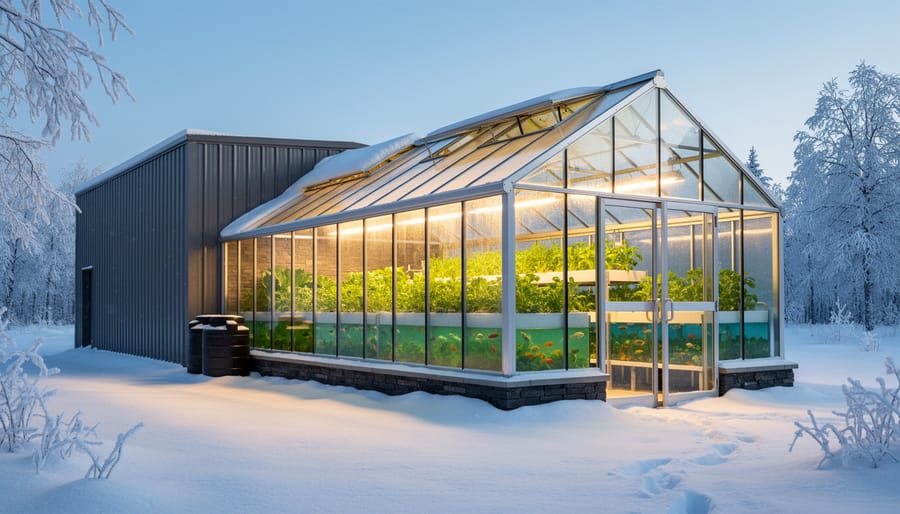
Passive Heating Strategies for Greenhouse Aquaponics
Reducing active heating costs in Alberta’s harsh winters requires smart passive design strategies that capture and retain warmth naturally. These approaches can significantly lower your energy demands before renewable systems even kick in.
Thermal mass is your greenhouse’s heat battery. Water tanks, concrete floors, or stone walls absorb solar heat during the day and release it gradually at night, stabilizing temperature swings. In aquaponic systems, your fish tanks already provide excellent thermal mass—a 1,000-litre tank can store substantial heat energy. Consider painting tanks dark colours on sun-exposed sides to maximize absorption, though ensure this doesn’t stress your fish with excessive light.
Double-wall or twin-layer glazing creates an insulating air gap that can reduce heat loss by 40-50% compared to single-layer polyethylene. While upfront costs are higher, Calgary-area farmers report heating bill reductions of up to 60% when combining quality glazing with proper sealing.
Earth-sheltering takes advantage of stable underground temperatures. Partially burying your greenhouse’s north wall or building into a hillside buffers against temperature extremes. One Red Deer operation reduced winter heating needs by 35% using this method combined with insulated north walls.
Solar gain maximization means strategic orientation and design. Face your greenhouse south with glazing angled to capture low winter sun—typically 60-70 degrees from horizontal in Alberta. Remove obstructions that create shade during peak daylight hours. Reflective materials on north walls can bounce additional light and heat toward growing areas.
These passive strategies work together, creating resilience before renewable energy systems need to compensate for heat loss.
Efficient Active Heating Solutions
When Alberta’s winter temperatures drop below -30°C, maintaining optimal water temperatures of 18-30°C for aquaponics requires reliable, cost-effective heating solutions that integrate seamlessly with renewable energy systems.
Heat pumps stand out as the most efficient option for Canadian aquaponic operations, delivering 3-4 units of heat for every unit of electricity consumed. Ground-source heat pumps achieve coefficient of performance (COP) ratings of 3.5-4.5, making them particularly valuable when paired with solar or wind generation. Air-source models work well in milder climates but efficiency drops significantly below -15°C, limiting their effectiveness during Alberta’s coldest months. The initial investment ranges from $15,000-30,000 for a medium-scale system, though provincial rebates can offset 25-40% of costs.
Solar water heaters complement photovoltaic systems by directly capturing thermal energy. Evacuated tube collectors maintain efficiency even during winter, though snow removal becomes essential. A 10-square-metre array can provide 30-50% of heating needs for a 4,000-litre system during shoulder seasons.
For farms with agricultural waste streams, biomass heating options offer dual benefits of waste management and renewable heat. Wood pellet or chip boilers achieve 80-90% efficiency ratings and work excellently with thermal storage tanks to smooth out heating demands.
Many Alberta producers find success combining geothermal heating systems with backup biomass during extreme cold snaps, ensuring year-round production reliability while maximizing renewable energy utilization.
Real-World Example: Alberta Farm Integration Success
When Trevor and Marissa Hansen decided to convert a portion of their traditional grain operation near Lethbridge into an aquaponic facility in 2019, they knew energy costs would be their biggest challenge. Operating a year-round system in Alberta’s climate seemed impractical until they explored solar integration.
The Hansens installed a 15-kilowatt solar array combined with a 20-kilowatt-hour battery bank to power their 280-square-metre greenhouse aquaponic system. Their setup includes twelve 1,000-litre fish tanks raising tilapia and rainbow trout, paired with deep water culture beds growing lettuce, herbs, and cherry tomatoes. The solar installation cost $42,000 upfront, with federal and provincial incentives reducing their out-of-pocket expense to approximately $28,500.
The biggest challenge they faced was maintaining consistent temperatures during Alberta’s harsh winters. Their solution involved strategic design choices: positioning the fish tanks along the north wall for thermal mass, installing R-40 insulation in the greenhouse foundation, and using automated thermal blankets that deploy on winter nights. The solar system powers backup propane heaters only during extended cloudy periods, dramatically reducing heating costs compared to conventional operations.
After three years of operation, the results speak for themselves. The Hansens generate roughly 70 percent of their annual energy needs from solar, with their battery system providing power during peak evening demand when grid electricity costs more. Their monthly energy bills dropped from a projected $1,800 to around $540. They produce approximately 4,500 kilograms of fish and 9,000 kilograms of produce annually, supplying three local restaurants and a farmers’ market cooperative.
Trevor notes that their system performs best from March through October when solar production peaks, allowing them to bank excess energy credits with their utility provider. Winter months still require grid supplementation, but thoughtful system design minimized this dependency.
The operation reached profitability in year two, ahead of their projected timeline. Marissa credits their success to starting small, learning the system thoroughly, and gradually expanding capacity rather than attempting a large-scale launch.
Their advice to other Alberta farmers considering aquaponics: integrate renewable energy from day one rather than retrofitting later. The upfront investment pays dividends through reduced operating costs and improved environmental sustainability, factors that increasingly matter to their restaurant clients and direct customers.
Getting Started: Planning Your Renewable Aquaponic System
Assessing Your Property’s Renewable Potential
Before investing in renewable-powered aquaponics, you’ll need to understand what resources your property offers. Start by evaluating solar potential—southern Alberta receives approximately 1,200-1,400 kWh per square metre annually, making it ideal for photovoltaic systems. Walk your property at different times of day to identify areas with unobstructed south-facing exposure and minimal shade from buildings or trees.
Wind resources vary considerably across the prairies. Contact Environment Canada for local wind speed data—systems typically require average speeds above 5 metres per second to be economically viable. Higher elevations and open fields generally perform better than sheltered areas.
Space assessment is crucial. A 100-square-metre aquaponic greenhouse might need 15-25 square metres for solar panels or a small wind turbine setback of 30 metres from structures. Consider future expansion when planning placement.
Investigate your grid connection options with your local utility provider. Some Alberta farmers benefit from micro-generation programs that allow selling excess power back to the grid, offsetting energy costs during low-production periods. Distance from existing electrical infrastructure affects installation costs, so document these details early in your planning process. Understanding these baseline conditions helps you make informed decisions about which renewable technologies suit your operation best.
Budget Planning and Available Incentives
Planning your budget realistically sets the foundation for a successful aquaponic venture. Initial setup costs for a small to medium-scale renewable-powered aquaponic system in Alberta typically range from $15,000 to $50,000, depending on system size, complexity, and energy infrastructure. This includes fish tanks, grow beds, plumbing, solar panels or wind turbines, and backup battery systems.
Canadian farmers have access to several funding opportunities that can significantly offset these costs. The Canadian Agricultural Partnership offers support for innovative farming projects, including sustainable food production systems. Alberta’s On-Farm Solar Photovoltaics Program provides rebates for solar installations, covering up to 30% of eligible costs. Agriculture and Agri-Food Canada’s AgriInnovate Program supports projects demonstrating environmental benefits and economic viability.
The federal government’s Canada Greener Homes Grant can help if you’re integrating your system with existing farm infrastructure, while Farm Credit Canada offers specialized financing for agricultural innovation projects. Many Alberta credit unions have developed green farming loan products with competitive rates for renewable energy investments.
Consider phased implementation to manage cash flow effectively. Start with a smaller system using one renewable energy source, then expand as you gain experience and revenue. Track your operational costs carefully during the first year, as heating expenses during Alberta winters can vary significantly. Local agricultural societies and regional innovation centres often provide free consultation services to help refine your budget and identify additional funding sources specific to your municipality.
Integrating renewable energy with your aquaponic system isn’t just environmentally responsible—it’s a smart economic decision that positions your operation for long-term success. As you’ve seen throughout this guide, combining solar panels, wind turbines, or biomass systems with aquaponics dramatically reduces operating costs while insulating your farm from volatile energy prices. For Canadian farmers, particularly those facing Alberta’s challenging climate conditions, this approach transforms aquaponics from a risky venture into a genuinely viable year-round production system.
The path forward starts with assessment and planning. Take time to evaluate your property’s renewable energy potential, calculate your system’s actual energy needs, and design with redundancy in mind. Remember that you don’t need to implement everything at once. Many successful operations begin with a smaller pilot system, gather real-world data from their specific location, and scale up gradually as they gain confidence and experience.
You’re not alone in this journey. Alberta’s agricultural community continues to grow stronger through knowledge sharing and collaboration. Connect with farmers who’ve already made this transition, reach out to renewable energy specialists familiar with agricultural applications, and tap into available government incentives that can significantly reduce your initial investment. Local agricultural extension services and aquaponics associations offer workshops, site assessments, and ongoing support tailored to Canadian conditions.
The future of sustainable food production is already taking root across the country. By combining aquaponics with renewable energy, you’re building a resilient business model that serves both your bottom line and your community’s food security. Start your assessment today—the investment in planning now will pay dividends for decades to come.