Rethink every insect on your farm as either an ally, a manageable presence, or a genuine threat requiring intervention. This shift transforms pest management from a chemical-dependent cycle into a strategic system where beneficial insects like ground beetles and parasitic wasps do much of the control work for you. In Canadian Prairie conditions, approximately 97% of insect species present no economic threat to crops, yet conventional approaches treat the field as a battlefield requiring total elimination.
Start by identifying which pests your farm can tolerate without yield loss. Canola, for example, can withstand up to 25% leaf defoliation during vegetative stages without impacting harvest. Similarly, cereal crops routinely support populations of aphids below economic thresholds when natural predators remain present. This tolerance-based approach reduces input costs while maintaining the predator populations that prevent future outbreaks.
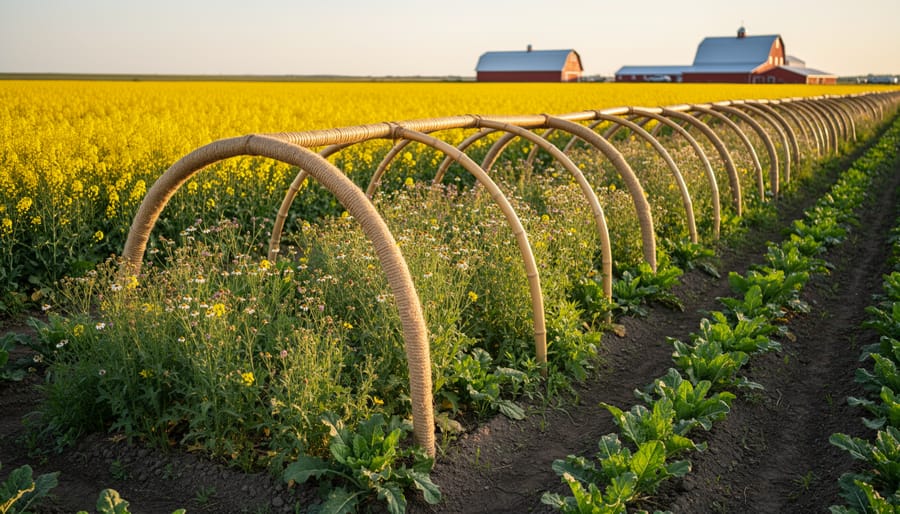
Build physical infrastructure that supports beneficial insect populations year-round. Beetle banks, hedgerows with native prairie plants, and undisturbed field margins provide overwintering habitat for predatory insects that emerge in spring exactly when pest populations begin building. Alberta farmers implementing these features report 40-60% reductions in targeted insecticide applications within three growing seasons.
The concept of sustainable pests challenges decades of agricultural messaging, but the economics are increasingly clear: farms that work with insect ecology rather than against it achieve comparable yields with significantly lower chemical costs and reduced resistance management challenges.
What Makes a Pest ‘Sustainable’?
Not all pests are created equal. In sustainable agriculture, we’re learning to distinguish between destructive pests that threaten crop viability and what we call “sustainable pests”—insect populations that exist at manageable levels and actually contribute to farm ecosystem health.
Sustainable pests are species that, when present in appropriate numbers, don’t cause significant economic damage while providing ecological benefits. Think of aphids at low densities: they become food sources for ladybugs, lacewings, and parasitic wasps that stick around to control more damaging pest outbreaks later. In Alberta’s grain systems, small populations of cereal leaf beetles can indicate a thriving predator community without impacting yields.
The key lies in understanding two critical concepts: economic thresholds and ecological thresholds. Economic threshold is the pest density at which control costs equal potential crop loss. For Alberta wheat farmers, this might be 8-12 aphids per stem. However, ecological threshold considers the broader farm ecosystem. That same aphid population might support beneficial insect populations worth far more than the minor yield reduction they cause.
Research from Agriculture and Agri-Food Canada shows that certain pest populations contribute directly to soil health. Wireworms and other soil-dwelling insects, while monitored carefully, help break down organic matter and improve soil structure when populations remain below damaging levels. Their presence indicates active soil biology—essential for crops like climate-ready crops that depend on robust soil ecosystems.
Central Alberta farmer James Kowalski puts it simply: “I used to spray at the first sign of any bug. Now I count and wait. My beneficial insect populations have tripled in three years, and I’m spending 40 percent less on inputs.” This shift from zero-tolerance to threshold-based management represents sustainable pest thinking in action—balancing production goals with ecological function for long-term farm resilience.
The Ecological Role of Common Prairie Pests
Aphids as Ecosystem Indicators
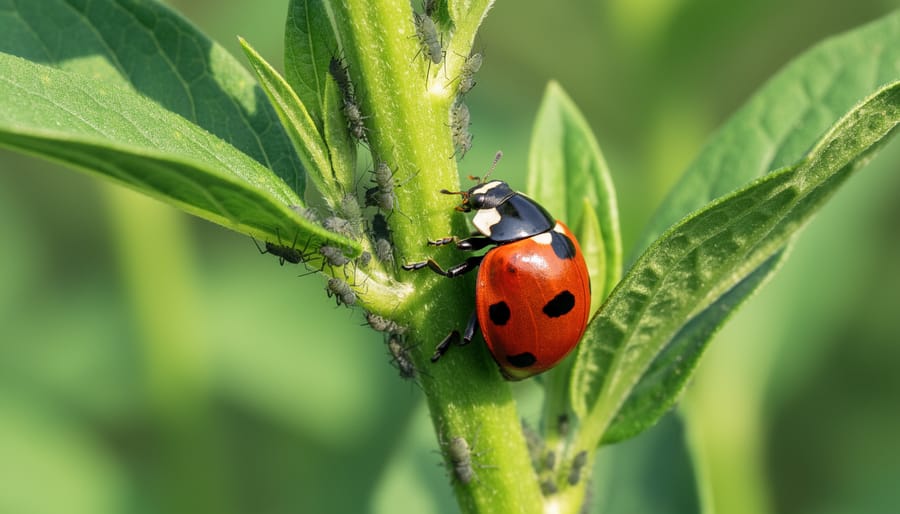
Small aphid populations on your crops aren’t necessarily a problem—they’re often a sign of a healthy, balanced farm ecosystem. When you spot a few aphids in your canola or pulse fields, consider them ecosystem indicators before reaching for chemical controls.
Research from Agriculture and Agri-Food Canada shows that low-level aphid populations, typically under economic threshold levels of 10-12 aphids per plant for most crops, serve as essential food sources for beneficial insects. Ladybugs, lacewings, and parasitic wasps depend on these small prey populations to establish themselves in your fields early in the season.
“We’ve observed on Alberta farms that fields with some aphid presence in spring actually have better natural pest control later on,” explains Dr. Sarah Chen, an integrated pest management specialist at Olds College. “Those early aphids attract and sustain beneficial insect populations that provide season-long protection.”
Think of these low populations as a living insectary. A single ladybug can consume 50 aphids daily, while lacewing larvae are equally voracious predators. Parasitic wasps lay eggs inside aphids, creating “aphid mummies” that you might notice as brown, crusty shells—a clear sign your beneficial insects are working.
The key is monitoring regularly and knowing your economic thresholds. For wheat, that’s typically 12-15 aphids per stem during heading. Below these levels, aphids provide more value as beneficial insect food than they cause in crop damage. This patience allows natural predators to build populations that protect against future pest outbreaks, reducing your input costs while supporting farm biodiversity.
Ground Beetles and Soil Health
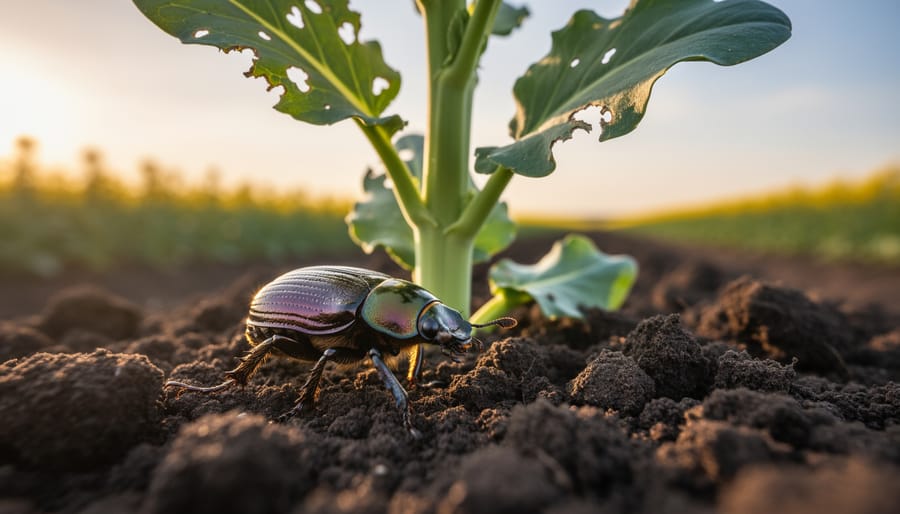
Ground beetles often get a bad reputation among Alberta farmers when they nibble on emerging canola or cereal seedlings in spring. However, these insects play a remarkable dual role that deserves our attention in sustainable farming systems. While some damage does occur during the narrow window of seedling emergence, ground beetles contribute far more value throughout the growing season through pest control and soil health improvement.
These beetles are voracious predators, consuming substantial numbers of pest species including cutworms, cabbage maggots, and aphids. Research from Agriculture and Agri-Food Canada shows that ground beetle populations in no-till fields can reduce pest populations by up to 40 percent without any chemical intervention. They’re particularly active at night, patrolling the soil surface and hunting for prey that many other beneficial insects miss.
Beyond pest control, ground beetles contribute to nutrient cycling by breaking down organic matter and creating channels in the soil as they move. These pathways improve water infiltration and root penetration, benefits that smart soil sensors can help you measure and track over time.
The key is understanding that minimal seedling feeding damage typically resolves within days as crops outgrow vulnerability, while the season-long benefits of beetle activity continue supporting your farm ecosystem. By maintaining diverse habitats like grassy field margins and reducing tillage, you encourage beetle populations that become valuable allies in building resilient, productive soil systems.
Grasshoppers in Rangeland Management
Grasshoppers are native prairie residents that play an important role in rangeland ecosystems. In healthy populations, they contribute to nutrient cycling by breaking down plant material and returning nitrogen to the soil through their droppings. They also serve as a vital food source for birds, small mammals, and beneficial insects. Understanding their ecological function helps Alberta ranchers make informed decisions about when intervention is actually necessary.
Problems typically arise when grasshopper populations exceed 8-12 insects per square metre, at which point they can consume enough forage to impact cattle nutrition and pasture recovery. However, these outbreak conditions often signal underlying rangeland health issues rather than simply bad luck. Overgrazed pastures with bare soil patches and limited plant diversity create ideal breeding conditions for grasshoppers, who prefer to lay eggs in exposed, compacted ground.
Rotational grazing offers a natural management approach that disrupts grasshopper lifecycles without chemicals. By moving cattle through pastures strategically, you maintain diverse plant communities with adequate ground cover that’s less attractive for egg-laying. Studies from the University of Alberta demonstrate that well-managed rotational systems can reduce grasshopper densities by 30-40% compared to continuously grazed pastures.
Timing matters too. Allowing pastures adequate rest between grazing periods—typically 30-60 days depending on growing conditions—promotes plant vigour and reduces the bare ground that grasshoppers seek. Many Alberta ranchers report that after transitioning to rotational systems, grasshopper problems diminished within two to three years as rangeland health improved and natural predator populations rebounded. This demonstrates how infrastructure decisions around grazing management directly influence pest dynamics.
Building Infrastructure That Supports Beneficial Pest Dynamics
Field Margin Design for Predator Habitat
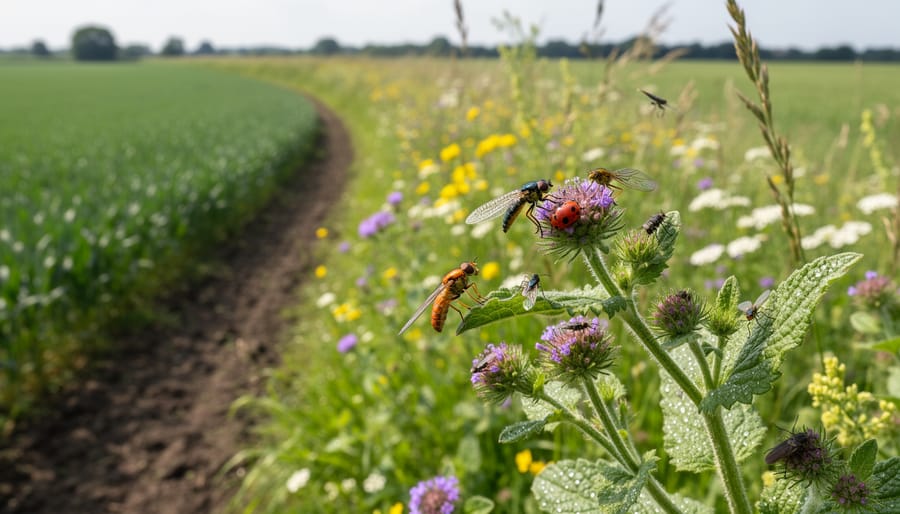
Field margins and hedgerows create essential corridors for beneficial insects while supporting a balanced ecosystem on your farm. These buffer zones, typically 3 to 6 metres wide along field edges, provide year-round habitat for predatory beetles, parasitic wasps, and hover flies that naturally regulate pest populations.
Start by selecting native Alberta plants that flower at different times throughout the growing season. Species like goldenrod, wild bergamot, and yarrow offer continuous nectar sources from spring through fall. Mix in shrubs such as chokecherry and saskatoon berry to provide shelter and overwintering sites. This diversity ensures beneficial insects have resources when crop fields aren’t flowering.
When establishing these margins, remember that some pest presence is necessary. Low populations of aphids or caterpillars serve as food sources that keep predator populations stable on your property. Research from Alberta Agriculture shows that farms with established field margins experience 40 percent fewer pest outbreaks because beneficial insects are already present when problems begin.
Plant your margins in strips rather than single rows to increase habitat complexity. A 5-metre margin might include a 2-metre native grass strip closest to the crop, followed by a 2-metre wildflower band, then a 1-metre shrub layer. This layered approach accommodates different insect species with varying habitat needs.
Avoid mowing these areas until after the first frost, allowing insects to complete their life cycles. If you must mow for weed control, leave at least half unmowed each time to maintain refuge areas. This practical compromise between habitat conservation and farm management keeps your beneficial insect workforce thriving season after season.
Monitoring Systems That Distinguish Threat Levels
Understanding when a pest crosses from manageable coexistence into economic threat is the cornerstone of working with sustainable pest populations. Rather than reacting to the first insect you spot, effective monitoring systems help you make informed decisions based on actual risk to your crop yields.
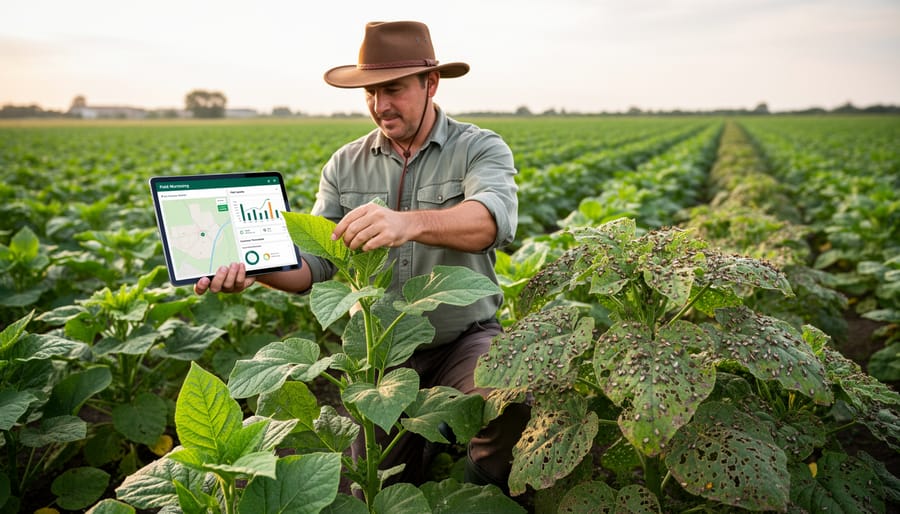
Start by establishing regular scouting schedules tailored to your growing season. For Alberta grain farmers, this typically means weekly field walks during critical growth stages, increasing to twice weekly during peak pest activity periods in July and August. Document what you find using simple tracking methods—whether that’s a notebook, smartphone app, or farm management software. The consistency matters more than the technology.
Economic thresholds are your decision-making guideposts. These research-backed numbers tell you exactly when a pest population justifies intervention. For example, wheat midge in Alberta has an established threshold of one midge per four to five wheat heads during the susceptible flowering stage. Below this level, the pest population remains sustainable and control costs exceed potential crop losses. The University of Alberta and Agriculture and Financial Services Alberta regularly publish updated threshold data for common regional pests.
Integrating smart monitoring technology can enhance your scouting efficiency without replacing boots-on-the-ground observation. Pheromone traps, sticky cards, and sweep nets provide quantifiable data that complement visual inspections. Many Alberta producers now use these tools in strategic field locations to track population trends before pests become visible problems.
Consider the success of Derek Hansen, a canola producer near Lacombe, who implemented threshold-based monitoring in 2021. By tracking flea beetle populations against established thresholds rather than spraying preventatively, he reduced insecticide applications by sixty percent while maintaining yields. His approach included twice-weekly counts of beetles per plant during the cotyledon to four-leaf stage, only intervening when counts exceeded economic thresholds.
The key is building confidence in the numbers. Start small with one pest species, learn its patterns on your farm, and expand your monitoring repertoire as you gain experience.
Real Alberta Farms Making It Work
When Trevor and Michelle Pedersen decided to transform their 240-hectare mixed grain and cattle operation near Lacombe, Alberta, they knew conventional pest management wasn’t delivering the returns they needed. Five years into implementing integrated pest management infrastructure, their farm tells a compelling story about what’s possible when you work with nature rather than against it.
“We were spending roughly $18,000 annually on insecticides alone,” Trevor explains. “Our beneficial insect populations were virtually non-existent, and we were seeing diminishing returns every season.” The turning point came in 2019 when the Pedersens began strategically installing beetle banks, hedgerows, and insectary strips throughout their property—creating permanent habitat corridors for predatory insects.
The results exceeded their expectations. Within three growing seasons, beneficial insect populations increased by 340 percent, measured through regular monitoring with sticky traps and visual assessments. Ladybugs, lacewings, and ground beetles became regular fixtures in their fields. Most significantly, their insecticide spending dropped to just $4,200 annually—a 77 percent reduction that directly improved their bottom line.
“The first year was definitely a learning curve,” Michelle admits. “We had to get comfortable with seeing some aphids on our canola, trusting that the predator insects would show up. And they did—just not on our timeline initially.” The Pedersens learned to distinguish between pest pressure that required intervention and populations that natural predators could manage effectively.
Their sustainable farm systems approach now includes 2.4 kilometres of flowering hedgerows featuring native shrubs like chokecherry and saskatoon, plus 12 beetle banks positioned strategically between fields. These structures provide overwintering habitat and pollen sources throughout the growing season.
Economic outcomes extended beyond reduced input costs. The Pedersens documented a 15 percent increase in canola yields, which they attribute to improved pollination from wild bees attracted to their habitat infrastructure. Their cattle operation also benefits, as the hedgerows provide windbreaks and shade.
“The biggest challenge was patience,” Trevor reflects. “This infrastructure takes two to three years to really establish and show results. But now that it’s working, we wouldn’t go back. Our farm is more resilient, our costs are down, and honestly, it’s just more enjoyable to farm when you see this ecosystem thriving around you.”
Expert Perspective: Shifting from Elimination to Management
Dr. Sarah Chen, an integrated pest management specialist with Agriculture and Agri-Food Canada in Lethbridge, has spent over fifteen years working directly with prairie farmers. Her research focuses on helping producers transition to more sustainable approaches without sacrificing yield or profit.
“The biggest shift we’re advocating for is moving away from the idea that every pest equals a problem,” Dr. Chen explains. “Traditional pest management operated on a zero-tolerance principle, but decades of research show this approach is neither economically sustainable nor ecologically sound.”
According to Dr. Chen, the concept of economic threshold levels represents a fundamental change in thinking. “We encourage farmers to ask: at what point does this pest population actually cost me money? Often, low pest populations cause minimal damage while supporting beneficial insects that provide free pest control services.”
This paradigm shift addresses a common concern among Alberta producers. “Farmers tell me they worry about losing control if they don’t spray immediately,” she notes. “But our field trials across the prairies consistently show that fields with diverse insect populations, including some pests, often have better natural pest regulation than those under intensive chemical management.”
The research backing this approach is compelling. A five-year study conducted across southern Alberta demonstrated that canola fields using economic thresholds rather than calendar-based spraying reduced insecticide applications by 40 percent while maintaining equivalent yields. “The key is monitoring,” Dr. Chen emphasizes. “You need to scout regularly and understand what’s happening in your fields.”
She acknowledges the learning curve. “It requires patience and a willingness to observe rather than react immediately. But farmers who embrace this approach consistently report lower input costs and improved soil health over time.”
For producers interested in transitioning, Dr. Chen recommends starting small. “Choose one field to monitor closely. Learn to identify beneficial insects alongside pests. Most importantly, connect with other farmers already using these methods. The peer-to-peer knowledge sharing happening across Alberta right now is remarkable.”
Rethinking your relationship with pests isn’t just an environmental choice—it’s a practical strategy that reduces input costs, strengthens biodiversity, and builds genuine farm resilience. When you work with natural pest dynamics rather than against them, you’re investing in systems that become more stable and productive over time. This approach fits naturally within integrated farm infrastructure planning, where each component supports the others.
Ready to start this growing season? Here are actionable first steps you can take right now:
Begin with observation. Walk your fields weekly and document which insects you see, where they appear, and what they’re doing. A simple notebook or smartphone photos work perfectly. This baseline helps you recognize beneficial species and understand pest cycles specific to your operation.
Create small habitat patches. Dedicate even 0.2 hectares to flowering plants that bloom at different times. Native species like goldenrod and yarrow support beneficial insects without competing with your crops.
Reduce one pesticide application. Choose a field where you’ve historically seen beneficial insects and monitor closely. Compare results against your treated areas to build confidence in reduced-input approaches.
Connect with other farmers trying ecological methods. Alberta has a growing community of producers sharing what works in our climate and soils. You’re not experimenting alone—you’re joining proven practices that are already delivering results across the prairies. Every small step builds momentum toward farms that work with nature, not against it.