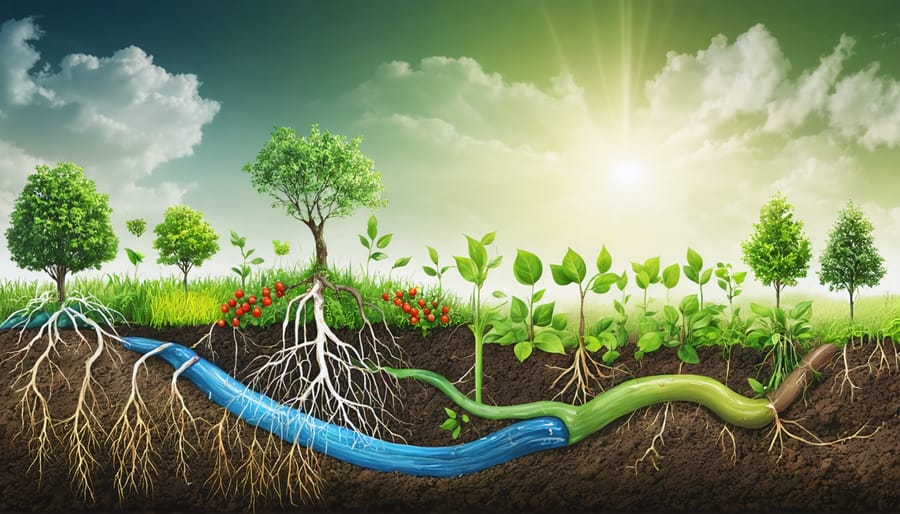

Understanding the carbon, nitrogen, and water cycles transforms farm economics. These three interconnected biogeochemical cycles move nutrients and resources through your soil, crops, and livestock systems—either building wealth or draining it. Alberta farmers who actively manage these cycles report input cost reductions of 20-30% while improving yields and climate resilience.
The carbon cycle determines soil organic matter levels, which directly impact water retention, nutrient availability, and fertilizer efficiency. Every 1% increase in soil organic matter can hold an additional 170,000 litres of water per hectare—critical during Alberta’s increasingly variable precipitation patterns. Your management decisions either sequester carbon in productive soil reserves or release it as lost fertility.
The nitrogen cycle represents your largest recurring input cost. Conventional approaches lose 50-70% of applied nitrogen through leaching, volatilization, and denitrification. Biological nitrogen fixation through strategic legume integration provides 80-150 kg of nitrogen per hectare annually at zero direct cost, while cover crops capture and recycle residual nutrients that would otherwise wash away.
The water cycle extends beyond precipitation. Healthy soil structure, driven by carbon-rich organic matter and living root systems, increases infiltration rates by 200-300% compared to degraded soils. This means capturing more of each rainfall event and reducing both drought vulnerability and runoff-related nutrient losses.
These cycles operate simultaneously on every farm. The question isn’t whether they’re functioning, but whether you’re directing them toward profitability and resilience or accepting passive degradation. The following strategies show exactly how to leverage each cycle for measurable economic returns.
Why Biogeochemical Cycles Matter in Your Agroforestry System
The Business Case for Working With Natural Cycles
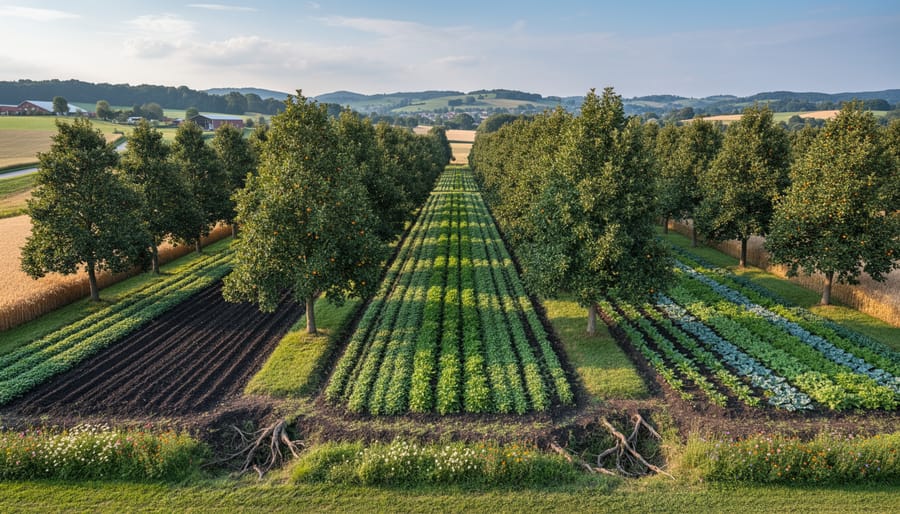
Working with nature rather than against it makes solid financial sense for your operation. When you align your practices with the carbon, nitrogen, and water cycles, you’re essentially tapping into free ecosystem services that reduce your dependence on expensive external inputs.
Consider the numbers: Alberta farmers who’ve adopted practices that enhance natural nitrogen cycling report cutting synthetic fertilizer costs by 30-50% within three years. That’s money directly back in your pocket. At the same time, improving soil organic matter through carbon cycle management typically boosts water retention by 20-30%, which means your crops handle drought stress better and you’re less vulnerable to yield losses during dry spells.
The revenue opportunities extend beyond cost savings. Farmers working with these cycles are accessing new income streams through carbon credit programs. In Alberta, several producers are now earning $15-40 per acre annually through protocols that reward soil carbon sequestration and reduced emissions. Some are also developing value-added products from farm biomass that would otherwise be waste, creating circular bioeconomy opportunities right on their land.
Manitoba farmer James Schneider, who integrated these principles on his 800-hectare operation, puts it plainly: “Once you understand how these cycles work together, you realize you’ve been paying for things nature provides for free. My input costs dropped 35% in four years, and my yields actually improved.”
The key is starting small, monitoring your results, and building from there. The cycles do the heavy lifting once you create the right conditions.
What Makes Agroforestry Different
Unlike conventional monoculture farming that often disrupts natural cycles through heavy tillage and chemical inputs, agroforestry works with nature’s processes to enhance all three biogeochemical cycles simultaneously. In Alberta’s challenging climate, this integrated approach offers distinct advantages.
Traditional row crop systems can deplete soil carbon and require substantial synthetic nitrogen applications—often 100-150 kg per hectare annually. Climate-resilient agroforestry systems reduce this dependency by incorporating deep-rooted trees and shrubs that capture atmospheric nitrogen and build soil organic matter year-round.
The diversity in agroforestry creates multiple pathways for nutrient cycling. Tree roots access nutrients from deeper soil layers that annual crops cannot reach, while leaf litter feeds soil biology. This vertical stratification means water infiltration rates can improve by 30-50% compared to bare cropland, a critical advantage during Alberta’s increasingly variable precipitation patterns.
Perhaps most importantly, agroforestry maintains living roots throughout the year, keeping carbon and nutrient cycles active even during winter months when conventional fields lie dormant. This continuous biological activity strengthens soil structure, reduces erosion, and builds long-term fertility without constant external inputs.
The Carbon Cycle: From Atmospheric Problem to Farm Asset
How Trees and Crops Work Together to Capture Carbon
In agroforestry systems, trees and crops create a powerful partnership for carbon capture that goes well beyond what either could accomplish alone. Understanding this process helps you maximize both environmental and economic benefits on your operation.
The carbon capture process begins with photosynthesis. Trees, with their extensive canopy area, draw down atmospheric carbon dioxide while your crops do the same closer to ground level. This creates multiple layers of carbon capture throughout the growing season. For Alberta farmers, strategically placed tree rows can capture carbon year-round, even when annual crops aren’t actively growing.
But the real magic happens below ground. Through photosynthesis, both trees and crops convert captured carbon into sugars. A significant portion of these sugars travels down to the roots, where plants release them as root exudates—essentially feeding the soil microbiome. These exudates are sticky compounds that help bind soil particles together, creating stable aggregates that lock carbon away for decades or even centuries.
Trees excel at long-term carbon storage. Their woody biomass accumulates carbon year after year, with mature trees storing several tonnes per hectare. Meanwhile, their deep root systems deposit carbon far below the plow layer, where it remains protected from disturbance. Annual crops contribute through their roots and residues, particularly when combined with reduced tillage practices.
In integrated systems, tree roots and crop roots occupy different soil zones, minimizing competition while maximizing total carbon input. This complementary relationship means you’re building soil organic matter more rapidly than with crops alone—typically seeing measurable increases within 3-5 years of establishment.

Turning Carbon Into Dollars: Value Chain Opportunities
Understanding how carbon cycling translates into real dollars helps farmers make informed decisions about implementing sustainable practices on their operations. When you actively manage carbon on your farm, you’re not just contributing to environmental health—you’re opening doors to multiple revenue streams and cost savings.
Carbon credits represent one of the most direct ways to monetize carbon management. Through programs like the Alberta Emission Offset System, farmers can earn credits by implementing carbon sequestration strategies such as shelterbelts, cover cropping, and reduced tillage. These credits can then be sold to companies looking to offset their emissions, with some Alberta farmers earning between $15 to $40 per tonne of CO2 sequestered.
Beyond carbon credits, improved soil organic matter directly enhances soil fertility and water retention. A Saskatchewan case study showed that farmers who increased soil carbon by 1% reduced their fertilizer costs by approximately 20% while maintaining yields. This happens because healthy, carbon-rich soils support beneficial microbes that naturally cycle nutrients, reducing your dependence on synthetic inputs.
Biomass products offer another value chain opportunity. Agroforestry systems produce wood chips for livestock bedding, fence posts, and even bioenergy feedstock. One central Alberta farm generates $3,000 annually from selective harvesting of their shelterbelts while maintaining the ecological benefits.
The cumulative effect is significant. A 160-hectare mixed farm near Red Deer implemented integrated carbon management and reported a 30% reduction in input costs over five years, plus $8,000 in annual carbon credit revenue. These aren’t theoretical benefits—they’re practical outcomes from farmers who recognized that managing the carbon cycle isn’t just environmental stewardship, it’s sound business strategy.
Management Practices That Maximize Carbon Benefits
Maximizing carbon benefits on your Alberta farm starts with strategic tree species selection. Opt for fast-growing native species like hybrid poplar or willow for shelterbelts, which can sequester up to 3-5 tonnes of CO2 per hectare annually while providing windbreaks for crops. When establishing agroforestry systems, space trees 4-6 meters apart to allow sufficient light penetration for understory crops or pasture.
Implement a strategic pruning schedule during dormant seasons to maintain tree health while creating woody residues. Don’t burn or remove these prunings—chip them and return them to the soil as mulch, where they’ll decompose and feed the carbon cycle. Alberta farmer Jim Hendricks from Lacombe County reports that this practice improved his soil organic matter by 1.2 percent over five years.
Cover cropping between tree rows is essential. Plant diverse mixes including legumes like field peas and deep-rooted species like daikon radish after harvest. These crops prevent carbon loss through erosion and add organic matter when terminated. Aim to keep living roots in the soil year-round.
For crop residue management, adopt a no-till or minimum-till approach. Leaving stubble intact protects soil carbon stocks and reduces decomposition rates by maintaining cooler, moister conditions. Research from Olds College demonstrates this can preserve 15-20 percent more soil carbon compared to conventional tillage.
The Nitrogen Cycle: Nature’s Free Fertilizer Factory
Nitrogen-Fixing Trees: Your Farm’s Fertilizer Partners
Nitrogen-fixing trees are like having a fertilizer factory right on your farm, converting atmospheric nitrogen into forms your crops can use through natural nutrient cycling. This biological process happens when specialized bacteria in root nodules capture nitrogen from the air and transform it into plant-available nutrients, reducing your need for synthetic fertilizers.
For Alberta’s climate, several hardy nitrogen-fixing species thrive despite our cold winters. Green alder is a native champion, tolerating temperatures down to -45°C and thriving in moist areas where other trees struggle. Siberian pea shrub, already popular in prairie windbreaks, fixes approximately 75-100 kg of nitrogen per hectare annually while providing excellent livestock fodder.
Manitoba maple and Russian olive also perform well in our region, though the latter requires careful management in some areas. These species can be integrated as shelterbelts, living fences, or alley cropping systems between crop rows.
John Peterson, who farms near Red Deer, planted Siberian pea shrub rows through his wheat fields five years ago. “My fertilizer costs dropped by 30 percent in adjacent strips,” he reports. “The trees also reduced wind erosion, so I’m getting multiple benefits.”
Start small by planting nitrogen-fixing trees along field edges or in degraded areas. As leaf litter and root matter decompose, they release nitrogen gradually, building soil fertility year after year. This investment pays dividends through reduced input costs and improved soil health for decades to come.

Closing the Loop: From Livestock Waste to Soil Nitrogen
Transforming livestock waste into a valuable nitrogen resource is one of the most practical applications of circular bioeconomy principles on your farm. Rather than viewing manure as a disposal challenge, you can close the nitrogen loop and reduce fertilizer costs significantly.
Composting manure creates a stable, slow-release nitrogen source that builds soil organic matter while minimizing nutrient runoff. Alberta farmers report that properly aged compost can reduce commercial nitrogen fertilizer needs by 30-50% when applied strategically. The composting process converts volatile ammonia into stable organic nitrogen compounds that release gradually throughout the growing season.
Strategic placement makes all the difference. Position composted manure near nitrogen-demanding crops like vegetables, corn, or young trees in your agroforestry systems. A farmer near Red Deer successfully uses composted cattle manure in rows between tree plantings, providing sustained nitrogen release that supports both crop and tree growth during establishment years.
Mulching with partially composted manure around fruit trees or berry bushes serves dual purposes: nitrogen delivery and moisture retention. Apply a 7-10 centimetre layer in early spring, keeping material 15 centimetres away from tree trunks to prevent bark damage.
The numbers speak clearly. Testing your compost helps determine nitrogen content, typically ranging from 1-3% depending on livestock type and composting methods. A simple soil test before and after application shows exactly how you’re rebuilding nitrogen levels naturally. This approach reduces input costs, improves soil health, and keeps valuable nutrients cycling productively within your farm ecosystem rather than becoming an environmental liability.
Preventing Nitrogen Loss and Water Contamination
Nitrogen is a valuable nutrient that can easily escape your fields through leaching, especially during Alberta’s spring snowmelt and heavy rainfall periods. When nitrogen leaches into groundwater or nearby streams, you lose both your fertilizer investment and risk water quality degradation. This is where strategic tree planting makes economic sense.
Tree roots act as living filters, capturing excess nitrogen before it moves beyond the root zone. Deep-rooted species like hybrid poplar can reach 3-4 metres down, intercepting nutrients that annual crops miss. A 2019 study from central Alberta showed that riparian buffers reduced nitrate levels in adjacent water bodies by up to 70% while maintaining crop productivity in nearby fields.
Consider planting shelterbelts along field edges or establishing riparian buffers near water sources. These systems capture nitrogen during critical leaching periods and gradually release it back into the soil as leaves decompose. You’re essentially creating a nutrient savings account rather than watching your investment wash away.
Many Alberta producers have found that even modest tree plantings—just 5-10% of total acreage—significantly reduce fertilizer runoff while providing additional benefits like windbreaks and wildlife habitat. The key is matching tree species to your soil conditions and placing them where nutrient movement is highest, typically along drainage pathways and field borders.
The Water Cycle: Building Drought Resilience Into Your System
How Trees Regulate Water in Agricultural Landscapes
Trees function as natural water managers in agricultural landscapes, offering practical benefits that can help Alberta farmers navigate increasingly unpredictable precipitation patterns. When strategically integrated into farm operations, trees fundamentally change how water moves through and stays in your soil.
The root systems of trees create channels that allow water to infiltrate deeper into the ground rather than running off the surface. Research from the University of Alberta shows that shelterbelts can increase water infiltration rates by up to 60% compared to open fields. This means more rainfall actually enters your soil profile where crops can access it, rather than washing away valuable topsoil or pooling in low-lying areas.
Once in the ground, this water replenishes aquifers and creates a moisture reserve that sustains both trees and nearby crops during dry periods. Trees also regulate humidity in their immediate surroundings through transpiration, releasing water vapor that can benefit adjacent crop rows. On hot summer days, the shade and moisture from tree plantings can lower temperatures by 2-5 degrees Celsius, creating microclimates that reduce crop stress.
For drought mitigation, this water regulation becomes particularly valuable. During the 2021 growing season, several central Alberta producers reported that fields near established shelterbelts maintained better moisture levels and required less irrigation than exposed areas. The trees essentially act as a buffer, moderating extremes and extending the time your soil retains workable moisture. This translates directly to reduced irrigation costs and improved crop resilience when rainfall becomes scarce.
Strategic Water Management Through Design
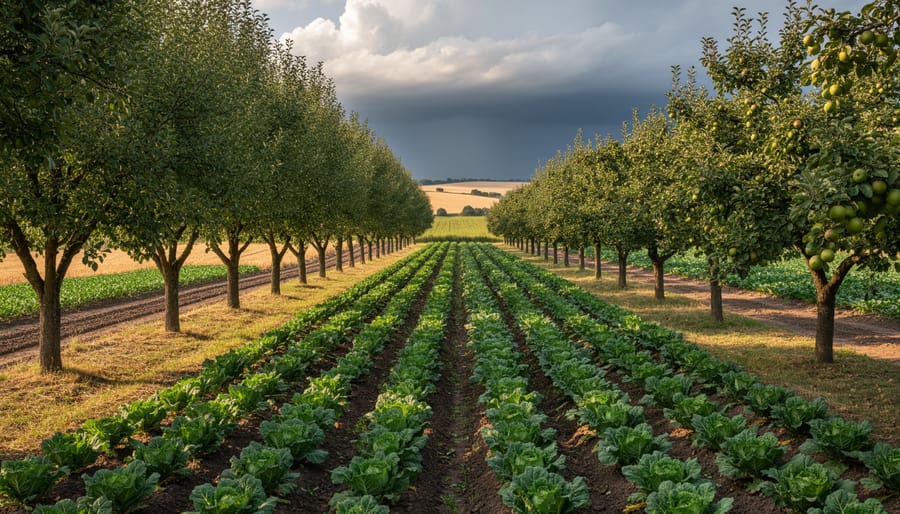
Thoughtful landscape design transforms your farm into a natural water capture and distribution system. By strategically positioning shelterbelts and selecting appropriate tree species, you can significantly improve moisture retention while reducing erosion and runoff.
Start by observing water movement across your property during spring melt and heavy rainfall. Place shelterbelts perpendicular to prevailing winds and along contour lines to slow water flow and encourage infiltration. In Alberta’s parkland and prairie regions, this approach can increase soil moisture by 15-25% in adjacent crop areas. Space your shelterbelts 100-150 metres apart on flatter terrain, closer on slopes.
Contour planting creates natural terraces that capture precipitation before it leaves your land. Trees and shrubs planted along these curves act as living berms, giving water time to soak into the soil profile rather than running off to drainage ditches. This technique works particularly well on rolling landscapes common throughout central Alberta.
Species selection matters tremendously for effective water management strategies. Choose deep-rooted trees like hybrid poplar or Manitoba maple that won’t heavily compete with crops while still improving water infiltration. Incorporate shrubs like caragana or red osier dogwood in your outer rows—their dense root systems excel at water capture.
Consider your site’s specific moisture conditions. Plant willow species in wetter swales where they’ll thrive while transpiring excess water. Reserve drought-tolerant species like ponderosa pine for drier ridges. This layered approach optimizes water distribution across diverse microclimates within your farm.
Capturing and Reusing Water: Circular Approaches
Water conservation doesn’t mean locking it away—it means using it multiple times before it leaves your operation. Managed wetlands capture runoff and slowly release water during dry periods, extending irrigation capacity by up to 30% according to research from the University of Alberta. These natural systems also filter nutrients before water reaches downstream areas, protecting water quality.
Water harvesting through dugouts, swales, and retention ponds stores precipitation where you need it most. Alberta rancher Tom Petersen reports his livestock watering system now relies 70% on captured runoff, reducing pumping costs and creating drought resilience. Strategic placement along contours slows water movement across fields, allowing more infiltration into soil reserves.
Integrate these systems with your livestock operations. Cattle can access managed wetlands during appropriate seasons, distributing manure nutrients while benefiting from clean water sources. This approach creates circular benefits—water nourishes pasture, livestock utilize both, and waste returns nutrients to the system. Even redirecting barn roof runoff into storage creates opportunities. Start small with one catchment area and expand as you see results.
Connecting the Cycles: Building Your Circular Bioeconomy System
Waste Streams Become Value Streams
Understanding biogeochemical cycles is valuable, but the real magic happens when you transform what many consider waste into profitable farm resources. This circular approach turns traditional costs into revenue streams while building ecosystem health.
Consider tree prunings from your shelterbelt or alley cropping system. Rather than burning or hauling them away, chip these branches into mulch. This organic matter suppresses weeds around high-value crops, retains soil moisture during dry Alberta summers, and gradually decomposes to feed the nitrogen and carbon cycles we’ve discussed. One cubic metre of wood chips can save approximately 30 litres of irrigation water per week during peak growing season.
Livestock integration offers another powerful example. Tom Henderson’s mixed farm near Red Deer demonstrates this beautifully. His cattle graze beneath established tree rows during shoulder seasons, converting fallen leaves and understory vegetation into valuable manure. This closed-loop system eliminates the need to purchase additional nitrogen fertilizer while building improved soil health through increased organic matter.
Composting systems complete the circle. Collect animal bedding, crop residues, and kitchen scraps in a dedicated three-bin system. Proper composting reaches temperatures of 55-65 degrees Celsius, killing weed seeds while creating nutrient-rich amendments. Henderson reports his composting operation now produces enough finished material to replace 40 percent of his previous synthetic fertilizer purchases.
For larger operations, biomass energy production adds another dimension. Coppiced willow or poplar from riparian buffers can fuel on-farm heating systems or generate income through local biomass markets. This approach captures solar energy stored through photosynthesis, releases it as heat, and returns mineral-rich ash to fields, maintaining nutrient cycling while reducing fossil fuel dependence.
Getting Started: First Steps for Alberta Farmers
Ready to optimize the biogeochemical cycles on your Alberta farm? Start with a simple assessment of your current land. Walk your property and note existing tree cover, soil health indicators, and water flow patterns. Document bare areas, erosion zones, and locations where water pools or runs off quickly.
Next, develop a phased implementation plan. You don’t need to transform everything at once. Begin with a pilot area—perhaps 2-4 hectares—where you can integrate nitrogen-fixing trees like caragana or hybrid poplar alongside your existing operations. This allows you to observe benefits before scaling up.
For species selection, choose plants suited to Alberta’s climate zones. Connect with your local Agricultural Fieldmen or the Alberta Agriculture and Irrigation regional offices for site-specific recommendations. Many offer free soil testing and can help match species to your soil type and goals.
Consider joining farmer networks like the Agroforestry and Woodlot Extension Society or attending workshops through Alberta’s Environmental Farms Plan program. These groups provide mentorship from farmers who’ve successfully integrated biogeochemical cycle management into their operations. Remember, even small changes—planting shelterbelts, establishing buffer strips, or adding cover crops—start enhancing these natural cycles immediately, building toward long-term resilience and profitability.
Understanding how carbon, nitrogen, and water cycles interact on your farm isn’t just good science—it’s good business. When you work with these natural systems rather than against them, you’re building a farm operation that’s more profitable, resilient to weather extremes, and valuable for the long term.
The beauty of this approach is that you don’t need to overhaul everything overnight. Start with one practice that makes sense for your operation: perhaps adding shelter belts to improve water retention, integrating cover crops to boost nitrogen cycling, or establishing a small agroforestry plot to enhance carbon sequestration. Each step forward creates momentum and builds your knowledge.
You’re not alone in this journey. Alberta’s agricultural community is full of farmers already seeing results from working with these biogeochemical cycles. Local agricultural extension services, industry groups, and fellow producers offer practical support and shared experiences. Many cost-share programs and technical resources are available specifically for Canadian farmers adopting regenerative practices.
The farms thriving today are those that recognize soil health and natural cycles as foundational assets. By understanding and enhancing these three biogeochemical cycles, you’re positioning your operation for both immediate gains and lasting success while contributing to a healthier agricultural landscape for future generations.