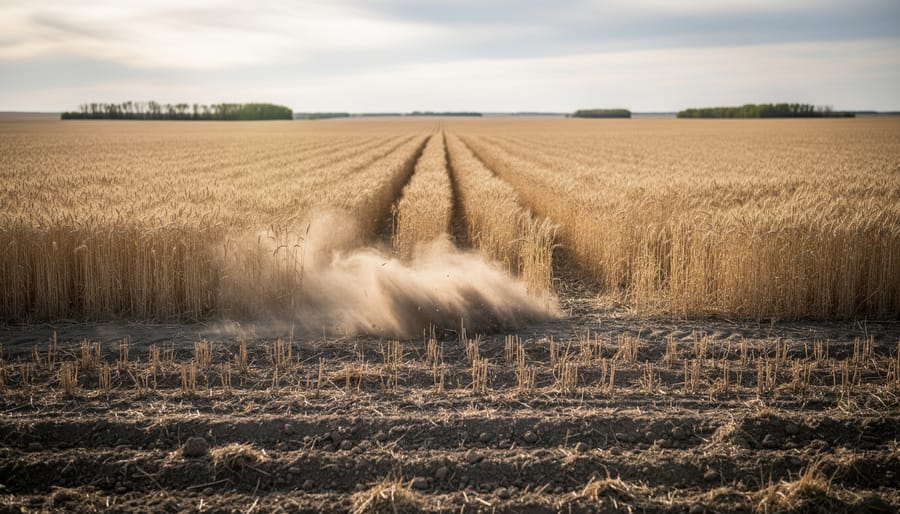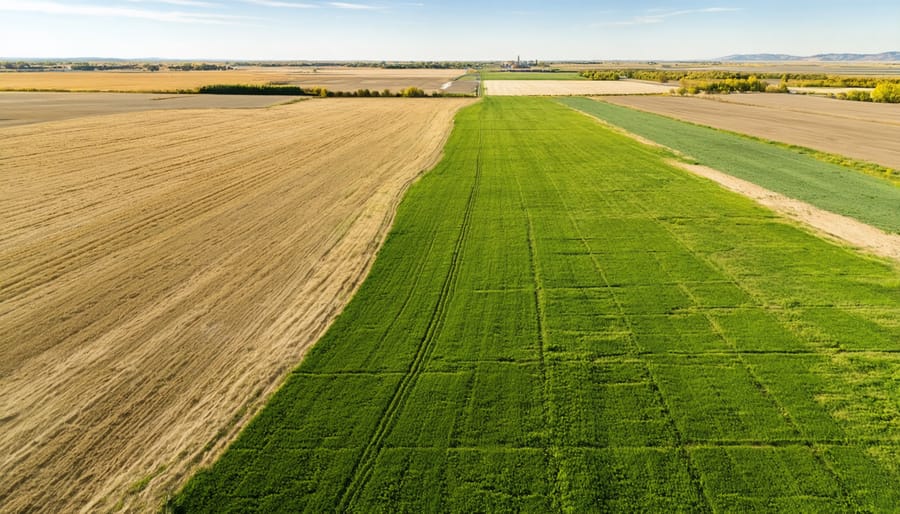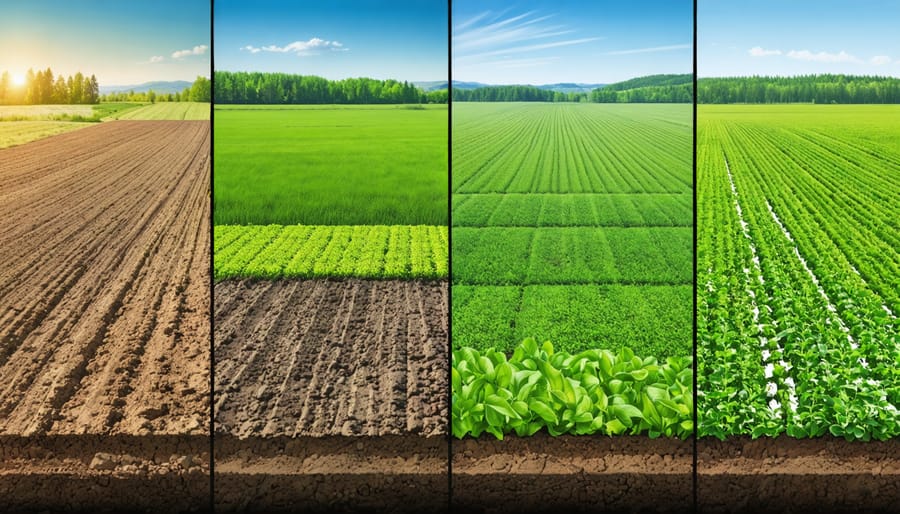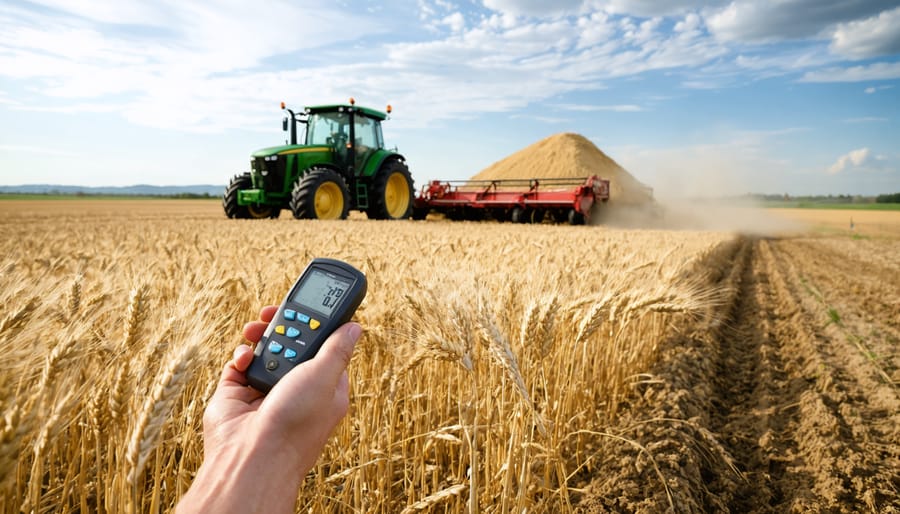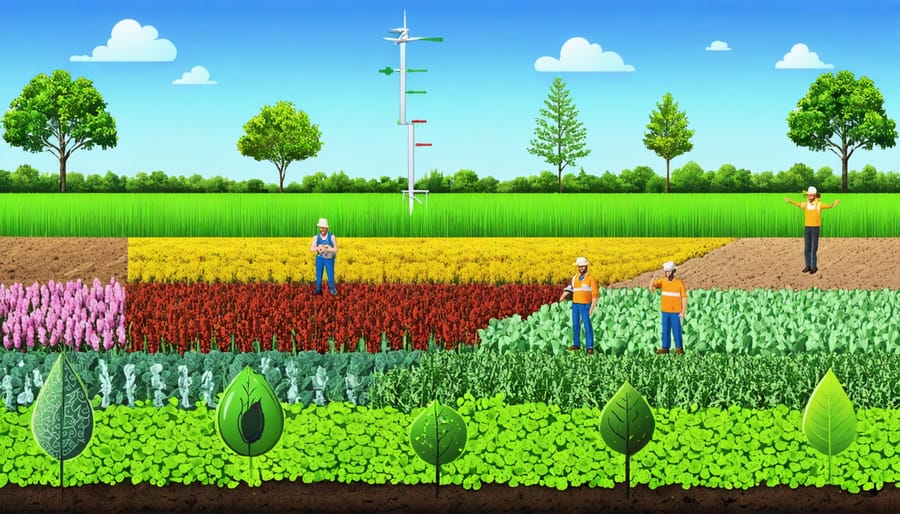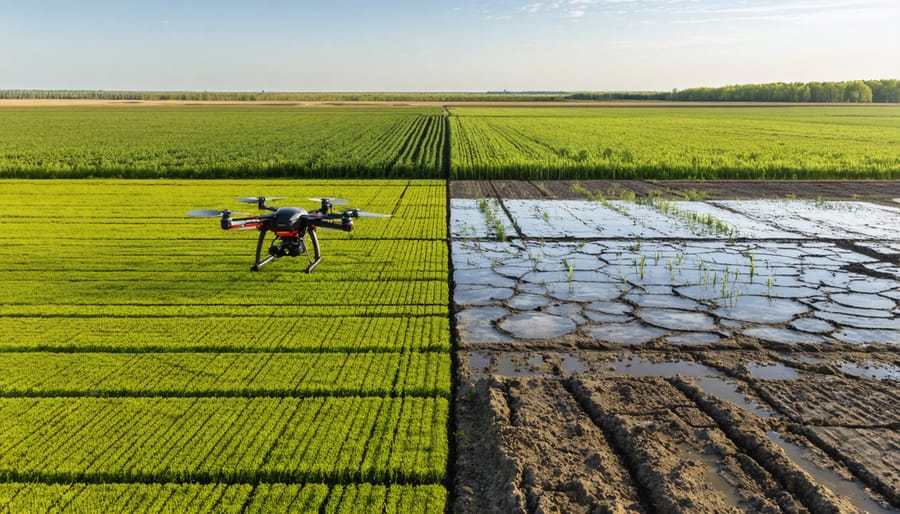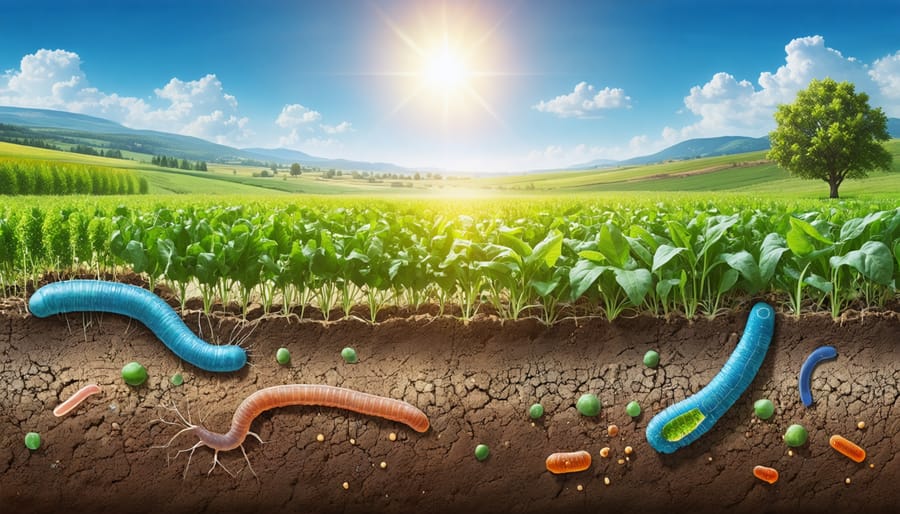
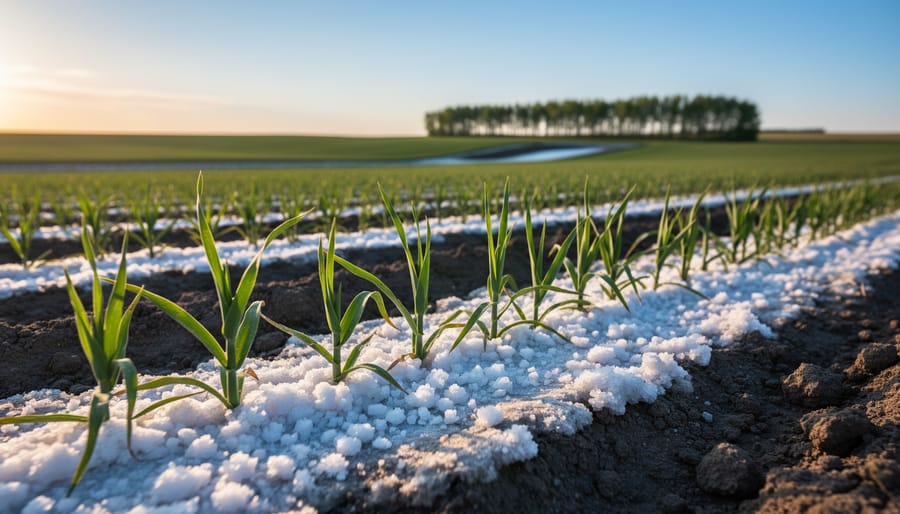
Salinity doesn’t mean you have to leave fields fallow. Salt-tolerant crops offer Alberta farmers a proven pathway to reclaim productivity from affected land while generating income and gradually improving soil conditions. These specialized varieties and species can thrive in soils with electrical conductivity levels that would devastate conventional crops, turning problem acres into productive assets.
The reality facing many Alberta producers is stark: approximately 2 million hectares across the Prairies show some degree of salinity impact, with concentrations particularly high in central and southern Alberta where subsurface water tables and poor drainage create persistent challenges. Traditional crop rotations fail in these conditions, forcing many farmers to simply abandon their most affected land. This represents not just lost revenue, but missed opportunities to actively rehabilitate soil through strategic crop selection.
Salt-resistant crops work by either excluding sodium from plant tissues, compartmentalizing salts within specific cells, or simply tolerating higher concentrations without yield penalties. Barley, for instance, maintains reasonable productivity at electrical conductivity levels up to 8 dS/m, while specialty forages like tall wheatgrass can handle levels exceeding 16 dS/m. These aren’t experimental options—they’re field-proven solutions already generating results for Alberta operations.
The approach requires matching crop selection to your specific salinity levels, understanding the distinction between germination tolerance and growing-season tolerance, and recognizing that salinity management is a multi-year commitment rather than a single-season fix. But farmers who’ve implemented these strategies report not only harvested crops from previously barren ground, but measurable improvements in soil conditions over time, expanding their productive acreage and protecting adjacent fields from salinity creep.
Understanding Salinity Challenges in Alberta’s Arid Regions
What Makes Alberta’s Soils Vulnerable
Understanding why salinity develops in Alberta’s agricultural lands starts with recognizing the unique environmental conditions that define the region. Alberta’s arid conditions create the perfect storm for salt accumulation in soils.
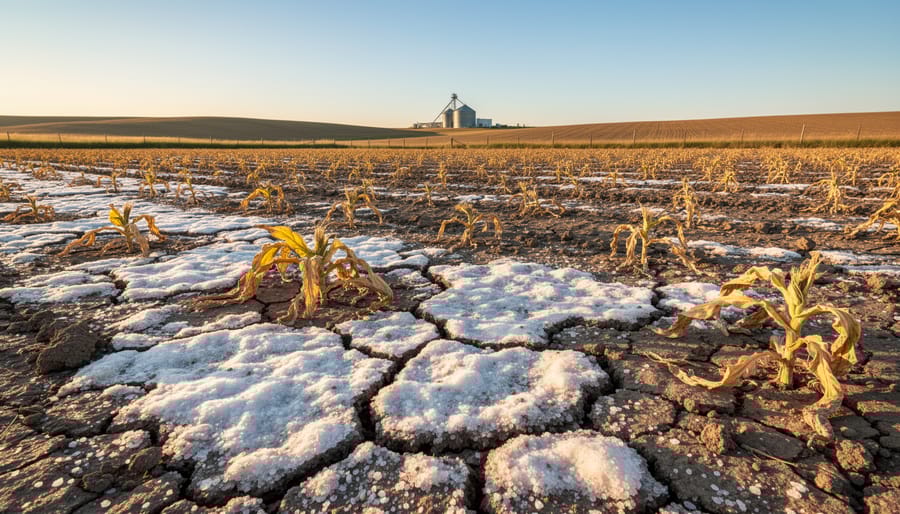
The province receives relatively low annual precipitation, typically ranging from 300 to 450 millimetres in many agricultural areas, while experiencing high evaporation rates during the growing season. This imbalance means that water moves upward through the soil profile, carrying dissolved salts to the surface rather than flushing them deeper into the ground. When this water evaporates, it leaves salt deposits behind in the root zone where crops grow.
Irrigation practices, while essential for crop production in drier regions, can inadvertently worsen salinity issues when water contains dissolved salts or when drainage systems are inadequate. Even relatively low-salt irrigation water accumulates minerals over time as water evaporates from fields.
Alberta’s geological history also plays a significant role. Many areas sit atop ancient marine sediments containing natural salt deposits. As groundwater moves through these geological layers, it picks up salts and carries them into the soil profile. Additionally, certain clay-rich soils common in the region have poor drainage characteristics, allowing salts to concentrate rather than leach away.
Dr. Angela Bedard-Haughn, a soil scientist at the University of Saskatchewan, notes that “understanding your specific soil conditions and water movement patterns is the first step toward managing salinity effectively.”
The Real Cost of Saline Soil for Your Farm
Saline soil creates a significant financial burden for Alberta producers. Research from Agriculture and Agri-Food Canada shows that salinity affects approximately 2 million hectares of agricultural land in the Prairies, with Alberta accounting for a substantial portion. On affected land, crop yields can drop by 25 to 75 percent depending on severity, translating to losses of $100 to $300 per acre annually for conventional crops like wheat and canola.
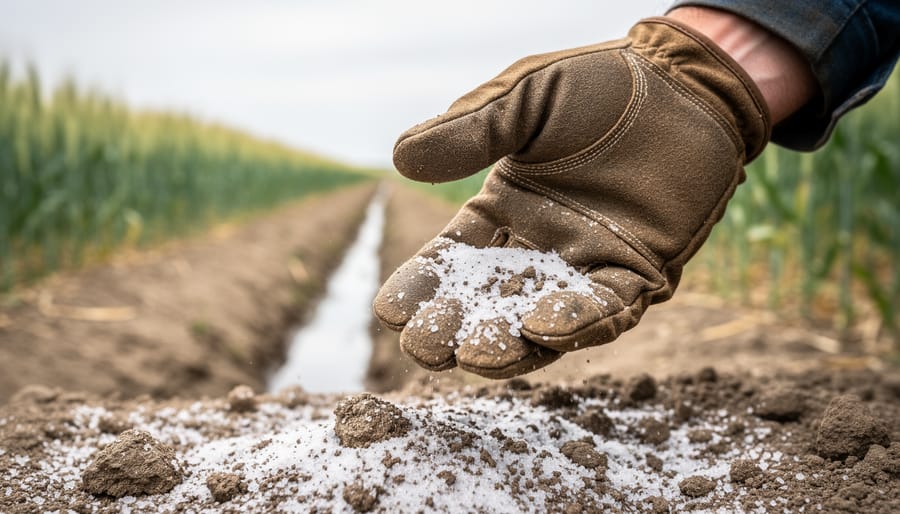
Beyond immediate yield reductions, salinity degrades long-term soil productivity. White salt crusts indicate severe salinization where nothing grows, but even moderate salinity levels reduce water infiltration and nutrient availability. The costs compound over time—what starts as a small affected area often expands as poor drainage and irrigation management continue. Many Alberta farmers report watching productive acres gradually become uneconomical to farm.
The economic impact extends to equipment maintenance and input costs. Saline soils often require additional fertilizer applications to compensate for nutrient deficiencies, yet uptake remains inefficient. Machinery also experiences accelerated corrosion in high-salt environments.
However, these losses aren’t inevitable. Rather than abandoning affected acres or investing heavily in reviving degraded soil through expensive remediation, many producers are turning to salinity-resistant crops as a practical solution. These crops maintain productivity on marginal land, converting problem areas back into revenue-generating assets while gradually improving soil conditions through continued plant growth and organic matter addition.
What Are Salinity-Resistant Crops and How Do They Work?
The Science Behind Salt Tolerance (Made Simple)
Plants dealing with salty soil face challenges similar to us trying to stay hydrated in a hot, dry environment. When salt levels are high in the soil, water becomes harder for plants to absorb—it’s like trying to drink through a blocked straw.
Salt-tolerant crops have developed three main survival strategies that work together. First, they control salt uptake at the root level, acting like selective bouncers that limit how much sodium and chloride enter the plant. Some varieties can actually exclude up to 90 percent of the salt present in soil water.
Second, these crops practice osmotic adjustment—essentially, they produce compounds like proline and glycine betaine that help balance the salt concentration between their cells and the surrounding environment. Think of it as adding your own ice to a too-salty drink to dilute the concentration. This allows them to maintain water uptake even when soil conditions are challenging.
Third, tolerant varieties compartmentalize salt in specific tissues, usually older leaves or specialized cells, keeping it away from sensitive growing points. When those leaves eventually drop, the salt goes with them—a natural detoxification system.
Dr. Robert Spencer from the University of Alberta’s agriculture faculty explains it this way: “These plants aren’t fighting the salt—they’re managing it. It’s about working with the challenge rather than against it.” For Alberta farmers dealing with patchy salinity, understanding these mechanisms helps explain why certain barley or canola varieties consistently outperform others in affected areas.
Tolerance Levels: What the Numbers Mean
Understanding salinity measurements helps you make informed decisions about crop selection for your fields. Electrical conductivity (ECe) measured in deciSiemens per meter (dS/m) is the standard way to quantify soil salinity levels.
Here’s what the numbers mean in practical terms: Readings below 2 dS/m indicate non-saline soil where most crops thrive without restriction. Between 2-4 dS/m represents slight salinity—sensitive crops start showing reduced yields, but many common varieties still perform well. Moderate salinity (4-8 dS/m) requires careful crop selection, as only moderately tolerant species maintain productivity. Strong salinity (8-16 dS/m) limits you to highly tolerant crops like barley or kochia. Anything above 16 dS/m is considered extreme, where even salt-tolerant species struggle.
Alberta agronomist Dr. Sarah Chen explains: “I tell farmers to test multiple spots in affected fields. Salinity often varies significantly across a field, so mapping these zones lets you match crop choices to specific areas rather than avoiding entire fields.”
Most soil testing labs across Alberta provide ECe measurements. Testing in early spring before seeding gives you time to plan appropriate crop rotations for different salinity zones.
Top Salinity-Resistant Crops for Alberta Producers
Forage and Feed Crops
When salinity affects your pastures and hay fields, specialized forage crops offer a practical path forward. These hardy varieties can maintain productivity on land where conventional forages struggle, turning problem areas into productive feed sources.
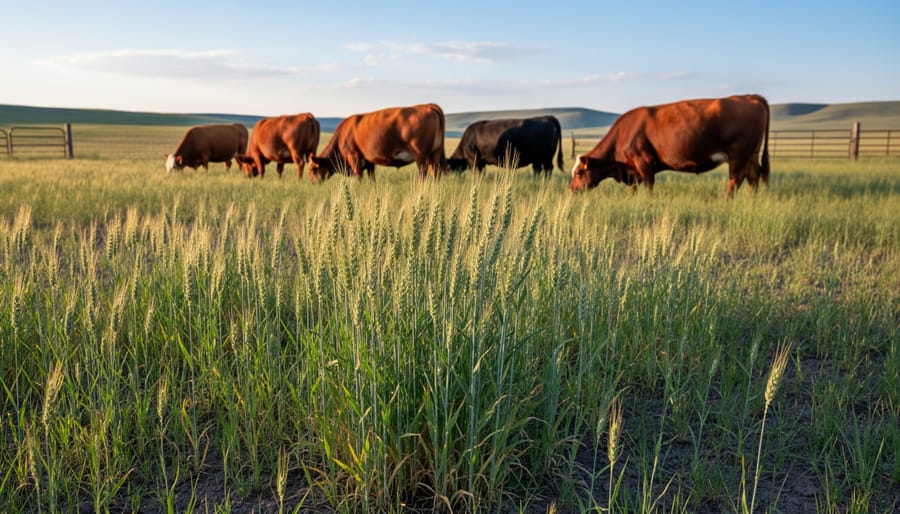
Tall wheatgrass stands out as one of the most salt-tolerant forages available to Alberta producers. This perennial grass thrives in soil with electrical conductivity levels up to 18 dS/m and tolerates seasonal waterlogging better than most alternatives. “We’ve seen tall wheatgrass establish successfully on quarter sections where alfalfa completely failed,” notes Dr. Patricia Markham, a forage specialist with Alberta Agriculture. While yields are typically 30-40% lower than standard timothy or brome grass in ideal conditions, it produces consistent harvests where other crops simply won’t grow.
For areas with moderate salinity (8-12 dS/m), slender wheatgrass and altai wildrye provide excellent options. These cool-season perennials establish quickly and produce palatable forage suitable for both grazing and hay production. Slender wheatgrass particularly shines in spring grazing systems, offering early-season growth when other forages are just breaking dormancy.
Kochia deserves consideration as an annual forage option, especially for reclamation projects. This fast-growing plant tolerates salinity levels up to 15 dS/m and produces substantial biomass within a single season. While livestock may need time to adjust to its unique flavor, kochia provides valuable protein content (15-18%) when harvested at the right stage.
Forage barley varieties like Haybet and Cowboy have demonstrated moderate salt tolerance (6-8 dS/m) while maintaining quality comparable to standard barley. These annuals work well in rotation systems, allowing producers to harvest feed while gradually improving soil conditions through proper management practices.
Grain and Oilseed Options
When dealing with saline soils, grain and oilseed producers have several viable options that can maintain productivity where conventional crops struggle. Let’s look at what works in Alberta’s challenging conditions.
Barley stands out as the most salt-tolerant cereal grain available to Canadian farmers. Two-row malting varieties can handle electrical conductivity levels up to 8 dS/m in the root zone, while six-row feed barley tolerates even higher levels. Under moderate salinity (4-6 dS/m), you can expect yields around 60-75% of normal production. Many Alberta farmers have found varieties like AC Metcalfe and CDC Copeland perform reliably on affected land.
Certain wheat cultivars also deserve consideration. While generally less tolerant than barley, durum wheat varieties like AC Avonlea show improved salt tolerance compared to standard spring wheats. Expect yield reductions of about 30-40% at 6 dS/m, but this still beats leaving land fallow.
Canola presents an interesting middle ground. Though traditionally considered moderately sensitive, newer hybrid varieties demonstrate improved tolerance. Research from Agriculture and Agri-Food Canada shows canola can produce economically viable yields up to 4 dS/m with proper management, though you’ll see 25-35% yield reduction compared to non-saline conditions.
Quinoa represents an emerging opportunity worth watching. This ancient grain thrives in saline conditions up to 10 dS/m and has generated strong market interest. Several Alberta producers have successfully test-plotted quinoa on marginal land, with yields ranging from 800-1,200 kg per hectare on moderately saline soils.
The key is matching crop selection to your specific salinity levels through soil testing. What works at 4 dS/m differs significantly from conditions at 8 dS/m, so accurate baseline data drives successful decisions.
Specialty and Alternative Crops
Beyond traditional crop alternatives, specialty and alternative crops are opening exciting revenue opportunities for Alberta farmers dealing with saline soils. These emerging options can transform problem areas into productive, high-value assets while diversifying your operation’s income streams.
Salicornia, commonly known as sea asparagus or samphire, represents one of the most promising specialty crops for saline conditions. This succulent plant actually thrives in salty environments that would devastate conventional crops, tolerating salinity levels up to 30 dSm. Fresh salicornia commands premium prices in restaurants and specialty food markets, typically selling for $15-25 per kilogram. The plant’s crisp texture and briny flavour have made it increasingly popular in Canadian culinary circles.
Sea beet and Atriplex species offer additional diversification options. While primarily used for livestock feed, these salt-loving plants establish quickly and provide excellent ground cover to prevent erosion in affected areas. Some Alberta producers have successfully integrated these crops into rotational grazing systems, effectively turning salinity challenges into functional forage resources.
The key consideration with specialty crops is market access. Before planting, establish relationships with local restaurants, farmers’ markets, or specialty food distributors. Start small with trial plots to understand growing requirements and market demand in your region. Agricultural professionals at your local extension office can provide guidance on cultivation techniques specific to Alberta’s climate.
While these crops won’t replace your primary production, they represent innovative ways to generate income from marginal land while you implement longer-term salinity management strategies. Think of them as value-added opportunities that work alongside, not instead of, your core operation.
Implementing Salt-Tolerant Crops on Your Operation
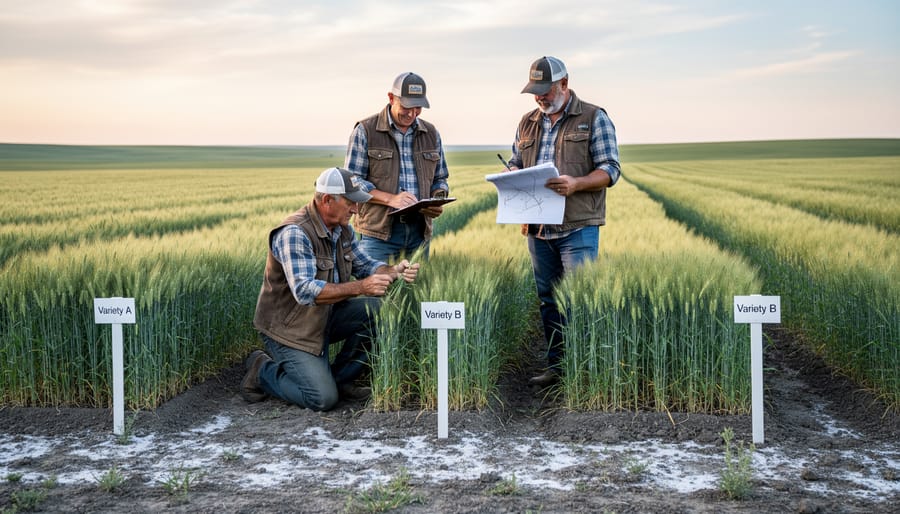
Mapping Your Saline Zones
Before you can effectively implement salinity-resistant crops, you need to understand where and how severe your salinity issues are. Start with professional soil testing through accredited labs like those recommended by Alberta Agriculture and Irrigation. Collect samples from multiple locations across your field, especially from areas showing poor growth or bare patches. Test for electrical conductivity (EC), which measures salt concentration—readings above 4 deciSiemens per metre (dS/m) indicate moderate to severe salinity that will impact most conventional crops.
Visual indicators can help you identify problem zones between formal testing. Look for white salt crusts on soil surfaces, especially in low-lying areas where water accumulates. Patchy crop growth, with stunted or absent plants in specific zones while surrounding areas thrive, often signals salinity hotspots. Native weeds like foxtail barley and salt grass naturally colonize saline areas and serve as reliable markers.
Many Alberta farmers are now using yield mapping data from their combines to identify consistently underperforming zones year after year. “We overlaid three years of yield maps and immediately saw the problem areas,” explains Tom Hendricks, a grain farmer near Lethbridge. “It gave us a clear picture of where to focus our salinity management efforts.”
Alberta Agriculture and Irrigation district offices offer guidance on interpreting soil tests and can connect you with agronomists experienced in salinity management. Some also provide access to electromagnetic soil mapping services that efficiently scan large areas to identify salinity patterns across entire fields.
Matching Crops to Your Conditions
Choosing the right crop starts with understanding your soil’s salinity level. A soil test measuring electrical conductivity (EC) will place your field into a category—slight, moderate, or severe salinity—which directly determines your options.
For fields with slight salinity (EC 2-4 dS/m), you have considerable flexibility. Consider your primary goal: forage crops like tall wheatgrass work well for livestock operations, while barley remains a solid grain option if you have established market connections and harvesting equipment.
Moderate salinity (EC 4-8 dS/m) narrows choices but still offers economic opportunities. Kochia excels as emergency forage, requires minimal equipment investment, and tolerates poor conditions. Tall fescue provides reliable pasture if you’re building long-term grazing systems.
Severe salinity (EC above 8 dS/m) demands specialist crops. Salicornia presents an emerging cash crop opportunity for producers near processing facilities or niche markets, though it requires specialized knowledge and different handling equipment than traditional grains.
Don’t overlook practical factors. Do you have forage harvesting equipment or relationships with local feedlots? Is irrigation available? What’s your risk tolerance for trying newer crops versus established ones? Alberta producer Tom Richardson from Lethbridge found success matching tall wheatgrass to his cattle operation’s existing infrastructure, avoiding costly equipment purchases while reclaiming previously unproductive acres.
Planting and Management Considerations
Successfully establishing salinity-resistant crops in Alberta requires adjustments to your standard practices. Let’s walk through the key considerations to set you up for success.
Seeding rates often need fine-tuning in saline conditions. Many salt-tolerant crops benefit from slightly higher seeding rates—typically 10-15% more than standard recommendations—to compensate for potentially reduced germination in affected areas. For barley, consider rates of 135-150 kg/ha in moderate salinity zones, while kochia for forage might require 2-3 kg/ha when broadcast.
Timing matters significantly. Plant salt-tolerant crops when soil temperatures reach optimal levels for each species, as stressed soils can slow emergence. In Alberta, this typically means late April through mid-May for most cereals and forages.
Fertilization requires a thoughtful approach. Salinity affects nutrient availability, particularly nitrogen and phosphorus. Conduct soil tests specifically for saline areas and adjust accordingly—you may need to apply phosphorus in band applications rather than broadcast to improve uptake efficiency.
Throughout the growing season, monitor crops closely for stress indicators beyond typical salt tolerance. “We’ve learned that even salt-tolerant varieties need attention during critical growth stages,” shares a central Alberta producer who’s successfully managed saline fields for five years. Adequate moisture during establishment proves particularly crucial, as it helps dilute salt concentrations around emerging seedlings.
Real Results: Alberta Farmers Using Salinity-Resistant Crops
Case Study: Southern Alberta Mixed Farm
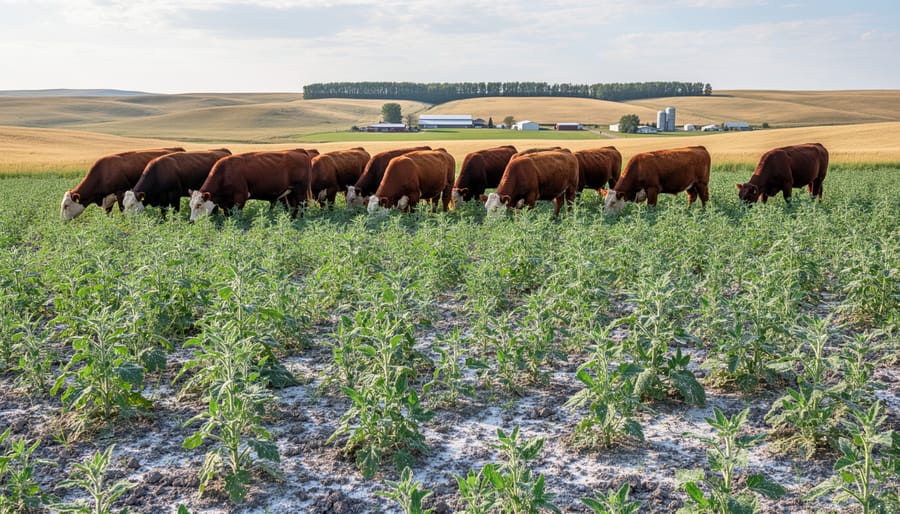
When Dale Henderson noticed bare patches spreading across his quarter section near Lethbridge, soil tests confirmed what he suspected: salinity levels had reached 8-12 dS/m in approximately 15 acres of his 160-acre property. These unproductive areas were costing him roughly $200 per acre annually in lost revenue from conventional crops that simply wouldn’t grow.
In 2019, Dale decided to transition these saline zones to tall wheatgrass, a perennial grass known for its exceptional salt tolerance. He seeded at a rate of 12 pounds per acre at a cost of $85 per acre, including seed and custom seeding work. The establishment year required patience, as tall wheatgrass develops slowly in its first season.
By year two, Dale was grazing 25 cow-calf pairs on the formerly barren land from mid-June through August. “The cattle actually prefer it mixed with the native grasses around the edges,” Dale explains. “It’s protein-rich forage when they need it most.”
The economic turnaround proved significant. Dale now generates approximately $150 per acre in grazing value, transforming a cost center into a productive asset. Beyond direct revenue, he’s noticed reduced weed pressure in adjacent fields and improved soil structure as the deep-rooted grass breaks up subsurface salt layers.
“These acres went from nothing to something useful,” Dale says. “It won’t replace my canola yields, but it sure beats looking at white patches every summer.”
Case Study: Grain Producer Adds Salt-Tolerant Barley
When Tom Henderson noticed yields dropping on a 40-hectare corner of his farm near Barrhead, Alberta, soil tests confirmed what he suspected: salinity levels had reached 8 dS/m, well above what his traditional wheat could tolerate. Rather than leaving the land fallow, Tom decided to test salt-tolerant barley varieties during the 2021 growing season.
“I started with AC Metcalfe and Cowboy varieties, which agronomists told me could handle salinity up to 12 dS/m,” Tom explains. “The first year was about learning what these crops could do on my worst land.”
The results exceeded his expectations. While his conventional barley yielded 2.1 tonnes per hectare on better land, the salt-tolerant varieties produced 1.6 tonnes per hectare on the saline patches—land that previously generated nothing. At $280 per tonne, this translated to $448 per hectare in revenue from otherwise unproductive acres.
Tom’s key lessons: plant salt-tolerant varieties slightly deeper (5 cm instead of 4 cm) to help seedlings establish in challenging soil conditions, and increase seeding rates by 10 percent to compensate for potential germination issues. He also discovered that these varieties worked best when combined with improved drainage, which he addressed by installing subsurface drainage tiles the following year.
“It’s not about matching yields on prime land,” Tom notes. “It’s about getting production from acres that weren’t paying their way. That’s made a real difference to our bottom line.”
Beyond Planting: Integrated Salinity Management
Combining Crops with Water Management
Salt-tolerant crops work best when paired with thoughtful water management strategies. Even the most resilient varieties need proper moisture to thrive, and smart irrigation practices can significantly reduce salt accumulation in your soil.
Start by optimizing your irrigation efficiency. Drip or micro-sprinkler systems deliver water directly to plant roots, minimizing evaporation that concentrates salts at the soil surface. Many Alberta producers have found that scheduling irrigation based on soil moisture sensors rather than calendar dates prevents over-watering, which can mobilize salts deeper into the root zone.
Drainage improvements are equally important. Installing tile drainage or improving surface drainage helps flush excess salts below the root zone and enhances water infiltration. Agricultural engineer Dr. Sarah Mitchell from Lethbridge College notes that proper drainage can reduce soil salinity levels by 30-40% over two growing seasons when combined with appropriate crop selection.
Regular water quality monitoring provides essential data for decision-making. Test both your irrigation water and soil regularly—Alberta Agriculture recommends spring and fall testing at minimum. Understanding your water’s electrical conductivity (EC) helps you select crops that match your conditions and adjust irrigation timing.
Consider implementing leaching schedules during low-salinity periods, typically after snowmelt when water quality is optimal. This strategic approach maximizes the benefits of your salt-tolerant crop investments while steadily improving soil conditions.
Building Soil Health in Saline Areas
While salinity-resistant crops are essential, supporting them with healthy soil practices amplifies their effectiveness and gradually improves field conditions over time. Think of it as creating a partnership between the right crops and the right environment.
Incorporating organic matter is one of the most powerful tools in your arsenal. Compost, manure, and crop residues help improve soil structure, enhance water infiltration, and reduce salt concentration near plant roots. Alberta farmer Tom Henderson saw noticeable improvements in his saline patches after three years of consistent building organic matter through green manures and targeted compost applications.
Cover cropping serves double duty in saline areas. Species like hairy vetch, fall rye, or even salt-tolerant barley as a cover crop help break up compacted layers, add biomass, and reduce salt movement upward through the soil profile. They’re working for you even when your main crop isn’t in the ground.
Biological amendments, including mycorrhizal inoculants and beneficial bacteria, support plant stress tolerance and nutrient uptake in challenging conditions. These soil management practices won’t eliminate salinity overnight, but they create momentum toward healthier, more productive fields season after season.
Resources and Support for Alberta Farmers
Navigating salinity management doesn’t have to be a solo journey. Alberta farmers have access to numerous resources and expert support to help implement effective strategies for growing crops on salt-affected land.
Start with Alberta Agriculture and Irrigation, which offers free soil testing services through their accredited labs and provides technical support for interpreting results. Their extension specialists can visit your operation to assess salinity issues and recommend site-specific solutions. Contact their Agricultural Information Centre at 310-FARM (3276) for personalized guidance.
The University of Alberta’s Department of Agricultural, Food and Nutritional Science conducts ongoing research into salinity-tolerant varieties suitable for prairie conditions. Their Field Crop Development Centre in Lacombe regularly hosts field days where you can see trial plots and speak directly with researchers testing new cultivars.
For soil and water testing, ALS Laboratory Group and Exova operate facilities across Alberta, offering comprehensive salinity analysis including electrical conductivity measurements and sodium adsorption ratios. Most tests provide results within a week, helping you make timely planting decisions.
Olds College’s Smart Farm initiative showcases precision agriculture technologies for managing variable salinity within fields, demonstrating how GPS-guided variable rate seeding can optimize crop selection across different zones.
Connect with your local agricultural fieldman through the Agricultural Service Board in your county or municipal district. These professionals understand regional salinity patterns and can connect you with cost-share programs for soil improvement projects.
The Prairie Agricultural Machinery Institute in Humboldt, Saskatchewan offers equipment testing reports that help identify machinery suitable for managing salinity-affected fields.
Financial support may be available through the Canadian Agricultural Partnership’s Environmental Stewardship and Climate Change program, which can offset costs of implementing beneficial management practices including salinity remediation efforts.
Managing saline land doesn’t have to mean leaving fields unproductive or watching your investment sit idle. Salinity-resistant crops offer a practical, economically viable path forward for Alberta farmers dealing with challenging soil conditions. These aren’t experimental crops requiring massive infrastructure changes—they’re proven options that fit within existing farm operations and equipment.
The key is starting small and building your knowledge as you go. Test a saline patch with barley or tall wheatgrass before committing entire fields. Track your results, compare yields, and adjust your approach based on what works for your specific conditions. Every farm’s salinity profile is different, and what succeeds for your neighbour might need tweaking for your land.
You’re not alone in this journey. Connect with your local agricultural extension office, reach out to agronomists who understand Alberta’s unique conditions, and talk with other farmers who’ve successfully managed saline areas. The Alberta agricultural community has a strong tradition of sharing knowledge and supporting one another through challenges.
Remember, the saline patches you’re worried about today can become productive, profitable parts of your operation. With the right crop choices and management practices, that difficult quarter section can contribute to your bottom line rather than drain resources. Taking that first step—whether it’s soil testing, selecting a trial crop, or talking with an expert—moves you closer to transforming challenging land into a productive asset that works for your farm’s future.